
Fibre Optic Trends Driving GTA Data Centres
By Michael Law · Industrial Real Estate Broker, Lennard Commercial Realty
Toronto’s data centre market is booming, with fibre optics driving this transformation. As Canada’s largest and most active colocation hub, the Greater Toronto Area (GTA) is experiencing rapid expansion due to AI and hyperscale cloud demands. Fibre connectivity is now a top priority for site selection and development, as delays can cost millions monthly. Key trends include:
- AI Workloads: Require up to 10x more fibre than traditional systems.
- Fibre Technology Advances: Single-mode fibre (SMF) for long-haul links and multi-mode fibre (MMF) for short distances are evolving to meet bandwidth needs.
- Route Diversity: Multiple, redundant fibre paths ensure uninterrupted operations.
- Key Locations: Proximity to 151 Front Street West and Lake Ontario submarine cables boosts connectivity.
With limited industrial land and growing demand, developers must integrate fibre, power, and location planning early to stay competitive in this thriving market.
The GTA Data Centre Market and Rising Fibre Demand
Toronto's data centre market is thriving, but it's also grappling with an urgent need for more fibre infrastructure. As the largest and most active colocation market in Canada, Toronto is experiencing explosive growth, fuelled by hyperscale and AI advancements. The numbers tell the story: the colocation market is projected to grow at a five-year CAGR of 18.3% through 2029, with hyperscale supply absorption rates consistently exceeding 100%. This demand far outstrips supply, making it clear that infrastructure expansion is overdue. The push for growth is coming from multiple fronts, including hyperscale investments and AI-driven innovations.
"Demand for capacity is accelerating at a pace we've never experienced before, driven by AI scale and a shift toward compute-led economies." - John Madden, Chief Data Centre Officer, Yondr
Hyperscale and AI-Driven Data Centre Growth
The growth in the GTA's data centre market is being driven by a mix of hyperscale providers, colocation operators, and facilities focused on AI. For instance, Microsoft made a significant shift in late 2024, moving from leasing colocation space to purchasing suburban land for its own Availability Zones. This move signals Microsoft's long-term commitment to the region. Similarly, STACK Infrastructure expanded the market's reach by opening a facility in Scarborough, while OVHcloud established a new node in Cambridge, Ontario, addressing the land scarcity closer to Toronto's core.
AI workloads are playing a pivotal role in this expansion. These applications demand up to ten times more fibre than traditional workloads to handle the GPU-to-GPU and inter-cluster connections essential for modern AI systems. This surge in demand highlights the importance of early planning for fibre connectivity.
Fibre Connectivity as a Site Selection Priority
The financial stakes of fibre connectivity are enormous. Delays in a 60 MW data centre project can cost as much as $14.2 million per month, making early diligence on connectivity a critical step in the development process.
"Fibre availability and quantity will determine whether a site launches on time with the correct resilience and whether the development has the optimum commercial viability once operations begin." - Alan Pritchard, Data Centre Consultant, FarrPoint
Developers are now prioritizing questions about proximity to existing fibre infrastructure, the feasibility of route diversity, delivery timelines, and potential civil engineering or wayleave challenges. Addressing these factors early in the site selection process is essential for keeping projects on track. This focus reflects the region's growing emphasis on integrating advanced fibre solutions, ensuring that developments meet both operational and commercial goals.
sbb-itb-1862e65
Fibre Optic Technology Advances for Data Centres
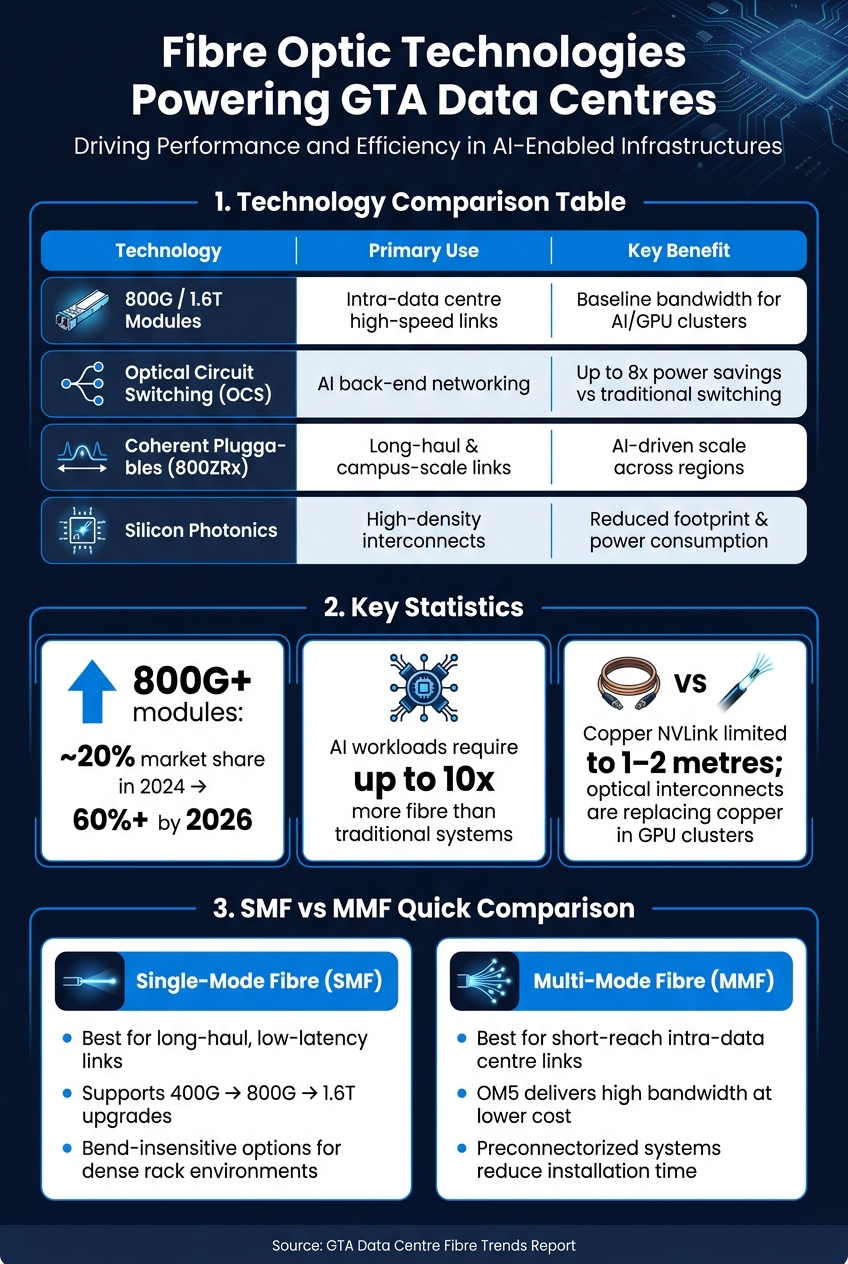
Fibre Optic Technologies Powering GTA Data Centres: Key Stats & Comparisons
The latest developments in fibre optic technology are driving faster, more efficient solutions tailored to the needs of modern data centres. These advancements are reshaping connectivity for long-haul, short-reach, and high-density computing environments.
Single-Mode Fibre for Long-Haul Connections
With the rise of AI and 5G, the demand for long-distance, low-latency connectivity has surged. Single-mode fibre (SMF) is now a cornerstone for these applications, ensuring stable links between geographically dispersed sites. Optical modules are evolving rapidly, moving from 400G to 800G and even reaching 1.6T to handle the workload of next-generation AI clusters. Projections indicate that 800G+ modules will grow from about 20% market share in 2024 to over 60% by 2026.
For operators in the Greater Toronto Area (GTA) upgrading older facilities, bend-insensitive SMF options, like Corning's SMF-28 Contour, offer practical benefits. These fibres provide low attenuation and enhanced bend performance, which are critical for managing cable congestion in dense rack setups.
Multi-Mode Fibre for Short-Reach Links
Multi-mode fibre (MMF) is the go-to solution for short-distance connections within data centres. When high bandwidth is needed over shorter spans, MMF - particularly advanced types like OM5 - delivers reliable performance at a lower cost compared to SMF. Preconnectorized systems, such as MMC, simplify installation and reduce labour costs, making them ideal for rapid expansions where speed is essential.
Optical Interconnects for AI and GPU Clusters
As data centres evolve, copper connections are giving way to optical interconnects, especially in high-density computing environments. Copper links like NVLink are limited to just one or two metres, which is insufficient for modern GPU clusters. Dimitris Mavrakis, Research Director at ABI Research, succinctly explains the shift:
"For decades, the guiding principle has been 'copper if you can, fibre if you must'... But AI systems demand it – not everywhere, but increasingly so. In five to 10 years, fibre will dominate [inside the rack]."
Two technologies are spearheading this transition:
- Optical Circuit Switching (OCS): This method routes signals along purely optical paths, bypassing the energy-intensive optical-electrical-optical conversion process. The result? Up to 8x power savings compared to traditional switching methods.
- Coherent Pluggable Modules (800ZRx): These modules are increasingly used for inter-facility and campus-scale links, simplifying network management and enabling seamless connectivity across distributed sites.
These innovations are crucial for supporting the GTA's growing data centre market. For instance, Telehouse Canada in Toronto has already adopted direct liquid cooling systems to keep up with the demands of high-density compute environments made possible by these optical advancements.
The table below summarizes the key technologies driving these changes:
| Technology | Primary Use | Key Benefit |
|---|---|---|
| 800G / 1.6T Modules | Intra-data centre high-speed links | Provides baseline bandwidth for AI/GPU clusters |
| Optical Circuit Switching (OCS) | AI back-end networking | Delivers up to 8x power savings |
| Coherent Pluggables (800ZRx) | Long-haul and campus-scale links | Supports AI-driven scale across regions |
| Silicon Photonics | High-density interconnects | Reduces footprint and power consumption |
Fibre Route Diversity and Redundancy in the GTA
In the Greater Toronto Area (GTA), the resilience of data centres heavily depends on robust route diversity. A single fibre connection simply doesn’t cut it for facilities aiming to ensure uninterrupted operations. Instead, route diversity - the presence of multiple, physically separate fibre paths - is what sets a strong, dependable data centre apart from one that’s vulnerable. Why does this matter? If one fibre route is disrupted due to construction, flooding, or equipment failure, a secondary, independent path keeps operations running smoothly. This redundancy is crucial, especially for hyperscale and enterprise tenants who rely on continuous connectivity.
The risks of overlooking connectivity issues are significant. For example, delays in a 60 MW project caused by poor route diversity or related problems could cost up to $14.2 million per month. Often, these delays stem from early-stage oversights, such as unanticipated engineering challenges that compromise true diversity.
"A site may appear attractive on paper, but if multiple diverse fibre routes are constrained... those issues can quickly become programme risks." - Alan Pritchard, Data Centre Consultant, FarrPoint
Proximity to Carrier Hotels and Network Hubs
In the GTA, 151 Front Street West in downtown Toronto serves as the region’s primary carrier hotel and network hub. Data centres that establish dual, physically diverse routes to this facility gain access to a rich ecosystem of carriers, cloud providers, and financial networks. Beyond connectivity, this proximity delivers low-latency connections - for instance, Toronto can connect to Ottawa and Montreal in just 6 to 7 milliseconds, and Chicago in about 10 milliseconds.
Another advantage? The Lake Ontario submarine cable, which provides a direct, non-terrestrial link to Buffalo, New York. This route bypasses common terrestrial bottlenecks, offering an additional layer of resilience. Coupled with diverse fibre routes, integrated planning for both power and connectivity further enhances the reliability of these sites.
Power Infrastructure and Fibre Availability
For any data centre site to be viable, power and fibre must be evaluated together. A site with abundant power but limited fibre diversity - or the reverse - falls short of meeting the resilience demands of hyperscale tenants. With industrial land vacancy in Toronto sitting at approximately 1%, finding locations that meet both power and fibre requirements is becoming increasingly difficult.
"The most successful data centre developments are unlikely to be the ones that identify power and hope the rest falls into place. They will be the ones that recognise infrastructure readiness as a package, with fibre connectivity sitting towards the front of consideration." - Alan Pritchard, Data Centre Consultant, FarrPoint
This integrated approach is influencing where new facilities are being built. Suburban areas like Scarborough and Cambridge are becoming attractive alternatives to the crowded downtown core. Operators such as STACK Infrastructure and OVHcloud have already expanded into these regions, where land availability, power capacity, and fibre access are more balanced.
For developers and industrial real estate professionals, taking a holistic view of power and fibre infrastructure is critical for long-term success in the GTA. Partnering with experts like Michael Law of Lennard Commercial – Industrial Real Estate Services (https://mlawrealestate.com) can provide valuable insights to navigate the complexities of site selection in this competitive market.
Conclusion: How Fibre Optics Are Driving GTA Data Centre Growth
Fibre optics have become a cornerstone for the success of data centre projects in the Greater Toronto Area (GTA). The Toronto colocation market is forecasted to generate US$467 million in 2024, with an impressive growth rate of 18.3% CAGR through 2029. This growth is being propelled by a combination of fibre connectivity, land availability, and power infrastructure.
The way connectivity is evaluated has shifted. Assessing fibre route diversity, civil engineering challenges, and wayleave issues early in the process helps avoid costly delays - delays that can rack up to US$14.2 million per month. As noted earlier, overlooking connectivity planning from the outset can have serious repercussions on project timelines.
The rise of high-density AI applications has further intensified the need for robust fibre networks and advanced optical interconnects. Marc Mondesir, Managing Director of Equinix Canada, emphasizes the importance of interconnection:
"What you need to really be able to benefit from in this digital economy is interconnection. The ability to connect to clouds, to connect to AI and connect to other customers."
These technical demands underscore the need for strategic planning. Fibre connectivity, power capacity, and land availability must be treated as a unified package. With downtown Toronto facing constraints, emerging suburban hubs like Scarborough and Cambridge are becoming pivotal. Early diligence in fibre infrastructure is crucial for scaling operations efficiently.
Michael Law of Lennard Commercial – Industrial Real Estate Services works with clients to navigate these complexities. In the GTA, infrastructure readiness is increasingly the deciding factor for site selection. Ultimately, aligning fibre connectivity with other infrastructure needs is the key to executing successful data centre projects in this rapidly growing market.
FAQs
How much more fibre do AI data centres need?
AI data centres are expected to demand up to ten times more fibre to keep up with the increasing need for high-bandwidth, AI-focused workloads. This sharp rise stems from the necessity to accommodate higher rack power densities and sophisticated interconnect architectures, both critical for today's data centre functionality.
What does “fibre route diversity” actually mean?
Fibre route diversity refers to having multiple, separate fibre paths leading to a data centre. This setup ensures resilience and redundancy in network connectivity. By using independent routes, it minimizes the risk of service interruptions if one path experiences an issue. This approach is crucial for keeping data centres running smoothly and reliably.
Why is 151 Front Street West so important for GTA data centres?
151 Front Street West is the largest colocation facility in Canada. Situated close to Union Station, it provides unparalleled access to carriers, fibre networks, and Toronto's bustling financial district. This prime location positions it as a critical hub for data centre connectivity and resilience in the Greater Toronto Area, meeting the region's increasing need for dependable digital infrastructure.

About Michael Law
Managing Partner and Industrial Real Estate Broker at Lennard Commercial Realty. Representing tenants and landlords across Toronto and the GTA for 15+ years. Michael specializes in GTA industrial real estate — connect with Toronto's leading industrial broker at mlawrealestate.com/industrial-broker-toronto.
Related Articles



More Toronto Industrial Real Estate Insights
Articles & Analysis
Toronto Industrial Market Forecast for 2026
Read →Before Leasing in the GTA: Hazmat Checks Warehouse Managers Must Ask
Canada-focused checklist for warehouse managers: confirm supplier labels and current SDSs, check flammable-quantity triggers, and verify hazardous-waste...
Read →Dual Agency in Toronto Industrial Deals: Michael Law’s Case Examples
How dual agency works in Toronto industrial deals, when written disclosure and consent are required, and how brokers handle confidentiality and conflicts.
Read →Avoid 60–90 Day Delays: GTA Yard Storage Zoning for Occupiers
This GTA checklist explains outdoor yard storage zoning, stormwater approvals, 60–90 day timelines, and broker support to speed permitting.
Read →GTA Early Access Clauses: 30 Days to 4–6 Months and Sample Wording
Practical GTA guide to drafting early access clauses for industrial leases. Covers 30 days to 4–6 months fixturing, sample clause language, permit...
Read →Common Questions
What is a sale-leaseback in industrial real estate?
A sale-leaseback is a transaction in which an industrial property owner sells their building to an investor and simultaneously signs a long-term lease to remain in the property as a tenant. The seller unlocks the capital tied up in their real estate while retaining full operational use of the facility. The buyer acquires a tenanted investment property with immediate cash flow from a known occupant.
Read →What is a dock-to-grade ratio in industrial real estate?
Dock-to-grade ratio in industrial real estate refers to the number of dock-level loading doors relative to the building's floor area, typically expressed as one dock door per X,000 square feet. It is a key specification for distribution and warehousing tenants because it determines how many trucks can load and unload simultaneously and therefore the building's throughput capacity.
Read →What is clear height in a warehouse or distribution centre?
Clear height in a warehouse or distribution centre refers to the usable vertical space from the finished floor to the lowest overhead obstruction — typically the bottom of the roof structure, sprinkler heads, or HVAC equipment. It is the single most important building specification for warehouse tenants because it determines how many racking levels can be installed and therefore how much product can be stored per square foot of floor space.
Read →