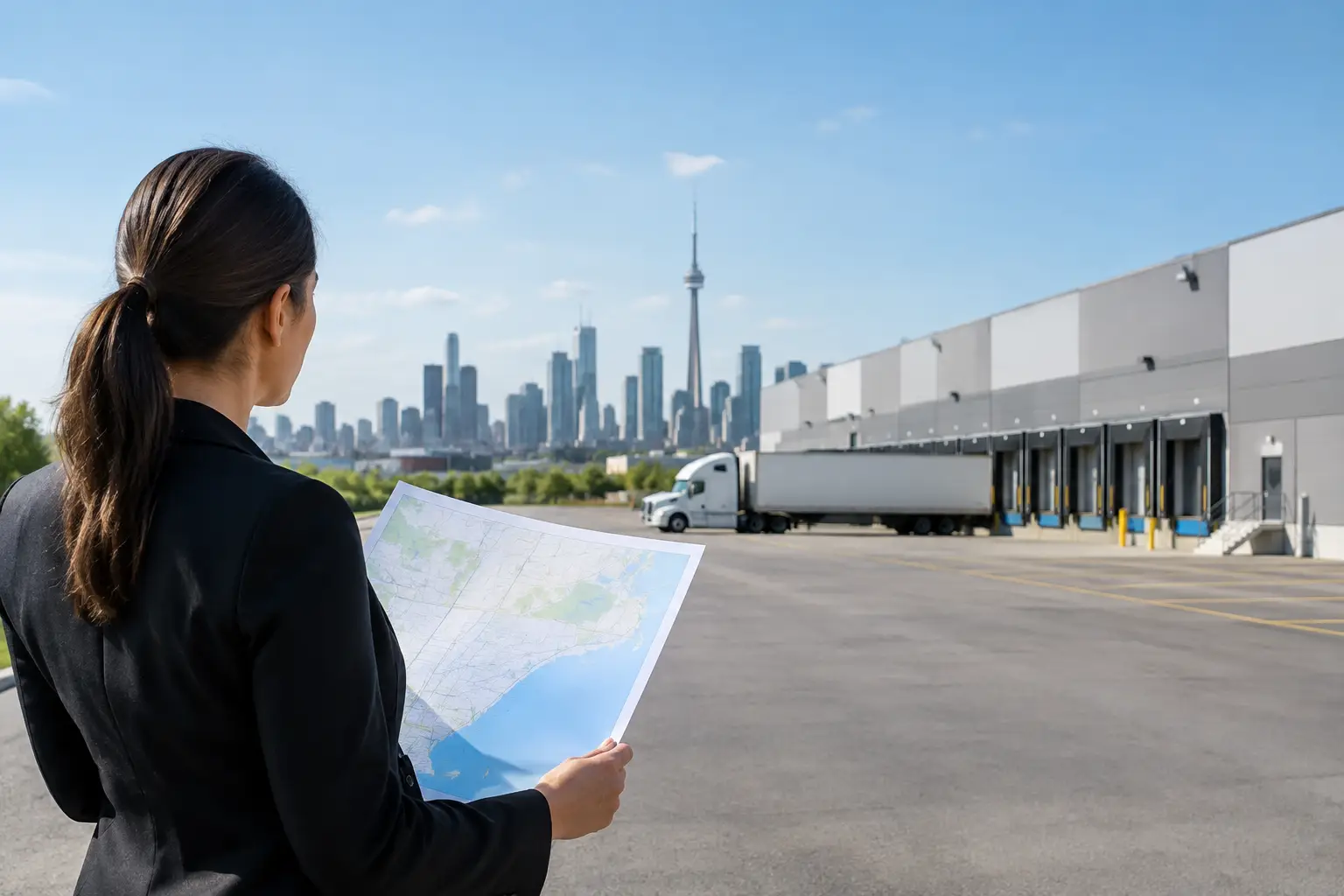
How to Choose Warehouse Location in the GTA
By Michael Law · Industrial Real Estate Broker, Lennard Commercial Realty
A warehouse can look efficient on a site plan and still create a daily operating problem. A few extra kilometers from a highway interchange, limited trailer storage, or a labor pool that is difficult to reach can affect delivery performance and payroll for years. Knowing how to choose warehouse location starts with the flow of your business, not a map of available buildings.
For operators, tenants, investors, and owners in Toronto and the GTA, the right location is rarely the lowest asking rent. It is the property that supports freight movement, staffing, customer service, and future capacity at an acceptable total cost. The trade-offs are real, particularly in a market where modern industrial supply is limited and major transportation corridors command a premium.
Start with the movement of goods
Before reviewing listings, map where inventory comes from and where it goes. A distributor receiving containerized imports may prioritize access to intermodal terminals, airports, or the Port of Montreal trucking network. A last-mile operator may place more value on proximity to dense customer areas. A manufacturer may need dependable access to suppliers, skilled labor, and outbound shipping routes.
This exercise should use actual shipment data rather than assumptions. Identify the origin and destination of your highest-volume lanes, delivery windows, average order size, and the number of daily truck movements. Then compare the travel time, not simply the distance, from each potential submarket. Ten kilometers near Highway 401 can take very different amounts of time depending on the interchange, time of day, and local congestion.
For many GTA users, access to Highways 401, 407, 400, 410, 427, and the QEW is a meaningful advantage. However, direct highway proximity is not automatically the answer. A building near a congested interchange may be less practical than one slightly farther away with stronger arterial access and fewer local restrictions. The best choice depends on your shipping pattern and service commitments.
Measure total occupancy and transportation cost together
Base rent is visible. The larger cost of a location is often less obvious. Transportation, labor, utilities, property taxes, maintenance obligations, and downtime caused by poor access should all be considered before a lease or acquisition decision.
A lower-rent building on the outer edge of the market can be a sound choice for bulk storage, regional distribution, or a business with predictable full-truckload shipments. It may be a poor choice for a high-frequency operation that sends many smaller orders into Toronto each day. The added driver time, fuel use, vehicle wear, and missed delivery capacity can outweigh rent savings quickly.
Build a simple annual model for each shortlisted site. Include occupancy costs, estimated inbound and outbound freight costs, employee commuting impact, parking requirements, racking or improvement costs, and anticipated expansion expenses. If the property is being purchased, include financing, capital reserves, and the likely cost of adapting the building to a future user.
A location decision should also account for taxes and operating expenses. Two buildings with similar rent can produce materially different occupancy costs because of differing tax assessments, utility arrangements, common-area charges, or landlord maintenance responsibilities. Review the lease structure closely rather than relying on a headline rate.
Confirm the site works for trucks, not just people
A warehouse location is only as useful as the site can handle. This requires more than checking the building size and dock count. Truck circulation, yard depth, turning radii, trailer parking, loading-door placement, curb cuts, and municipal restrictions all affect throughput.
Visit the property at the times your operation will be busiest. Observe truck traffic entering and leaving the area, queuing at nearby intersections, and turning into the site. Ask whether deliveries are restricted overnight, whether idling rules apply, and whether shared driveways or easements could interfere with access. In older industrial areas, a building may have adequate square footage but insufficient yard functionality for modern 53-foot trailers.
The building itself should support the operation as well. Clear height, column spacing, loading configuration, floor condition, sprinkler capacity, power supply, and office percentage influence how efficiently space can be used. A cross-dock building may justify a higher cost for a high-volume distribution operation, while a lower-cost single-load facility may be entirely appropriate for storage or light manufacturing.
Evaluate labor access before committing
Labor availability is one of the most common reasons a seemingly attractive location fails to perform. Warehouse staff, drivers, supervisors, maintenance technicians, and production workers need a realistic path to the site. A location that is difficult to reach by public transit or requires a long commute may lead to higher turnover, more absenteeism, and recurring recruitment expense.
Assess the surrounding labor market by role, not as a general population figure. A food distributor with early shifts has different needs than a light manufacturer requiring certified technicians. Consider shift timing, transit service, parking capacity, nearby competing employers, and local wage pressure. In some GTA submarkets, a location closer to the labor base can be more valuable than a slightly better highway position.
Talk with operational leadership early. The people responsible for hiring, dispatch, safety, and receiving often identify practical constraints that are not visible in brokerage data or demographic reports.
Verify zoning, permits, and operational permissions
Never assume an industrial building permits your intended use. Zoning bylaws can distinguish among warehousing, distribution, manufacturing, outdoor storage, vehicle repair, retail accessory uses, and specific product categories. A permitted use for one business may not cover another, even within the same industrial district.
Confirm the zoning designation, legal nonconforming status if applicable, parking requirements, loading requirements, signage permissions, and any restrictions on outdoor storage or trailer parking. If you plan to make improvements, determine whether permits, site-plan approval, fire-code upgrades, or environmental reviews may be required.
Environmental due diligence is equally important for buyers and long-term tenants. Current and historical uses, neighboring properties, soil conditions, and prior environmental reports can affect financing, redevelopment plans, insurance, and future resale. This is not an area to address after terms have been agreed. It should inform both property selection and negotiation strategy.
Plan for growth, but avoid paying for unused capacity
Choosing a warehouse location is a multi-year decision, so the property should accommodate a reasonable growth path. That may mean extra trailer parking, expansion land, flexible demising options, additional power capacity, or a submarket with nearby alternatives if a larger facility is needed later.
Still, paying for speculative capacity can strain a business. The goal is not to secure the largest building available. It is to understand what growth is likely during the lease term or investment horizon and what options exist if that growth occurs faster than expected. Renewal rights, expansion rights, rights of first offer on adjacent space, and assignment or sublease flexibility can be as valuable as additional square footage on day one.
For investors, flexibility broadens the future tenant pool. Buildings with functional loading, competitive clear height, usable yards, and access to major routes generally have stronger leasing appeal than properties tailored too narrowly to one occupier's needs.
Use a weighted site comparison
When several locations appear workable, a weighted comparison prevents the decision from becoming driven by a single visible factor such as rent or building size. Assign importance based on your operation, then score each site against the same criteria. A practical comparison may include:
- Freight access and estimated transportation cost
- Labor availability, transit, and employee parking
- Building loading, clear height, and operational layout
- Zoning, permits, and environmental risk
- Total occupancy cost and required capital investment
- Expansion options and long-term exit flexibility
The scores do not replace judgment, but they make trade-offs clear. If one location costs more but reduces daily delivery time, improves staffing, and gives the business room to grow, the higher rent may be the more disciplined financial choice.
Bring real estate and operations together early
Warehouse searches move faster when the decision team is aligned before tours begin. Finance may focus on occupancy cost, operations on throughput, and ownership on long-term value. Each perspective is valid, but the selected property must work across all three.
A commercial real estate advisor can help translate operational requirements into a realistic search area, identify risks in a proposed site, and structure terms that preserve flexibility. Michael Law Commercial Real Estate approaches industrial decisions with the understanding that a warehouse is not simply a real estate expense. It is a working asset that affects the business every day.
The right location should make your operation easier six months after move-in, not merely look attractive when the offer is signed. Test every candidate against real trucks, real people, real shipment patterns, and the business you expect to run next.

About Michael Law
Managing Partner and Industrial Real Estate Broker at Lennard Commercial Realty. Representing tenants and landlords across Toronto and the GTA for 15+ years. Michael specializes in GTA industrial real estate — connect with Toronto's leading industrial broker at mlawrealestate.com/industrial-broker-toronto.
Related Articles



More Toronto Industrial Real Estate Insights
Articles & Analysis
Common Questions
What is a sale-leaseback in industrial real estate?
A sale-leaseback is a transaction in which an industrial property owner sells their building to an investor and simultaneously signs a long-term lease to remain in the property as a tenant. The seller unlocks the capital tied up in their real estate while retaining full operational use of the facility. The buyer acquires a tenanted investment property with immediate cash flow from a known occupant.
Read →What is a dock-to-grade ratio in industrial real estate?
Dock-to-grade ratio in industrial real estate refers to the number of dock-level loading doors relative to the building's floor area, typically expressed as one dock door per X,000 square feet. It is a key specification for distribution and warehousing tenants because it determines how many trucks can load and unload simultaneously and therefore the building's throughput capacity.
Read →What is clear height in a warehouse or distribution centre?
Clear height in a warehouse or distribution centre refers to the usable vertical space from the finished floor to the lowest overhead obstruction — typically the bottom of the roof structure, sprinkler heads, or HVAC equipment. It is the single most important building specification for warehouse tenants because it determines how many racking levels can be installed and therefore how much product can be stored per square foot of floor space.
Read →