
Triple Net Lease Negotiation Tips for Industrial Tenants
Triple Net Lease Negotiation Tips for Industrial Tenants
When negotiating a Triple Net (NNN) lease for industrial spaces in Ontario, tenants must prepare for costs beyond base rent. These leases shift additional expenses like property taxes, insurance, and maintenance (TMI) to tenants, potentially increasing total costs by 25% to 40%. While NNN leases offer lower base rent, they require careful negotiation to avoid financial risks. Key areas to focus on include:
- Maintenance Responsibilities: Clarify repair vs. replacement costs (e.g., HVAC replacements should be landlord's responsibility).
- Rent Escalation: Negotiate caps on increases, especially for controllable expenses like CAM.
- Audit Rights: Ensure you can review the landlord’s financial records for accuracy.
- Insurance Costs: Confirm fair allocation of landlord's insurance premiums and avoid clauses allowing unilateral coverage increases.
- Flexibility: Secure options for expansion, early termination, or subletting to align with business changes.
With Ontario's industrial lease rates softening since 2025, tenants have more leverage to negotiate favourable terms. Work with brokers and legal counsel to ensure your lease protects your financial interests and operational needs.
Triple Net Lease Cost Breakdown: Base Rent vs. Total Occupancy Costs for Ontario Industrial Tenants
Key Components of Triple Net Leases
Tenant Obligations Under an NNN Lease
With a Triple Net (NNN) lease, you’re not just covering the base rent - you're also paying for Taxes, Maintenance, and Insurance (TMI). These additional costs can range from $8 to $25+ per square metre annually, significantly adding to your overall expenses.
"A Triple Net lease essentially means you're paying to run your portion of the building. While it offers a lower base rent, you carry the risk of unpredictable and escalating additional rent costs." - UL Lawyers
One of the biggest challenges with NNN leases is the extensive maintenance responsibilities they often place on tenants. Depending on the lease terms, you could be on the hook for maintaining HVAC systems, plumbing, electrical systems, parking lots, landscaping, and even the roof. For instance, replacing an HVAC unit could cost upwards of $10,000, making it essential to carefully review these clauses.
Another factor to consider is budgeting uncertainty. If the landlord’s estimated operating costs fall short, you might face a hefty year-end reconciliation bill to cover the difference.
Understanding these obligations isn’t just helpful - it’s crucial. Next, let’s break down the key terms that will shape your financial exposure.
Key Terms Industrial Tenants Should Know
To effectively negotiate an NNN lease, you need to understand specific terms that directly influence your financial responsibilities. Here’s a quick guide:
| Term | What It Means |
|---|---|
| TMI / CAM | Taxes, Maintenance, and Insurance - your share of the building’s operating costs |
| Gross-up Provision | Lets landlords calculate variable expenses as if the building were 95–100% occupied, ensuring tenants don’t underpay in a partially vacant property |
| Base Year | Sets a baseline for taxes or operating costs, so you only pay for increases above this amount in future years |
| Audit Rights | Gives you the ability to review the landlord’s financial records to confirm the accuracy of CAM charges and tax reconciliations |
| Proportionate Share | Your unit’s square footage as a percentage of the building’s total leasable area, determining your share of TMI costs |
The gross-up provision is particularly important. If a building is only 60% occupied, landlords can still charge you based on 95–100% occupancy for variable costs like utilities and security. While this ensures the landlord recovers their costs, it may mean you’re paying more than your actual share. Always clarify how gross-up provisions are applied in your lease.
Similarly, the base year can have a big impact. If the base year assessment is incorrect or set artificially low, you could end up paying for tax increases that were already in place before you signed the lease. To protect yourself, independently verify the base year assessment before finalizing the agreement.
sbb-itb-1862e65
The 6 Tips To Negotiating Your NNN Lease!

Negotiating Maintenance and Repair Responsibilities
Hidden costs in an NNN lease often stem from vague maintenance clauses, which can leave tenants footing the bill for nearly any expense.
"The absence of an exclusion list in an NNN lease is a red flag - it means the landlord may be able to pass through virtually any expense." - Lextract
Separating Repair and Replacement Costs
One key area to address in your lease is the difference between repairs and capital replacements. Repairs are about fixing or restoring something, like patching a small roof leak or replacing HVAC filters. These are typically the tenant's responsibility. Capital replacements, on the other hand, involve installing entirely new systems, such as a new roof membrane or HVAC unit, and should be the landlord's obligation.
Standard NNN leases often blur this line, so it’s important to insist on clear definitions. Additionally, any replacement costs passed on to you should be spread out over the useful life of the asset. For instance, if a new HVAC system costs $30,000 and has a 15-year lifespan, you should only pay for the portion that aligns with your lease term, rather than the full amount upfront.
"To avoid incurring large costs towards the end of a lease term, the tenant should ensure that these replacement costs are amortized over an extended period (typically the life of the capital item)." - Nicholas A. Cummings, Partner, Lerners LLP
Tenants should also exclude structural elements like foundations, load-bearing walls, and building envelopes from their responsibilities. Repairs resulting from landlord negligence or pre-existing environmental issues should similarly be excluded.
Once cost responsibilities are clarified, it’s equally important to set performance benchmarks for key systems to avoid unexpected maintenance issues.
Setting Performance Standards for Key Building Systems
Before signing the lease, ask the landlord to provide written confirmation that all major systems, such as HVAC, plumbing, and electrical, are in good working order and comply with current Ontario Building Code standards at the time of possession. This step helps you avoid inheriting deferred maintenance problems.
Here’s a breakdown of typical tenant responsibilities and negotiation points for major systems:
| System | Typical Tenant Responsibility | What to Negotiate |
|---|---|---|
| HVAC | Routine maintenance and filters | Annual repair cap; landlord covers full unit replacement |
| Roofing | Clearing drains, minor leaks | Landlord responsible for membrane replacement; request remaining useful life disclosure |
| Parking Lot | Striping and sweeping | Landlord responsible for repaving and sub-base repairs |
| Plumbing | Interior fixtures | Landlord responsible for main lines and latent defects |
These performance standards, combined with clear cost allocations, provide a strong foundation for protecting tenants from unexpected expenses.
In addition to the table, there are two practical steps you can take to strengthen your position. First, request maintenance logs and CAM statements from the past three to five years. This can help you identify recurring issues with ageing building systems. Second, establish a $5,000 repair threshold that requires landlord approval, paired with a "deemed approval" clause. This clause ensures that if the landlord doesn’t respond within 10 to 30 days, the repair is automatically approved. Both steps can prevent disputes and keep your operations running smoothly without unnecessary interruptions.
Rent and Escalation Terms: Managing Cost Increases
Once you've clarified maintenance responsibilities, the next priority is keeping rent escalation under control. This is crucial to avoid unexpected cost hikes. NNN leases typically last 10–15 years, and poorly negotiated escalation clauses can quickly eat into your margins. To keep rent costs predictable, it's essential to carefully review your escalation terms.
Reviewing Rent Escalation Clauses
There are three common types of rent escalation structures: fixed increases, CPI-linked adjustments, and hybrid models. Each of these is negotiable. Fixed increases, often around 3% annually, are straightforward, while CPI-linked adjustments fluctuate with inflation, potentially leading to unpredictable costs. If you agree to a CPI-linked clause, it’s wise to negotiate a floor and a cap - for instance, no less than 1.5% and no more than 4% per year - to protect against inflation spikes. Hybrid models that combine fixed increases with CPI caps can offer a balanced approach to managing costs.
"That 'standard' 3% annual increase? Not always written in stone." - IndustrialSpaces.net
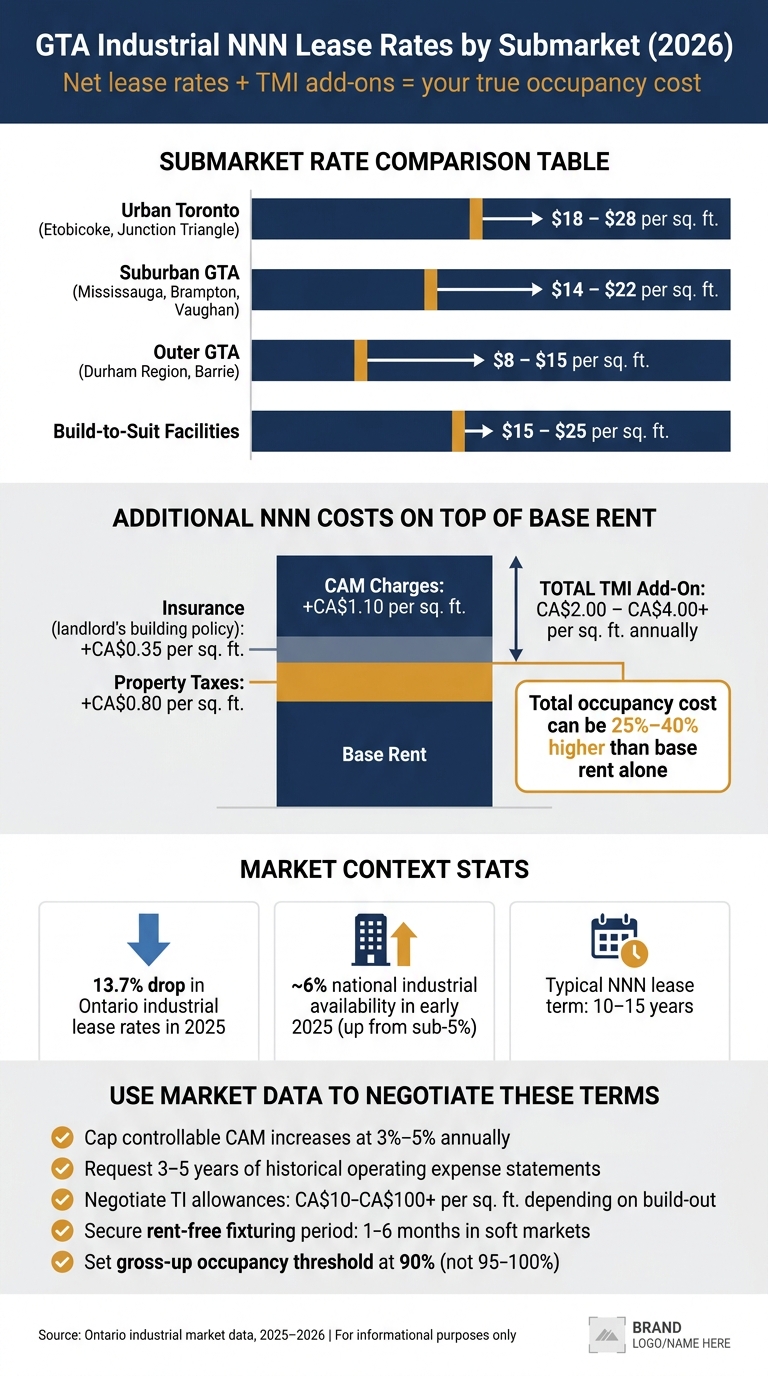
Another key area to examine is Additional Rent, which includes taxes, insurance, and CAM (common area maintenance) charges. For example, a base rent of CA$4.50 per square foot can climb to CA$6.75 per square foot once you add typical NNN costs like taxes (CA$0.80), insurance (CA$0.35), and CAM charges (CA$1.10). To avoid surprises, consider negotiating an annual cap on operating expense increases. This cap can help shield you from sudden spikes caused by factors like vacancies or poor building management.
"Proportionate share means what the lease says it means. It is rarely the simple math you would expect." - Dennis J. Tobin, Partner, Blaney McMurtry LLP
Negotiating Rent Abatement and Improvement Allowances
Managing rent increases is only part of the equation. You should also aim to secure concessions that reduce upfront costs. One option is negotiating a rent-free fixturing period, which typically lasts 1–3 months but can extend to 3–6 months in slower markets.
Another valuable concession is a Tenant Improvement (TI) allowance. This is funding provided by the landlord to cover construction, systems, and finishes. TI allowances can range from around CA$10 per square foot for minor updates to CA$100 or more for a shell build-out. Make sure to clarify whether the allowance covers just hard costs like construction or also includes soft costs such as permits and architectural fees. If your build-out comes in under budget, try to negotiate converting any unused TI funds into additional rent abatement rather than forfeiting them.
In 2025, industrial lease rates in Ontario dropped by 13.7% compared to the previous year, with vacancy rates in major markets nearing 3% or higher. In these softer market conditions, landlords may be more willing to agree to lower escalation rates or offer more generous TI allowances.
"A thoughtfully negotiated lease can give you a real competitive edge. On the other hand, a poorly understood one can become a source of major financial pain." - UL Lawyers
Controlling Operating Expenses in NNN Leases
Even if your rent escalation terms are fixed, operating expenses can still rise sharply. In Canadian industrial NNN leases, additional rent - covering taxes, insurance, and CAM (common area maintenance) - can tack on CA$2.00 to CA$4.00 per square foot to your base rent, sometimes even more. Without proper lease protections, these costs can keep climbing each year. Here are some strategies to help keep these expenses in check.
Expense Caps and Gross-Up Provisions
One of the key points to grasp is the difference between controllable and uncontrollable expenses. Controllable costs include items like landscaping, snow removal, security, and property management fees - areas where landlords decide how much to spend. These are the expenses you should aim to cap. On the other hand, uncontrollable costs, such as property taxes and insurance premiums, are more difficult to limit since landlords have little say over them.
For controllable expenses, negotiate an annual CAM cap of 3% to 5%. Ensure property management fees don't exceed 5% of gross revenue, and watch for administrative or overhead charges that go beyond 15% of total CAM costs. Anything above that could mean you're essentially paying twice for management.
Pay close attention to gross-up provisions. In multi-tenant buildings, landlords often adjust variable operating expenses as if the building were nearly fully occupied - usually 95% to 100% - even if it’s not. Negotiating a 90% occupancy threshold is more favourable for tenants. Additionally, fixed costs like property taxes and insurance should not be part of gross-up calculations, as these don't change with occupancy levels.
"Uncapped CAM is a critical risk in NNN leases. Without a cap on controllable expense increases, a tenant has no limit on how much annual CAM growth they absorb." - Lextract
When it comes to big-ticket items like roof replacements, structural repairs, or major HVAC upgrades, make sure these capital expenditures are excluded from operating expenses. If they must be included, insist that they are amortized over their useful life instead of being billed as a lump sum. This one clause can save you from sudden, hefty charges.
Reviewing Annual Reconciliation Statements
These protections work hand in hand with keeping cost increases under control. At the end of each lease year, landlords reconcile estimated operating expenses with actual costs. If actual expenses exceed what was estimated, you’ll get billed for the difference. Without clear lease terms, this process can become a financial headache.
Always include a formal audit right in your lease. This clause allows you to legally review the landlord's financial records to verify reconciliation statements and avoid hidden or duplicate charges. Without it, disputing a bill becomes nearly impossible. When you review a reconciliation statement, check for things like management fees being charged alongside salaries for on-site staff - a potential double charge. Additionally, request three years of historical operating expense data. This will help you identify trends, negotiate realistic caps, and avoid sudden cost surprises.
With Ontario's industrial vacancy rates expected to climb to around 3% or higher by 2026, tenants currently have more negotiating power. Landlords eager to fill vacancies are now more open to granting audit rights, clarifying expense definitions, and capping controllable costs.
Insurance and Liability Coverage for Industrial Tenants
Insurance is often an overlooked expense in a triple net (NNN) lease, yet it can become a significant cost. Under this structure, you're not only responsible for your own insurance but also for reimbursing the landlord's building insurance premium as part of your additional rent. Essentially, you're paying twice: once for your policies and again for the landlord’s.
Understanding Insurance Requirements
As a tenant, you're generally required to carry Commercial General Liability (CGL) insurance, with minimum coverage in Ontario typically ranging between CA$2 million and CA$5 million. In certain cases, landlords may also require umbrella or excess liability coverage exceeding CA$5 million, especially if the property involves higher-risk operations. Before signing a lease, confirm that these requirements are both reasonable and affordable for your business. For example, insurance premiums for a logistics warehouse will likely differ significantly from those for a chemical facility.
In addition to CGL, you’ll need property and contents insurance to protect your inventory, equipment, and leasehold improvements, as these are not covered under the landlord's building insurance. Many leases also recommend or require business interruption insurance, which ensures you can continue paying rent if an event like a fire temporarily halts operations. Here's a quick breakdown of insurance responsibilities in a typical NNN lease:
| Insurance Type | Carried By | Paid For By |
|---|---|---|
| Commercial General Liability (CGL) | Tenant | Tenant |
| Property / Contents | Tenant | Tenant |
| Building Insurance | Landlord | Tenant (via additional rent) |
| Business Interruption | Tenant | Tenant |
| Umbrella / Excess Liability | Tenant | Tenant |
Understanding these responsibilities can help you negotiate more favourable lease terms.
Pay particular attention to two key clauses during lease negotiations. First, avoid language that allows the landlord to unilaterally increase minimum coverage requirements during the lease term. Such clauses can unexpectedly raise your costs. Second, carefully review indemnity provisions to ensure you're not held accountable for environmental contamination or structural damage that predates your tenancy or results from another party’s actions.
Since you’re covering the landlord's building insurance costs as part of your rent, it’s crucial to confirm the policy reflects your fair share. Negotiate the right to review insurance invoices and policy details to ensure your pro-rata costs are accurate and not inflated by excessive coverage. This is particularly important in multi-tenant buildings, where higher-risk operations by other tenants could drive up premiums that you’re partially funding.
By addressing these insurance-related aspects upfront, you’ll reduce the risk of unexpected liabilities and ensure compliance with lease terms.
Documentation and Compliance Checklist
Even minor administrative errors in insurance compliance can lead to lease defaults. To avoid issues, follow these steps before moving in and at every renewal:
- Submit your Certificate of Insurance (COI) listing the landlord as an "additional insured" before your occupancy date.
- Verify your coverage limits meet or exceed the lease’s minimum requirements, including umbrella policies if needed.
- Review exclusions in your property insurance, as standard policies often exclude floods, earthquakes, and pollution. You may need additional endorsements for these risks.
- Identify and negotiate reset clauses that allow landlords to increase minimum coverage requirements, and push for their removal.
- Audit the annual reconciliation of building insurance costs to ensure your share is fair and based on actual premiums paid.
"The 'additional rent' section is notorious for causing the biggest financial shocks for tenants." - UL Lawyers
Keeping a compliance calendar with key dates like COI renewals, policy expirations, and reconciliation reviews can help you stay on top of your obligations and prevent disputes.
Negotiating Flexibility in Industrial Lease Agreements
When it comes to industrial leases, it’s not just about managing costs. Structuring a lease that allows for adaptability is just as important. Businesses evolve, and your lease should evolve with them. Whether you're expanding, downsizing, or restructuring, a well-negotiated lease can reduce risks and accommodate these changes seamlessly.
Expansion and Contraction Options
Planning for growth? Negotiate provisions like a Right of First Refusal (ROFR) or a Right of First Offer (ROFO) for adjoining spaces. These clauses let you claim additional square footage before it's offered to others, often at pre-agreed rates and conditions.
If you need to downsize, an early termination clause can provide an exit strategy. While landlords don’t usually offer these clauses freely, they can be negotiated - though they often come with requirements like advance notice and a termination fee. Starting these talks at least 6 to 9 months before your lease ends ensures you’re in a strong position.
Watch out for relocation clauses. These allow landlords to move you to another unit, which can be a major headache if you’ve invested in custom infrastructure. Push to remove or limit these clauses to avoid disruptions.
Finally, make sure your lease allows for flexibility in transferring or assigning it, especially as your business evolves.
Lease Assignment and Subletting Provisions
If your business undergoes major changes - like a sale, merger, or restructuring - transferring your lease shouldn’t become a roadblock. In Ontario, the Commercial Tenancies Act prevents landlords from unreasonably withholding consent for assignments, unless the lease states otherwise. Ensure your agreement clearly defines this "reasonableness" standard.
Here are two key areas to focus on:
- Permitted transfers: Negotiate exemptions for specific scenarios, like selling your business to an affiliate or reorganizing your company, so landlord approval isn’t required.
- Release of liability: If you assign the lease to a financially stable party, negotiate to release yourself from liability for the remainder of the lease term. Without this, you could still be held accountable.
Be cautious of recapture clauses, which allow landlords to terminate the lease and reclaim the space instead of approving a sublease. Also, insist on a defined timeline for landlord responses to consent requests - 10 business days is a fair standard - to avoid unnecessary delays.
"A lease is no longer merely a document for space; it is a strategic instrument that must protect against future disruptions while enabling digital and physical growth." - Cassandra Da Re, Lawyer, Dale & Lessmann LLP
Using Market Research to Strengthen Your Negotiating Position
Walking into lease negotiations without market data puts you at a significant disadvantage. Understanding current market conditions can give you the leverage you need to negotiate more favourable terms.
Researching Comparable Lease Rates and Terms in the GTA
Industrial rents in the Greater Toronto Area (GTA) have seen dramatic changes in recent years. Between 2019 and 2024, basic rental rates for industrial and warehouse spaces doubled or even tripled. However, in 2025, Ontario's industrial lease rates dropped by 13.7%, creating an opportunity for tenants renewing leases to negotiate better terms compared to just a couple of years ago.
When evaluating your lease, look beyond base rent. Factor in total occupancy costs, which include property taxes, insurance, and common area maintenance (CAM) charges. These can add $3 to $8 per square foot annually in a typical GTA NNN lease scenario. Here's a snapshot of 2026 net lease rates across GTA submarkets to help you set realistic expectations:
| Submarket | 2026 Net Lease Rate (per sq. ft.) |
|---|---|
| Urban Toronto (Etobicoke, Junction Triangle) | $18 – $28 |
| Suburban GTA (Mississauga, Brampton, Vaughan) | $14 – $22 |
| Outer GTA (Durham Region, Barrie) | $8 – $15 |
| Build-to-Suit Facilities | $15 – $25 |
Vacancy and absorption rates in your target submarket are equally important. High vacancy rates can shift the power in your favour, while tight supply can make negotiations tougher. For instance, national industrial availability rose to approximately 6% in early 2025, a notable increase from the sub-5% rates that had dominated the GTA for years. As the Business Development Bank of Canada (BDC) recommends:
"Talk to a commercial realtor to get up-to-date market lease rates in the area, so as to use any above-market asking rent in bargaining." - Business Development Bank of Canada (BDC)
To get the most accurate and granular insights, consider working with firms like Lennard Commercial, which offer proprietary market data and off-market intelligence specific to Toronto and the GTA.
Beyond understanding market trends, it’s also essential to evaluate the financial health of your landlord to avoid potential pitfalls.
Assessing Landlord Financial Stability
After benchmarking lease rates, take the time to assess your landlord's financial stability. A landlord under financial stress may cut corners on maintenance, inflate management fees, or fail to meet their obligations, which can directly impact your experience as a tenant in an NNN lease.
Start with a title search to confirm property ownership and negotiate an SNDA (Subordination Non-Disturbance and Attornment) agreement to protect your tenancy if the landlord defaults on their loan. As Matthew Loven, Partner at Maslon LLP, explains:
"The tenant will want to know that it will not be forced out of the building in the event the landlord defaults on its own loan. This is covered by Subordination Non-Disturbance and Attornment ('SNDA') and estoppel provisions." - Matthew Loven, Partner, Maslon LLP
Additionally, check the vacancy rates across the landlord's other properties. High vacancies in their portfolio could indicate cash flow issues, which might translate into poorly managed operating expenses for your building. For leases longer than three years, ensure the lease is registered on title at the Land Registry Office. This simple but often overlooked step protects your interest if the property changes ownership.
Lastly, pay attention to how the landlord handles the negotiation process. Delays in providing documentation or vague estimates for operating expenses can signal future difficulties. These red flags shouldn’t be ignored, as they often reflect how the landlord will manage the property after the lease is signed.
Working with Professional Advisors During Lease Negotiations
Once you’ve done your market research and outlined your cost control strategies, bringing in professional advisors can help you navigate the intricate details of lease agreements and avoid expensive pitfalls.
When to Work with a Commercial Real Estate Broker
It’s crucial to involve a broker before entering any verbal agreements. Their role goes far beyond just finding available spaces. Brokers provide insights into the often-large gap between asking rents and what tenants actually pay, which can make a big difference in a competitive market.
As Ognjen Marjanovic, a commercial real estate expert, puts it:
"A knowledgeable commercial real estate agent can be your critical advantage to identify opportunities and negotiate a lease that aligns with your goals."
Brokers can negotiate perks like tenant improvement allowances, rent-free fit-up periods, and limits on increases to common area maintenance fees. They also help you determine your best alternative to a negotiated agreement (BATNA), empowering you to walk away from deals that don’t meet your needs. For industrial tenants in the Greater Toronto Area, working with Lennard Commercial, led by Michael Law, provides access to exclusive market data and localized insights that can give you a stronger position during negotiations.
While brokers help secure favourable terms, legal counsel ensures those terms are clearly and fairly outlined in the lease.
Involving Legal Counsel in the Lease Review Process
Legal expertise is essential to ensure the final lease reflects the agreements made during negotiations. In Ontario, commercial leases don’t follow a standard format - they’re drafted by the landlord’s lawyer and often favour the landlord.
Nicholas A. Cummings, Partner at Lerners LLP, explains:
"Commercial leases are often lengthy contracts which cover a number of situations, risks, expenses and liabilities... careful consideration should be given to reviewing and negotiating the terms."
A lawyer’s role includes addressing unclear rent terms, identifying risks like environmental indemnity clauses, and negotiating fair restoration obligations. They’ll also work to include cure periods, which allow you time to fix a default before the landlord can take further action. Additionally, they ensure that major costs, such as HVAC or roof replacements, are amortized over their useful life instead of being charged as a lump sum. For leases lasting more than three years, your lawyer can register a Notice of Lease at the Land Registry Office to protect your tenancy in case the property changes ownership.
Here’s an overview of how different advisors contribute to a strong lease negotiation strategy:
| Advisor Type | Primary Role | Key Focus Areas |
|---|---|---|
| Commercial Broker | Market leverage and site sourcing | Market data, tenant improvement allowances, BATNA |
| Legal Counsel | Contract review and compliance | Lease language, environmental liability, cost amortization |
| Architect/Engineer | Technical feasibility | Build-out plans, structural maintenance obligations |
In Ontario, basic legal reviews for commercial leases are often offered as flat-fee services, while more complex agreements may incur hourly charges. Either way, the cost of legal advice is a small investment compared to the potential financial risks of signing a poorly defined NNN lease.
Conclusion: Key Takeaways for Industrial Tenants
Negotiating a Triple Net (NNN) lease can be complex, but thorough preparation can make all the difference. While the base rent might seem manageable, the actual cost of occupancy often climbs 25% to 40% higher once property taxes, insurance, and maintenance are factored in. Recognizing this difference is critical before signing on the dotted line.
Some aspects of lease negotiations carry more weight than others. For example, it’s wise to ensure that major capital expenses - like replacing a roof, HVAC systems, or structural components - fall under the landlord’s responsibility or are amortized over time instead of being charged as a lump sum. Additionally, try to negotiate caps on controllable operating costs, secure the right to audit Common Area Maintenance (CAM) reconciliations, and get written confirmation regarding the condition of key building systems before the lease begins.
Cost control is crucial, but flexibility matters just as much. Provisions for assignment rights, subletting, and options to expand or downsize can protect your business if your needs change during a 10- to 15-year lease term. Without these safeguards, you could find yourself stuck in a lease that no longer serves your business in a shifting market.
"The financial exposure in an NNN lease is substantially larger than the base rent figure suggests, and that exposure is defined by the specific language in the lease document." - Lextract
Finally, no amount of preparation can replace the insight of experienced professionals. A commercial real estate broker can provide market insights and strengthen your negotiating position. Legal counsel ensures the agreed-upon terms are accurately documented, and a property consultant can help identify potential risks before they turn into expensive problems. For expert advice on industrial lease negotiations in the Greater Toronto Area, consider reaching out to Michael Law at Lennard Commercial - Industrial Real Estate Services.
FAQs
What NNN costs should I exclude or cap?
When dealing with controllable or variable NNN costs, like common area maintenance (CAM) charges, it's smart to either exclude or set caps on these expenses. CAM charges can cover things like landscaping, snow removal, security, and janitorial services. To avoid unexpected increases, negotiate limits on these costs and ensure the lease agreement clearly defines which expenses are reimbursable.
How do I negotiate repair vs. replacement?
When it comes to a triple net lease, it's crucial to clearly outline who is responsible for repairs and replacements. Generally, landlords take care of structural repairs - think the roof, foundation, and exterior walls - while tenants are responsible for interior maintenance and non-structural elements like fixtures and minor repairs.
To prevent misunderstandings, it's wise to include specific repair thresholds and approval processes in the lease. For instance, you might set a dollar limit for minor repairs that tenants can handle without landlord approval, while requiring landlord involvement for more expensive or major replacements. Using precise language ensures both parties know exactly what’s expected and minimizes the risk of disputes down the line.
What should I ask for before I sign?
Before committing to a Triple Net (NNN) lease for industrial property, it's crucial to carefully review the base rent per square foot, the rent escalation schedule, and the allocation of property tax responsibilities. Make sure to clarify details about maintenance obligations, insurance coverage, and common area expenses. Look for precise definitions, limits on recoverable costs, and inspection rights to fully understand your financial commitments and reduce potential risks throughout the lease term.
Written by
Michael Law
Partner, Lennard Commercial · Industrial Real Estate Specialist