Ultimate Guide to Tenant Improvement Negotiations
Ultimate Guide to Tenant Improvement Negotiations
Tenant improvement (TI) negotiations are a critical part of leasing industrial space in the Greater Toronto Area (GTA). Whether you're signing a new lease or renewing one, understanding how to optimize your TI allowance can save you money and help you create a functional space tailored to your needs.
Key Points:
- What are TIs? Physical changes to a leased space to meet tenant requirements, like HVAC systems, electrical upgrades, or office build-outs.
- TI Allowance (TIA): A dollar amount per square foot provided by landlords, typically $15–$30/sq ft for 5–10-year leases in the GTA.
- Impact on Costs: TIAs are factored into your rent. For example, a $50/sq ft allowance could add $0.83/sq ft/month over five years.
- Preparation: Define space needs, create a detailed budget, and assess the base building condition to avoid hidden costs.
- Negotiation Tips: Focus on lease clauses like rent commencement, reimbursement timelines, and restoration obligations. Consider trade-offs like longer lease terms for higher allowances or converting unused TI funds into rent credits.
- Build-Out Options: Choose between tenant-managed or landlord-managed construction based on your control and workload preferences.
Quick Insights:
- Always clarify which costs qualify for reimbursement (e.g., design fees, permits).
- Secure phased payments tied to milestones to manage cash flow during construction.
- Protect against risks like fluctuating material costs or TI recapture clauses if you exit early.
This guide offers practical steps to navigate TI negotiations effectively and avoid costly mistakes.
Understanding Tenant Improvement Allowances
How TI Allowances Are Structured
Tenant Improvement (TI) allowances are typically calculated as a dollar amount per square foot of leased space. For instance, a $20/sq ft allowance on a 10,000 sq ft warehouse equals $200,000. In the Greater Toronto Area (GTA), these allowances for industrial and flex spaces generally range between $15 and $30 per square foot, depending on lease terms of five to ten years.
These allowances are usually provided through a reimbursement system. Tenants pay contractors upfront and then submit invoices for repayment within 30–60 days. Alternatively, payments may be tied to specific construction milestones. In some cases, landlords handle the entire project as a turnkey build-out, delivering a ready-to-use space tailored to the tenant's needs.
It’s also important to clarify which expenses qualify for reimbursement. While most landlords restrict allowances to hard costs like labour and materials, tenants can negotiate to include soft costs such as architectural fees, engineering, permits, and project management.
"A common mistake is focusing solely on the allowance amount per square foot. Experienced tenants understand that structure matters as much as size." - Suburban Real Estate
Once the structure of the allowance is clear, it’s time to identify the key players involved in the TI process.
Key Parties in the TI Process
A successful tenant improvement project relies on collaboration between several stakeholders. Understanding the role of each party can help prevent miscommunications and delays:
| Party | Role |
|---|---|
| Tenant | Defines space needs, manages the budget, and often hires the design and construction team. |
| Landlord | Provides funding, approves plans, and may oversee construction in turnkey projects. |
| Broker | Negotiates the TI allowance and lease terms, offering market insights and benchmarks. |
| Architect | Creates detailed space plans and specifications to support the allowance request. |
| Contractor | Executes the construction work and provides cost estimates. |
| Project Manager | Coordinates timelines, manages communication between parties, and ensures the project stays on budget. |
Among these, brokers and architects play particularly influential roles. Brokers bring market knowledge to the negotiation table, while architects ensure that the plans align with the tenant’s needs and justify the requested allowance.
With these roles clarified, the next step is understanding what influences the allowance amount.
What Affects Allowance Amounts
Several factors determine the size of a TI allowance, starting with lease terms and tenant creditworthiness. Longer leases and tenants with strong credit histories may receive an additional $10–$20 per square foot. However, newer businesses or those lacking a Canadian credit history may face reduced allowances or be required to provide personal guarantees for the unamortized portion of the allowance if the lease is terminated early.
Market conditions also play a significant role. In times of higher industrial vacancy, tenants often have greater leverage to negotiate larger allowances or other benefits, such as rent abatement. The intended use of the space is another critical factor. For example, specialized facilities like GMP-compliant food processing plants require more technical work than standard warehouses, which landlords must consider when determining allowances.
"The relevant question isn't just 'what's the market rate for TI?' It's 'what does it actually cost to build this space out to my spec?'" - Anica Petkovic, IPG
While a strong TI allowance might cover 25% to 40% of the total build-out cost, it rarely covers everything. Understanding the gap between the allowance and actual costs is crucial to avoid unexpected financial surprises during the project.
sbb-itb-1862e65
Negotiating Tenant Improvement Allowances | Brokers Round Table

How to Prepare for TI Negotiations
When it comes to negotiating tenant improvement (TI) allowances, preparation is everything. Let’s dive into the key steps to set yourself up for success.
Defining Your Space Requirements
Before starting negotiations, take the time to clearly outline your space's needs. For industrial tenants, this means looking at both the square footage and how the space will function. Think about things like production line layouts, loading dock access, ceiling heights, power capacity, and any other specialized infrastructure your operations require.
The delivery condition of the space is another major factor. A cold shell typically includes just the bare structural essentials - concrete floors and walls, with no HVAC, lighting, or interior finishes. On the other hand, a warm shell comes with basic mechanical and electrical systems already in place. Knowing which type of space you’re starting with will help you determine the scope of work needed and the size of the TI allowance you should request.
It’s a great idea to bring in an architect or contractor early in the process. Have them walk through the space with you to document your requirements. This step not only ensures you don’t miss anything critical but also gives you a solid foundation for your negotiations.
Once you’ve defined your needs, the next step is to translate them into numbers.
Building a Preliminary Budget
With your space requirements locked in, it’s time to create a detailed budget. Start by identifying your TI gap - the difference between the landlord’s offered allowance and the actual cost of the build-out you’re planning.
Break down the budget into hard costs (like framing, flooring, mechanical/electrical/plumbing systems, and safety installations) and soft costs (such as architectural fees, permits, legal reviews, and project management). Landlords often exclude soft costs from TI allowances by default, so it’s important to negotiate for their inclusion. Don’t forget to set aside 10%–20% as a contingency for unexpected expenses or code-related upgrades.
Keep in mind that some aspects, like MEP (mechanical, electrical, and plumbing) upgrades, can eat up to 65% of your TI budget in more complex projects - even before you get to the aesthetic finishes. To make sure your numbers are accurate, get at least three contractor bids. However, be aware that fluctuating material prices and trade labour shortages - especially projected for 2026 - can make quotes outdated within six months.
"The most valuable tool in your negotiation kit is not a lawyer. It is a builder who tells you the truth before you commit to the lie." - Austin Woo, Founder, Rococo Creative
Once you’ve got your budget, the next step is to ensure the base building can actually support your plans.
Reviewing Base Building Conditions
Even the most generous TI allowance can disappear quickly if the base building has hidden problems. Sometimes landlords offer appealing per-square-foot allowances, but the space itself may require costly infrastructure upgrades. If the lease doesn’t clearly assign responsibility for these upgrades, you could be stuck footing the bill.
Before you start negotiating, bring in professionals to assess critical systems like electrical capacity, HVAC performance, plumbing, fire protection, and roof or loading dock conditions. For industrial spaces, it’s also smart to request a Phase I Environmental Site Assessment to ensure there are no hidden contamination issues that might create liability down the road.
Document any deficiencies you find. These can be powerful leverage points to negotiate higher allowances, get the landlord to fund repairs, or adjust the lease terms. Lastly, don’t overlook the work letter - this document spells out the condition in which the landlord will deliver the space and clarifies what improvements they’re responsible for before you take possession.
How to Negotiate TI Terms
Lease Clauses That Affect TI
Certain lease clauses can have a big impact on your Tenant Improvement (TI) deal. Once you've done your homework, it's time to focus on weaving key TI terms into your lease agreement.
One of the most critical clauses is how rent commencement is defined. Make sure this is tied to "Substantial Completion" (verified by a Certificate of Occupancy) to avoid paying rent on a space you can't use. Couple this with a landlord delay protection clause, which extends your rent-free period day-for-day if the landlord delays plan approvals or TI fund disbursements.
Set up a clear TI draw process with a disbursement timeline of 15–30 business days, and ensure reimbursements are tied to construction milestones. On the cost side, push to include soft costs like architectural fees and permits in the list of eligible expenses, as landlords often try to exclude these.
Don’t overlook sunset date extensions and restoration requirements. If delays like permit issues or supply chain problems push your project past the TI draw deadline, you could lose access to unused funds. Negotiate automatic extensions for such delays and clarify upfront whether you'll need to remove improvements when the lease ends.
"Every right you did not negotiate into the lease is a right you do not have." - Lextract
Trading Off Concessions
TI allowances are just one part of the bigger financial picture, and savvy negotiators treat them as such.
One of the most common trade-offs is between lease term and allowance size. Since landlords recover TI costs over the lease term, a longer lease often means a bigger allowance. For example, extending a lease from five to seven years could add $10 to $20 per square foot to your TI allowance. Always crunch the numbers - a slightly higher base rent might be worth it if it comes with a significantly larger TI package.
If the landlord can't increase the TI allowance, free rent conversion is another option. For instance, three months of rent abatement on a $30/sqft/year lease equates to about $7.50/sqft in extra TI value. You could also negotiate for the landlord to cover additional build-out costs as an amortized loan, added to your monthly rent at an agreed interest rate.
Finally, ensure any unspent TI funds can either roll over as a rent credit or be redirected toward furniture, fixtures, and equipment (FF&E), rather than reverting to the landlord.
Once these trade-offs are on the table, turn your attention to minimizing risks.
Managing Risk in TI Negotiations
Fluctuating construction costs are a big concern in 2026. Material and labour prices have been unpredictable, and quotes can become outdated in as little as six months. To protect yourself, negotiate the ability to submit rolling reimbursement requests tied to construction milestones. This ensures steady cash flow and limits your exposure to mid-project cost hikes.
Be aware of TI recapture clauses if you leave the space early. These clauses may require you to repay the unamortized portion of the TI allowance. For example, on a $50/sqft allowance spread over a five-year lease, you'd owe about $0.83/sqft per month remaining if you exit early. Make sure you understand this liability before signing.
Lastly, consolidate all construction-related terms into a formal Work Letter or Construction Rider attached to the lease. As the Fiffik Law Group advises:
"A lease that is silent on the renovation period is a lease that is not yet ready to sign."
Having these terms clearly documented is the best way to safeguard your investment in the build-out.
Managing the Build-Out and Close-Out
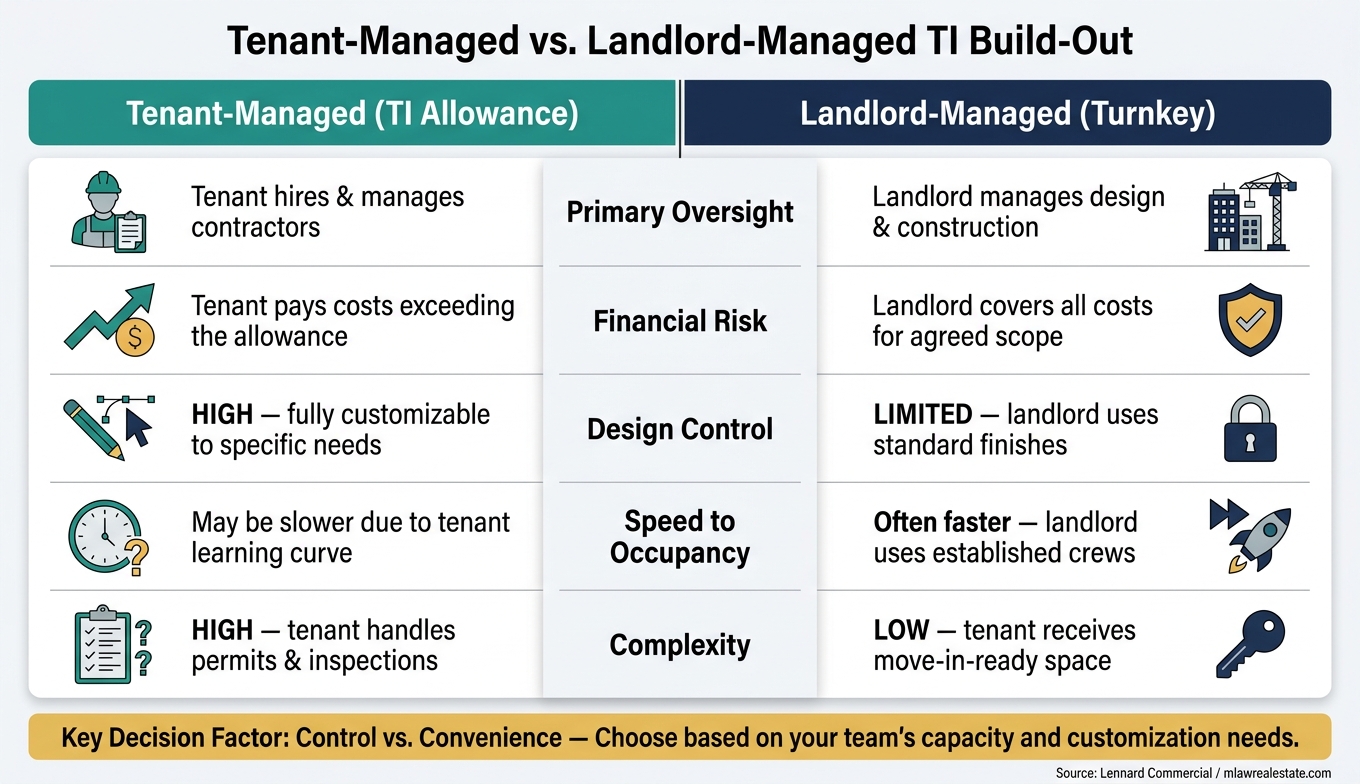
Tenant-Managed vs. Landlord-Managed TI Build-Out: Key Differences
With the tenant improvement (TI) terms nailed down, the focus shifts to steering the build-out process efficiently.
Tenant-Managed vs. Landlord-Managed Construction
Once your TI terms are set, the next big decision is deciding who will handle the construction. There are two main approaches: tenant-managed, where you hire and oversee contractors, or landlord-managed, often referred to as a turnkey build-out, where the landlord takes care of everything and delivers a ready-to-use space.
| Feature | Tenant-Managed (TI Allowance) | Landlord-Managed (Turnkey) |
|---|---|---|
| Primary Oversight | Tenant hires and manages contractors | Landlord manages design and construction |
| Financial Risk | Tenant pays for costs exceeding the allowance | Landlord covers all costs for the agreed scope |
| Design Control | High; tenant customizes to specific needs | Limited; landlord often uses standard finishes |
| Speed to Occupancy | May be slower due to the tenant's learning curve | Often faster as the landlord relies on established crews |
| Complexity | High; tenant handles permits and inspections | Low; tenant receives a move-in-ready space |
The choice boils down to how much control you want versus how much administrative work you're prepared to take on. If your landlord insists on using their approved contractors, negotiate for the ability to get independent bids to avoid inflated costs. For tenant-managed projects, try to secure an early access or fixturing period. This allows you to start construction before the lease officially begins, helping you avoid paying rent on a space that’s not yet usable.
Once you've picked the right model, it’s time to focus on regulatory requirements and documentation.
Permits, Inspections, and Documentation
In the Greater Toronto Area, any interior alterations to non-residential buildings require a building permit - even if the floor area remains unchanged. Expect municipal review timelines to range from four to eight weeks in 2026.
For industrial and commercial spaces, permit fees as of 1 January 2026 are $11.53 per m² for Group F and E occupancies, and $12.45 per m² for business and assembly uses (Groups A, B, D). Your permit application must include several key documents:
- A completed Application for a Permit to Construct or Demolish (updated 16 February 2026)
- A Schedule 1 Designer Information Form
- An Existing Life Safety System Form (for most non-residential alterations)
All drawings must be submitted in PDF format, drawn to scale, and include the designer’s registration and qualification details.
Keep detailed records throughout the process. This includes signed contractor agreements, permits, progress photos, itemized invoices, and inspection reports. These will be critical when submitting TI draw requests and during the final close-out phase.
Completing the Project and Planning Ahead
With your TI framework in place, clearly defined close-out procedures are key to a smooth handover. Substantial completion should be based on an objective standard, such as the issuance of a Certificate of Occupancy, rather than relying solely on the landlord’s judgment. Once this milestone is reached, schedule a joint walkthrough with the landlord to create a written punch list of any remaining issues, complete with deadlines for fixes.
Before releasing final payments, collect conditional lien waivers from contractors and subcontractors to protect yourself from potential mechanic’s liens. After this, both parties should sign a Commencement Date Confirmation Letter to clearly establish the rent commencement and lease expiration dates.
It’s also wise to budget an extra 10–15% beyond your TI allowance for costs that are often excluded, like specialized equipment or furniture. Check if unused TI funds can be applied toward early rent payments instead of being forfeited. Projects with well-structured coordination protocols tend to finish 23% faster than those without, making a strong case for setting up clear procedures before construction even starts.
Conclusion: Key Steps for Effective TI Negotiations
Recap of Key Steps
Navigating tenant improvement (TI) negotiations successfully involves careful planning, a structured approach, and diligent follow-through. Before starting discussions with a landlord, ensure you have a reliable construction estimate in hand. Document your specific infrastructure requirements - like power amperage, clear height, and dock count - and thoroughly assess the base building conditions to avoid unexpected expenses.
The structure of your agreement is just as important as the allowance itself. Push for phased milestone payments, include soft costs (such as design fees, permits, and engineering), and secure extensions for force majeure events on draw deadlines of 12–18 months. When evaluating proposals, focus on total occupancy costs, which include additional rent, the value of the TI allowance, and restoration obligations, rather than simply looking at the headline rent.
In the Greater Toronto Area (GTA), industrial tenants can benefit from creating genuine competition among landlords. Engaging with three to five landlords over a short two- to three-week period can help shift the balance of pricing power back to tenants. This tactic becomes especially effective as Ontario's industrial vacancy rates are projected to rise to 3% or higher by 2026.
By following these steps, tenants can better protect their interests while also leveraging professional expertise to navigate the complexities of TI negotiations. Some critical clauses to focus on include:
| Critical TI Clause | What to Lock In |
|---|---|
| Eligible Costs | Include both hard and soft costs (design, permits, engineering) |
| Payment Method | Phased reimbursement tied to construction milestones |
| Draw Deadline | 12–18 months with rights to force majeure extensions |
| Unused TI Funds | Option for rent credit or carryover |
| Restoration Obligations | Clearly defined and limited scope |
Working with an industrial real estate expert can further enhance your negotiation outcomes.
Working with an Industrial Real Estate Specialist
Once your TI terms are established, expert guidance can help you finalize the deal effectively. TI negotiations often involve intricate details like construction budgets, lease laws, municipal permits, and specific submarket trends. A single oversight can lead to costly mistakes, making it essential to collaborate with an industrial real estate specialist.
Michael Law of Lennard Commercial specializes in industrial real estate across Toronto and the GTA. His expertise spans lease renewals, relocations, and user acquisitions. With access to off-market opportunities and detailed submarket-level data on vacancy and absorption, Michael can help tenants gain a competitive edge in TI negotiations. For leases exceeding $200,000 in total value, hiring a specialist like Michael Law is a practical choice, as landlords typically cover their fees.
To put things into perspective, a landlord’s total cost to re-lease a 5,000 sq ft space - including vacancy downtime, broker commissions, and a new TI package - can climb to approximately $350,000. Armed with solid market data and professional representation, tenants are far better positioned to secure favourable terms in their lease agreements.
FAQs
How can I tell if a TI allowance is “good” for my deal?
A “good” tenant improvement (TI) allowance depends on several factors, including the type of property, current market conditions, the lease duration, and the extent of the build-out required. To determine if the allowance is reasonable, compare it to standard market ranges and check if it adequately covers your anticipated costs.
It's also essential to review the terms carefully - look at aspects like flexibility in how the allowance can be used, whether you have control over contractor selection, and what expenses are eligible. If you're in a strong position to negotiate, such as committing to a longer lease or having strong credit, you may be able to secure more favourable terms. Lastly, don’t forget to factor the allowance into your total occupancy costs to ensure it aligns with your overall financial strategy.
What TI costs are usually excluded - and how can I get them covered?
Tenant improvement (TI) costs usually don't cover things like furniture, fixtures, and equipment (FF&E), decorations, signage, kitchen appliances, or outdoor upgrades. These expenses are generally the tenant's responsibility. However, it's worth bringing these needs up during lease negotiations. Some landlords might agree to include certain items in the TI allowance, depending on the lease terms and the broader agreement.
What lease clauses are important if my build-out is delayed or I leave early?
When negotiating a lease, there are several critical clauses to pay attention to. These can make a significant difference in how smooth the process is and how fair the terms are for you.
- Construction Timelines: Make sure the lease includes clear deadlines for construction and a precise definition of what "substantial completion" means. This clarity helps avoid disputes later.
- Rent Commencement: Aim for rent payments to begin only after the space is substantially complete. Additionally, negotiate for extensions if there are delays in construction.
- Early Access Rights: Try to secure access to the property before the official lease start date. This can be useful for setting up the space or moving in equipment.
- Landlord Delays: Protect yourself with clauses that address landlord-caused delays. Remedies like rent extensions can help offset the inconvenience.
- Early Termination: If there's a chance you may need to leave the lease early, ensure the penalties and conditions for early termination are clearly outlined. This can save you from unexpected costs down the line.
Written by
Michael Law
Partner, Lennard Commercial · Industrial Real Estate Specialist