Warehouse Space Optimization vs Expansion Costs
Warehouse Space Optimization vs Expansion Costs
Deciding between optimizing your warehouse space or expanding your facility depends on your business goals, budget, and timeline. Here's what you need to know:
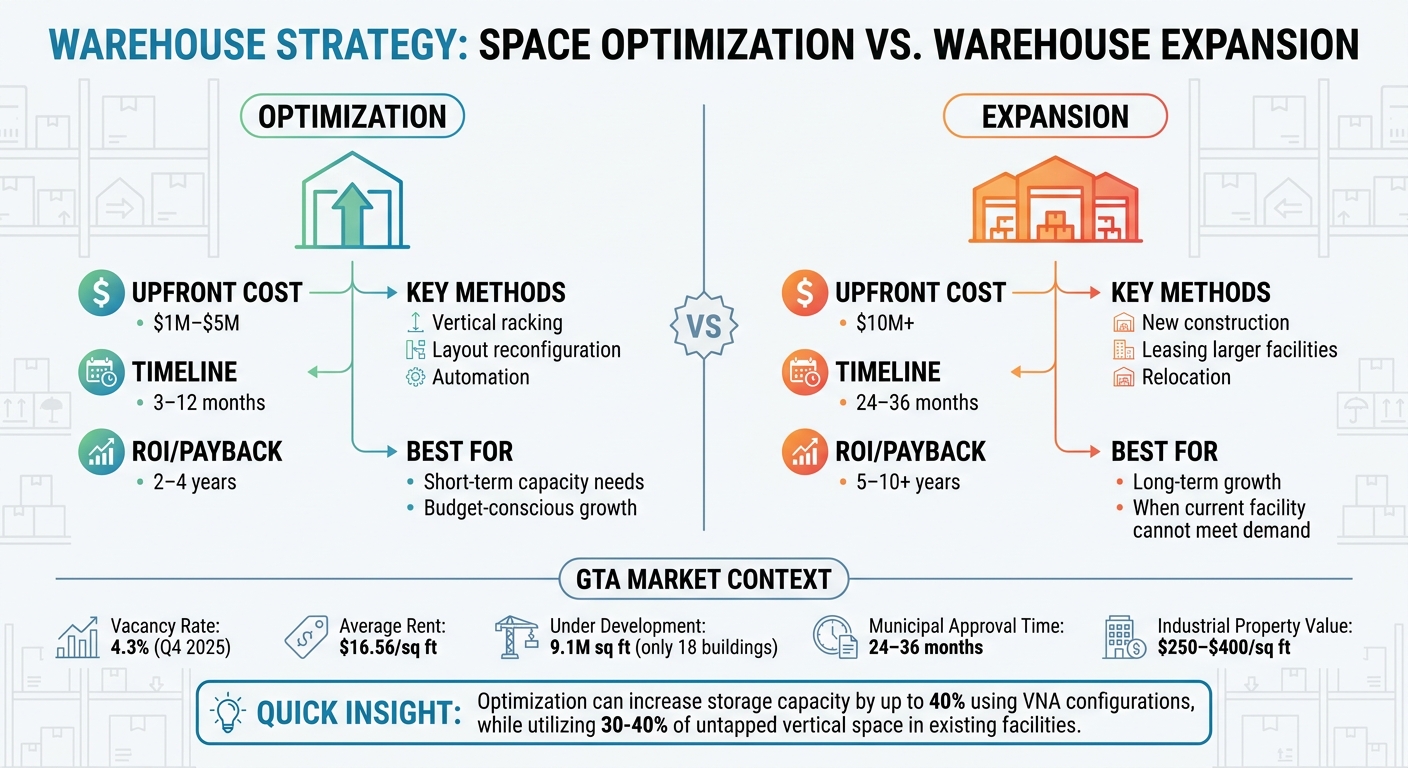
- Warehouse Optimization: Focuses on improving the efficiency of your existing space. Techniques include vertical racking, reconfiguring layouts, and automation. It's faster (3–12 months), more affordable ($1M–$5M upfront), and offers a quicker ROI (2–4 years).
- Warehouse Expansion: Involves leasing, relocating, or building new facilities. While it provides more capacity, it's costlier ($10M+ upfront) and takes longer (24–36 months). ROI can take 5–10+ years.
Key GTA Market Challenges:
- Low vacancy rates (4.3% as of Q4 2025) and high rental costs ($16.56/sq ft average).
- Limited construction pipeline, with only 9.1M sq ft under development in 2025.
- Rising land costs and prolonged municipal approval timelines (up to 36 months).
Quick Tip: Start by optimizing your current space to save costs and time. Expansion is best suited for long-term growth needs when your current facility can't meet demand.
Quick Comparison:
| Factor | Optimization | Expansion |
|---|---|---|
| Upfront Cost | $1M–$5M | $10M+ |
| Timeline | 3–12 months | 24–36 months |
| ROI | 2–4 years | 5–10+ years |
| GTA Market Impact | Mitigates high rents | Limited by low supply |
Bottom Line: For most GTA businesses facing rising costs and limited space, optimization is the smarter short-term move, while expansion is a longer-term investment requiring careful planning.
Warehouse Optimization vs Expansion: Cost, Timeline and ROI Comparison
Warehouse Space Optimization: Lower-Cost Approaches
Methods for Maximizing Current Space
Modern warehouses with 32–36‑foot clearances offer a major advantage by allowing for vertical space utilization, something older facilities with 20–24‑foot clearances simply can't match. A great example of this is a 3PL operator who transitioned from bulk floor storage to a 27‑foot high selective racking system in a 32‑foot clearance warehouse. This shift created over 5,000 pallet positions - boosting capacity without needing extra square footage.
High-density racking systems like double‑deep, drive‑in, push‑back, and pallet flow racks are also excellent for minimizing aisle space and freeing up floor area. Additionally, storage platforms and mezzanines can make use of previously untouched vertical space. These "buildings within a building" allow operations like hand-picking to move off the floor, dramatically changing how space is used.
Another effective method is auditing floor plans and reconfiguring pallet racking to align with inventory velocity. This approach can unlock hidden storage capacity, improve picking speeds, and cut down on worker travel time. Shaun Schwartz, Director of Marketing & Sales Strategy at North American Steel, highlights the importance of this step:
"Optimizing a storage system can be a lifeline for a growing business in a challenging market".
Optimization Benefits: Cost, Timeline, and Returns
Optimizing your current warehouse space is much faster than building new facilities. Constructing a new warehouse typically takes 12–18 months, but expanding or optimizing an existing space can often be completed in just 3–6 months. This shorter timeline ensures operations can continue with minimal disruption.
The cost advantages are just as appealing. Optimization avoids the hefty expenses tied to land purchases and new construction. Many warehouses only use about 60–70% of their vertical storage capacity, leaving 30–40% of cubic space untouched. By implementing Very Narrow Aisle (VNA) configurations, storage capacity can increase by as much as 40%. With labour costs making up roughly 65% of total warehouse expenses, improvements like better slotting and automation reduce idle time and prevent overstaffing. These operational upgrades not only cut costs but also improve efficiency, making optimization a smart move in competitive markets. As lease rates in the Greater Toronto Area (GTA) climb, optimization offers a practical and cost-conscious alternative to expansion.
GTA Optimization Example
In the Greater Toronto Area, where vacancy rates are at historic lows and lease costs continue to rise, optimizing existing warehouse space has become essential. For many, it's the only realistic option to avoid signing leases at higher rates for new facilities. Companies like Canadian Rack Technologies provide tailored, turn-key solutions that adapt to the unique challenges of the GTA market, reclaiming unused corners and making better use of ceiling space. To keep up with changing needs, warehouse operators should review their pallet racking and storage configurations at least once a year.
sbb-itb-1862e65
Expansion Costs and Obstacles: Understanding the Investment
Expansion Options: Construction, Leasing, and Relocation
While making better use of existing space can save time and money, expanding warehouse capacity comes with its own set of challenges.
In the Greater Toronto Area (GTA), businesses looking to grow their warehouse space usually consider three main options: building new facilities, leasing larger spaces, or relocating. Constructing a new warehouse - whether it’s an addition to an existing site or a custom-built standalone facility - provides long-term control and allows for equity growth. However, this approach requires a significant upfront investment and ties up capital for years. Leasing, on the other hand, offers quicker access to space without the hefty financial commitment, though it leaves businesses vulnerable to rising rents and market fluctuations. For instance, leasing a 20,000-square-foot facility in a prime GTA location, such as near Highway 401, costs over $305,000 annually at current rates of $15.25 per square foot (NNN), excluding utilities and operating costs. Relocation often involves moving to a larger leased facility in a location better suited to logistics.
Most industrial leases in the GTA are structured as triple-net (NNN), where tenants cover base rent in addition to property taxes, insurance, and maintenance. While industrial spaces generally require fewer customizations than office buildings, specialized needs - like refrigeration, enhanced electrical systems, or advanced racking - can still demand significant upfront spending. The following sections dive deeper into the financial, operational, and timing challenges tied to these expansion methods.
Financial and Operational Obstacles
Expanding in the GTA comes with steep financial barriers. One of the biggest issues is land scarcity. Limited availability of suitable sites, combined with geographic constraints, has driven property values through the roof. This high demand for industrial real estate has further compounded the cost challenges.
Construction costs have also soared due to rising material prices, labour shortages, and increased interest rates. These factors make new warehouse developments more expensive than ever. Redeveloping brownfield sites in established industrial zones can add another layer of complexity, as environmental assessments and cleanup efforts often lead to higher costs and longer timelines. Additionally, modern facilities frequently require costly upgrades to power infrastructure to support advanced HVAC systems, automated handling equipment, or specialized refrigeration needs.
The GTA’s compressed cap rates, currently at 4.0–4.5%, add another layer of risk. With property values highly sensitive to interest rate changes, even a 100 basis point increase can significantly impact returns on leveraged investments. Industrial real estate now accounts for 45% of Canada’s total commercial real estate investment volume as of 2026, highlighting the intense competition for quality assets. These financial and operational challenges make expansion both risky and time-intensive.
Expansion Timelines and Potential Risks
In addition to financial hurdles, time delays can create major risks for businesses. Municipal approvals - such as site plan reviews, building permits, and environmental assessments - can stretch development timelines to 24–36 months. This extended timeframe ties up capital and reduces flexibility. Budget overruns are also common, especially when unexpected environmental remediation or permitting delays arise. New developments may even face opposition from local communities concerned about increased truck traffic, noise, or operational disruptions. The strain on development is evident, with Canada’s annual new industrial supply dropping nearly 39% year-over-year in 2025.
Even leasing presents its own set of challenges. While it generally allows for quicker occupancy compared to construction, the GTA’s low vacancy rate of 3.2–4.0% makes finding suitable spaces difficult. Moreover, the "functional vacancy" for modern facilities - those with clear heights of 28 feet or more and sufficient truck courts - is even lower, making it hard for businesses to secure the right space quickly.
Cost and ROI Comparison: Optimization vs Expansion
Cost Comparison Table
When tackling warehouse capacity challenges in the GTA, understanding the cost differences between optimization and expansion is crucial. Here's a breakdown:
| Factor | Optimization (Lower-Cost) | Expansion (High-Cost) |
|---|---|---|
| Upfront Capital | $1M–$5M (racking, WMS, automation) | $10M+ (land, construction, infrastructure) |
| Project Timeline | 3–12 months | 24–36 months |
| ROI/Payback Period | 2–4 years | 5–10+ years |
| Ongoing Expenses | Software licences, equipment maintenance | Rent/mortgage, property taxes, utilities, higher labour |
| 3-5 Year Total Cost | Lower (efficiency-focused) | Higher (capacity-focused) |
Optimization offers a faster return on investment, typically within 2–4 years, compared to the 5–10+ years often required for expansion. In the GTA, where industrial real estate prices range from $250 to $400 per square foot, the cost of a full-scale optimization program might hover around $3 million. On the other hand, building a new 50,000-square-foot facility could exceed $15 million before even considering inventory relocation.
Take, for instance, a case from July 2024. North American Steel compared two facilities: an older 100,000-square-foot warehouse with a 16-foot clear height and a modern 34,000-square-foot building with a 40-foot clear height. The older facility, housing 7,920 pallet positions, cost about $1,915,000 annually ($19.15 per square foot, including TMI). Meanwhile, the modern facility provided 7,992 pallet positions at a higher rate of $23.86 per square foot but cost only $811,240 annually. This resulted in an impressive 58% saving of over $1.1 million per year.
These examples highlight the stark differences in upfront costs and long-term savings, setting the stage for a deeper dive into Total Cost of Ownership (TCO).
Calculating Total Cost of Ownership
Looking beyond initial expenses, the Total Cost of Ownership (TCO) provides a fuller picture of the financial impact over a 3–5 year period.
For optimization, TCO includes investments in racking, WMS, and automation, along with ongoing costs like maintenance, software licences, and energy. These expenses are often offset by significant labour savings, which can represent up to 65% of a warehouse's operating costs. Energy-efficient upgrades, such as LED lighting and motion sensors, further reduce costs.
In contrast, expansion involves additional layers of expense. TCO for expansion includes land acquisition, construction (ranging from $20 to $60 per square foot), permits, utility upgrades, and IT infrastructure. Operational costs in the GTA add $3–$8 per square foot annually for property taxes, insurance, and maintenance. Hidden costs, such as dual operations during relocation or temporary dips in productivity, can also add to the financial burden.
"The right question isn't 'Can we afford more space?' - it's 'Will the added space generate a return above our cost of capital and strategic alternatives?'" - Ashley Taylor, Product Manager, Cleverence
Using your Weighted Average Cost of Capital (WACC) to discount future cash flows is a smart way to assess the Net Present Value (NPV) of each option. This approach ensures you're making decisions based on long-term value rather than just upfront costs, helping you choose the most financially sound path forward.
GTA Market Factors Affecting Your Decision
Limited Supply and High Demand in the GTA
The industrial real estate market in the Greater Toronto Area (GTA) is grappling with a severe supply crunch, forcing businesses to focus on making the most of their current spaces rather than expanding. As of late 2025, the availability rate has dropped to just 4.3%, marking a 40-basis-point decline compared to the previous year. This tight market makes securing expansion space a significant challenge, even for businesses willing to pay higher rents.
The construction landscape paints an equally challenging picture. At present, only 18 buildings (totalling 9.1 million square feet) are under development, a sharp decline from the 69 buildings (19.5 million square feet) that were in the pipeline three years ago. Developers are shying away from speculative projects due to rising land costs, labour expenses, and uncertainty surrounding material prices and tariffs. As a result, most new developments are design-build projects for specific tenants, leaving fewer ready-to-move-in options for businesses needing immediate space.
Rental rates mirror these tight conditions, with average asking net rents across the GTA now at $16.56 per square foot. GTA North leads the pack with $17.55 per square foot, while GTA East offers slightly more affordable rates at $15.01 per square foot. Sublet space is also becoming scarcer, dropping by 27% (1.8 million square feet) during 2025 alone.
Adding to the complexity, municipal approvals now take 24–36 months, further delaying construction in an already land-starved market. The Greenbelt restrictions limit the availability of developable land, leaving businesses with tough decisions: either commit to long-term, uncertain expansion timelines or focus on optimizing their existing facilities to meet immediate needs.
"But if we do see some sort of agreement on trade and trade stability, I think businesses will know what the environment's going to be like, and they can dust off those expansion plans, and we could see economic activity and growth increase toward the end of 2026." - Keith Reading, Senior Director, Research, Morguard
Given these hurdles, having expert guidance is more important than ever.
Working with Lennard Commercial for Custom Solutions

Navigating the GTA's competitive industrial real estate market requires a strategic approach, and that's where Lennard Commercial comes in. Their expertise helps businesses find tailored solutions to address both immediate needs and long-term goals.
For companies looking to optimize their operations, Lennard Commercial offers lease renewal services designed to negotiate terms that provide cost stability. This stability allows businesses to confidently invest in upgrades like new equipment and technology, even in a low-vacancy market.
If expansion is the goal, Lennard Commercial provides relocation and user purchasing services. These include access to off-market opportunities and in-depth site selection analysis, ensuring businesses can make informed decisions. Additionally, their investment sale advisory helps owner-occupiers secure long-term cost predictability, which is crucial in a market where prime industrial properties in Toronto are now selling for $250 to $400 per square foot.
To learn more about how Lennard Commercial can help your business, visit mlawrealestate.com.
Conclusion: Selecting the Right Approach
Main Points to Remember
Optimizing your current space offers quicker returns with lower financial risks. Simple upgrades like energy-efficient lighting, smart building systems, or modernized HVAC setups demand less capital than building new facilities or relocating. With industrial properties in the GTA valued at over $300 per square foot, focusing on optimization allows you to extract maximum value per square foot without stretching your budget too thin.
Expansion is ideal when growth outpaces your current infrastructure. If your facility can no longer support modern racking or if moving closer to key customer locations becomes critical, expansion might be the answer. Keep in mind, though, that expansion often involves longer timelines due to municipal approvals and the limited availability of developable land.
A phased approach balances flexibility and cost. Many companies start by optimizing - streamlining layouts, introducing automation, or renegotiating leases - while keeping an eye on growth trends. This approach preserves capital and allows for adjustments if market conditions shift unexpectedly.
These points provide a framework for making informed, strategic decisions.
How to Make Your Decision
Start by analysing your current space. Assess dimensions, power capacity, loading dock ratios (a standard is one door per 10,000–15,000 square feet), and parking availability to identify bottlenecks and potential improvements. Engage with your team to uncover operational inefficiencies or overlooked opportunities for optimization.
Next, forecast your growth using multiple scenarios. Your project should remain viable even if demand drops 10% below your baseline projections. Calculate the Total Cost of Ownership (TCO), factoring in expenses like rent or mortgage, property taxes, insurance, and maintenance (typically $3–$8 per square foot annually in the GTA). Don’t forget transition costs, such as dual operations, inventory relocation, and staff training.
Finally, evaluate your operational needs against current market trends. This will help you determine whether optimization or expansion offers the best long-term value. For instance, favourable market conditions might make lease renewal negotiations more advantageous.
Getting Expert Help for Your Warehouse Strategy
Once you've completed your analysis and forecasts, consider working with professionals who can refine your strategy. Lennard Commercial provides expert insights and customized plans to help businesses navigate the competitive GTA market. Their lease renewal services can secure stable terms, freeing up resources for facility improvements. For those considering expansion, their relocation and site selection expertise ensures access to off-market opportunities and detailed market insights.
Additionally, Lennard Commercial’s investment sale advisory helps owner-occupiers achieve long-term cost stability. Given the impact strategic decisions can have on overall performance, expert guidance can make all the difference. To explore your warehouse strategy, visit mlawrealestate.com.
How to Maximize Warehouse Space Without Moving
FAQs
How do I know if my warehouse can be optimized further?
To determine whether your warehouse operations could be running more efficiently, take a close look at a few critical areas: space utilization, inventory management, and operational workflows.
Start by examining how products are organized - does the layout make sense for quick and easy access? Next, ensure you're using real-time inventory tracking systems to keep stock levels accurate and avoid delays. Finally, review how smoothly your picking, packing, and shipping processes are running. Are there bottlenecks or unnecessary steps slowing things down?
If you spot inefficiencies in any of these areas, making targeted changes could significantly boost your warehouse's performance. On the other hand, if everything is already running smoothly, additional improvements might be harder to achieve.
Which optimization upgrades usually pay back the fastest?
The quickest returns often stem from improvements that make better use of space and boost efficiency. For instance, reorganizing products for easier access, implementing real-time inventory tracking systems, and fine-tuning picking and packing processes can rapidly cut costs and streamline operations.
What hidden costs should I budget for if I expand or relocate in the GTA?
When planning to expand or relocate a warehouse in the GTA, it's important to account for hidden costs that go beyond just leasing or purchasing the property. For example, permit delays can cause supply chain disruptions, while infrastructure upgrades - such as enhanced security systems or climate control - can add to your expenses. Don't forget increased utility bills, either.
Other potential costs include meeting local compliance standards, conducting environmental assessments, or dealing with market fluctuations that could impact your budget. Careful planning and thorough budgeting can help ensure a smooth transition and keep operations running efficiently in Toronto’s competitive industrial real estate market.
Written by
Michael Law
Partner, Lennard Commercial · Industrial Real Estate Specialist