Prevent Spoilage: GTA Tenant Rep's 3 Cold Storage Lease Checks
By Michael Law · Industrial Real Estate Broker, Lennard Commercial Realty
Before signing anything, verify three things: refrigeration capacity and redundancy match your load, utility and backup-power costs are allocated in writing, and term length with tenant improvement allowances is locked before you commit. Miss any one of these, and you risk spoiled inventory or a lease that quietly bleeds cash. As Michael Law | Lennard Commercial has seen across dozens of GTA industrial deals, undefined “substantial completion” language is where most cold storage tenants get burned.
TL;DR:
- Verifying refrigeration capacity and redundancy against actual product needs is critical to avoid operational risks and costly surprises after signing.
- Clear lease language on utility pass-throughs, alarm response SLAs, and temperature setpoints helps prevent unexpected charges and equipment failures.
- Ensuring the lease timing is tied to verifiable occupancy permits or CFIA registration protects against paying rent before legally operating.
- Negotiating term lengths of 10 to 15 years with renewal options and specific TIA and assignment rights strengthens leverage and flexibility.
- Working with a tenant-side expert helps secure better terms, technical protections, and access to unlisted GTA cold storage options.
Table of Contents
- Evaluating facility condition: what to inspect in a legacy or modern building
- Lease economics and operating-cost allocation that matter for cold storage
- What technical items and SLAs belong in the lease?
- Canadian regulatory and due-diligence items that affect lease start
- Negotiation checklist: what to prioritize in the LOI and lease
- When you can’t find space: convert, build-to-suit, or use a 3PL
- Michael Law’s practitioner perspective: quick wins and red flags
- Why the standard cold storage checklist isn’t enough
- Secure your next cold storage lease with tenant-side representation
- Sources
- FAQ
Evaluating facility condition: what to inspect in a legacy or modern building
A cold storage building’s mechanical systems age faster than its shell, and that mismatch causes most post-signing surprises. Before you negotiate anything, walk the facility with someone who can read a compressor nameplate, not just a floor plan.
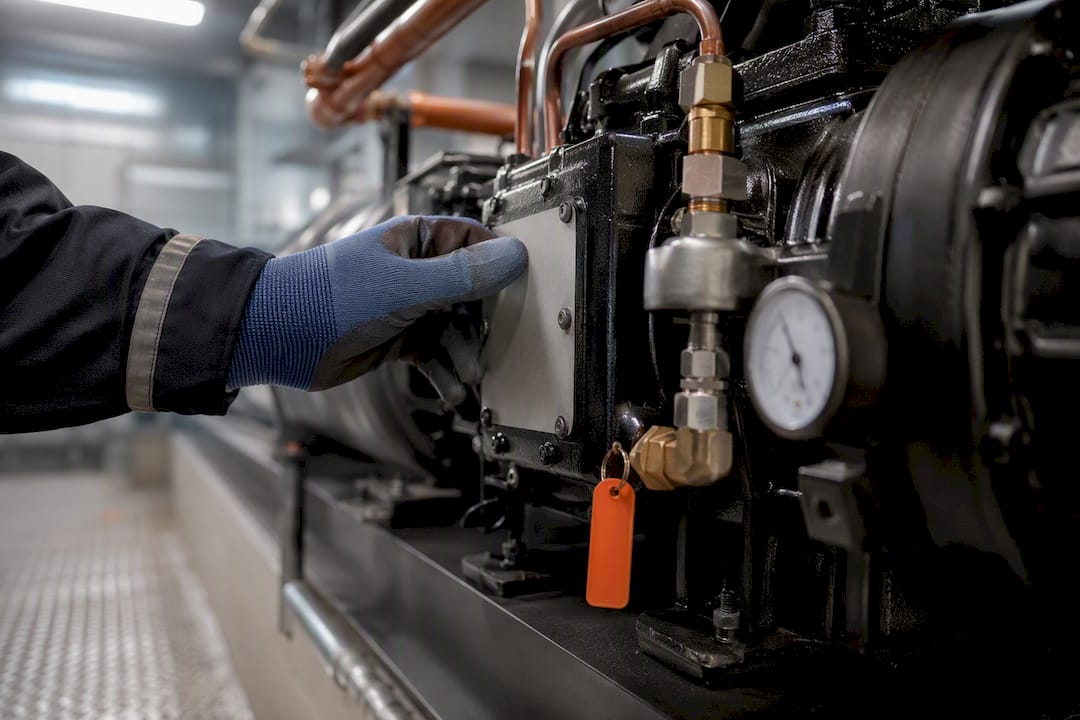
Start with the refrigeration plant itself. You want the compressor’s rated capacity, the maintenance log for the past two to three years, and a realistic estimate of remaining service life from the landlord’s mechanical contractor. Facilities built or retrofitted in the last decade tend to run more efficiently and finance more easily, which matters if your landlord is leveraged against the property, according to financing guidance for cold storage assets.
Beyond the compressors, check:
- Insulation thickness and condition in walls, ceiling, and dock doors, since gaps are where energy cost overruns start.
- Clear height, floor load rating, and drainage, especially in blast-freeze or wash-down areas.
- Dock design and door count relative to your truck volume and staging needs.
- Backup generator capacity and whether refrigeration runs on an N+1 design, meaning one compressor can fail without stopping cooling.
- Alarm and telemetry access, so you can see temperature history independently of the landlord’s system.
Pro Tip: Ask for the facility’s actual electrical single-line diagram, not a summary. It tells you whether there’s spare capacity for a second compressor or backup unit if your volume grows.
Verifying compressor capacity and redundancy against your product’s actual temperature needs remains one of the most overlooked steps in cold storage leasing decisions, and it’s the single biggest driver of operational risk after the lease is signed.
Lease economics and operating-cost allocation that matter for cold storage
Cold storage operating costs behave nothing like a dry warehouse, and gross leases hide that difference until your first winter electricity bill arrives. Electricity in a frozen or chilled facility can run $0.50 to $1.00 or more per square foot monthly, compared to roughly $0.05 to $0.15 in standard dry warehouse space. That gap is the entire reason net leases with explicit pass-through language dominate this asset class in the GTA.
Push for these clauses before you sign a letter of intent:
- Explicit utility pass-through language naming electricity, backup generator fuel, and refrigerant top-ups separately from general TMI.
- Audit rights on operating cost statements, with a defined window (typically 90 to 180 days) to dispute charges.
- A clear base-year definition if any portion of the lease is gross, so increases are measured against a fixed benchmark.
- Caps on controllable operating costs, distinct from truly uncontrollable items like utility rate hikes.
- Defined payment timing and consequences for late reconciliation, cutting both ways.
The legal risk of getting this wrong is real, not theoretical. In the McRae Cold Storage matter, a tenant’s failure to pay increased energy costs as contemplated under the lease led to default and loss of renewal rights, a cautionary precedent documented through Ontario’s regulatory framework. Vague cost-sharing language doesn’t just cost money. It can cost you the space entirely. Understanding how triple net structures actually work in GTA industrial leasing before you negotiate puts you in a stronger position than reacting to the landlord’s first draft.
What technical items and SLAs belong in the lease?
A cold storage lease is an operating agreement disguised as a real estate contract, and it should read that way. Verbal assurances about temperature control mean nothing once a compressor fails at 2 a.m.
- Define setpoints in the lease itself. State the exact temperature range required for each zone, such as -18°C for frozen and 2°C to 8°C for chilled, and require the landlord to confirm installed compressor capacity matches that load, not just the building’s historical use.
- Require telemetry access. You need the right to pull temperature logs and alarm history independently, not rely on the landlord’s word. This also supports retention requirements if a regulator or insurer ever asks for records.
- Set response-time SLAs. Specify how fast a technician must respond to a refrigeration alarm, typically within two to four hours for critical failures, and what remedy applies if that SLA is missed repeatedly.
- Assign refrigerant responsibility. Name who handles leak detection, reporting, and remediation, and require a maintenance log showing refrigerant top-up history before you sign.
Pro Tip: Ask for temperature-log export rights in writing. Without them, you’re trusting the landlord’s dashboard during a dispute you’re trying to prove.
Canadian regulatory and due-diligence items that affect lease start
Rent commencement should never hinge on an undated landlord letter. Tie it instead to something verifiable: an occupancy permit, or CFIA registration where your operation involves federally regulated food handling. That single change protects you from paying rent on a space you legally cannot yet operate.
Before signing, confirm:
- Municipal zoning permits your specific use, including any outdoor yard storage or refrigerated container staging.
- A Phase 1 Environmental Site Assessment has been completed, with remediation responsibility for refrigerant contamination clearly allocated.
- Utility service capacity has been confirmed with the local hydro authority, not just assumed from the building’s electrical panel size.
- Loading, permitted use, and slab load ratings match your actual operation, since Ontario industrial due-diligence standards flag vague permitted-use clauses as a leading cause of post-signing disputes.
Building this checklist into your due-diligence process early saves weeks of back-and-forth once you’re under a tight closing deadline.
Negotiation checklist: what to prioritize in the LOI and lease
Term length isn’t just a landlord preference. Lenders financing purpose-built cold storage typically expect 10 to 20 year lease commitments from creditworthy tenants, which gives you real leverage to negotiate in return.
- Term and renewal rights. A 10 to 15 year commitment is standard for purpose-built cold storage; use that length to negotiate a right of first refusal or first offer on adjacent expansion space.
- Tenant improvement allowances. Separate mechanical upgrades (compressor replacement, insulation retrofit) from cosmetic build-out, and push for landlord-funded mechanical work amortized over the lease term rather than paid upfront.
- Assignment and sublease rights. Cold storage tenants often need flexibility as volume shifts; negotiate the right to assign or sublease without unreasonable landlord consent requirements.
- Restoration limits and TMI audit rights. Cap your restoration obligation at reasonable wear-and-tear standards, and reserve the right to audit operating cost statements before any increase takes effect.
When you can’t find space: convert, build-to-suit, or use a 3PL
Cold storage vacancy in the GTA stays tight, and sometimes the right facility simply isn’t listed. Three paths exist, each with different risk profiles.
- Conversion of dry warehouse space works if the building has spare electrical capacity, adequate floor drainage, and structural bones that support added insulation. Power upgrades are usually the biggest cost driver.
- Build-to-suit gives you exact specifications but requires a pre-lease commitment and a developer with a track record in refrigerated construction, since construction risk allocation depends heavily on who’s chosen to build.
- Third-party logistics (3PL) outsourcing avoids leasing entirely but shifts control to a provider’s SLA. Prioritize temperature-integrity guarantees and inventory visibility over headline pricing.
Choosing between these options often comes down to timeline pressure and how much developer partnership your growth plan can absorb.
Michael Law’s practitioner perspective: quick wins and red flags
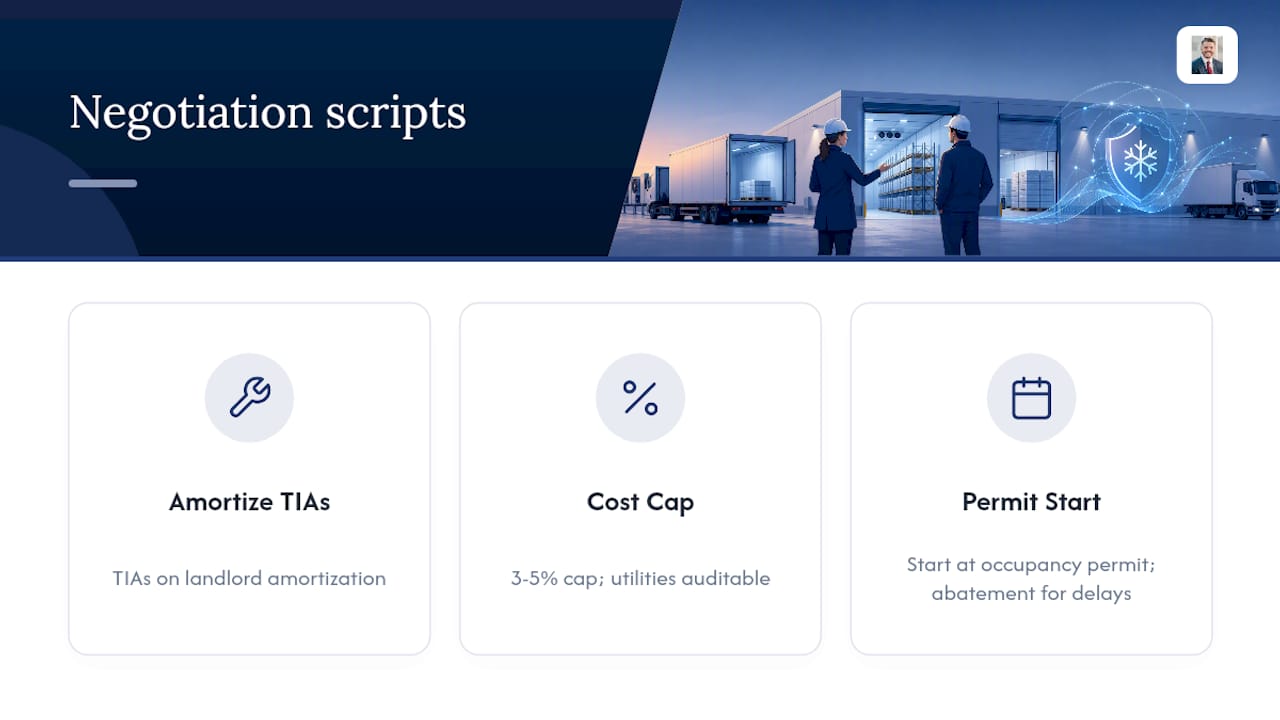
Three negotiation scripts consistently work in GTA cold storage deals. First, tie mechanical TIAs to a landlord amortization schedule rather than a lump-sum tenant payment. Second, propose a cap on controllable operating cost increases at 3% to 5% annually, leaving true utility pass-throughs uncapped but auditable. Third, insist commencement dates reference the occupancy permit date, with a rent abatement schedule if permits are delayed through no fault of the tenant.
Walk away, or at minimum pause, if a landlord refuses to specify who covers backup-power costs during an outage, or if the permitted-use clause is vague about refrigerated versus frozen operations. Both are common in older GTA industrial stock being repositioned for cold storage.
Bring in tenant representation and a commercial real estate lawyer no later than the LOI stage, not after. By the time a lease draft arrives, your leverage on term flexibility and TIA structure has usually already narrowed.
Why the standard cold storage checklist isn’t enough
Most cold storage guidance treats this like any other industrial lease with a colder loading dock. That framing misses the point entirely. The mechanical systems are the asset, not the building shell, and every lease clause needs to protect against equipment failure the way a manufacturing lease protects against a stopped production line.
What gets underestimated most is the utility allocation clause. Tenants focus energy on rent-per-square-foot and TIA dollar amounts, then treat operating cost language as boilerplate. That’s backwards for cold storage, where electricity can run several times higher than dry warehouse space and where a single ambiguous clause has already cost a Canadian tenant its renewal rights in a documented case.
If you take one thing from this guide, prioritize the utility pass-through and commencement-date language before you even discuss base rent. Everything else, term length, TIA structure, assignment rights, is negotiable within a reasonable range. Get the operational protections wrong, and no rent discount makes up for it.
— Michael Law
Secure your next cold storage lease with tenant-side representation
A tenant-side representative can provide crucial support when negotiating a cold storage lease against a landlord’s legal and technical team. The real advantage isn’t just market access. It’s having someone who reads a compressor nameplate and a lease clause with equal fluency, so utility allocation, TIA structure, and commencement language get resolved before you’re financially committed.
A first engagement typically starts with a market scan of available GTA cold storage inventory, moves into LOI drafting with the technical and cost protections outlined above, and continues through lease negotiation milestones until due diligence closes. If you’re evaluating cold storage space in Toronto or across the GTA, reach out to start a market scan and get a first read on what’s realistically available before your current lease expires.
Sources
- CanLII — regulatory/legal reference (McRae example cited in research)
- Expanding your footprint: a guide for leasing more cold storage space | Refrigerated & Frozen Foods
- Cold storage and distribution center financing | Jeremy Kresky
- Industrial property due diligence Ontario | Buyer checklist
FAQ
What are the downsides of using a cold storage warehouse?
Cold storage carries significantly higher operating costs than dry warehouse space, with electricity alone often running several times higher per square foot. Mechanical failures also carry higher stakes since a compressor outage can destroy inventory within hours, making redundancy and monitoring non-negotiable rather than optional upgrades.
What are the requirements for a cold storage warehouse?
At minimum, a cold storage facility needs adequate compressor capacity for its temperature zones, sufficient insulation and envelope integrity, backup power or generator redundancy, and monitoring systems that let tenants verify temperature compliance independently. Municipal zoning approval and, where food handling applies, CFIA registration are also required before operations can legally begin.
How do you determine cold storage requirements?
Requirements are typically set by matching product type to temperature zone, frozen goods generally need around -18°C while chilled products need 2°C to 8°C, then sizing compressor capacity and redundancy to that specific load. Reviewing maintenance records and asking for the facility’s electrical single-line diagram gives a realistic picture of whether existing equipment can meet those needs.
What are the two main types of cold storage facilities?
Cold storage facilities generally split into frozen storage, maintained around -18°C for long-term product preservation, and chilled or refrigerated storage, held between 2°C and 8°C for perishables with shorter shelf lives. Some facilities operate multi-temperature zones within the same building to serve both needs under one roof.
Should I use a tenant representative when leasing cold storage in the GTA?
Given how tight cold storage inventory remains across the GTA, working with a tenant representative such as Michael Law at Lennard Commercial typically improves access to unlisted opportunities and strengthens negotiating leverage on TIAs, term length, and utility cost allocation.
Recommended

About Michael Law
Managing Partner and Industrial Real Estate Broker at Lennard Commercial Realty. Representing tenants and landlords across Toronto and the GTA for 15+ years. Michael specializes in GTA industrial real estate — connect with Toronto's leading industrial broker at mlawrealestate.com/industrial-broker-toronto.