Commercial real estate denver: 2026 investor's guide
By Michael Law · Industrial Real Estate Broker, Lennard Commercial Realty
TL;DR:
- Denver’s commercial real estate market is shifting towards longer lease commitments, driven by infrastructure investments and demand for logistics space. Investors should focus on off-market opportunities, prioritize modern industrial specifications, and understand submarket nuances for successful acquisitions. Relying on broker networks and live market intelligence is essential due to data lag and market complexity.
Commercial real estate in Denver is defined as income-producing property used for business purposes, spanning industrial, office, retail, and mixed-use asset classes across the metro area. The Denver commercial real estate market is drawing serious attention from investors and business owners in 2026, driven by infrastructure investments like the $280 million East Colfax Bus Rapid Transit project, rising demand for logistics space in corridors like Stapleton, and a measurable shift in tenant behaviour toward longer lease commitments. Major players including Prologis and Madison Commercial Properties are actively deploying capital here. Whether you are evaluating Denver commercial properties for acquisition, leasing industrial space, or repositioning a portfolio, understanding the mechanics of this market is the difference between a well-timed move and a costly one.
What defines commercial real estate in denver’s industrial market?
Denver’s industrial sector is the most active segment of its commercial real estate market right now. Demand is concentrated in logistics, warehousing, and light manufacturing, with tenants prioritising functional specifications over aesthetics.
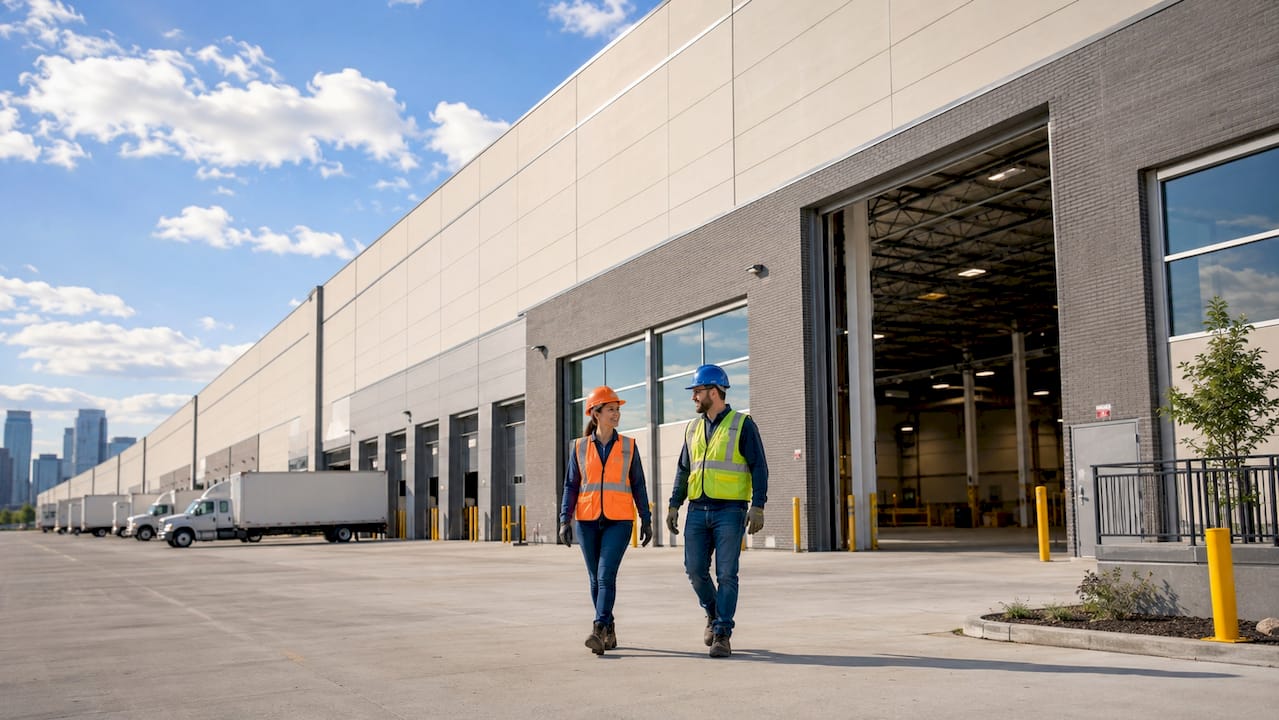
The Stapleton submarket is the clearest benchmark for what quality industrial space looks like in Denver. Prologis Stapleton Business Center Building 9 illustrates the standard: approximately 18,000 SF of total space, 30-foot clear heights, ESFR fire suppression systems, and up to six dock doors. That combination of height and door count is what separates a functional logistics facility from a compromised one.
Key physical specifications to demand
When evaluating any Denver industrial listing, these are the specifications that determine operational viability:
- Clear height: 30 feet is the current standard for modern logistics. Anything below 24 feet limits racking configurations and reduces usable cubic volume significantly.
- Dock doors: A mix of dock-high and drive-in doors is the baseline. Dock-high doors serve transport trucks; drive-in doors accommodate forklifts and smaller vehicles.
- Fire suppression: ESFR (Early Suppression Fast Response) systems are required for high-pile storage and are a non-negotiable for most logistics tenants.
- Office integration: Most 18,000 SF industrial units include roughly 1,728 SF of integrated office space, which supports administrative functions without requiring a separate lease.
- Power supply: Three-phase electrical service is standard for manufacturing users. Confirm amperage before signing.
- Truck court depth: A minimum of 130 feet is required for 53-foot trailers to manoeuvre safely.
Pro Tip: Always request the as-built drawings for any industrial space before submitting an offer. Ceiling heights listed in marketing materials are sometimes measured to the structural deck, not the underside of the lowest obstruction. The difference can be 2–3 feet.
Investors evaluating Denver commercial properties for acquisition should treat these specifications as value drivers, not just tenant preferences. A building that meets modern logistics standards commands premium rents and attracts creditworthy tenants. A building that falls short faces prolonged vacancy or discounted leasing.
How are lease structures and market trends shaping denver in 2026?
Denver’s commercial real estate market is at a genuine inflection point in 2026. The data confirms it, but the interpretation requires context.
Over 50% of leases signed in Q2 2026 in Denver’s office market were new leases or expansions, not renewals. That is a structural shift. For the prior five years, renewals dominated because tenants were managing uncertainty, not making commitments. The move toward new leases and expansions signals that occupiers are now planning for growth, not just survival.
The lease term trend reinforces this. Denver tenants are now committing to 7–10 year leases at a rate not seen since before 2020. That confidence reflects a market where tenants believe their operational footprint will hold or grow. For investors, longer lease terms mean more predictable cash flow and stronger asset valuations.
The role of infrastructure in driving retail and industrial demand
The $280 million East Colfax BRT investment is not a peripheral story. It is a direct demand driver for retail investment along East Colfax, where frontage volumes exceed 26,000 vehicles per day and average surrounding household incomes exceed $172,000. Those are institutional-grade retail fundamentals.
Triple net (NNN) lease structures on East Colfax properties include 3–5% scheduled annual rent increases. That escalation structure is deliberate. It protects investors against inflation without requiring lease renegotiation, and it compounds meaningfully over a 10-year hold.
Here is how the current lease environment stacks up for investors evaluating Denver commercial real estate:
- New lease activity is accelerating. The shift from renewals to new leases and expansions indicates genuine demand, not just lease obligation fulfilment.
- NNN structures with rent escalations are the preferred vehicle. They transfer operating costs to tenants and build inflation protection directly into the lease.
- Infrastructure investment is a leading indicator. The East Colfax BRT project is already influencing retail corridor valuations before the line is fully operational.
- Debt maturity is creating deal flow. Nearly $600 billion in national commercial real estate debt is maturing through 2026, forcing owners to transact. That pressure creates acquisition opportunities for well-capitalised buyers.
One critical nuance: CRE market data carries a 12–24 month lag. Reports published today reflect decisions made in 2024 or early 2025. Treat published vacancy rates and absorption figures as trailing indicators, not real-time signals. Experienced brokers with live transaction data are a more reliable source of current market conditions than any published report.
The broader industrial and logistics sector is showing similar momentum globally. Industrial and logistics trends from late 2025 point to sustained growth across major markets, which contextualises Denver’s activity within a wider structural shift toward distribution-focused real estate.
How do you find and acquire the right denver commercial property?
The most valuable Denver commercial properties rarely appear on public listing platforms. Off-market opportunities in Denver are accessed primarily through broker networks, not through LoopNet or CoStar searches. Those platforms capture a fraction of available inventory, and the properties listed there have often been passed over by better-informed buyers.
This is not a minor distinction. In a market where deal flow is accelerating and competition for quality assets is rising, the difference between a public listing and a broker-sourced opportunity can be the difference between paying market price and acquiring at a discount.
The acquisition process that protects your capital
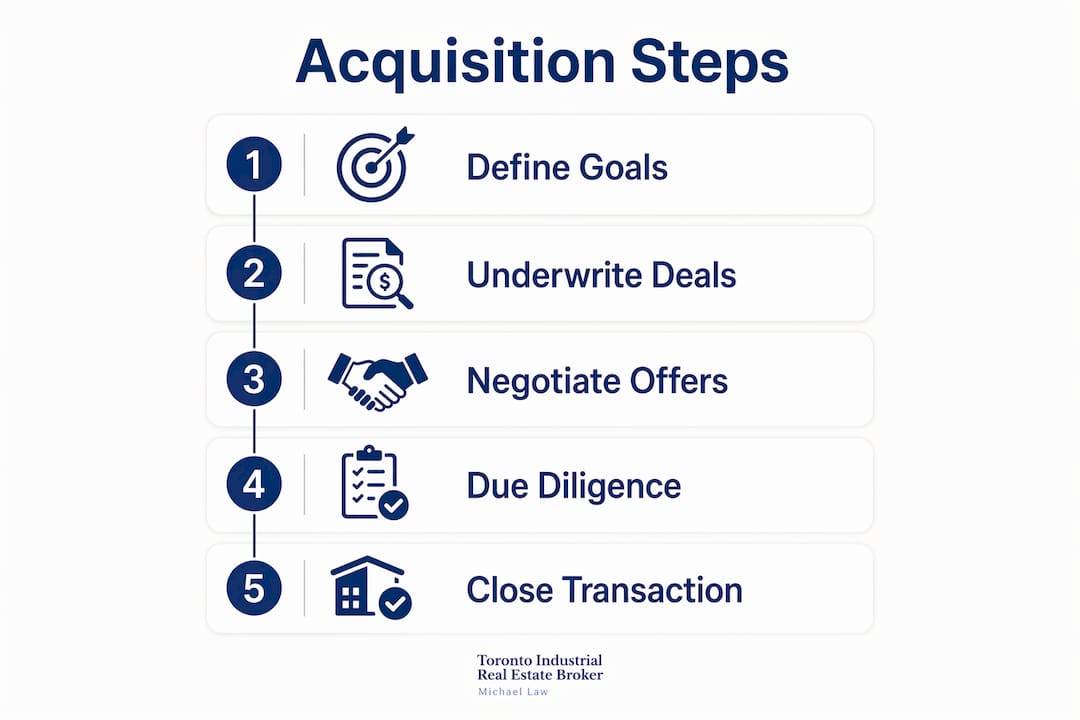
A disciplined multi-step acquisition process is the standard for minimising risk in Denver’s commercial real estate market. Skipping steps does not accelerate the deal. It creates liability.
Step 1: Define your acquisition goals with precision. Specify asset type, submarket, size range, budget, and intended use. An investor acquiring a logistics facility for a long-term hold has different criteria than a business owner buying an owner-user building. Conflating the two leads to misaligned underwriting.
Step 2: Underwrite rigorously before making an offer. Analyse cash flow projections, comparable sales, vacancy history, and lease terms. For income-producing properties, model multiple rent scenarios, not just the current in-place rent.
Step 3: Negotiate with full market context. A buyer’s agent with live transaction data negotiates from a position of knowledge. Without that context, you are negotiating blind.
Step 4: Conduct thorough due diligence. This includes physical inspection, environmental assessment, title review, zoning confirmation, and lease audit. Sale-by-owner properties require heightened scrutiny. Sellers without representation have no obligation to disclose risks proactively, and many do not.
Pro Tip: When evaluating any Denver industrial property for sale by owner, commission an independent Phase I Environmental Site Assessment before removing conditions. Industrial sites carry contamination risk that is not visible during a physical walkthrough, and remediation costs can exceed the acquisition price.
The due diligence process for industrial properties is more technical than for office or retail. Structural integrity, loading capacity, utility infrastructure, and environmental history all require specialist review. Budget for it. The cost is negligible relative to the risk it mitigates.
Which denver submarkets offer the strongest investment potential?
Submarket selection is where investment theses are won or lost. Denver’s commercial real estate market is not uniform. Each submarket has distinct demand drivers, risk profiles, and return characteristics.
| Submarket | Primary Asset Type | Key Demand Driver | Investment Profile |
|---|---|---|---|
| Stapleton | Industrial / Logistics | Airport proximity, distribution corridors | Core and core-plus; strong tenant demand |
| East Colfax | Retail / Mixed-Use | BRT infrastructure, high income demographics | Value-add; NNN lease upside |
| RiNo (River North) | Office / Creative / Mixed-Use | Redevelopment momentum, tech and creative tenants | Opportunistic; higher risk, higher upside |
| LoDo (Lower Downtown) | Office / Retail | Urban density, professional services demand | Core; lower yield, stable occupancy |
| I-70 Corridor | Industrial / Distribution | Highway access, regional logistics networks | Core-plus; institutional-grade logistics |
Stapleton is the clearest choice for investors prioritising logistics and distribution. Its proximity to Denver International Airport and access to major distribution corridors makes it the preferred location for tenants like third-party logistics providers and e-commerce fulfilment operators. Prologis has committed significant capital here, which is itself a market signal.
East Colfax is the most interesting value-add play in 2026. The BRT investment is a catalyst that has not yet been fully priced into retail corridor assets. Strong demographics and redevelopment momentum in areas like RiNo and LoDo are creating additional opportunities for investors willing to accept repositioning risk.
The I-70 Corridor deserves attention from investors focused on industrial logistics. Highway access is the primary site selection criterion for distribution tenants, and the I-70 Corridor delivers direct connectivity to regional markets. Industrial logistics trends from comparable markets confirm that highway-adjacent industrial assets are outperforming urban infill locations on a total return basis.
Customised site selection strategies are required for each asset class. A retail investment thesis built on BRT infrastructure requires different underwriting than a logistics acquisition thesis built on distribution access. Treating Denver as a single market rather than a collection of distinct submarkets is the most common mistake investors make here.
For investors building a portfolio, the strongest risk-adjusted allocation in 2026 combines a core Stapleton industrial position with a value-add East Colfax retail position. That pairing captures both stable cash flow and appreciation upside without concentrating risk in a single submarket or asset type. You can review current industrial properties for sale to benchmark what comparable assets look like across active markets.
Key takeaways
Denver’s commercial real estate market rewards investors who combine submarket-specific knowledge with disciplined acquisition processes and broker-sourced deal access.
| Point | Details |
|---|---|
| Industrial specs drive value | Prioritise 30-foot clear heights, ESFR systems, and dock-high doors when evaluating Denver industrial assets. |
| Lease structure matters | NNN leases with 3–5% annual escalations protect against inflation and compound returns over long hold periods. |
| Off-market access is critical | The best Denver commercial properties are sourced through broker networks, not public listing platforms. |
| Submarket selection determines returns | Stapleton suits core logistics investment; East Colfax suits value-add retail plays in 2026. |
| CRE data lags reality | Published market reports reflect conditions from 12–24 months prior; use live broker intelligence for current decisions. |
What i’ve learned about denver’s market that most reports miss
Denver gets written about as a single market. It is not. The industrial corridor around Stapleton and the I-70 interchange operates on entirely different fundamentals than the office market in LoDo or the retail corridor on East Colfax. Investors who treat them as interchangeable end up with misaligned assets and underperforming portfolios.
The shift toward 7–10 year lease commitments is real, and it matters more than most commentary acknowledges. Short-term renewals were a symptom of uncertainty. The move toward longer terms is not just a confidence signal. It is a structural change in how tenants are planning their operations. That changes the underwriting calculus for acquisitions significantly.
The data lag point is one I return to constantly. When a market report tells you vacancy is rising or absorption is slowing, that data reflects decisions made 12–24 months ago. The market you are entering today is not the market those numbers describe. Investors who act on published reports as if they are real-time signals consistently overpay or miss windows.
My practical advice: build a relationship with a broker who is actively transacting in your target submarket. Not a broker who covers the whole metro. One who knows the specific corridors, the specific landlords, and the specific deals that are moving. That relationship is worth more than any market report.
The off-market access point applies equally whether you are in Denver or in the GTA industrial corridors I work in daily. The best assets do not get listed publicly. They move through networks. If you are relying on LoopNet to find your next acquisition, you are seeing what everyone else has already passed on.
At Lennard Commercial Realty, the transaction intelligence we build through active deal flow is what separates our clients’ outcomes from those who rely on published data alone. The same principle applies in any active commercial real estate market.
— Michael
How Mlawrealestate can support your industrial real estate goals
Mlawrealestate specialises in industrial real estate advisory across the GTA, with deep expertise in leasing, investment sales, and acquisition strategy. The same principles that drive strong outcomes in Denver’s industrial market apply directly to GTA corridors in Mississauga, Brampton, Vaughan, and the broader Durham Region.
Whether you are a logistics operator seeking a new facility, a private investor building an industrial portfolio, or a business owner evaluating an owner-user acquisition, Mlawrealestate delivers the broker intelligence and transaction support that public platforms cannot. Explore current commercial property listings and connect with Michael Law directly for a market consultation tailored to your acquisition or leasing objectives.
FAQ
What types of commercial real estate are available in denver?
Denver’s commercial real estate market includes industrial, office, retail, and mixed-use properties. The industrial segment, concentrated in submarkets like Stapleton and the I-70 Corridor, is the most active asset class in 2026.
What are typical lease structures for denver commercial properties?
Triple net (NNN) leases are the standard structure for retail and industrial properties in Denver. These leases typically include 3–5% annual rent escalations and transfer operating costs to the tenant.
How do i find off-market commercial real estate listings in denver?
Off-market Denver commercial properties are accessed through dedicated broker networks. Public platforms like LoopNet and CoStar capture only a fraction of available inventory, and the most competitive assets rarely appear there.
Which denver submarket is best for industrial investment?
Stapleton is the strongest submarket for core industrial investment in 2026, offering 30-foot clear-height buildings, strong logistics demand, and institutional-grade tenant activity from operators like Prologis.
How reliable is denver commercial real estate market data?
Published CRE market data carries a 12–24 month structural lag. Reports reflect decisions made well before publication, so investors should supplement published data with live broker intelligence for accurate current-market assessments.
Recommended

About Michael Law
Managing Partner and Industrial Real Estate Broker at Lennard Commercial Realty. Representing tenants and landlords across Toronto and the GTA for 15+ years. Michael specializes in GTA industrial real estate — connect with Toronto's leading industrial broker at mlawrealestate.com/industrial-broker-toronto.