Commercial real estate Kansas City: 2026 investor guide
By Michael Law · Industrial Real Estate Broker, Lennard Commercial Realty
TL;DR:
- Kansas City industrial real estate is tight, with a vacancy rate of 5.0 percent and high tenant demand.
- Construction is centered on large build-to-suit projects, limiting speculative space for smaller tenants.
- Strong local relationships and careful modeling of tax abatements are key for successful investment in this market.
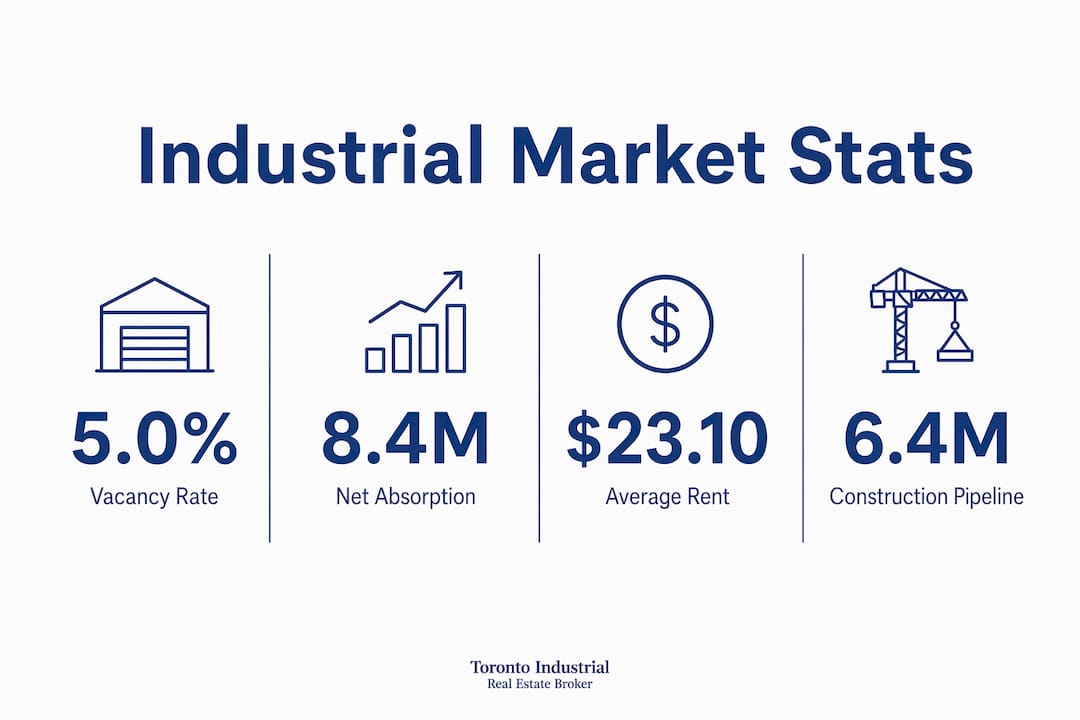
Commercial real estate in Kansas City is defined by a 5.0% industrial vacancy rate and 8.4 million square feet of net absorption in 2025, making it one of the tightest industrial markets in the American Midwest. The market spans warehousing, logistics, manufacturing, and retail assets across a metro that sits at the crossroads of major North American freight corridors. Lending conditions stabilised in early 2026, and the KC Fed Commercial Real Estate Index rose steadily through Q1, giving investors a predictable environment to plan acquisitions. For investors and business owners evaluating Kansas City commercial properties, the data points clearly in one direction: demand is real, supply is constrained, and timing matters.
What are the current industrial real estate market trends in Kansas City?
The Kansas City industrial market tightened considerably through 2025. Vacancy fell 40 basis points to reach 5.0% by the fourth quarter, a level that signals genuine supply pressure rather than a temporary dip. That compression reflects sustained occupier demand from logistics, e-commerce, and manufacturing users who continue to prioritise the city’s central location and intermodal infrastructure.

Net absorption reached 8.4 million square feet across 2025. That figure represents real occupancy growth, not just lease signings, and it confirms that tenants are actively taking possession of space rather than simply renewing in place. Understanding industrial absorption trends is critical for any investor trying to read where rents are heading next.
The construction pipeline adds another layer of complexity. The total pipeline sits at approximately 6.4 million square feet, and the majority of that space is committed to large build-to-suit projects, including a 2.35 million square foot facility for Panasonic and a 630,000 square foot project for Amazon. That concentration of build-to-suit activity means speculative space for smaller occupiers is scarce. Investors cannot assume new supply will relieve pressure on existing assets.
Rental rates dipped slightly in the most recent quarter but the forecast calls for growth of 2.5% to 3.25% by year-end 2026, with current rates sitting at $23.10 per square foot. That trajectory rewards investors who acquire now rather than waiting for rates to peak. The retail sector adds useful context: retail leasing outpaced new deliveries by six to one in 2025, and retail investment volume reached $888 million, a 55.4% year-over-year increase. Broad commercial demand across asset classes reinforces the city’s appeal.
Kansas City industrial market snapshot: 2025 to 2026
| Metric | Figure |
|---|---|
| Industrial vacancy rate (Q4 2025) | 5.0% |
| Net absorption (full year 2025) | 8.4 million sq ft |
| Current average rental rate | $23.10 per sq ft |
| Forecast rental rate growth (2026) | 2.5%–3.25% |
| Total construction pipeline | 6.4 million sq ft |
| Retail investment volume (2025) | $888 million |
Pro Tip: Track build-to-suit completions quarterly. When a major tenant takes possession of a new facility, it removes demand from the existing stock and can temporarily soften rents in that submarket, creating a short acquisition window for value-focused investors.
How do lending conditions and financial factors affect commercial real estate investment in Kansas City?
Financial conditions in Kansas City are as favourable as they have been in several years. The KC Fed CRE Index rose from 0.06 to 0.21 in Q1 2026, a meaningful increase that reflects growing transaction activity and lender confidence across the metro. A rising index does not guarantee returns, but it confirms that capital is moving and that the market is not frozen by credit uncertainty.
Lending standards and loan demand remained largely unchanged through the same period. That stability matters because it gives developers and investors a reliable baseline for underwriting. When lenders shift standards abruptly, deal timelines stretch and pricing dislocates. The current environment avoids both problems.
For investors planning acquisitions or development projects, the practical implications are significant:
- Underwriting confidence. Stable lending standards mean debt service assumptions hold from term sheet to close, reducing the risk of late-stage repricing.
- Longer planning horizons. Predictable credit conditions allow investors to model multi-year hold periods without building in large interest rate shock buffers.
- Competitive but accessible debt. Capital is available for well-located industrial assets, but lenders remain selective on speculative projects, reinforcing the value of existing stabilised properties.
- Equity positioning. Private investors with equity capital can move faster than leveraged buyers when debt markets tighten, giving them a structural advantage in competitive situations.
Pro Tip: Request a lender’s most recent CRE credit standards memo before submitting a term sheet. If standards tightened in the prior quarter, build an extra 30 to 60 days into your closing timeline to account for additional due diligence requirements.
Reading 2026 industrial real estate trends alongside the KC Fed data gives investors a comparative lens. Markets with similar vacancy profiles and stable lending conditions have historically seen rent growth follow absorption with a six to twelve month lag.
What unique challenges and opportunities exist for industrial property investors in Kansas City?
The Kansas City commercial real estate market rewards investors who understand its local character. Several factors distinguish it from larger coastal markets, and each one creates both a risk and an opportunity depending on how well-prepared you are.
-
Off-market access through relationships. Local relationships unlock off-market deals that never appear on commercial listing platforms. Multi-generational family-owned industrial properties in Kansas City frequently trade through trusted broker networks rather than public marketing campaigns. Investors without those connections compete only on listed inventory, which is already priced for the market.
-
Tax abatement expiration risk. Tax abatements expiring in the near term, including key downtown properties with abatements set to lapse around early 2028, can materially increase tax liabilities. That increase flows directly through to net operating income and compresses valuations. Investors who model current tax bills without accounting for abatement expiry will overpay.
-
Limited speculative space for smaller occupiers. Smaller occupiers face constrained speculative inventory, which means businesses needing 20,000 to 80,000 square feet cannot simply wait for a suitable listing to appear. The build-to-suit pipeline serves large users. Everyone else competes for a thin slice of existing stock.
-
Emotional intelligence in deal-making. Commercial real estate decisions in Kansas City carry a personal dimension that pure financial analysis misses. Sellers of long-held family assets weigh legacy, community ties, and trust alongside price. Investors who approach these conversations transactionally often lose to buyers who invest time in the relationship first.
-
Submarket asymmetries. Not all Kansas City industrial submarkets behave identically. The I-70 corridor, the south loop, and the north industrial nodes each carry different vacancy profiles, infrastructure access, and tenant demand characteristics. Treating the metro as a single market leads to mispriced acquisitions.
The investors who perform best in Kansas City combine financial discipline with local market knowledge. That combination is harder to replicate than capital alone.
How to identify and evaluate industrial commercial properties in Kansas City?
Evaluating Kansas City industrial real estate listings requires a structured approach. The market moves quickly enough that underprepared investors lose deals to buyers who already have their analysis frameworks in place.
Key property parameters to assess
Start with the physical and locational fundamentals before touching the financials. Clear height, dock door count, column spacing, power supply, and truck court depth determine which tenants can occupy a building. A property with 24-foot clear height serves a different tenant pool than one with 32-foot clear height, and that difference shows up in lease rates and vacancy risk.
Location within the metro matters as much as the building itself. Proximity to I-70, I-435, and the Kansas City intermodal facilities drives logistics tenant demand. Properties within two miles of major freight infrastructure command a premium and carry lower vacancy risk over a full market cycle.
Using market data as a screening tool
Market reports and absorption data function as the first filter in any property evaluation. If a submarket shows rising vacancy while the broader metro tightens, that divergence signals a structural problem rather than a temporary softness. Screen out submarkets with negative absorption trends before spending time on individual property analysis.
Rental rate benchmarks matter equally. The current market average of $23.10 per square foot gives you a reference point, but submarket rents can vary by $3 to $5 per square foot in either direction. A property leased significantly below market rate represents either a value-add opportunity or a credit risk depending on the tenant’s covenant strength.
Financial analysis framework
Multi-dimensional financial analysis separates disciplined investors from those who rely on gut feel. The core inputs for any Kansas City industrial acquisition include:
- In-place rent versus market rent. Identify the gap and model the lease-up timeline if the property is below market.
- Weighted average lease expiry. Short lease terms create rollover risk. Long terms with below-market rents create mark-to-market upside.
- Tax abatement status. Confirm whether any abatement applies, when it expires, and what the assessed value will be post-expiry.
- Capital expenditure requirements. Older industrial buildings in Kansas City often require roof, dock equipment, or electrical upgrades within a five-year hold period.
The industrial property investment analyser at Mlawrealestate provides a structured framework for running these calculations across multiple scenarios before committing to a letter of intent.
Leveraging brokerage relationships
Experienced local brokers provide market intelligence that no listing platform replicates. They know which properties are quietly available before formal marketing begins, which landlords are motivated, and which submarkets are about to see new supply. Engaging a broker early in your search process, rather than after you identify a target, gives you access to that intelligence at the point when it is most useful.
Top industrial investment strategies consistently show that investors who work with specialised advisors close deals faster and at better terms than those who search independently. The Kansas City market is no exception.
Key takeaways
Kansas City industrial real estate offers a compelling combination of low vacancy, rising rents, and stable lending conditions that rewards investors who act with local knowledge and financial discipline.
| Point | Details |
|---|---|
| Vacancy is tight | The 5.0% industrial vacancy rate signals genuine supply pressure across the Kansas City metro. |
| Absorption confirms demand | 8.4 million sq ft of net absorption in 2025 reflects real occupier growth, not just lease activity. |
| Build-to-suit dominates supply | Large projects for Panasonic and Amazon consume most new pipeline, leaving little speculative space for smaller users. |
| Tax abatements require scrutiny | Abatement expirations can sharply reduce net operating income and compress valuations for unwary investors. |
| Relationships drive off-market access | Local broker networks unlock family-owned and off-market industrial properties that never reach public listings. |
What I have learned about the Kansas City industrial market
The Kansas City market taught me something that no spreadsheet captures: the deal often hinges on the conversation before the offer. I have watched well-capitalised investors lose to buyers who spent three months building a relationship with a family that had owned a warehouse since the 1970s. The family did not want the highest price. They wanted to know the building would be respected and the employees would be treated fairly. That is not a soft consideration. It is the deciding factor.
The tax abatement issue is the one I see investors underestimate most consistently. A property that looks like a 6.5% cap rate at acquisition can look like a 5.2% cap rate two years later once the abatement expires and the tax bill resets. That compression is not a surprise if you model it correctly. It is only a surprise if you do not look for it.
The build-to-suit pipeline concentration also creates a counterintuitive opportunity. When Panasonic and Amazon absorb millions of square feet in new facilities, they vacate existing space elsewhere in the metro. That secondary vacancy, created by large users upgrading to purpose-built facilities, often presents better value than anything currently listed. The investors who track those moves before the vacated space hits the market are the ones who acquire at the best basis.
My broader view is that Kansas City rewards patience and preparation in equal measure. The market is not as liquid as Chicago or Dallas, which means mispriced assets stay mispriced longer. That is a feature, not a flaw, for investors who do their homework.
— Michael
How Mlawrealestate supports industrial real estate investors
Industrial real estate advisory requires more than access to listings. It requires the analytical depth to evaluate a deal correctly and the market relationships to find it before it is widely known.
Mlawrealestate delivers institutional-grade market intelligence, financial analysis, and transaction support to investors and business owners navigating competitive industrial markets. The team’s industrial real estate expertise spans leasing, investment sales, owner-user acquisitions, and land advisory across some of North America’s most active industrial corridors. Whether you are evaluating your first acquisition or repositioning an existing portfolio, the advisory approach at Mlawrealestate is built around data, relationships, and measurable outcomes. Michael Law is also affiliated with Lennard Commercial Realty, one of Canada’s most respected commercial brokerages, further deepening the market intelligence available to clients.
FAQ
What is the industrial vacancy rate in Kansas City right now?
The Kansas City industrial vacancy rate stood at 5.0% at the end of Q4 2025, down 40 basis points year over year. That level reflects sustained occupier demand and limited new speculative supply.
How much industrial space was absorbed in Kansas City in 2025?
Kansas City recorded 8.4 million square feet of net industrial absorption in 2025. That figure confirms active occupancy growth across logistics, warehousing, and manufacturing users throughout the metro.
What are Kansas City industrial rental rates in 2026?
Current industrial rental rates average $23.10 per square foot, with forecasts projecting growth of 2.5% to 3.25% by year-end 2026. Submarket rates vary, so individual property analysis against local benchmarks is necessary.
Why do tax abatements matter when buying commercial real estate in Kansas City?
Tax abatements can expire and significantly increase a property’s annual tax liability, which directly reduces net operating income and compresses the cap rate. Investors must model post-abatement tax bills before finalising acquisition pricing.
How do I find off-market industrial properties in Kansas City?
Off-market industrial properties in Kansas City are most reliably accessed through established local broker relationships. Family-owned assets in particular rarely reach public listing platforms, making early broker engagement the most effective sourcing strategy.
Recommended

About Michael Law
Managing Partner and Industrial Real Estate Broker at Lennard Commercial Realty. Representing tenants and landlords across Toronto and the GTA for 15+ years. Michael specializes in GTA industrial real estate — connect with Toronto's leading industrial broker at mlawrealestate.com/industrial-broker-toronto.