
Commercial real estate los angeles: 2026 market guide
By Michael Law · Industrial Real Estate Broker, Lennard Commercial Realty
TL;DR:
- Los Angeles commercial real estate includes industrial, office, retail, and multifamily assets utilized for income generation. The market rebounded in 2025 with $37 billion in deals, driven mainly by private investors and owner-users, while institutional activity remains cautious. Success in LA requires local expertise, data-driven decisions, strategic negotiation, and understanding sector and submarket nuances.
Commercial real estate in Los Angeles is defined as income-producing property used for business purposes, spanning industrial, office, retail, and multifamily assets across one of North America’s largest and most complex urban markets. The LA market generated $37 billion in commercial property deals in 2025, signalling a meaningful rebound after years of post-pandemic recalibration. For investors, corporate tenants, and owner-users, understanding how capital flows, which sectors lead, and how local regulations shape outcomes is not optional. It is the difference between a profitable position and a costly mistake.
What types of commercial real estate los angeles offers
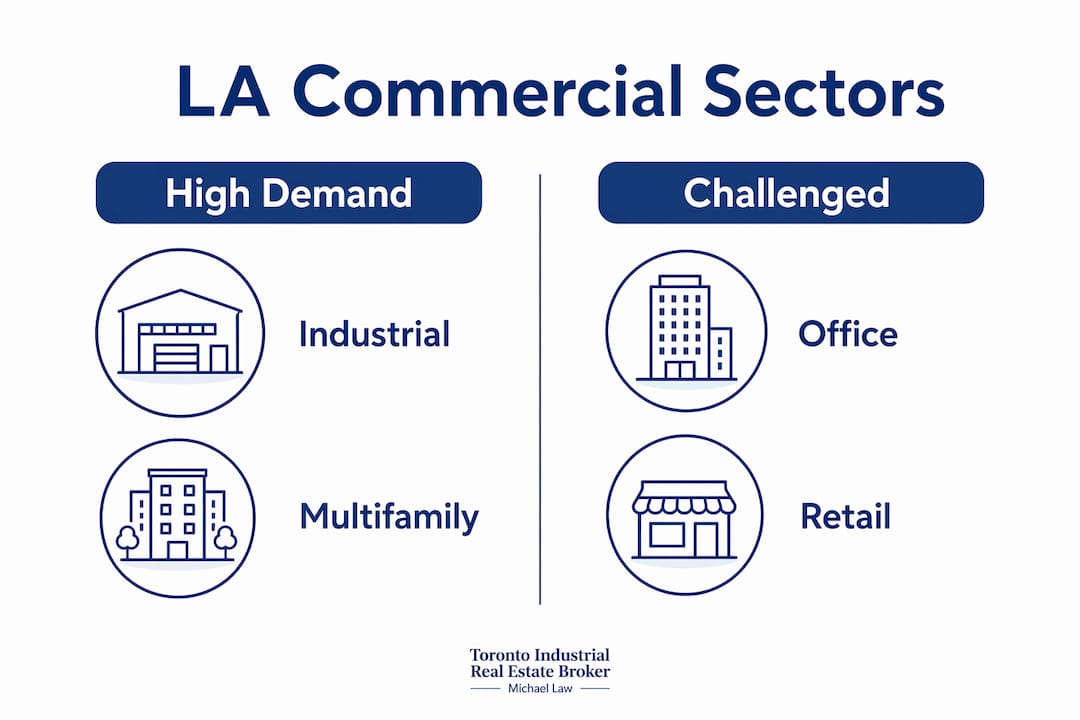
Los Angeles commercial properties fall into four primary sectors: industrial, office, retail, and multifamily. Each sector carries distinct demand drivers, vacancy profiles, and tenant profiles. Knowing the differences before committing capital or signing a lease is non-negotiable.

Industrial is the strongest performing sector in the LA market right now. Industrial leasing activity hit 33.3 million square feet in 2025, driven by e-commerce fulfilment, port-adjacent logistics, and last-mile delivery demand. That volume reflects sustained occupier demand despite rising rents in key submarkets like the Inland Empire, Commerce, and Vernon.
Office is the most challenged sector. Office vacancy in LA sat at approximately 15.9% in late 2025, as tenants continued to downsize and consolidate footprints. Submarkets like Century City and Playa Vista hold better than Downtown LA, where vacancy runs higher and concession packages are more generous.
Retail is bifurcated. High-street retail in Beverly Hills, Melrose Avenue, and Abbot Kinney continues to attract premium tenants and commands strong rents. Suburban strip centres and enclosed malls face persistent pressure from e-commerce and shifting consumer behaviour.
Multifamily sits at the intersection of residential and commercial investment. Apartment buildings with five or more units are classified as commercial assets in LA, and they attract significant institutional and private capital due to the city’s chronic housing shortage.
Comparing LA commercial property types
| Property Type | Investment Appeal | Typical Tenant Profile | Current Demand |
|---|---|---|---|
| Industrial | High | Logistics, e-commerce, manufacturing | Strong |
| Office | Moderate to low | Corporate, professional services | Weak to recovering |
| Retail (prime) | Moderate to high | Luxury brands, food and beverage | Stable |
| Retail (suburban) | Low to moderate | Discount, services, grocery | Mixed |
| Multifamily | High | Residential renters | Very strong |
Pro Tip: If you are evaluating Los Angeles retail real estate, prioritise street-level locations in high-foot-traffic corridors over enclosed mall space. The rent premium is real, but so is the occupancy stability.
Who invests in LA commercial properties, and why it matters
The buyer composition in any commercial market tells you more about risk appetite and pricing direction than any headline number. In Los Angeles, private capital investors made up 61.4% of all buyers in 2025, the highest share in a decade. That concentration signals that high-net-worth individuals and private equity groups are driving price discovery, not institutions.
Institutional buyers accounted for approximately 23.8% of buyers in 2025. That figure is low by historical standards. Institutions are watching the market rather than leading it, waiting for clearer signals on interest rates, cap rate stabilisation, and office sector recovery before deploying large allocations.
Owner-users are the third force shaping the market. Owner-users accounted for approximately 23% of all office sales in LA in 2025. Companies are buying their own buildings rather than leasing, locking in occupancy costs and building equity. This trend is most visible in professional services, healthcare, and media production.
Several macro forces are reshaping capital flows in the LA market:
- Migration patterns: Net outmigration from California has moderated, but it has not reversed. Population shifts affect retail demand and multifamily absorption in specific submarkets.
- Employment concentration: Tech, entertainment, healthcare, and logistics remain the dominant employment sectors. Each drives distinct commercial space demand.
- Interest rate sensitivity: Cap rate expansion since 2022 has compressed valuations, creating selective buying opportunities for well-capitalised investors.
- Selective recovery by sector: The 2025 commercial real estate outlook confirms that recovery is uneven across asset classes, with industrial and multifamily outperforming office and suburban retail.
Understanding who is buying and why they are buying tells you where pricing pressure will come from next. When private capital dominates and institutions stay on the sidelines, expect continued price discovery and selective deal flow rather than broad market appreciation.
How does commercial property management work in los angeles?
Commercial property management in Los Angeles is the day-to-day operational oversight of income-producing assets, covering rent collection, maintenance, vendor management, and tenant relations. Asset management, by contrast, is the strategic oversight aimed at maximising long-term value and exit performance across a portfolio. Confusing the two leads to misaligned expectations and underperforming assets.
Fee structures in LA follow industry norms with local adjustments for complexity. Management fees range from 5–6% for single-tenant industrial properties and 7–10% for multi-tenant properties due to the higher operational demands of managing multiple leases, common areas, and tenant relationships simultaneously. Monthly minimums apply on smaller assets, which can make management fees disproportionately high on low-revenue properties.
Los Angeles adds a layer of regulatory complexity that no other major North American market quite matches. Here is what owners must account for:
- Rent Stabilisation Ordinance (RSO): The LA market’s rent stabilisation and tenant protection laws apply to a broad range of residential and mixed-use properties. Violations carry financial penalties and legal exposure.
- Tenant protection laws: Just-cause eviction requirements, relocation assistance obligations, and notice period rules apply across multiple property types. These are not optional and are actively enforced.
- Zoning complexity: LA’s zoning code is layered with overlays, specific plans, and coastal zone restrictions. A property’s permitted use is not always obvious from its address or current occupancy.
- Environmental compliance: Industrial properties in particular face scrutiny under California Environmental Quality Act (CEQA) and local air quality regulations, especially near ports and freight corridors.
- Seismic retrofit requirements: Older concrete and soft-storey buildings face mandatory retrofit timelines under city ordinances, creating capital expenditure obligations for owners.
Local expertise in complex regulations is not a luxury in LA. It is the primary risk mitigation tool available to property owners. A manager unfamiliar with RSO provisions or CEQA triggers can expose an owner to six-figure liabilities on a single transaction.
Pro Tip: When evaluating commercial property management firms in Los Angeles, ask specifically about their experience with your asset class and submarket. A firm that manages Beverly Hills retail and a firm that manages Vernon industrial are not interchangeable, regardless of their fee structure.
What are the best strategies for investing in LA real estate?
Investing in LA real estate successfully requires combining data-driven site analysis with disciplined negotiation and submarket-level timing. Generic market views do not generate returns. Submarket-specific intelligence does.
Data-driven site selection is a strategic imperative for corporate tenants and investors alike. Before committing to a lease or purchase, analyse vacancy trends, absorption rates, comparable rents, and tenant movement patterns at the submarket level. Tools like CoStar, CBRE’s market reports, and JLL’s research platform provide the data layer. The interpretation of that data is where advisors add value.
Lease negotiation is more flexible than most tenants realise. Free rent and other concessions are negotiable for credit-worthy tenants, particularly on agreements longer than three years. In a market where office vacancy sits near 16%, landlords in weaker submarkets are willing to offer significant tenant improvement allowances, free rent periods, and flexible termination options to secure quality tenants. Tenants who negotiate without professional representation consistently leave value on the table.
For investors evaluating commercial space for lease in LA, the following strategic principles apply:
- Buy the submarket, not just the building. A well-located asset in a recovering submarket outperforms a premium building in a declining one over a five-year hold.
- Understand your exit before you enter. Cap rate assumptions at acquisition must account for the possibility that institutional buyers remain cautious at exit, limiting your buyer pool.
- Industrial assets carry the strongest fundamentals. Port-adjacent logistics, cold storage, and last-mile facilities in Los Angeles and the Inland Empire have the tightest vacancy and strongest rent growth of any commercial sector.
- Office acquisitions require a thesis. Buying distressed office buildings in LA can generate strong returns, but only with a clear repositioning plan, a realistic renovation budget, and a tenant pipeline.
Viewing commercial space as an extension of corporate branding elevates site selection from a cost exercise to a strategic business decision. The address, building quality, and submarket signal something to clients, employees, and competitors. Companies that treat their office or industrial location as a brand asset make better long-term decisions than those that treat it purely as a cost line.
“Lease negotiation flexibility exists even in tight markets, especially for tenants with strong financial standing willing to sign multi-year agreements.” — Commercial Lease Negotiation Insights
For investors who want a comparative lens, industrial real estate trends in 2026 in the GTA offer useful parallels. Both markets are navigating a post-correction reset, with industrial assets leading recovery and office lagging. The dynamics of capital allocation, submarket divergence, and tenant demand are strikingly similar across both geographies.
Understanding how market analysis shapes investment success is the foundation of every sound acquisition or leasing decision in a complex market like Los Angeles.
Key takeaways
Los Angeles commercial real estate rewards investors and tenants who combine submarket-level data with disciplined negotiation and local regulatory expertise.
| Point | Details |
|---|---|
| Industrial leads all sectors | Industrial leasing hit 33.3 million square feet in 2025, making it the strongest asset class in LA. |
| Private capital dominates buying | Private investors made up 61.4% of buyers in 2025, signalling price discovery over broad appreciation. |
| Management fees vary by complexity | Single-tenant industrial fees run 5–6%; multi-tenant properties cost 7–10% due to operational demands. |
| Regulation is a primary risk | Rent stabilisation, tenant protection laws, and CEQA compliance require local expert management. |
| Negotiation leverage exists | Credit-worthy tenants on multi-year leases can secure free rent and tenant improvement allowances. |
What the LA market reset actually means for investors
The phrase “market reset” gets used loosely. In Los Angeles, it means something specific. Asset values have repriced. Cap rates have expanded. And the buyers who dominated the 2019 to 2022 cycle, largely institutional capital chasing compressed yields, have stepped back. What remains is a market driven by private capital and owner-users, both of whom are making decisions based on operational need and long-term conviction rather than short-term yield compression.
I have watched similar dynamics play out in the GTA industrial market. When institutional buyers pause, it creates a window for well-capitalised private investors to acquire assets at prices that reflect current fundamentals rather than peak-cycle optimism. That window does not stay open indefinitely. When institutions return, and they will, pricing adjusts quickly.
The most common mistake I see investors make in complex markets like LA is conflating sector-level data with submarket reality. The office sector in LA has a 15.9% vacancy rate on average. But Century City and Playa Vista are performing at a fraction of that vacancy. Downtown LA is performing far worse. Buying “office in LA” is not a strategy. Buying a specific building in a specific submarket with a specific tenant profile is a strategy.
The same principle applies to industrial. The Inland Empire and South Bay submarkets have different rent trajectories, different tenant profiles, and different infrastructure constraints. Treating them as interchangeable because they both fall under “LA industrial” is how investors overpay or miss opportunities.
Local expertise is not a soft advantage. It is the primary source of alpha in a market this complex. Whether you are managing a property, negotiating a lease, or acquiring an asset, the quality of your local knowledge determines your outcome more than any macro trend.
— Michael
Work with an expert on your next commercial property decision
Whether you are evaluating Los Angeles commercial properties, negotiating a lease in a competitive submarket, or building an industrial portfolio, the quality of your advisory team determines your outcome.

Mlawrealestate delivers institutional-grade market intelligence and transaction expertise across commercial and industrial real estate. From strategic site selection to lease negotiation and investment acquisitions, the team brings the data and the local knowledge to move with confidence. Explore current commercial property listings and services to see active opportunities and advisory offerings. For industrial-specific mandates in the GTA and beyond, connect directly through Michael Law at Lennard Commercial Realty for transaction support backed by a proven track record.
FAQ
What is commercial real estate in los angeles?
Commercial real estate in Los Angeles refers to income-producing properties used for business purposes, including industrial, office, retail, and multifamily assets. The market generated $37 billion in transactions in 2025, making it one of the most active commercial markets in North America.
What are the best neighbourhoods for commercial real estate in LA?
Century City and Playa Vista lead for office assets, while the Inland Empire, South Bay, and Vernon dominate for industrial. Beverly Hills and Abbot Kinney remain the strongest corridors for prime retail real estate in Los Angeles.
How much does commercial property management cost in los angeles?
Management fees in LA range from 5–6% of collected rents for single-tenant industrial properties to 7–10% for multi-tenant assets. Monthly minimums apply on smaller properties, and fees increase with regulatory complexity.
Who are the main buyers of LA commercial properties?
Private capital investors made up 61.4% of buyers in 2025, followed by institutional buyers at 23.8%. Owner-users accounted for approximately 23% of office sales, reflecting a shift toward company-owned spaces.
Can tenants negotiate better terms on commercial leases in LA?
Yes. Credit-worthy tenants signing agreements longer than three years can negotiate free rent periods, tenant improvement allowances, and flexible termination clauses. Professional representation materially increases negotiation leverage, particularly in submarkets with elevated vacancy.
Recommended

About Michael Law
Managing Partner and Industrial Real Estate Broker at Lennard Commercial Realty. Representing tenants and landlords across Toronto and the GTA for 15+ years. Michael specializes in GTA industrial real estate — connect with Toronto's leading industrial broker at mlawrealestate.com/industrial-broker-toronto.