Commercial real estate Pittsburgh: 2026 investor guide
By Michael Law · Industrial Real Estate Broker, Lennard Commercial Realty
TL;DR:
- Pittsburgh commercial real estate in 2026 focuses on stability and careful, data-driven investments. Investors should consider property taxes, neighborhood tiers, and operational complexity to succeed. The office-to-residential shift offers opportunities but relies on public funding and local expertise.
Pittsburgh commercial real estate is defined as income-producing property in Allegheny County used for business, industrial, retail, or multi-family purposes. The market in 2026 is characterised by stabilisation and selective momentum, shifting focus from speculative growth toward long-term tenant decisions and data-driven acquisitions. Major institutional anchors including UPMC, Carnegie Mellon University, and the University of Pittsburgh underpin demand across office, medical, and mixed-use sectors. For business owners and investors entering this market, understanding the interplay between property type, neighbourhood tier, and Allegheny County’s tax structure is the difference between a well-underwritten deal and a costly surprise.
What types of commercial real estate are available in Pittsburgh?
Pittsburgh commercial properties span five primary categories: office, industrial, retail, multi-family, and mixed-use. Each category performs differently depending on location, asset quality, and current demand drivers. Knowing which type fits your investment goal or occupancy need is the first decision you make.

Office
Office vacancy remains elevated across Pittsburgh, and new office construction is paused, allowing existing inventory to absorb gradually. That pause is actually good news for tenants. It means landlords are competing for occupiers, and lease incentives including free rent periods and tenant improvement allowances are more available than they were three years ago. The flight-to-quality trend is real: companies expanding in-person work are choosing modern, amenity-rich buildings over older Class B and C stock. Older properties face genuine occupancy pressure and will continue to do so.
Industrial
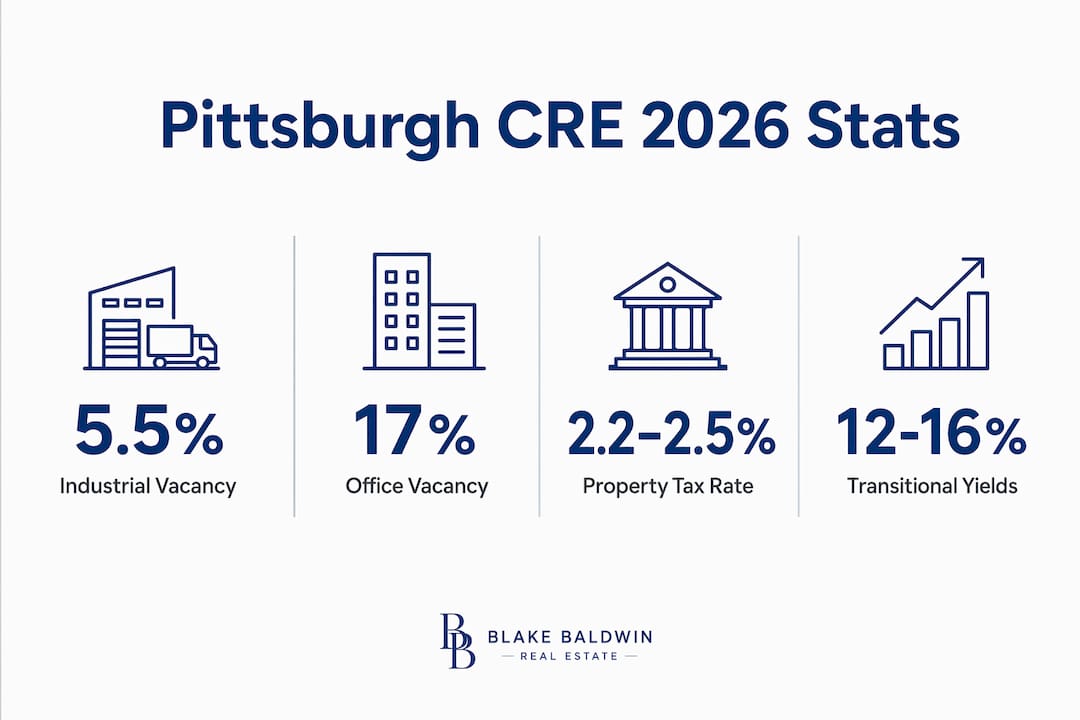
Pittsburgh’s industrial sector is one of the more resilient asset classes in the region. Industrial vacancy has stabilised at approximately 5.5%, following the correction period known as the Great Freight Recession. That figure reflects a market where well-located logistics and distribution assets still attract strong demand. Limited speculative construction and a diverse industrial base support this resilience. Investors tracking industrial leasing trends will recognise this pattern from other mid-sized North American markets recovering from freight-cycle corrections.
Retail and multi-family
Retail performance varies sharply by neighbourhood. Strip District and Lawrenceville retail corridors outperform suburban power centres, driven by foot traffic from residential density and hospitality. Multi-family assets, particularly in transitional neighbourhoods, carry the highest nominal gross yields but also the highest management complexity. Mixed-use projects combining ground-floor retail with upper-floor residential are gaining traction in revitalising districts.
Pro Tip: Match your property type to your operational capacity. Industrial and well-located retail require less active management than transitional multi-family. If you are a first-time Pittsburgh investor, start with stabilised industrial or B+ retail before moving into higher-yield, higher-complexity assets.
| Property type | Typical vacancy | Gross yield range | Management complexity |
|---|---|---|---|
| Office (Class A) | Elevated, stabilising | Moderate | Low to medium |
| Industrial | ~5.5% | Moderate to strong | Low |
| Retail (prime corridors) | Low | Moderate | Medium |
| Multi-family (B+ areas) | Low | 6–7% | Medium |
| Multi-family (transitional) | Variable | 12–16% | High |
Which Pittsburgh neighbourhoods offer the best commercial opportunities?
Pittsburgh’s commercial property market divides into four micro-market tiers: premium, B+, B, and transitional. Each tier carries different risk profiles, yield expectations, and operational demands.
Premium and B+ submarkets
Lawrenceville, East Liberty, Bloomfield, and Regent Square represent the B+ tier. Property values in these submarkets range from $280,000 to $385,000 as of Q2 2026, with gross yields of 6–7%. These neighbourhoods attract stable tenants, benefit from walkability and transit access, and carry lower vacancy risk than transitional areas. East Liberty in particular has seen significant institutional investment, with mixed-use projects anchored by national retailers and medical tenants. Squirrel Hill functions as a premium residential and retail corridor with very low vacancy and strong rent growth.
Transitional neighbourhoods
Homewood and Larimer sit in the transitional tier. Nominal gross yields of 12–16% are available here, but these figures require careful interpretation. Higher yields reflect higher risk: tenant turnover, deferred maintenance, and more intensive property management. Investors who underestimate operational complexity in these areas often find their net returns far below the headline number. That said, for experienced operators with local management capacity, these neighbourhoods offer genuine value-add potential as public investment continues to move eastward from Downtown.
Downtown and the Strip District
Downtown Pittsburgh is undergoing a publicly funded transformation from traditional office to residential and mixed-use. The Strip District, immediately east of Downtown, has become one of the city’s most active commercial corridors, driven by food, hospitality, and creative office tenants. Public policy through the Urban Redevelopment Authority (URA) and the Housing Authority of the City of Pittsburgh (HACP) is actively reshaping the Downtown office cluster. Investors considering Downtown assets need to understand that the value proposition has shifted from pure office occupancy to adaptive reuse potential.
| Neighbourhood | Tier | Typical value range | Gross yield | Key driver |
|---|---|---|---|---|
| Squirrel Hill | Premium | High | Low to moderate | Retail, residential density |
| Lawrenceville | B+ | $280K–$385K | 6–7% | Mixed-use, hospitality |
| East Liberty | B+ | $280K–$385K | 6–7% | Medical, retail anchors |
| Bloomfield | B+ | $280K–$385K | 6–7% | Residential, local retail |
| Homewood | Transitional | Below market | 12–16% | Value-add, public investment |
| Larimer | Transitional | Below market | 12–16% | Redevelopment pipeline |
| Strip District | B+ to premium | Moderate to high | Moderate | Hospitality, creative office |
What should investors and tenants know about leasing and acquisition strategy?
The Pittsburgh CRE market in 2026 rewards patience and preparation. Stabilisation and selective momentum define the current environment. That means good deals still exist, but they move quickly. Speed and accuracy in underwriting are not optional.
The property tax problem most investors miss
Allegheny County’s effective property tax rate runs between 2.2% and 2.5%, which is materially higher than comparable Pennsylvania metros. That gap compresses debt service coverage ratios (DSCR) on deals that look attractive on a rent-to-price basis. An investor who underwrites a Pittsburgh acquisition using Philadelphia or Pittsburgh suburban tax assumptions will overestimate cash flow. Build the Allegheny County tax burden into your model before you run any other numbers.
Due diligence priorities
A data-driven investment approach is the standard for successful Pittsburgh acquisitions in 2026. Rigorous rent validation, multi-scenario ROI analysis, and neighbourhood-level operational assessment are the three pillars of sound due diligence. Verify actual collected rents, not asking rents. Model at least three scenarios: base case, downside (10% vacancy increase), and stress (20% vacancy increase plus tax reassessment). The market intelligence frameworks used in other stabilising North American markets apply directly here.
Leasing strategy for tenants
Tenants in Pittsburgh office space leasing negotiations hold more leverage than they did in 2022 or 2023. Elevated vacancy gives occupiers room to negotiate on rent, lease term, and tenant improvement allowances. The flight-to-quality trend means landlords of Class A buildings are competing hard for creditworthy tenants. Use that competition. Request multiple proposals from comparable buildings before committing. Understand the difference between gross leases and net leases, and model the full occupancy cost including operating expenses and property tax pass-throughs.
Key due diligence steps for buyers and tenants:
- Verify collected rents against lease abstracts, not just rent rolls
- Model Allegheny County property tax at 2.2–2.5% effective rate from day one
- Assess neighbourhood operational complexity before committing to transitional assets
- Request tenant improvement allowances and free rent periods in all Class A office negotiations
- Confirm zoning and permitted use for any mixed-use or conversion play
- Engage a local commercial real estate agent in Pittsburgh with submarket-specific transaction history
Pro Tip: In a stabilising market, the best deals are absorbed quickly. Have your financing pre-arranged and your underwriting model ready before you identify a target property. Investors who move from identification to offer in under two weeks consistently outperform those who take a month to decide.
How is the office-to-residential shift reshaping Pittsburgh’s CRE outlook?
Pittsburgh’s Downtown office market is not recovering in the traditional sense. Office construction has paused and vacancy sits at approximately 17%, a figure that reflects structural change rather than a temporary cycle. The city’s response is a publicly funded pivot toward residential conversion and mixed-use redevelopment.
The conversion economics
Converting a vacant Downtown skyscraper into residential units is expensive. The structural modifications, mechanical upgrades, and floor-plate reconfiguration required for residential use typically cost far more than new suburban construction. Public-private partnerships via the URA and HACP are designed to bridge that financial gap, using state and city funds to make conversions viable where private capital alone cannot justify the cost. These subsidies are not guaranteed and require navigating a competitive application process.
What this means for investors and occupiers
The shift creates both risk and opportunity. For office tenants, it means the Downtown supply of Class A space will tighten over the next five to seven years as older buildings exit the office inventory. Locking in a long-term lease in a quality Downtown building now may prove advantageous. For investors, conversion plays require deep local knowledge, access to public funding programmes, and patience. The Strip District illustrates the upside: former industrial and office buildings converted to mixed-use have generated strong returns for early movers.
Challenges and opportunities in the office-to-residential shift:
- Challenge: Conversion costs are high and often require public subsidy to pencil out
- Challenge: Zoning approvals and heritage designations can delay timelines significantly
- Challenge: Office tenants displaced by conversion face a tightening Class A supply
- Opportunity: Mixed-use assets in revitalising corridors attract premium residential and retail rents
- Opportunity: Public-private incentives from URA and HACP reduce capital requirements for qualifying projects
- Opportunity: Early movers in transitional-to-B+ neighbourhoods benefit from public investment spillover
Key takeaways
Pittsburgh’s commercial real estate market in 2026 rewards investors and tenants who combine local market intelligence with disciplined, data-driven underwriting.
| Point | Details |
|---|---|
| Industrial sector resilience | Vacancy at ~5.5% and limited new supply make well-located industrial assets the most stable Pittsburgh CRE bet. |
| Property tax is a deal variable | Allegheny County’s 2.2–2.5% effective tax rate must be modelled from day one to protect DSCR. |
| Neighbourhood tier drives yield and risk | B+ areas like Lawrenceville yield 6–7%; transitional areas like Homewood yield 12–16% with significantly higher complexity. |
| Office tenants hold leverage now | Elevated vacancy and paused construction give tenants room to negotiate rent, free periods, and improvement allowances. |
| Conversion plays require public funding | Office-to-residential conversions in Downtown Pittsburgh depend on URA and HACP subsidies to close the cost gap. |
My read on Pittsburgh CRE in 2026
I spend most of my time in Ontario’s industrial market, where vacancy is tight and tenants have very little negotiating room. Pittsburgh is a different environment, and that difference is instructive.
What strikes me about the Pittsburgh market is how clearly the data separates the informed investor from the speculative one. The property tax issue is a perfect example. Allegheny County’s effective rate of 2.2–2.5% looks like a footnote until you run the numbers. Then it becomes the single biggest variable in your underwriting. Investors who skip that step do not just underperform. They lose money on deals that looked fine on paper.
The neighbourhood tier framework matters just as much. The 12–16% gross yields in Homewood and Larimer are real, but they are not passive income. They are compensation for active management, higher tenant turnover, and operational risk. If you are not set up to manage that complexity locally, those yields will not materialise.
The office-to-residential conversion trend is the most interesting structural shift in the market. Pittsburgh is not unique in facing elevated office vacancy, but the city’s willingness to use public capital to accelerate conversion is notable. The investors who will benefit most are those who understand the URA and HACP funding process well enough to access it. That requires local relationships, not just capital.
The stabilising market is a genuine window. Data-driven execution and local intelligence are the two inputs that separate good outcomes from average ones in this environment.
— Michael Law
Working with Michael Law | Lennard Commercial
Michael Law | Lennard Commercial advises business owners, investors, and corporate occupiers on commercial real estate transactions across North American markets. Whether you are evaluating a Pittsburgh industrial acquisition, assessing a mixed-use conversion opportunity, or negotiating a long-term office lease, the process starts with accurate market data and disciplined underwriting.
Michael Law’s advisory work covers property location strategy, lease negotiation, investment analysis, and site selection for occupiers and investors who need more than a listing search. If you are weighing a Pittsburgh commercial property decision and want a structured, data-backed framework to guide it, connect with Michael Law | Lennard Commercial directly through mlawrealestate.com.
FAQ
What is the current office vacancy rate in Pittsburgh?
Pittsburgh’s office vacancy sits at approximately 17% in 2026, with new construction paused and the market gradually absorbing existing inventory through conversions and flight-to-quality demand.
How does Allegheny County property tax affect commercial real estate returns?
Allegheny County’s effective property tax rate of 2.2–2.5% is higher than most comparable Pennsylvania metros, compressing debt service coverage ratios and reducing net cash flow on deals underwritten without accounting for it.
Which Pittsburgh neighbourhoods offer the best commercial real estate yields?
B+ neighbourhoods like Lawrenceville, East Liberty, and Bloomfield offer gross yields of 6–7% at property values between $280,000 and $385,000. Transitional areas like Homewood and Larimer offer 12–16% gross yields with significantly higher management complexity.
Is Pittsburgh a good market for industrial real estate investment?
Yes. Industrial vacancy in Pittsburgh has stabilised at approximately 5.5%, with limited speculative construction and steady demand from logistics and supply chain operators supporting asset values.
What incentives exist for office-to-residential conversions in Pittsburgh?
The Urban Redevelopment Authority (URA) and the Housing Authority of the City of Pittsburgh (HACP) provide public funding to bridge the cost gap in Downtown office-to-residential conversions, making projects viable that private capital alone cannot support.
Recommended

About Michael Law
Managing Partner and Industrial Real Estate Broker at Lennard Commercial Realty. Representing tenants and landlords across Toronto and the GTA for 15+ years. Michael specializes in GTA industrial real estate — connect with Toronto's leading industrial broker at mlawrealestate.com/industrial-broker-toronto.