Commercial warehouse lease in the GTA: 2026 guide
By Michael Law · Industrial Real Estate Broker, Lennard Commercial Realty
TL;DR:
- A commercial warehouse lease is a legal contract where tenants pay rent and additional costs for industrial space. Market data shows that tenants can negotiate better terms by understanding TMI components, lease clauses, and physical building factors. Engaging experienced professionals ensures tenants mitigate risks and secure favorable lease conditions.
A commercial warehouse lease is a legally binding contract that grants a business the right to occupy industrial storage or distribution space in exchange for rent, under defined terms and conditions. In the Greater Toronto Area, these agreements almost always follow a triple-net (NNN) structure, meaning the tenant pays base rent plus a share of property taxes, building insurance, and maintenance costs. Understanding every component of your warehouse rental agreement before signing is the difference between a lease that supports your operations and one that quietly erodes your margins.
What are the key costs in a commercial warehouse lease?

The true cost of an industrial space lease has two parts: net rent and additional rent, commonly called TMI (taxes, maintenance, and insurance). Most tenants focus on the headline net rent figure and underestimate what TMI adds to their monthly bill. Total occupancy cost equals net rent plus TMI, and tenants who compare only base rent make poor budgeting decisions.
Net rent and TMI in 2026
For Class A warehouse space in the GTA, base rent currently ranges from $17.50 to $22.00 per square foot annually. TMI adds a further $4.50 to $6.50 per square foot each year. On a 20,000-square-foot facility, that TMI range alone adds $90,000 to $130,000 annually on top of your net rent.
TMI components typically include property taxes, building insurance, common area maintenance, snow removal, landscaping, and building management fees. Only controllable costs, such as maintenance and management fees, are eligible for annual caps. Property taxes and insurance are non-controllable and pass through at actual cost.
Annual escalations and lease length
Annual rent escalations in GTA industrial leases currently run at 3–5%. Tenants who negotiate fixed increases of 2.5–3% per year gain predictability and protect their operating budgets over a long-term warehouse lease. CPI-linked escalations sound fair in principle but can spike unexpectedly during inflationary periods.
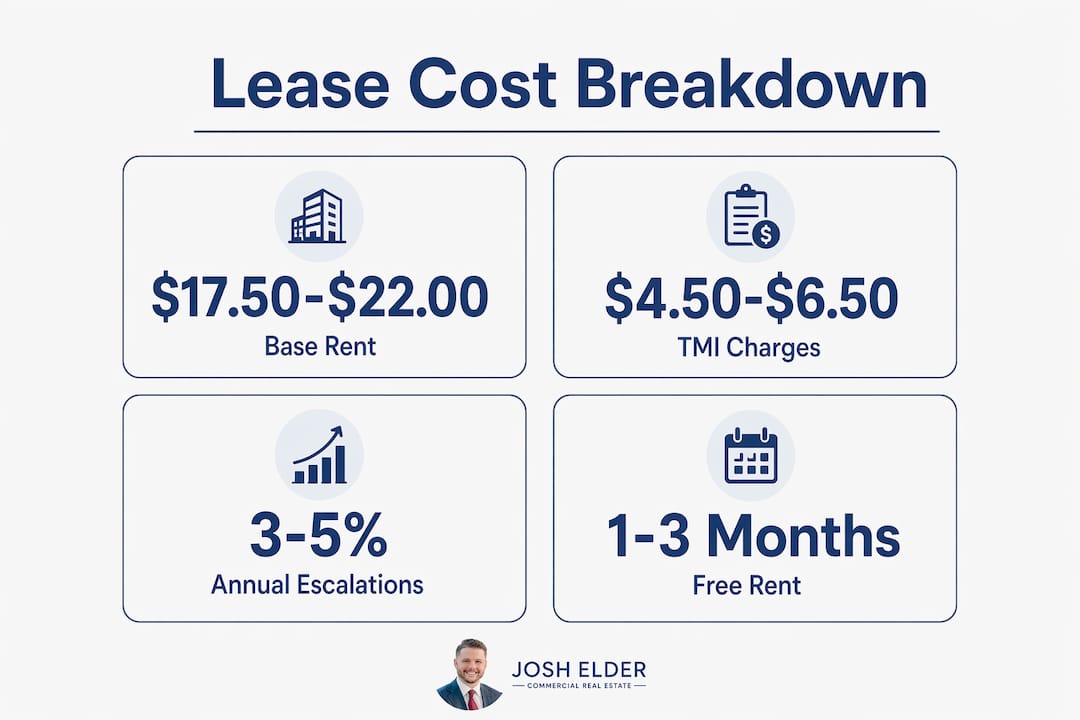
Lease length directly affects the size of tenant improvement allowances (TIAs). Longer commitments, typically 5 to 10 years, unlock TIAs of $10–$25 per square foot. Shorter terms may offer flexibility but come with little to no landlord contribution toward fit-out costs.
Typical lease inducements in 2026
| Inducement | Typical Range | Notes |
|---|---|---|
| Free rent period | 1–3 months | More common on longer lease terms |
| Tenant improvement allowance | $10–$25/sq ft | Tied to 5- to 10-year commitments |
| Fixed rent escalation | 2.5–3% annually | Negotiated alternative to CPI-linked increases |
| TMI cost cap | 4–5% annually | Applies to controllable costs only |
Pro Tip: Ask for free rent at the start of the lease, not the end. Front-loaded free rent reduces your cash outlay during the fit-out period when your space is not yet generating revenue.
Which lease clauses carry the most risk for tenants?
Industrial lease language is complex, and it frequently shifts unforeseen costs onto the tenant. Professional lease review by a commercial real estate expert is not optional. It is the most cost-effective step you can take before committing to a warehouse rental agreement.
Repair and maintenance obligations
The repair clause defines who pays for what when something breaks. In many GTA warehouse leases, tenants are responsible for HVAC maintenance and repair, even when the equipment is aging or undersized. HVAC, roof, and environmental clauses are the three areas most likely to generate unexpected tenant costs. Push for a clause that limits your HVAC obligation to maintenance and minor repairs, with major capital replacements remaining the landlord’s responsibility.
Roof and structural repairs should always sit with the landlord. If a lease assigns structural obligations to the tenant, that is a red flag worth negotiating hard on before signing.
Permitted use clauses
The permitted use clause defines what activities you can legally conduct in the space. A clause written too narrowly can prevent you from adding a secondary operation, such as light assembly or cross-docking, without landlord consent. Write the permitted use broadly enough to cover your current operations and any foreseeable expansion of activity.
Distribution, warehousing, and related logistics operations should all be named explicitly. Vague language like “general commercial use” creates ambiguity that landlords can exploit if your operations evolve.
Subletting, assignment, and termination rights
Your right to sublet or assign the lease matters most when your business changes. A merger, acquisition, or downsizing can leave you locked into space you no longer need. Negotiate assignment rights that allow transfer to a related corporate entity without landlord consent. For subletting, push for a clause that requires the landlord to respond within a defined timeframe and not unreasonably withhold approval.
Early termination rights are rare in GTA industrial leases but not impossible to negotiate. A termination option at year five of a ten-year term, with a defined penalty, gives you an exit if your space needs change dramatically.
Restoration obligations and personal guarantees
Restoration obligations require tenants to remove improvements and return the space to its original condition at lease end. This can mean removing mezzanines, racking systems, or custom dock equipment at significant cost. Negotiate surrender terms upfront that allow you to leave improvements in place if the landlord agrees.
Personal guarantees expose your personal assets to lease obligations. Where possible, limit the guarantee to 12–24 months of rent rather than the full lease term.
Pro Tip: Request a “landlord’s work” schedule as part of the lease. This documents the condition of the space at possession and protects you from being held responsible for pre-existing deficiencies at lease end.
How can tenants negotiate better warehouse lease terms in the GTA?
Negotiation leverage in the GTA industrial market has shifted meaningfully in 2026. New supply in Milton, Brampton, Ajax, and Pickering has put pressure on landlords of older warehouse buildings, creating real room to negotiate. Tenants who understand current GTA industrial market trends enter negotiations with a significant advantage.
A practical negotiation sequence
- Establish your total occupancy cost target. Calculate the maximum you can pay per square foot all-in, including net rent, TMI, and utilities. This number anchors every negotiation.
- Request competing proposals from multiple landlords. Even if you have a preferred building, competing offers give you documented leverage to push for better terms.
- Negotiate escalations before free rent. Locking in a fixed 2.5–3% annual escalation saves more money over a ten-year term than one extra month of free rent.
- Push for TMI caps on controllable costs. Caps of 4–5% annually on controllable operating costs prevent unexpected spikes in your additional rent. Also negotiate audit rights so you can verify TMI reconciliations each year.
- Size your TIA request to your actual fit-out cost. Get contractor quotes before negotiating the allowance. Landlords respond better to specific, justified numbers than to round-figure requests.
- Negotiate the lease term strategically. A five-year term with two five-year renewal options gives you flexibility without sacrificing the inducements that come with longer commitments.
- Engage a tenant representative broker. A broker specialising in GTA industrial leasing knows current market rates, recent comparable transactions, and which landlords are most motivated to deal.
Pro Tip: Never accept the landlord’s first TMI estimate without requesting a detailed breakdown. Ask for the prior year’s actual TMI reconciliation statement. This tells you exactly what you will pay and whether the estimate is accurate.
What physical factors should you assess before signing a warehouse lease?
The right lease terms mean nothing if the building cannot support your operations. Physical suitability assessment is a separate discipline from lease negotiation, and both require equal attention before you commit.
Critical building specifications
Key warehouse suitability factors include clear height measured under joists, the number and type of loading doors, electrical service specifications, sprinkler system rating, and yard and trailer parking availability. Each of these affects your daily operations and your fit-out cost.
- Clear height: Most modern GTA distribution facilities offer 32–40 feet of clear height. Older buildings may offer only 20–24 feet, which limits racking configurations and throughput.
- Dock doors and drive-in access: Count dock-high doors and drive-in ramps separately. A facility with 10 dock doors but no drive-in access may not suit operations that receive full truckloads and small parcel deliveries simultaneously.
- Electrical service: Confirm the amperage and voltage available at the building. Cold storage, EV charging for fleet vehicles, and automated conveyor systems all require significantly more power than standard warehousing.
- Sprinkler system rating: Your sprinkler system must match your storage configuration. High-piled storage of certain commodities requires ESFR (Early Suppression Fast Response) sprinklers. Confirm the existing system rating before signing.
- Yard and trailer parking: Verify that the site accommodates your trailer count. Zoning for outdoor storage and permitted uses must be confirmed before signing, as not all industrial zones allow trailer parking or outdoor storage.
Expansion potential and permit requirements
| Factor | What to Verify | Why It Matters |
|---|---|---|
| Right of first offer | Adjacent unit availability | Supports future expansion without relocation |
| Zoning classification | Permitted uses and outdoor storage | Prevents operational restrictions post-move |
| Truck court depth | Minimum 130 feet for 53-foot trailers | Affects loading efficiency and safety |
| Build-out feasibility | Structural capacity for mezzanines | Determines fit-out scope and permit requirements |
| Power capacity | Amperage available at the panel | Critical for automated or refrigerated operations |
Confirm permit requirements for any planned improvements with the local municipality before you sign. Build-out timelines in GTA municipalities can run 8–16 weeks for permit approval alone. Factor this into your free rent negotiation.
Key takeaways
A commercial warehouse lease in the GTA is defined by its total occupancy cost, not its headline net rent, and tenants who negotiate every component from TMI caps to restoration terms consistently achieve better financial outcomes.
| Point | Details |
|---|---|
| Total cost over base rent | Add TMI of $4.50–$6.50/sq ft annually to net rent for a true occupancy cost comparison. |
| Negotiate fixed escalations | Lock in 2.5–3% annual increases rather than CPI-linked hikes to protect your long-term budget. |
| Review critical clauses | HVAC, restoration, and permitted use clauses carry the highest tenant risk and must be negotiated carefully. |
| Leverage new GTA supply | New deliveries in Milton, Brampton, Ajax, and Pickering give tenants real negotiating power in 2026. |
| Assess physical fit first | Confirm clear height, dock count, electrical capacity, and zoning before committing to any lease. |
What I have learned from a decade of GTA warehouse leasing
The single most common mistake I see tenants make is treating the net rent number as the lease. They negotiate hard on base rent, accept the landlord’s TMI estimate without question, and sign a lease that quietly costs them 20–30% more than they budgeted once TMI reconciliations, HVAC repairs, and restoration obligations land.
The GTA industrial market in 2026 is genuinely more tenant-friendly than it was two years ago. New supply in submarkets like Milton and Pickering has created real competition among landlords. Tenants who understand this and come to the table with market data, competing proposals, and a clear total-cost target are getting deals that would have been impossible in 2022. The leverage is there. Most tenants just do not know how to use it.
My strongest advice is this: do not sign a warehouse lease without a specialized commercial real estate professional reviewing it. Not a general practice lawyer. Not a residential agent. Someone who reads industrial leases every week and knows what “standard” actually looks like in the current GTA market. The cost of that review is trivial compared to the liability you accept when you sign a lease with a poorly worded HVAC clause or an uncapped TMI provision.
Flexibility is worth paying for. A renewal option, a right of first offer on adjacent space, and a clearly defined permitted use clause are not luxuries. They are the provisions that allow your business to grow, pivot, and exit without catastrophic cost. Negotiate them in at the start, because you will not get them later.
— Michael Law
Working with Michael Law | Lennard Commercial on your next lease
Securing the right warehouse space in the GTA requires more than finding an available building. It requires knowing what comparable tenants are paying, which landlords are motivated, and exactly which lease clauses to push back on.
Michael Law | Lennard Commercial specialises in tenant representation across the GTA, including Mississauga, Brampton, Vaughan, Markham, Ajax, Pickering, Milton, and Burlington. Whether you are negotiating your first industrial warehouse lease or restructuring an existing one, Michael Law brings current market data, transaction experience, and direct landlord relationships to every deal. Review recent leasing case studies to see how this expertise translates into better terms for GTA tenants.
FAQ
What is a triple-net lease in a commercial warehouse context?
A triple-net lease requires the tenant to pay base rent plus property taxes, building insurance, and maintenance costs separately. This structure is the standard for GTA industrial and warehouse leases.
What is a fair TMI rate for GTA warehouse space in 2026?
TMI in the GTA currently ranges from $4.50 to $6.50 per square foot annually. Rates vary by building age, location, and the landlord’s operating cost structure.
How long is a typical warehouse lease term in the GTA?
Most GTA industrial leases run 5 to 10 years. Longer terms unlock larger tenant improvement allowances and more free rent, while shorter terms offer flexibility at the cost of fewer inducements.
Can tenants negotiate caps on TMI increases?
Tenants can negotiate annual caps of 4–5% on controllable operating costs such as maintenance and management fees. Property taxes and insurance pass through at actual cost and are not capped.
What questions about warehouse leases should I ask before signing?
Confirm who is responsible for HVAC repairs, what the permitted use clause covers, whether restoration is required at lease end, and what the TMI reconciliation process looks like. These four areas generate the majority of tenant disputes in GTA industrial leases.
Recommended

About Michael Law
Managing Partner and Industrial Real Estate Broker at Lennard Commercial Realty. Representing tenants and landlords across Toronto and the GTA for 15+ years. Michael specializes in GTA industrial real estate — connect with Toronto's leading industrial broker at mlawrealestate.com/industrial-broker-toronto.