How to manage capital expenditures for industrial properties
By Michael Law · Industrial Real Estate Broker, Lennard Commercial Realty
TL;DR:
- Effective CapEx management in GTA industrial properties involves developing a dynamic Capital Improvement Plan based on thorough property assessments. Proper project prioritization, reserve funding, and tax classification are essential to maintaining asset value and financial health. Leveraging technological tools and clear tenant communication supports strategic capital cycles and optimal leasing outcomes.
Capital expenditure management for industrial properties is defined as the systematic process of planning, funding, and executing major physical investments in a building to preserve asset value and sustain financial performance. Property managers, investors, and business owners across the Greater Toronto Area who master this discipline avoid the reactive maintenance cycles that quietly destroy net operating income. The industry term is capital expenditure planning, often abbreviated as CapEx planning, and it sits at the intersection of physical asset management and financial forecasting. Done well, it turns a building’s condition data into a year-by-year investment roadmap. Done poorly, it produces emergency capital calls at the worst possible moment.
How to manage capital expenditures for industrial properties with a strategic capital improvement plan
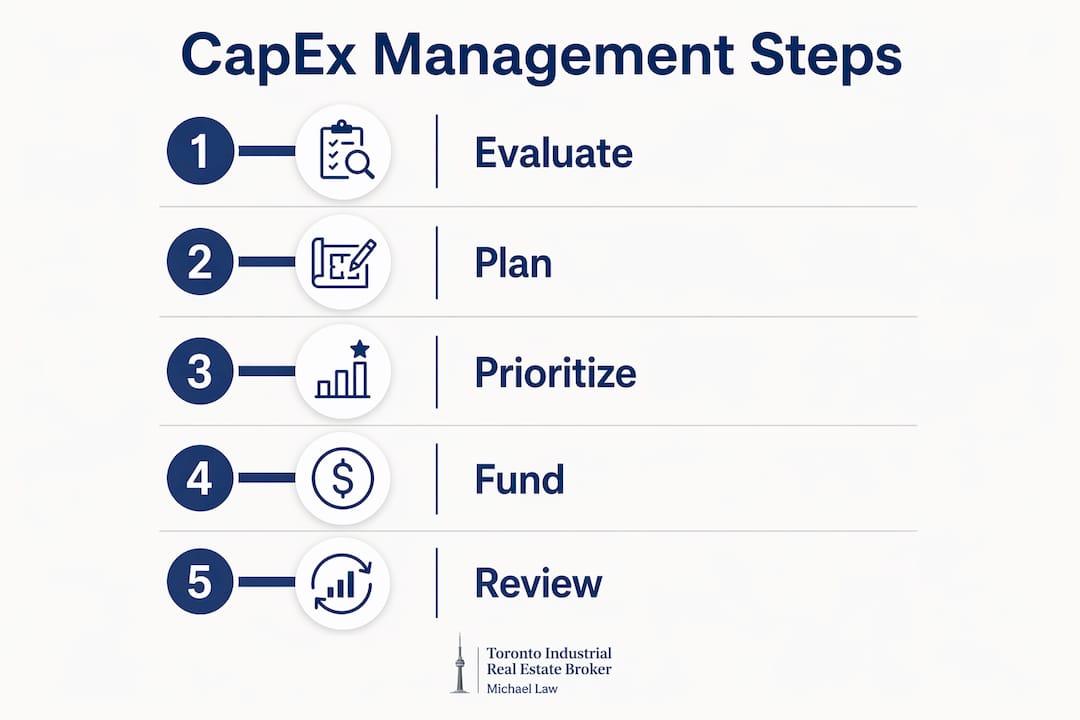
A Capital Improvement Plan, or CIP, is the foundational document for any serious CapEx programme. It is not a spreadsheet updated once a year. Effective CapEx planning is a dynamic process that links asset data with financial reserves and market conditions. Properties without a structured system enter reactive maintenance cycles and risk depleting their reserves entirely. That outcome is avoidable with a disciplined, step-by-step approach.
Step 1: Conduct a thorough building evaluation
A comprehensive building evaluation covering roofing, HVAC, electrical, plumbing, and structural integrity is the mandatory starting point for any CIP. This is not a routine inspection. It is an underwriting exercise that quantifies physical risk and assigns remaining useful life to every major building system. For a 50,000 square foot distribution facility in Brampton or a manufacturing plant in Hamilton, the gap between a surface-level walkthrough and a proper property condition assessment (PCA) can translate to millions of dollars in unplanned spending. Engage a qualified building consultant to produce a PCA that is auditable, not just readable.

Pro Tip: Commission a PCA before acquiring any industrial asset in the GTA. The document becomes the baseline for your entire CapEx schedule and gives you negotiating leverage on purchase price if deferred maintenance is identified.
Step 2: Prioritise projects using a clear ranking framework
Once the building evaluation is complete, sort every identified need into four categories:
- Safety and code compliance: Electrical panel upgrades, fire suppression systems, and structural repairs that carry regulatory or liability risk. These are non-negotiable and must be funded first.
- Tenant impact: Roof leaks, loading dock failures, and HVAC breakdowns that directly affect a tenant’s operations. In the GTA industrial market, where logistics and e-commerce tenants operate on tight schedules, downtime is a lease-renewal risk.
- Efficiency and value-add: LED lighting retrofits, insulation upgrades, and dock leveller replacements that reduce operating costs and support industrial property upgrades that improve asset value.
- Long-term capital replacements: Roof membrane replacement, parking lot resurfacing, and mechanical system overhauls scheduled five to fifteen years out.
Step 3: Build the plan as a living document
A CIP loses its value the moment it becomes static. Schedule quarterly reviews to incorporate new inspection findings, tenant feedback, and updated cost estimates. Building information modelling (BIM) software and property management platforms such as Yardi or MRI Software allow GTA asset managers to attach condition data directly to budget line items, creating a traceable link between physical observations and financial commitments. Stakeholder communication matters here. Owners, lenders, and tenants each have a different stake in the capital plan, and aligning their expectations early prevents disputes when large expenditures are triggered.
What financial tools and metrics assist in CapEx planning and prioritisation
Sound industrial property financial planning requires more than a list of projects. It requires metrics that tell you whether your reserves are adequate and whether your cash flow can absorb planned spending without external financing.
The two ratios every GTA investor should track
The cash-flow-to-CapEx ratio is calculated by dividing operating cash flow by annual capital expenditure. A ratio above 1.0 confirms the property generates enough cash to cover capital needs without additional debt. This ratio is the first number a sophisticated GTA investor should pull when stress-testing an acquisition model. The CapEx reserve ratio, calculated as annual reserve contributions divided by net operating income, measures whether the reserve fund is being replenished at a rate proportional to the asset’s income. A low ratio signals future shortfalls even when current cash flow looks healthy.
The table below summarises how to interpret these two metrics in practice:
| Metric | Formula | Healthy threshold | What a low reading signals |
|---|---|---|---|
| Cash-flow-to-CapEx ratio | Operating cash flow ÷ annual CapEx | Above 1.0 | Reliance on external financing for capital needs |
| CapEx reserve ratio | Annual reserve contributions ÷ NOI | 5% to 10% of NOI | Reserve depletion risk within 3 to 5 years |
Reserve fund sizing and contingency budgeting
Replacement reserves must be kept separate from the operating budget. Reserve governance prevents the common mistake of using capital funds to plug operating shortfalls, a practice that leaves assets underfunded precisely when major components reach end of life. Size your reserve fund by translating the PCA’s remaining useful life data into a time-scaled, inflation-adjusted contribution schedule. A roof with twelve years of remaining life on a 100,000 square foot Mississauga warehouse requires a different annual contribution than one with three years remaining.
Budget industrial renovations with a 15 to 20 percent contingency fund and split costs into hard costs (materials and labour) and soft costs (permits, design fees, and insurance). This distinction matters because soft costs are frequently underestimated, particularly on older industrial buildings in Toronto’s inner suburbs where heritage or environmental constraints add complexity. Structural engineering and MEP assessments completed before budgeting reduce estimation risk significantly.
Pro Tip: Use scenario-based planning with at least three budget cases: base, upside, and stress. The stress case should model a 20 percent cost overrun on your two largest projects simultaneously. If that scenario depletes your reserve below three months of operating expenses, resequence the projects.
Platforms such as OxMaint offer dynamic CapEx modelling that incorporates inflation escalation and remaining useful life projections into a single dashboard. This type of tool moves capital expense management from a spreadsheet exercise to a live financial instrument.
How to classify capital versus operational expenditures under Canadian tax rules
Misclassifying a capital expenditure as an operating expense, or vice versa, creates both cash flow distortions and audit exposure. The Canada Revenue Agency applies principles similar to the U.S. framework when determining whether an expenditure must be capitalised or can be deducted immediately.
The U.S. standard under Treasury Regulation 1.263(a)-3 provides a useful analytical framework even for Canadian properties. It requires capitalising expenditures that meet the Betterment, Restoration, or Adaptation (BAR) test:
- Betterment: The work materially improves the property beyond its prior condition. Replacing a standard loading dock with a high-speed automated dock qualifies. Repairing a damaged dock seal does not.
- Restoration: The work returns a major component to working condition after it has reached the end of its useful life. A full roof membrane replacement is restoration. Patching a section of membrane is a repair.
- Adaptation: The work converts the property to a new or different use. Converting a single-tenant warehouse in Vaughan into a multi-tenant flex facility is adaptation.
Capitalisation versus deduction is determined by the nature of the expenditure outcome, not by the language on an invoice or a contractor’s description. A property manager who labels a full HVAC replacement as “maintenance and repairs” on the general ledger creates an audit risk that far outweighs any short-term tax benefit.
Bonus depreciation provisions and Section 179 expensing (relevant for U.S. holdings) allow immediate deduction of qualifying equipment and improvement costs, improving near-term cash flow. Canadian equivalents include the Capital Cost Allowance (CCA) system, which assigns depreciation rates by asset class. Consulting a tax professional who specialises in commercial real estate is not optional for any GTA investor managing a portfolio above two or three assets. The interaction between CCA classes, lease recoverability clauses, and reserve contributions is complex enough that errors compound across fiscal years.
What are the best practices for funding and financing industrial CapEx projects
Identifying the right projects is only half the problem. Funding them without disrupting cash flow or violating lender covenants is the other half. GTA industrial investors have access to several financing structures that are worth understanding before a major capital cycle begins.
C-PACE financing for energy and resiliency upgrades
C-PACE financing uses a special property tax assessment lien that is senior to mortgages but subordinate to property taxes. It provides long-term fixed-rate financing for energy efficiency, renewable energy, and resiliency improvements, with repayment structured through the property tax bill. For a Burlington or Hamilton industrial owner looking to fund a major HVAC upgrade or rooftop solar installation, C-PACE removes the need to refinance the existing mortgage or draw down a reserve fund. The trade-off is that the senior lien position changes the capital stack, which requires lender consent and careful intercreditor negotiation.
The comparison below illustrates how common CapEx funding options differ:
| Funding option | Best suited for | Key consideration |
|---|---|---|
| Internal reserves | Planned replacements within 1 to 3 years | Requires disciplined ongoing contributions |
| C-PACE financing | Energy and resiliency upgrades | Senior lien requires lender consent |
| Construction loan | Large-scale redevelopment | Short-term, requires permanent takeout |
| Equity injection | Value-add acquisitions | Dilutes ownership; suited to institutional capital |
Reserve governance and lender documentation
Lenders on GTA industrial assets increasingly require auditable documentation linking PCAs to CapEx schedules, including draw packages, lien waivers, and site inspections before releasing reserve funds. This is not bureaucratic friction. It is a discipline that protects both the lender and the owner from misallocating capital. Property managers who maintain invoice-level substantiation and condition-linked reserve schedules find that lender draw processes move faster and with fewer disputes.
Digital procurement tools such as Maden Pay can reduce friction in the project funding cycle by centralising vendor payments, tracking lien waiver status, and providing real-time visibility into project cash flow. For a GTA investor managing multiple industrial assets across Markham, Pickering, and Ajax, this type of platform replaces a fragmented email-and-spreadsheet process with a traceable financial record.
Pro Tip: Sequence your CapEx projects to protect liquidity. Complete the highest-risk, lowest-cost items first. This builds a track record of successful project execution that lenders and co-investors can evaluate before you commit to the larger, more capital-intensive phases.
Aligning your capital investment strategies with the realities of the GTA market, where vacancy rates and rental trends shift by submarket, ensures that capital deployed today supports the asset’s competitive position in three to five years.
Key takeaways
Effective CapEx management for industrial properties requires integrating physical condition data, financial reserves, and project sequencing into a single, continuously updated Capital Improvement Plan.
| Point | Details |
|---|---|
| Start with a PCA | A property condition assessment is the underwriting foundation for every CapEx decision. |
| Track two core ratios | Monitor cash-flow-to-CapEx above 1.0 and CapEx reserve ratio at 5 to 10 percent of NOI. |
| Separate reserves from operations | Reserve funds must never be used to cover operating shortfalls or lender covenants are at risk. |
| Classify expenditures correctly | Apply the BAR test to every project to align tax treatment with the actual nature of the work. |
| Sequence projects for liquidity | Complete high-risk, lower-cost items first to protect cash flow and build lender confidence. |
What I have learned managing CapEx in the GTA industrial market
The most common mistake I see GTA industrial owners make is treating the capital budget as an annual line item rather than a multi-year financial instrument. They approve a number in November, spend it by March, and then face a roof failure in September with nothing left in reserve. The problem is not the amount budgeted. It is the absence of a time-scaled, inflation-adjusted schedule that connects each building system’s remaining useful life to a specific funding year.
Lease language is the other area where I see significant value destroyed. Many landlords assume that capital reserve contributions are recoverable from tenants under the CAM clause, only to discover during a lease renewal negotiation that the language does not support it. Reserve recoverability disputes can turn a planned recoverable expense into a direct NOI hit. Reading the lease before building the CapEx schedule is not optional.
The GTA industrial market in 2026 is competitive enough that asset quality directly affects leasing velocity and renewal probability. A Vaughan logistics facility with a deferred roof replacement and aging dock equipment will lose a renewal to a newer Caledon or Milton asset that a landlord has maintained properly. Capital investment is not a cost centre. It is a retention tool.
I also advocate strongly for transparent communication with tenants when major capital projects are planned. A tenant who receives sixty days’ notice and a clear project timeline is far more cooperative than one who discovers scaffolding on a Monday morning. That cooperation matters when you need access to the building during business hours and when the lease renewal conversation starts six months later.
The technology available today, from OxMaint’s dynamic modelling to BIM-integrated property management platforms, makes data-driven CapEx planning accessible to owners of single assets, not just institutional portfolios. There is no excuse for reactive capital management in 2026.
— Michael
Plan your next industrial CapEx cycle with Mlawrealestate
Managing capital expenditures for industrial properties in the GTA requires both financial discipline and deep local market knowledge. Mlawrealestate provides institutional-grade advisory services to property owners, investors, and occupiers across Burlington, Hamilton, Milton, Caledon, and every major GTA industrial corridor.

Whether you are acquiring an asset and need a CapEx-informed valuation, or you are a landlord planning a capital cycle ahead of a lease renewal, Mlawrealestate brings the transaction experience and market data to support every stage of the decision. Explore current GTA industrial listings or connect directly with Michael through Lennard Commercial Realty to discuss your specific asset and investment objectives.
FAQ
What is a capital expenditure in industrial real estate?
A capital expenditure in industrial real estate is any spending that materially improves, restores, or extends the useful life of a building component, such as a roof replacement, HVAC overhaul, or dock equipment upgrade. It is distinguished from an operating expense by the nature of the outcome, not the size of the invoice.
How much should I budget for CapEx reserves on a GTA industrial property?
Industry practice recommends maintaining a CapEx reserve ratio of 5 to 10 percent of net operating income annually, with the specific amount determined by a property condition assessment that assigns remaining useful life to each major building system.
What is the difference between a capital improvement plan and a maintenance budget?
A Capital Improvement Plan covers major, non-recurring investments in building systems and infrastructure over a multi-year horizon, while a maintenance budget covers routine, recurring repairs that keep existing systems operational. The two must be managed separately to prevent reserve depletion.
Can C-PACE financing be used for industrial properties in Ontario?
C-PACE financing structures are more established in the United States, but similar energy financing mechanisms are emerging in Ontario for commercial and industrial properties. Owners considering energy efficiency upgrades should consult a commercial real estate advisor familiar with current provincial incentive programmes and lender consent requirements.
How does lease language affect CapEx cost recovery from tenants?
Lease recoverability of capital reserve contributions depends entirely on the specific CAM and capital expenditure clauses negotiated in the lease. Landlords who assume recovery without confirming the lease language risk absorbing planned capital costs as direct NOI reductions, particularly on older GTA industrial leases drafted before modern recovery language became standard.
Recommended

About Michael Law
Managing Partner and Industrial Real Estate Broker at Lennard Commercial Realty. Representing tenants and landlords across Toronto and the GTA for 15+ years. Michael specializes in GTA industrial real estate — connect with Toronto's leading industrial broker at mlawrealestate.com/industrial-broker-toronto.