How to manage multi-tenant industrial buildings in 2026
By Michael Law · Industrial Real Estate Broker, Lennard Commercial Realty
TL;DR:
- Effective multi-tenant industrial management relies on digital workflows, clear lease clauses, and tenant-specific communication portals. Properly attribution of work orders, utility sub-metering, and enforced protocols prevent disputes and protect asset value. Knowing local market practices and maintaining disciplined procedures are essential for tenant retention and operational success.
Multi-tenant industrial building management is defined as the coordinated oversight of leasing, maintenance, cost allocation, and tenant relations across a property occupied by two or more separate industrial businesses. Knowing how to manage multi-tenant industrial buildings effectively separates properties that retain tenants and grow in value from those that bleed occupancy and generate disputes. The core disciplines are digital workflow automation, structured service-level agreements (SLAs), transparent common area maintenance (CAM) accounting, and tenant-specific communication protocols. Michael Law | Lennard Commercial works with property owners and managers across the Greater Toronto Area (GTA) who face exactly these challenges in one of North America’s most competitive industrial markets.
How to manage multi-tenant industrial buildings with digital tools
Technology is the single biggest operational lever available to property managers of multi-tenant industrial facilities. Without it, work orders get lost, CAM charges go unattributed, and tenant complaints pile up in email inboxes with no audit trail.

Computerised Maintenance Management Systems (CMMS) and purpose-built facility management platforms give managers a structured way to log, assign, and track every maintenance request. The critical feature is attribution: every work order must be coded at entry as tenant-exclusive, common area, or apportioned. Automated work order attribution connects directly to CAM accounting systems, reducing month-end reconciliation from weeks to hours. That single capability eliminates the most common source of tenant billing disputes in multi-tenant industrial parks.
Structured digital facility management with configured SLA tiers can achieve 80–90% programme adoption and reduce implementation time by 30–40%. Those numbers reflect the difference between a platform that staff actually use and one that collects dust after onboarding.
Tenant-specific portals are equally important. A portal that shows Tenant A their own service requests, invoices, and maintenance history, without any visibility into Tenant B’s records, solves both a privacy problem and a relationship problem. Managers who route all tenant communication through a single shared channel create legal exposure and erode trust.
Pro Tip: When selecting a facility management platform for GTA industrial properties, choose one that supports multi-currency CAM reporting and integrates directly with your accounting software. Platforms that require manual data export between systems reintroduce the reconciliation errors you are trying to eliminate.
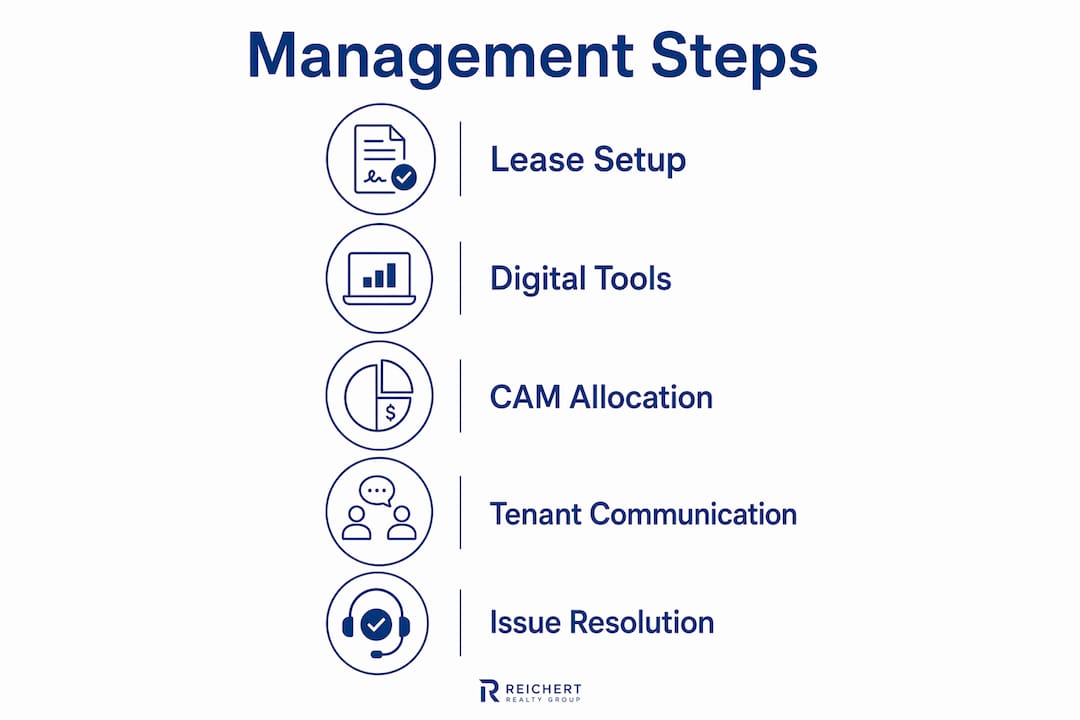
The table below compares the feature categories that matter most for multi-tenant industrial management:
| Feature category | What to look for | Why it matters |
|---|---|---|
| Workflow automation | Auto-assignment of work orders by zone or tenant | Eliminates manual routing and delays |
| SLA tracking | Per-tenant response timers with escalation alerts | Keeps service commitments visible and enforceable |
| CAM allocation | Attribution codes linked to accounting in real time | Prevents billing disputes and manual reconciliation |
| Tenant portals | Isolated, access-controlled views per tenant | Protects privacy and reduces inbound phone calls |
| Reporting | Exportable CAM summaries and maintenance logs | Supports annual CAM reconciliation and audits |
What lease structures work best for shared industrial spaces?
Lease structure is the foundation of every multi-tenant industrial property. Get it wrong and you spend years arbitrating disputes that the lease should have prevented.
Flex industrial landlords increasingly favour Modified Gross Leases with Base Year Stops over Absolute Net-Net-Net (NNN) leases in multi-tenant settings. The reason is structural. Multiple tenants cannot each hold individual responsibility for one continuous roof membrane or a shared central utility plant. A Modified Gross Lease with a Base Year Stop sets a baseline expense year, then passes only the increases above that baseline to tenants. This gives landlords expense recovery while giving tenants cost predictability.
SLA design belongs inside the lease, not in a separate verbal agreement. A four-tier response system classifies issues as emergency, urgent, standard, or scheduled, based on the tenant’s operational risk profile. A cold storage operator losing refrigeration at 2:00 AM is an emergency. A request for a replacement light fixture in an administrative office is scheduled. Treating both the same way destroys credibility with the tenant who actually needed the emergency response.
HVAC maintenance is a recurring flashpoint in multi-tenant industrial leases. Quarterly preventative maintenance contracts enforced through lease clauses and audited by property managers protect landlords from absorbing costs caused by tenant neglect. Without that clause, a tenant who ignores filter changes for two years hands the landlord a compressor replacement bill.
Key lease clauses for multi-tenant industrial properties:
- CAM cap clause: Limits annual CAM increases to a negotiated percentage, protecting tenants from cost spikes.
- Roof penetration protocol: Requires landlord approval and bonded roofing vendors for any tenant modification to the roof.
- HVAC maintenance obligation: Specifies quarterly servicing requirements and gives the landlord audit rights.
- Utility sub-metering provision: Requires individual metering for electricity, gas, and water where shared infrastructure exists.
- SLA response schedule: Defines the four-tier response system and associated response windows by issue category.
- Expense exclusion list: Specifies which capital expenditures are excluded from CAM recovery.
Managing CAM costs fairly across multiple tenants
CAM management is where multi-tenant industrial properties either build tenant trust or lose it. The mechanics are straightforward. The execution is where most managers fall short.
CAM in industrial real estate covers parking lot maintenance, exterior lighting, landscaping, snow removal, shared loading dock repairs, and building insurance, among other expenses. Each of these costs must be documented with invoices, attributed to the correct cost category, and allocated to tenants based on their proportionate share of the building’s gross leasable area. Linking CAM expenses to attributed work orders and connecting that data directly to accounting platforms enables real-time CAM categorisation. It eliminates manual errors and accelerates dispute resolution when tenants question a charge.
Individual utility sub-metering prevents unfair billing by allocating costs based on actual consumption. Without sub-metering, a light-manufacturing tenant pays the same utility rate as a heavy-process neighbour running three shifts. That inequity generates disputes and, over time, reduces retention.
Pro Tip: Establish a CAM cap in every new lease and track cumulative CAM increases against that cap annually. “Capital creep” occurs when landlords gradually reclassify capital expenditures as operating expenses. Maintaining a clear expense exclusion list in the lease, reviewed each year, prevents this from becoming a dispute at reconciliation time.
Common CAM expense categories to track separately:
- Exterior maintenance (parking, paving, landscaping, snow removal)
- Shared mechanical systems (HVAC for common areas, plumbing)
- Utilities for common areas (lighting, water)
- Property insurance and management fees
- Security and access control systems
Managers who connect their CMMS directly to their accounting platform gain one more advantage: real-time CAM reporting. Tenants who can see a live summary of their CAM charges, supported by work order records, rarely escalate to formal disputes. Transparency is the cheapest dispute-resolution tool available.
Best practices for tenant communication and service coordination
Tenant communication in a multi-tenant industrial building is not a soft skill. It is an operational system that either functions or fails.
Tenant-isolated portals with per-tenant SLA tracking are the baseline standard for professional multi-tenant management. Each tenant submits service requests through their own portal, sees status updates in real time, and receives completion notifications without any visibility into other tenants’ activity. This structure removes the privacy and legal risks that come from managing all tenant communications through a single shared channel.
Contractor access coordination is a common source of operational disruption in shared industrial facilities. A roofing contractor working on a shared roof membrane needs access protocols that protect all tenants, not just the one who initiated the request. Scheduling contractor visits during off-peak hours, providing advance notice to all affected tenants, and logging access in the facility management system are non-negotiable practices.
Utilities and parking logistics require written rules, not informal agreements. In multi-tenant flex parks, parking allocation disputes and shared loading dock conflicts are among the most frequent complaints. Addressing these in the lease and reinforcing them through the tenant portal reduces the volume of reactive calls to the property manager.
Common pitfalls in maintenance coordination:
- Failing to notify adjacent tenants before noisy or disruptive maintenance work
- Allowing contractors to access shared mechanical rooms without a logged work order
- Using a single email inbox for all tenant requests, which creates attribution gaps
- Scheduling non-emergency repairs during a tenant’s peak operating hours without consultation
- Closing work orders without tenant confirmation of satisfactory completion
For GTA property managers overseeing multi-tenant industrial spaces in markets like Brampton, Mississauga, and Vaughan, the diversity of tenant types adds complexity. A logistics operator running 24-hour shifts has different service expectations than a light-manufacturing tenant working standard business hours. Your SLA tiers must reflect that reality.
Common challenges in multi-tenant industrial management and how to solve them
Every experienced property manager encounters the same set of recurring problems. Recognising them early and having a documented response saves time and protects asset value.
| Challenge | Root cause | Expert solution |
|---|---|---|
| Manual CAM reconciliation errors | Work orders not attributed at entry | Implement attribution codes in CMMS at work order creation |
| Tenant billing disputes | No sub-metering for utilities | Install individual meters; bill on actual consumption |
| Voided roof warranties | Unauthorized tenant roof penetrations | Enforce landlord-approved, bonded vendor requirement in lease |
| Institutional knowledge loss | No documented procedures | Maintain a digital operations manual updated after each major repair |
| SLA non-compliance | No per-tenant tracking | Use facility management software with SLA timers per tenant |
Unauthorized roof penetrations are a particularly costly mistake. A tenant who installs an HVAC unit or antenna without using a landlord-approved, bonded roofing contractor can void a multi-year roof warranty. The financial exposure from a single voided warranty on a large industrial roof far exceeds the cost of enforcing the protocol in the first place.
Work order attribution errors are the most common source of CAM disputes. When a technician closes a work order without assigning it to the correct cost category, that expense either gets absorbed by the landlord or misallocated to the wrong tenant. Both outcomes are avoidable with a CMMS that requires attribution before a work order can be closed.
Institutional knowledge loss during staff turnover is underestimated as a risk. When the property manager who knows which tenant has a custom HVAC arrangement or a negotiated parking exception leaves, that knowledge leaves with them. A digital operations manual, updated after every non-routine repair or lease amendment, is the only reliable safeguard.
For a detailed look at how occupancy costs break down across GTA industrial properties, the numbers often surprise both landlords and tenants.
Key takeaways
Effective multi-tenant industrial building management requires attributed digital workflows, structured lease clauses, individual utility metering, and tenant-isolated communication portals to protect asset value and retain tenants.
| Point | Details |
|---|---|
| Attribute every work order | Code each work order at entry as tenant-exclusive, common area, or apportioned to prevent CAM disputes. |
| Use Modified Gross Leases | Base Year Stop structures suit multi-tenant flex industrial better than Absolute NNN leases. |
| Install utility sub-metering | Individual meters eliminate billing inequity and reduce tenant disputes over shared utility costs. |
| Enforce roof penetration protocols | Require bonded, landlord-approved vendors for all roof work to preserve warranty coverage. |
| Isolate tenant portals | Separate portals per tenant protect privacy, reduce inbound calls, and create a clear service record. |
What I have learned managing GTA industrial properties
The property managers who consistently outperform in the GTA industrial market share one habit: they treat every maintenance decision as a financial decision. Not in a penny-pinching way. In a total cost of ownership way.
I have seen landlords defer a $15,000 parking lot repair for two years, then spend $60,000 on full repaving because the base failed. I have seen the reverse too: landlords who invested in a proper CMMS, trained their team on attribution discipline, and watched their CAM reconciliation process shrink from a three-week ordeal to a two-day report. The technology does not do the work. The discipline does. The technology just makes the discipline visible.
The GTA industrial market adds a layer of complexity that managers in other markets do not face at the same intensity. Vacancy rates have been historically tight across Brampton, Mississauga, and Vaughan. That means tenants have options, and a poorly managed building loses good tenants to better-operated properties. Retention is not a soft metric here. It is a direct driver of asset value.
My strongest advice for property managers taking on a multi-tenant industrial asset is this: read every lease before you do anything else. The lease tells you what you are responsible for, what the tenant is responsible for, and where the gaps are. The gaps are where disputes live. Closing those gaps with clear SLA schedules, CAM caps, and maintenance audit rights is not bureaucratic overhead. It is the job.
Local relationships matter too. Knowing which mechanical contractors in Mississauga respond reliably to emergency calls, which roofing vendors carry the right bonding for warranty-compliant work, and which inspectors are active in Brampton’s industrial corridors gives you a real operational edge. That knowledge does not come from a platform. It comes from years of working in the market.
— Michael Law
Working with Michael Law | Lennard Commercial on GTA industrial properties
Managing a multi-tenant industrial building in the GTA requires more than operational discipline. It requires an understanding of local lease structures, market rental rates, and the tenant mix that makes a property perform over the long term.

Michael Law | Lennard Commercial advises property owners and managers across Toronto, Brampton, Mississauga, Vaughan, and surrounding markets on industrial leasing, tenant representation, and property positioning. Whether you are structuring leases for a flex industrial property in Brampton or evaluating a cold storage asset in Toronto, the team brings direct market knowledge to every engagement. Connect with Michael Law | Lennard Commercial at mlawrealestate.com or through the Lennard Commercial profile to discuss your property’s specific management and leasing needs.
FAQ
What is a Modified Gross Lease in multi-tenant industrial buildings?
A Modified Gross Lease sets a base year for operating expenses and passes only cost increases above that baseline to tenants. It is the preferred structure for multi-tenant flex industrial properties where shared infrastructure makes Absolute NNN leases impractical.
How does CAM allocation work in a multi-tenant industrial building?
CAM costs are allocated to tenants based on their proportionate share of the building’s gross leasable area. Each expense must be documented, attributed to the correct cost category, and linked to a work order in the facility management system.
What is a four-tier SLA response system for industrial tenants?
A four-tier SLA system classifies maintenance requests as emergency, urgent, standard, or scheduled based on the tenant’s operational risk. This structure sets clear response windows and prevents low-priority requests from consuming resources needed for critical issues.
Why does utility sub-metering matter in multi-tenant industrial properties?
Without individual sub-metering, tenants with low utility consumption subsidise heavy-usage neighbours. Sub-metering allocates costs based on actual consumption, which eliminates the most common source of utility billing disputes.
How do unauthorized roof penetrations affect a landlord’s warranty?
A tenant who modifies the roof without using a landlord-approved, bonded roofing contractor can void the building’s multi-year roof warranty. Enforcing a written roof penetration protocol in the lease is the only reliable way to prevent this exposure.
Recommended

About Michael Law
Managing Partner and Industrial Real Estate Broker at Lennard Commercial Realty. Representing tenants and landlords across Toronto and the GTA for 15+ years. Michael specializes in GTA industrial real estate — connect with Toronto's leading industrial broker at mlawrealestate.com/industrial-broker-toronto.