How to report industrial lease issues: 2026 guide
By Michael Law · Industrial Real Estate Broker, Lennard Commercial Realty
TL;DR:
- Reporting industrial lease issues requires precise documentation, timely notices, and adherence to specific deadlines. Proper preparation involves reviewing lease clauses and gathering comprehensive evidence before formal reporting. Escalating disputes should follow a step-by-step process, starting with written complaints, mediation, and then legal action if necessary.
Reporting industrial lease issues is defined as the formal process of notifying your landlord, property manager, or relevant authority about a breach, deficiency, or dispute under your commercial lease agreement. For business tenants in the Greater Toronto Area, knowing how to report industrial lease issues correctly can mean the difference between a swift resolution and a costly legal battle. The process requires three things done right: a clear written record, timely notice sent by Certified Mail or verified digital means, and a specific deadline for the other party to respond. Skipping any one of these steps weakens your position before you even begin.
What must you do before reporting an industrial lease issue?
Preparation is the foundation of every successful lease complaint. Before you send a single notice, you need to know exactly what your lease says and what evidence supports your claim.
Review your lease clauses first
Start with the specific clauses that govern your dispute. For maintenance problems, locate the repair and maintenance obligations section. For financial disagreements, find the operating cost reconciliation and audit rights clauses. For triple net (NNN) leases, which are standard across GTA industrial properties in Mississauga, Brampton, and Vaughan, audit windows are strictly defined. Missing them forfeits your rights entirely.
Environmental due diligence is also worth reviewing at this stage, particularly if your dispute involves property condition or contamination concerns. Inheriting liability for pre-existing issues is a real risk in industrial tenancies.
Document everything before you write a single word
Clear documentation of all correspondence is the most critical evidence in industrial lease disputes. Courts and mediators consistently favour the party with the better paper trail. Collect the following before drafting your complaint:
- All written communications with your landlord or property manager, including emails, text messages, and letters
- Photographs and video of any physical deficiencies, damage, or maintenance failures
- Invoices and financial records related to operating cost disputes or unauthorized charges
- Copies of prior notices you have already sent, with proof of delivery
- Inspection reports from third parties, if available
Identify the correct recipient for your complaint. In most GTA industrial properties, this is the property manager rather than the building owner directly. Confirm the name, title, and mailing address from your lease before sending anything.
Pro Tip: Create a chronological evidence folder, either physical or digital, from day one of any dispute. Label every document with the date received or sent. This single habit saves hours of reconstruction later and makes your complaint file immediately credible to any reviewer.

How do you formally report industrial lease issues?
The formal reporting process follows a clear sequence. Each step builds on the last, and skipping ahead rarely speeds things up.
Step-by-step: how to file a lease complaint
- Draft a written complaint letter. State the specific problem, reference the exact lease clause being violated, and set a clear deadline for resolution. For non-emergency maintenance issues, a reasonable deadline is typically 5–14 business days.
- Send via Certified Mail with Return Receipt. Certified Mail with return receipt is the legally recognized method for proving notice delivery. This safeguards your right to remedy and any future claims.
- Follow up in writing if there is no response. Send a second notice referencing the first, noting the missed deadline, and stating your next steps.
- Escalate to government or municipal channels if unresolved. In Ontario, tenants can contact the Landlord and Tenant Board for residential matters, but for commercial and industrial leases, the path leads to civil courts or the Ontario Superior Court of Justice depending on the amount in dispute.
- Preserve your audit window for financial disputes. NNN lease audit notices must be submitted within 15–45 days after receiving the annual reconciliation statement. Formal forensic reviews typically occur between days 45–75, and litigation commences after 90–120 days if the matter remains unresolved.
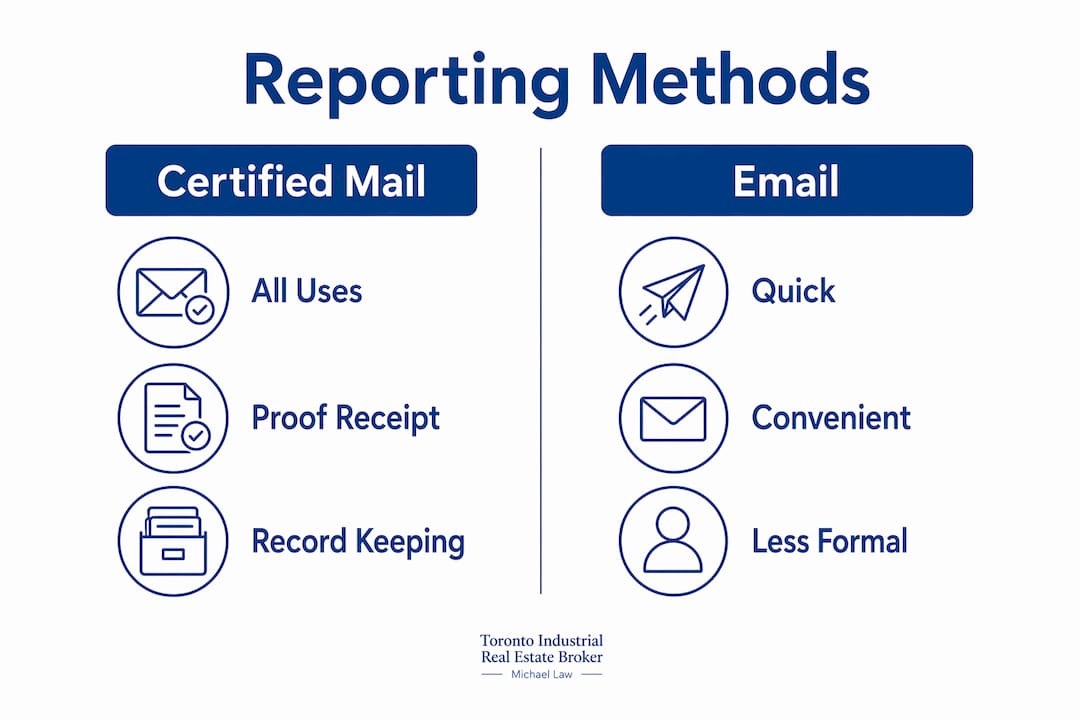
Reporting methods compared
| Method | Best Used For | Key Advantage | Limitation |
|---|---|---|---|
| Certified Mail with Return Receipt | All formal notices | Legally proven delivery | Slower than email |
| Email with Read Receipt | Routine follow-ups | Fast, timestamped record | Weaker legal standing alone |
| In-Person Meeting with Written Confirmation | Complex disputes needing dialogue | Builds relationship | Must be followed by written summary |
| Government Agency Complaint | Unresolved safety or code violations | External authority | Requires complete evidence file |
| Demand Letter via Lawyer | Pre-litigation escalation | Signals serious intent | Higher cost |
Pro Tip: Never rely on a verbal agreement to fix a problem. After any phone call or in-person meeting about a lease dispute, send a brief email summarizing what was discussed and agreed upon. This converts a conversation into a written record.
What mistakes commonly derail industrial lease disputes?
The most damaging errors in lease dispute reporting are not legal technicalities. They are process failures that could have been avoided with basic preparation.
Missing audit and filing deadlines
Neglecting audit deadlines is the single most common way tenants lose their right to dispute overpayments in triple net leases. Once the audit window closes, typically 30–90 days post-reconciliation, that right is permanently forfeited. GTA industrial tenants operating under NNN structures in markets like Milton, Oakville, and Burlington face this risk every year at reconciliation time.
Poorly organised or incomplete evidence
Submitting a complaint without a complete evidence file creates delays rather than resolutions. Government agency intake officers prioritise well-prepared, complete files. Incomplete complaints often sit in a queue indefinitely. Your file should include the original notice, proof of delivery, photographs, inspection reports, and any relevant financial records.
Failing to reference specific lease clauses
A complaint that says “the landlord is not maintaining the property” is far weaker than one that says “the landlord has failed to comply with Section 8.3 of the lease, which requires HVAC maintenance within 10 business days of written notice.” Specificity signals that you know your rights. It also removes the landlord’s ability to claim ignorance of the obligation.
“Experts emphasise reviewing lease specifics and documenting every communication to build strong cases before attempting legal action.” — How to Handle Lease Disputes in the Industrial Sector
Ignoring dispute resolution clauses
Many industrial leases in the GTA include mandatory mediation clauses that require tenants to attempt mediation before pursuing litigation. Skipping this step can result in a court dismissing your claim on procedural grounds. Read your lease’s dispute resolution section carefully before escalating.
What are your next steps if the problem persists?
When a formal complaint does not produce results, escalation is the only path forward. The sequence matters.
Escalation options after initial reporting
- Request mediation. Mediation is often faster, confidential, and less expensive than litigation. Many GTA commercial lease disputes are resolved at this stage. Mediators specialising in commercial real estate are available through the ADR Institute of Ontario and the Ontario Bar Association.
- Send a formal Demand Letter. A Demand Letter via Certified Mail with Return Receipt is the critical first legal step before formal dispute proceedings. It signals that litigation is imminent and often prompts landlords to negotiate.
- File in Small Claims Court for financial disputes under the threshold. Small Claims Court handles lease disputes involving financial damages typically under $35,000 in Ontario. This is a practical venue for resolving commercial lease disagreements without lengthy litigation.
- Engage the Ontario Superior Court of Justice for larger claims. Disputes involving significant financial damages or complex lease interpretation require the Superior Court. Legal representation is strongly advised at this stage.
- Consult a commercial real estate lawyer or broker. A lawyer with commercial lease experience can review your position and advise on the strength of your claim. A broker like those at Lennard Commercial Realty can provide market context that supports your case, particularly for rent disputes.
When to involve a commercial real estate specialist
Engaging a specialist early in a dispute is not a sign of weakness. It is a cost-saving move. A commercial real estate advisor can identify whether your landlord’s position is consistent with current GTA market norms, which is particularly relevant for lease negotiation disputes involving rent escalation or operating cost allocations. In a market as active as the GTA industrial corridor, where vacancy rates and rental benchmarks shift quarterly, having current data on your side strengthens every negotiation.
Pro Tip: Before engaging a lawyer, ask a commercial real estate broker to review the disputed clause against current market standards. If your landlord’s position is clearly out of step with the market, that data point alone can resolve the dispute without litigation.
Key takeaways
Reporting industrial lease issues effectively requires documentation, strict deadline adherence, and a clear escalation path from written notice to mediation to legal action.
| Point | Details |
|---|---|
| Document before you report | Collect all communications, photos, invoices, and lease clauses before drafting any complaint. |
| Send notices by Certified Mail | Certified Mail with Return Receipt is the legally recognised method for proving notice delivery in lease disputes. |
| Respect audit windows | NNN lease audit notices must be filed within 15–45 days of reconciliation receipt or rights are permanently lost. |
| Reference specific lease clauses | Every complaint must cite the exact clause being violated to establish clear legal standing. |
| Escalate through mediation first | Attempt mediation before litigation; many GTA industrial lease disputes resolve at this stage at far lower cost. |
What i’ve learned about lease disputes in the GTA industrial market
The most consistent pattern I see in GTA industrial lease disputes is not bad faith from landlords. It is tenants who did not read their lease carefully before signing and are now surprised by what it says. A tenant in Brampton once came to me six months into a dispute over operating cost reconciliation. The lease had a 30-day audit window. They had missed it by three weeks. That dispute was over before it started.
The GTA industrial market is one of the most competitive in Canada. Landlords in Mississauga, Vaughan, and the Durham Region know their leases well. They have legal teams who draft these documents to protect their interests. As a tenant, you need to know your lease just as well. That means reading every clause before you sign, not after a problem arises.
The second pattern I see is tenants who communicate verbally and then wonder why nothing gets fixed. A phone call is not a notice. An email without a deadline is not a complaint. The only communication that protects you in a lease dispute is written, specific, and delivered in a way that can be proven.
My honest advice: get a commercial real estate advisor involved before you sign, not after you are in a dispute. Understanding due diligence in industrial leasing at the front end of a transaction is far cheaper than resolving a dispute at the back end. The GTA market moves fast. Lease terms that seemed reasonable in 2022 may look very different against 2026 market conditions. Know what you signed, document everything, and do not wait to escalate when something goes wrong.
— Michael
How Mlawrealestate supports GTA industrial tenants facing lease issues
Industrial lease disputes are rarely simple, and the GTA market adds its own layer of complexity. Mlawrealestate works directly with business owners and tenants across Toronto, Mississauga, Brampton, Vaughan, and the broader GTA to provide expert guidance on lease review, dispute positioning, and tenant representation.

Whether you are dealing with an unresolved maintenance complaint, a contested NNN reconciliation, or a landlord who is not honouring lease terms, Mlawrealestate brings the market knowledge and transaction experience to support your position. Explore available commercial and industrial properties across the GTA, or learn about industrial real estate in Caledon if you are considering a relocation or new lease. Early consultation protects your interests before a dispute becomes a legal matter.
FAQ
What is the first step to report an industrial lease issue?
The first step is to send a written complaint letter to your landlord or property manager by Certified Mail with Return Receipt, referencing the specific lease clause being violated and setting a clear deadline for resolution.
How long does a landlord have to respond to a maintenance complaint?
For non-emergency industrial maintenance issues, a reasonable response deadline is 5–14 business days from the date of written notice. Your lease may specify a shorter or longer period.
What is an NNN audit window and why does it matter?
An NNN audit window is the period during which a tenant must submit written notice of intent to audit operating cost reconciliations. This window is typically 15–45 days after receiving the reconciliation statement. Missing it permanently forfeits your right to contest the charges.
When should you escalate an industrial lease dispute to court?
Escalate to Small Claims Court for financial disputes under $35,000 in Ontario, or to the Ontario Superior Court of Justice for larger or more complex claims, after mediation has failed or been refused by the landlord.
Can a commercial real estate broker help with a lease dispute?
Yes. A commercial real estate broker can provide current market data to support your position in rent or operating cost disputes, and can refer you to legal specialists with commercial lease experience in the GTA.
Recommended

About Michael Law
Managing Partner and Industrial Real Estate Broker at Lennard Commercial Realty. Representing tenants and landlords across Toronto and the GTA for 15+ years. Michael specializes in GTA industrial real estate — connect with Toronto's leading industrial broker at mlawrealestate.com/industrial-broker-toronto.