How to underwrite industrial property: a GTA investor's guide
By Michael Law · Industrial Real Estate Broker, Lennard Commercial Realty
TL;DR:
- Underwriting industrial property involves evaluating physical specs, tenant quality, lease terms, and market context to determine investment risk. Accurate assessment of building specifications, tenant creditworthiness, and submarket dynamics is essential for reliable underwriting and securing favorable financing. Conservative modeling of exit cap rates and expense reserves mitigates risks in a market with evolving supply, demand, and financing conditions.
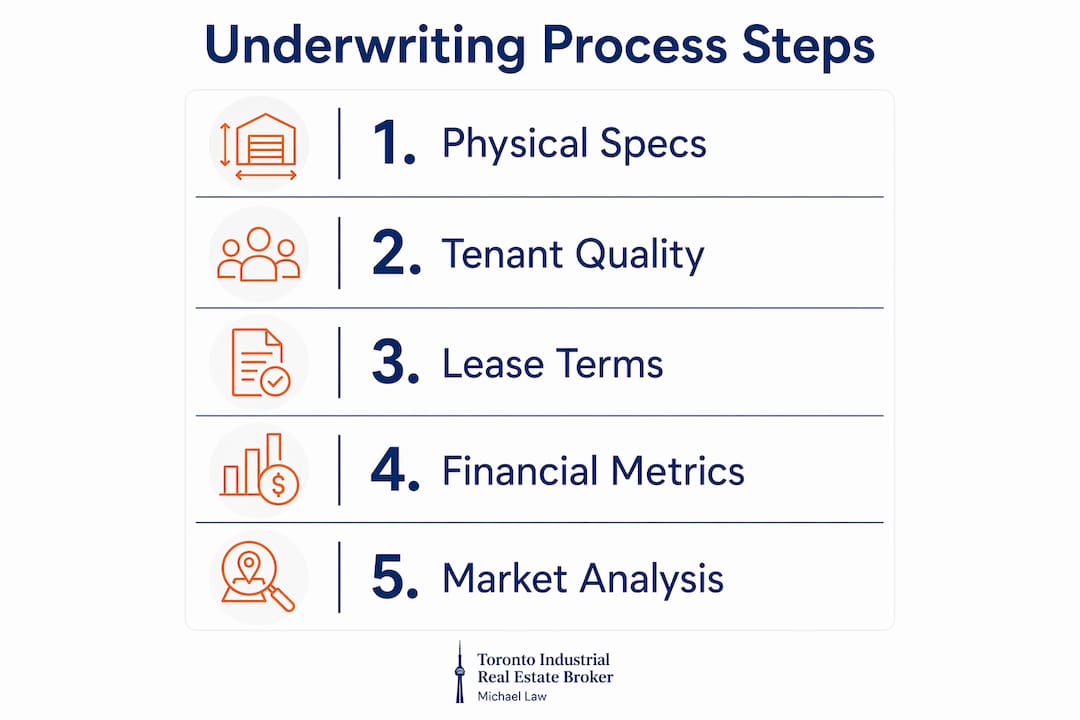
Underwriting industrial property is the process of evaluating an industrial asset’s physical specifications, tenancy, financial metrics, and market context to determine its investment value and risk profile. In the Greater Toronto Area, where industrial vacancy rates have tightened across nodes like Mississauga, Brampton, Vaughan, and the Durham Region, this process carries real consequences. Get it right and you secure a performing asset with predictable cash flows. Get it wrong and you inherit deferred capital expenditure, weak tenants, or a loan structure that cannot survive a lease rollover. This guide walks through every critical layer of industrial property underwriting, from building specs to lender benchmarks, with GTA-specific context throughout.
How to underwrite industrial property: physical and technical specs
Industrial property underwriting begins with the building itself, and the specifications that determine which tenants can actually use the space. The most consequential spec is clear height, measured from the finished floor to the underside of the sprinkler deflector, not to the roof deck. A property marketed as 32-foot clear may actually deliver 30 feet once sprinkler deflectors are accounted for. That two-foot discrepancy eliminates a meaningful portion of the modern logistics tenant universe.

Dock door count and configuration critically affect tenant suitability. Modern Class A distribution centres require one dock door per 5,000 to 7,500 square feet and one trailer parking stall per 5,000 to 10,000 square feet. Legacy properties in older GTA industrial parks, particularly in North York and parts of Etobicoke, often fall well short of these ratios. That gap limits the tenant pool and compresses achievable rents relative to newer product in Caledon, Milton, or the Highway 410 corridor.
Beyond doors and height, you need to assess column grid spacing, floor load capacity (measured in pounds per square foot), and electrical service. A 50-foot by 50-foot column grid is the functional minimum for modern racking configurations. Electrical service below 2,000 amps at 600 volts increasingly disqualifies a building for e-commerce fulfilment or light manufacturing tenants who run automated equipment.
Fire suppression type is a material underwriting variable. ESFR (Early Suppression Fast Response) sprinkler systems allow tenants to rack product to greater heights without in-rack sprinklers, which reduces tenant fit-out costs and broadens the tenant universe. Properties with older wet-pipe or dry-pipe systems may require costly retrofits to attract Class A tenants, and those retrofit costs belong in your capital expenditure model from day one.
Pro Tip: Never rely solely on the offering memorandum for physical specs. Request the original architectural and structural drawings, then verify clear height by direct measurement to the sprinkler deflector. Discrepancies between marketed specs and actual conditions are common and can materially affect your underwriting.
| Physical spec | Modern Class A standard (GTA) |
|---|---|
| Clear height | 36 to 40 feet (minimum 32 feet) |
| Dock doors | 1 per 5,000 to 7,500 SF |
| Trailer parking | 1 stall per 5,000 to 10,000 SF |
| Column grid | 50 ft x 50 ft minimum |
| Floor load | 35,000 lbs per SF or greater |
| Electrical service | 2,000 amps at 600 volts |
| Fire suppression | ESFR sprinkler system |
If the property includes an outdoor storage yard, underwrite it separately. Industrial outdoor storage (IOS) parcels serve a distinct tenant base, including container depots, equipment yards, and fleet operators, and they command different cap rates than the warehouse component.
How do tenant creditworthiness and lease terms affect underwriting?
The tenant story is decisive in underwriting both the debt and equity side of an industrial deal. A Class A building with a weak tenant on a short lease is a riskier asset than a secondary building with an investment-grade tenant on a ten-year term. Lenders and equity investors price that risk accordingly, and your underwriting model must reflect it.
Tenant credit profile is the starting point. Investment-grade tenants, such as publicly traded logistics operators, national retailers, or government entities, produce more predictable cash flows and give lenders confidence to offer better loan terms. Private or single-location tenants require deeper scrutiny: review financial statements, operating history, and the strategic importance of the specific location to their business.
Lease structure matters as much as tenant quality. Triple-net (NNN) leases are the standard in GTA industrial, where the tenant pays property taxes, insurance, and maintenance costs above a base rent. However, hidden landlord responsibilities in NNN leases can disrupt projected net cash flows despite the NNN label. Structural repairs, roof replacement, and capital items are frequently carved back to the landlord in lease schedules. Read the full lease document, not the summary in the offering memorandum.
Rent relative to market is the third pillar of the tenant story. A tenant paying below-market rent on a long-term lease represents a value-add opportunity at rollover but also a cash flow gap in the near term. A tenant paying above-market rent on a short remaining term introduces rollover risk. Both scenarios require explicit modelling. Rent escalation clauses, typically structured as fixed annual bumps of 2% to 3% or CPI-linked adjustments, directly affect your projected net operating income over the hold period.
The following criteria are the minimum you should assess for every tenant and lease in your underwriting:
- Tenant credit rating or financial statements for the past three years
- Lease commencement date, expiry date, and any renewal options
- Base rent versus current market rent for comparable GTA industrial space
- Annual rent escalation structure and frequency
- Landlord versus tenant responsibility for capital items (roof, HVAC, sprinklers)
- Permitted use clauses and any exclusivity or co-tenancy provisions
- Assignment and subletting rights, which affect exit flexibility
Pro Tip: Always request and read the full executed lease, including all schedules and amendments. Lease summaries prepared by vendors routinely omit clauses that impose landlord obligations or restrict your ability to re-lease the space.
Which financial metrics are essential for evaluating industrial deals?
Industrial property valuation and deal feasibility rest on a defined set of quantitative metrics. Understanding how to apply them, and what current lenders expect, separates disciplined underwriting from guesswork.
The debt service coverage ratio (DSCR) measures net operating income against annual debt service. Industrial assets require a minimum 1.25x DSCR as of 2026 lending standards, meaning the property must generate $1.25 in net operating income for every $1.00 of debt service. This is a hard floor for most institutional lenders, and many apply a 1.30x or 1.35x covenant for secondary markets or shorter lease terms.
Loan-to-value (LTV) ratios for stabilised industrial assets are capped at 75% under current 2026 standards. Debt yield, calculated as net operating income divided by total loan amount, must reach a minimum of 8% on stabilised industrial assets. Debt yield has become the preferred metric for lenders because it is independent of interest rate assumptions, making it a more reliable stress test than DSCR alone.
Cap rate is the ratio of net operating income to purchase price, and it drives your going-in yield calculation. Class A industrial in primary GTA markets trades at cap rates in the high 4s to low 6s. Secondary industrial assets in markets like Hamilton, Oshawa, or Barrie trade at 6.5% to 8%. For exit underwriting, assume cap rate expansion of 50 to 100 basis points beyond your going-in rate. That conservative assumption protects your return model against market softening at disposition. You can explore GTA industrial cap rate ranges in more detail to calibrate your assumptions by submarket.
Pro Tip: Model your exit at a cap rate 75 basis points wider than your entry cap rate. If the deal still pencils at that assumption, you have a defensible underwriting position. If it does not, you are relying on cap rate compression to generate returns, which is a speculative bet, not an investment thesis.
| Metric | Class A GTA industrial | Secondary GTA industrial |
|---|---|---|
| Going-in cap rate | 4.5% to 6.0% | 6.5% to 8.0% |
| Exit cap rate assumption | Add 50 to 75 bps | Add 75 to 100 bps |
| Minimum DSCR | 1.25x to 1.35x | 1.25x to 1.30x |
| Maximum LTV | 70% to 75% | 65% to 70% |
| Minimum debt yield | 8.0% | 8.0% to 9.0% |
Loan structure varies by lender type. Life companies and pension funds offer the lowest rates but require strong sponsorship and long lease terms. Schedule A banks apply the most conservative LTV and DSCR covenants. CMHC-insured financing, available for qualifying industrial assets, can extend amortisation periods and reduce debt service, improving DSCR on tighter deals.
How does market analysis shape industrial underwriting decisions?
Market analysis is not background context in industrial underwriting. It is a direct input into your rent assumptions, vacancy modelling, and exit cap rate selection. Skipping it or treating it as a formality produces underwriting that looks precise on a spreadsheet but fails in execution.
Submarket vacancy rates determine how quickly you can re-lease a property if the current tenant vacates. In the Mississauga Airport corridor and Brampton’s Highway 410 node, vacancy has remained structurally tight, supported by persistent demand from e-commerce and third-party logistics operators. In contrast, some secondary nodes in the outer 905 belt have seen vacancy tick upward as new supply has been delivered ahead of absorption. Your underwriting must reflect the specific submarket, not the GTA average.
New supply pipelines are equally important. A 500,000-square-foot speculative development delivering within 18 months of your projected lease rollover date in the same submarket is a material risk. Review municipal building permit data and developer announcements for the relevant node before finalising your re-leasing assumptions. Proximity to transportation infrastructure, including Highway 400, 401, 410, and 427 interchanges, as well as CN and CP rail access points, directly affects tenant demand depth and achievable rents.
Verifying market rents through comparable lease transactions is non-negotiable. Offering memoranda cite asking rents, not executed net rents. In the GTA, the spread between asking and net effective rents can be significant once tenant inducements, free rent periods, and leasehold improvement allowances are factored in. Use market analysis tools and broker-sourced comparable data to ground your rent assumptions in actual transaction evidence.
Pro Tip: Assess the depth of the tenant base in the submarket, not just current vacancy. A submarket with five active tenant requirements in your size range is fundamentally different from one with fifty. Deeper tenant demand reduces re-leasing risk and supports your exit assumptions.
What are the most common industrial underwriting mistakes to avoid?
Even experienced investors make systematic errors when underwriting industrial deals. Recognising these patterns before you commit capital is the most direct form of risk management available.
The most costly mistake is underwriting an IOS yard at warehouse cap rates. IOS parcels should be valued separately at an IOS cap rate, which commands a 75 to 150 basis point premium over warehouse rates. Failing to carve out the IOS component can undervalue the asset by up to 18%, meaning you either overpay or miss the true value in a disposition scenario.
Relying on the offering memorandum without independent technical due diligence is the second most common error. Offering memoranda are marketing documents. They present the asset in its best light and routinely omit deferred maintenance, environmental concerns, and capital expenditure requirements. A Phase I environmental site assessment, a building condition report, and a review of municipal records are the minimum required before finalising your underwriting. Reviewing commercial due diligence practices specific to GTA industrial assets will help you structure this process correctly.
Sponsor experience is a factor that many investors underestimate in their own underwriting. Experienced sponsors receive better financing terms, including lower rates and nonrecourse options, even when the underlying financials are identical to those of a less experienced buyer. If you are building a track record, partnering with an experienced operator on your first few deals can materially improve your access to capital.
The following mistakes appear repeatedly in GTA industrial underwriting reviews:
- Accepting marketed clear heights without independent measurement to the sprinkler deflector
- Modelling NNN leases as fully passive without reviewing landlord obligations in the lease schedules
- Using asking rents rather than net effective rents from executed comparable transactions
- Ignoring capital expenditure requirements for roof, HVAC, and fire system compliance
- Applying a single cap rate to a mixed-use industrial site that includes IOS components
- Underestimating re-leasing costs, including tenant inducements and downtime, at lease expiry
Pro Tip: Build a capital expenditure reserve into your underwriting from day one. Roof replacement, HVAC upgrades, and sprinkler retrofits are not exceptional events on GTA industrial assets. They are predictable costs that belong in your model, not in a footnote.
Key takeaways
Disciplined industrial property underwriting requires integrating physical specs, tenant quality, financial metrics, and submarket data into a single coherent investment thesis.
| Point | Details |
|---|---|
| Physical specs drive tenant universe | Verify clear height, dock ratios, and electrical service against Class A standards before modelling rents. |
| Tenant story is the decisive factor | Assess credit profile, lease term, and rent relative to market as the primary risk variables. |
| 2026 lending benchmarks are firm | Target a minimum 1.25x DSCR, 75% LTV cap, and 8% debt yield to meet institutional lender requirements. |
| Underwrite IOS separately | Apply an IOS cap rate 75 to 150 bps above warehouse rates to avoid mispricing mixed-use industrial sites. |
| Conservative exit assumptions protect returns | Model cap rate expansion of 50 to 100 bps at exit to stress-test your investment thesis against market softening. |
What I have learned from underwriting GTA industrial deals
I have spent years working through industrial acquisitions across the GTA, from tight infill sites in Mississauga to large-format logistics assets in Caledon and Milton, and the single most consistent observation I can share is this: the investors who get into trouble are almost always the ones who treated underwriting as a financial exercise rather than an investigative one.
The numbers on a spreadsheet are only as reliable as the assumptions behind them. I have reviewed deals where the going-in cap rate looked compelling but the tenant was paying 15% above market on a lease with 18 months remaining. The model looked fine until you stress-tested the rollover. That is not a financial modelling problem. That is a failure to read the tenant story correctly.
What I find underappreciated in most underwriting frameworks is the role of sponsor track record. Lenders in the GTA industrial market are not just underwriting the asset. They are underwriting you. I have seen identical deals get financed at materially different rates based solely on the sponsor’s operating history. If you are newer to industrial acquisitions, the most direct way to improve your financing terms is to build a credible operating narrative, even if that means starting with smaller assets or co-investing with experienced operators.
The e-commerce and logistics demand wave that drove GTA industrial rents to record levels has moderated, but the structural case for well-located, functional industrial assets remains intact. What has changed is the margin for error. In a market where cap rates have expanded from their 2021 lows and financing costs remain elevated, conservative underwriting is not a defensive posture. It is the only posture that makes sense. Model your exit conservatively, verify every spec independently, and read every lease document in full. Those three habits will protect you from the majority of industrial underwriting errors I have seen in this market.
— Michael
Work with a GTA industrial real estate specialist
If you are actively underwriting industrial investments in the Greater Toronto Area, the quality of your market intelligence and deal analysis directly affects your outcomes.

Mlawrealestate, operating through Lennard Commercial Realty, provides institutional-grade advisory for industrial acquisitions, investment sales, and owner-user transactions across all major GTA industrial nodes, including Caledon, Brampton, Mississauga, Vaughan, and the Durham Region. Whether you need verified comparable rent data, lease review support, or acquisition strategy for a specific submarket, the team at Mlawrealestate brings the transaction experience and local market depth to help you underwrite with confidence. Contact us directly to discuss your next industrial deal.
FAQ
What does underwriting industrial property mean?
Underwriting industrial property is the process of evaluating a building’s physical specifications, tenant quality, lease structure, and financial metrics to determine its investment value and risk. The goal is to assess whether the asset can support the proposed financing and deliver the targeted return.
What DSCR do lenders require for industrial properties in 2026?
Industrial assets require a minimum 1.25x DSCR under 2026 lending standards, with LTV capped at 75% and a minimum debt yield of 8% on stabilised properties. Some lenders apply stricter covenants for secondary markets or short remaining lease terms.
How do you assess tenant quality when underwriting industrial deals?
Assess tenant credit profile through financial statements or credit ratings, review the lease term remaining and rent relative to current market, and read the full executed lease to identify any landlord obligations that reduce net cash flow.
What is an IOS yard and why does it need separate underwriting?
An industrial outdoor storage (IOS) yard is a paved or gravelled parcel used for container storage, equipment yards, or fleet parking. IOS parcels command a cap rate 75 to 150 basis points above warehouse rates, so underwriting them at warehouse cap rates can misvalue the asset by up to 18%.
Which GTA industrial submarkets have the strongest fundamentals for investors?
The Mississauga Airport corridor, Brampton’s Highway 410 node, Vaughan, and the Milton/Caledon area consistently show tight vacancy and strong tenant demand from logistics and e-commerce operators, making them the most defensible submarkets for conservative industrial underwriting in the GTA.
Recommended

About Michael Law
Managing Partner and Industrial Real Estate Broker at Lennard Commercial Realty. Representing tenants and landlords across Toronto and the GTA for 15+ years. Michael specializes in GTA industrial real estate — connect with Toronto's leading industrial broker at mlawrealestate.com/industrial-broker-toronto.