Industrial land assembly process: Ontario investor guide
By Michael Law · Industrial Real Estate Broker, Lennard Commercial Realty
TL;DR:
- The industrial land assembly process in Ontario involves consolidating adjacent parcels through careful due diligence and municipal approval. Mastering regulations, early assessments, and coordinated approvals is essential in the competitive GTA market. Effective negotiation and thorough preparation help avoid costly delays and project failures.
The industrial land assembly process is the methodical consolidation of adjacent land parcels into a single, larger site suitable for industrial development or expansion in Ontario. Known formally as land consolidation or site assembly, this process sits at the intersection of property law, municipal planning, and commercial real estate strategy. Ontario’s Planning Act governs the framework, while municipal planning authorities, the Ontario Land Tribunal, and provincial legislation such as Bill 98 shape the practical path forward. For investors and developers working in the GTA, where industrial land scarcity is acute, mastering this process is not optional. It is the difference between securing a viable development site and losing ground to competing uses.
What does the industrial land assembly process involve?
The industrial land assembly process begins long before any purchase agreement is signed. It starts with a clear-eyed assessment of what you need, what the market offers, and what the regulatory environment will permit.

The GTA faces severe pressure on industrial land supply. The Ontario Greenbelt permanently protects 810,000 hectares from urban sprawl. That constraint removes vast tracts from the development pipeline and pushes investors toward more complex assembly strategies in established employment areas. Since 2019, over 1,200 acres of employment land in Toronto have been redesignated for residential or mixed-use purposes. Each redesignation tightens the pool of viable industrial sites further.
Understanding zoning bylaws and industrial land classifications is the first prerequisite. Ontario municipalities designate land as General Industrial, Prestige Industrial, or Employment Area, and each classification carries different permitted uses, setback requirements, and building envelope rules. Assembling parcels across two zoning categories creates immediate complications that require an Official Plan Amendment or zoning bylaw amendment before development can proceed.
Site-specific technical factors matter as much as zoning. The most commonly overlooked criteria in industrial site selection are utility capacity and labour geography. A site may be physically sufficient but fail if the local electrical grid or transit infrastructure cannot support the intended operation. Environmental site conditions also require early scrutiny. Phase I and Phase II Environmental Site Assessments are critical due diligence components to identify contamination risks, and brownfield sites can add significant cost and time to any project timeline.
Key prerequisites to evaluate before committing to an assembly:
- Zoning compatibility: Confirm all target parcels share a compatible industrial designation or identify the amendment pathway required.
- Utility capacity: Assess electrical, water, sanitary, and natural gas capacity against your projected operational load.
- Environmental status: Order Phase I ESAs on all parcels before signing any binding agreement.
- Labour market access: Map transit routes and commute times for the workforce your operation requires.
- Municipal plan alignment: Confirm the site aligns with the municipality’s Employment Area policies and any secondary plans in effect.
Pro Tip: Engage a civil engineer before you make an offer. Early servicing assessments reveal infrastructure constraints that can kill a project after you have already spent money on legal and planning fees.
How do you navigate the regulatory approval process?
Ontario’s regulatory approval process for industrial land development follows a defined statutory sequence. Understanding each step prevents costly delays and positions your application for success.
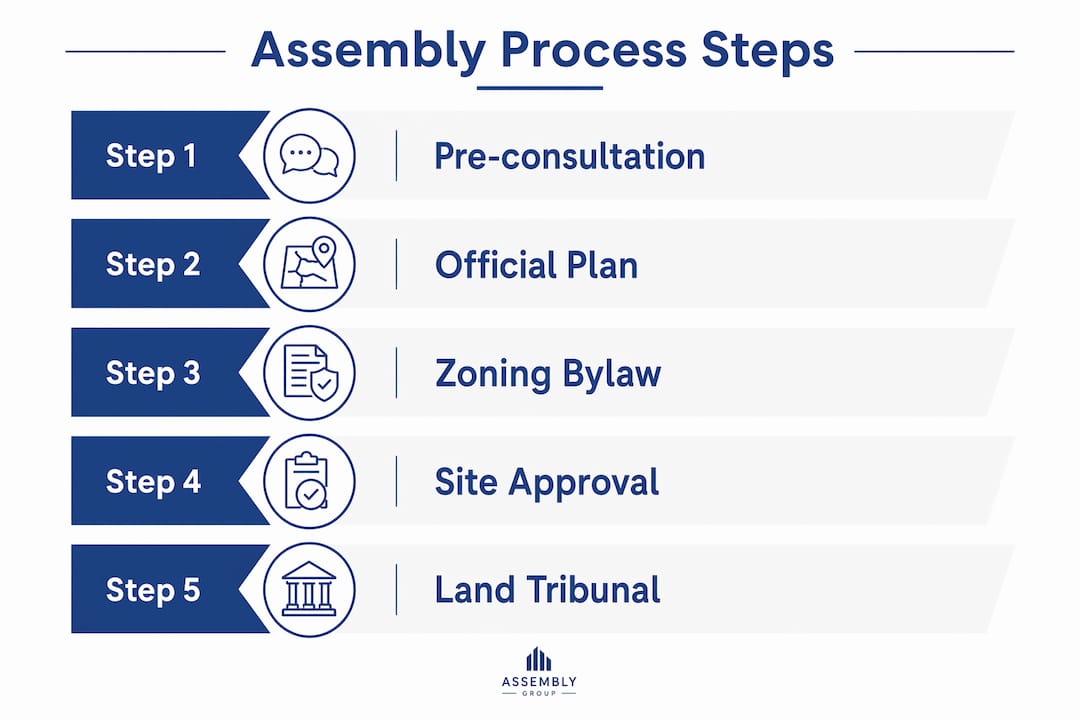
Step 1: Pre-consultation with municipal planning staff
Pre-consultation is the most underused tool in the approval process. A pre-consultation meeting with municipal planning staff is critical to avoid incomplete applications that stall statutory decision timelines indefinitely. Bring preliminary servicing assessments and draft technical studies to this meeting. Municipalities will tell you exactly what studies they require for a complete application, which eliminates guesswork and reduces resubmissions.
Step 2: Official Plan Amendment
If your assembled site does not conform to the existing Official Plan, you must apply for an Official Plan Amendment (OPA). Ontario municipalities have a statutory 120-day timeline to make decisions on OPA applications once deemed complete. That clock only starts when the municipality accepts your application as complete, which makes the pre-consultation step critical. An OPA application typically requires a planning justification report, a transportation impact study, a servicing and infrastructure report, and a market demand analysis.
Step 3: Zoning bylaw amendment
An OPA rarely stands alone. Most industrial assemblies also require a zoning bylaw amendment to align permitted uses, setbacks, and building heights with the proposed development. This application runs concurrently with the OPA in most municipalities, which saves time. The municipality reviews both applications together and issues decisions within the same statutory window where possible.
Step 4: Site Plan Approval
Site Plan Approval (SPA) under Section 41 of the Planning Act is the final regulatory gate before construction. Municipal SPA reviews increasingly focus on infrastructure capacity verification, including water, sanitary, and storm sewer systems. Grading plans, stormwater management reports, and servicing drawings receive detailed technical scrutiny. Integrating civil engineering expertise early in the OPA process increases approval likelihood by ensuring technical feasibility is established before the SPA stage.
Step 5: Ontario Land Tribunal appeals
If a municipality refuses your OPA or zoning amendment, or fails to decide within the statutory period, you may appeal to the Ontario Land Tribunal (OLT). OLT hearings add months to a project timeline and significant legal cost. The best way to avoid the OLT is to build a technically complete, well-supported application from the start.
Pro Tip: File your OPA and zoning bylaw amendment applications simultaneously. Most Ontario municipalities process them together, and concurrent filing can shave months off your overall approval timeline.
The regulatory timeline for a typical industrial assembly in Ontario looks like this:
| Approval stage | Typical timeline | Key submission requirement |
|---|---|---|
| Pre-consultation | 4–8 weeks | Concept plan, preliminary studies |
| OPA and zoning amendment | 120 days (statutory) | Full planning and technical package |
| Site Plan Approval | 60–120 days | Engineering drawings, servicing reports |
| OLT appeal (if required) | 12–24 months | Legal representation, expert witnesses |
Bill 98, introduced in 2026, will require municipalities to adopt standardised official plans by 2028–2029. The legislation prohibits municipalities from imposing enhanced local development standards beyond health and safety requirements. For industrial land developers, this standardisation reduces approval uncertainty across different GTA municipalities.
What negotiation strategies work for land consolidation?
Effective land consolidation requires a disciplined approach to parcel identification, seller engagement, and title management. Most industrial assemblies involve three to ten separate parcels, each with its own ownership structure, encumbrances, and timeline.
The first step is confidential parcel identification. Publicly announcing an assembly intention drives up land prices immediately. Experienced developers use numbered companies or agents to approach landowners without revealing the full scope of the project. This approach preserves negotiating leverage and prevents holdout pricing from individual sellers who recognise their parcel as the last piece of the puzzle.
Managing existing leases is one of the most underestimated complications in site assembly planning. Ontario’s Commercial Tenancies Act governs the rights of existing tenants, and leases with remaining terms can delay vacant possession by years. Review every lease on every parcel before signing a purchase agreement. Identify termination clauses, demolition provisions, and notice requirements. Factor tenant relocation costs and lease buyout expenses into your project budget from the beginning.
Title searches and environmental assessments run in parallel with negotiations. A clean title search confirms there are no easements, rights-of-way, or restrictive covenants that would prevent the intended industrial use. Environmental assessments confirm the soil and groundwater conditions are acceptable or quantify the remediation cost if they are not. Both processes take time, and both should begin as soon as a parcel is under conditional agreement.
Development charges are a significant cost item in any large assembly. Development charges cover approximately 80% of growth-related capital infrastructure expenses. The remaining 20% falls on the developer or, in some cases, on taxpayers through public subsidies. Budget for this gap explicitly. Large assemblies can also attract public scrutiny, and projects have remained opaque to the public for over two years during the assembly phase, which creates political risk when approvals become public.
Financing the assembly itself requires a clear capital structure. Industrial land development financing covers acquisition, carrying costs, and pre-development expenses across a timeline that can span three to five years before a shovel enters the ground. Understanding your industrial financing options early prevents capital shortfalls at critical stages.
Key negotiation tactics for a successful assembly:
- Stagger your conditional periods. Align due diligence deadlines across parcels so you can walk away from the entire assembly if one parcel fails its environmental or title review.
- Use option agreements where possible. Options give you time to complete planning approvals before committing full purchase capital.
- Build in demolition and remediation allowances. Negotiate price reductions that reflect known environmental or structural costs on each parcel.
- Communicate with tenants early. Transparent communication with existing tenants reduces legal disputes and preserves your reputation with the local business community.
What are the most common pitfalls in industrial land assembly?
The most frequent cause of failed industrial assemblies is underestimating infrastructure capacity. A site that appears adequate on paper often reveals inadequate electrical service, insufficient water pressure, or overloaded storm sewer systems once engineering studies begin. Operational costs can outweigh incentive savings over a ten-year horizon when infrastructure deficiencies are not caught early. Choosing a site solely for financial incentives leads to failures driven by logistical bottlenecks, insufficient skilled labour, or poor utility access.
Incomplete application submissions are the second most common problem. A municipality that deems your OPA application incomplete resets the 120-day statutory clock. Every reset adds months to your timeline and increases carrying costs on land you are already paying for. The solution is thorough pre-consultation and a complete technical package on first submission.
Managing municipal revisions efficiently requires a dedicated project manager with planning and engineering experience. Municipalities routinely request additional studies or revised drawings after initial submission. Each request has a response deadline, and missing those deadlines can result in your application being placed at the back of the review queue.
Public acceptance is a factor that developers frequently underestimate. Large industrial assemblies in established neighbourhoods attract scrutiny from adjacent residents and local business associations. Transparency about the project’s employment and economic benefits builds goodwill that translates into fewer objections at public meetings.
Pro Tip: Assemble your team before you assemble your land. A land use planner, civil engineer, environmental consultant, and real estate lawyer should all be engaged before you make your first offer. Their early input shapes every decision that follows.
Common pitfalls to avoid:
- Signing firm purchase agreements before environmental assessments are complete.
- Failing to account for tenant lease terms and relocation costs in the project budget.
- Submitting OPA applications without pre-consultation, leading to incomplete application notices.
- Ignoring labour market access when evaluating site viability.
- Underestimating the time and cost of municipal revisions and resubmissions.
Human judgment remains indispensable when using GIS and AI tools in site selection analysis. Technology identifies candidate sites efficiently, but assessing political climate, community acceptance, and future infrastructure changes requires experienced local knowledge. The GTA’s industrial market moves quickly, and local expertise is a genuine competitive advantage.
For developers considering how to structure a larger industrial project from the ground up, a detailed look at building investment property in the GTA provides useful context on sequencing capital, approvals, and construction timelines.
Key takeaways
Successful industrial land assembly in Ontario requires regulatory fluency, disciplined due diligence, and a multidisciplinary team engaged from the earliest stage of the process.
| Point | Details |
|---|---|
| Start with pre-consultation | Meet municipal planning staff before submitting any application to avoid incomplete filings that reset statutory timelines. |
| Assess infrastructure first | Confirm utility capacity, servicing, and environmental conditions on every parcel before signing binding agreements. |
| Run approvals concurrently | File OPA and zoning bylaw amendment applications simultaneously to reduce the overall approval timeline. |
| Budget for the development charge gap | Development charges cover approximately 80% of infrastructure costs; plan for the remaining 20% from the start. |
| Assemble your team early | Engage a planner, civil engineer, environmental consultant, and lawyer before making your first offer on any parcel. |
What I have learned from Ontario industrial assemblies
The thing that surprises most investors when they enter an industrial land assembly for the first time is how much of the process happens before any land changes hands. The planning work, the engineering studies, the pre-consultation meetings, the environmental reviews: all of that happens while you are still negotiating purchase agreements. That front-loading is not inefficiency. It is the only way to avoid spending millions on land that cannot be developed the way you intend.
I have seen projects stall because a developer signed firm on three parcels before discovering that the local electrical substation had no available capacity for the next seven years. That is not a recoverable situation. It is a write-down. The fix is simple: order the utility capacity study before you go firm on anything.
The regulatory environment in Ontario is genuinely improving. Bill 98’s standardisation of official plans across municipalities will reduce the variance in approval timelines that has made multi-municipality assemblies so unpredictable. That said, the 120-day statutory clock only starts when your application is deemed complete. Municipalities have wide discretion in what they require for completeness, and that discretion is where projects get stuck. Pre-consultation eliminates most of that uncertainty.
The GTA’s industrial land market is one of the most competitive in North America. The Greenbelt constraint is permanent. Employment land redesignations are ongoing. The window for assembling viable industrial sites in established submarkets like Brampton, Vaughan, and Mississauga is narrowing every year. Investors who understand the GTA industrial market and move with discipline will find opportunities. Those who wait for perfect conditions will find the land already gone.
The most valuable thing a developer can bring to an Ontario industrial assembly is patience combined with preparation. The process rewards people who do the work upfront and penalises those who try to shortcut due diligence.
— Michael Law
Working with Michael Law | Lennard Commercial on industrial land acquisition
Industrial land assembly in Ontario is a process where the right advisory team changes the outcome. Michael Law | Lennard Commercial brings over a decade of hands-on experience in GTA industrial real estate, covering site selection, acquisition strategy, and the full regulatory pathway from pre-consultation through to Site Plan Approval.
Whether you are assembling parcels in Brampton, Vaughan, Mississauga, or further afield, the team at Michael Law | Lennard Commercial provides market intelligence, parcel identification support, and broker expertise that accelerates your timeline and reduces risk. Explore current industrial real estate opportunities in Aurora or review available industrial properties in Newmarket to understand what is available in key GTA submarkets right now. Contact Michael Law | Lennard Commercial directly to discuss your assembly objectives and get a clear picture of what is achievable in today’s market.
FAQ
What is the industrial land assembly process?
The industrial land assembly process is the consolidation of multiple adjacent parcels into a single site large enough for industrial development. It involves property acquisition, environmental due diligence, and municipal planning approvals under Ontario’s Planning Act.
How long does industrial land assembly take in Ontario?
A typical industrial assembly in Ontario takes three to five years from initial parcel identification to construction-ready site. The OPA and zoning amendment process alone carries a statutory 120-day decision timeline once an application is deemed complete.
What is Bill 98 and how does it affect land assembly?
Bill 98, enacted in 2026, requires Ontario municipalities to adopt standardised official plans by 2028–2029. It prohibits municipalities from imposing local development standards beyond health and safety requirements, which reduces approval uncertainty for industrial land developers.
Do I need an Official Plan Amendment for industrial land assembly?
An OPA is required when the assembled site does not conform to the existing Official Plan designation. Many assemblies that cross zoning boundaries or propose uses not currently permitted require both an OPA and a concurrent zoning bylaw amendment.
What due diligence is required before assembling industrial land?
Phase I and Phase II Environmental Site Assessments, title searches, utility capacity studies, and a review of existing tenant leases are all required before committing to any parcel in an industrial assembly. Skipping any of these steps creates financial and legal exposure that can derail the entire project.
Recommended

About Michael Law
Managing Partner and Industrial Real Estate Broker at Lennard Commercial Realty. Representing tenants and landlords across Toronto and the GTA for 15+ years. Michael specializes in GTA industrial real estate — connect with Toronto's leading industrial broker at mlawrealestate.com/industrial-broker-toronto.