
Industrial property management companies: 2026 guide
By Michael Law · Industrial Real Estate Broker, Lennard Commercial Realty
TL;DR:
- Industrial property management companies focus on lease administration, maintenance, and data-driven cost controls. They improve NOI by reducing expenses, recovering revenues, and minimizing vacancy periods through specialized services. Their structured onboarding, maintenance planning, and transparent tenant relations lead to higher operational and financial performance.
Industrial property management companies are specialised firms that oversee the day-to-day operations, financial performance, and physical upkeep of warehouses, distribution centres, and manufacturing facilities. Unlike generic commercial property management, these firms focus on triple-net lease administration, predictive maintenance of industrial-grade systems, and data-driven cost controls that directly protect net operating income (NOI). Professional management reduces operating expenses by 3–8% and cuts vacancy periods by 30–60 days compared to self-management. For GTA industrial property owners, that gap in performance is the difference between a stabilised asset and a chronically underperforming one.
What do industrial property management companies actually do?
Industrial property management is the professional administration of income-producing industrial real estate assets, covering lease compliance, physical maintenance, financial reporting, and tenant relations. The term “industrial property management” is the recognised industry standard. “Warehouse management firms” and “logistics property management” describe the same function applied to specific asset subtypes.
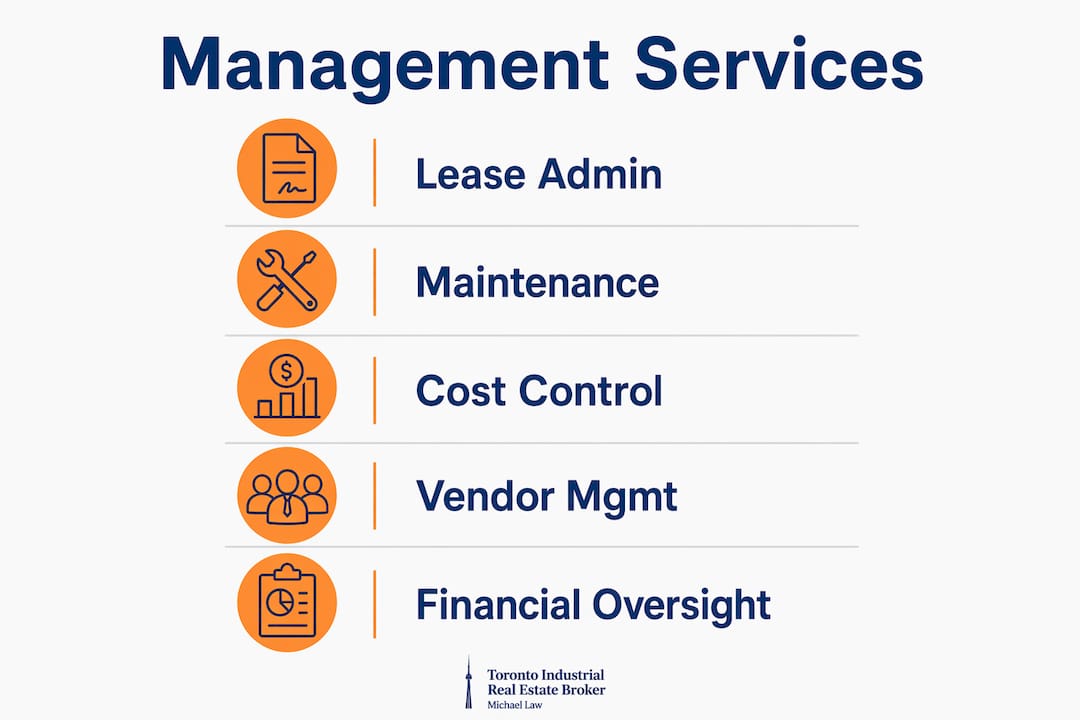
The core responsibilities fall into four categories: lease administration, physical asset maintenance, financial reporting, and tenant relationship management. Each category demands specialised knowledge that generic residential or retail property managers do not carry. A firm managing a 200,000-square-foot distribution centre in Brampton faces compliance obligations, mechanical systems, and lease structures that have no equivalent in office or retail management.

The GTA industrial market is one of the most competitive in Canada, with active corridors in Mississauga, Vaughan, Markham, and the Durham Region. Owners in these markets need management partners who understand local vacancy dynamics, submarket rent trends, and the operational demands of logistics and manufacturing tenants. Mlawrealestate provides market intelligence across all major GTA industrial nodes to support exactly these decisions.
What specialised services do industrial property management companies provide?
The services that separate industrial management firms from general property managers centre on technical depth and financial precision. Four areas define this specialisation.
Lease administration and revenue integrity
Triple-net leases are the standard structure in industrial real estate. Under a triple-net lease, the tenant pays base rent plus their proportionate share of property taxes, insurance, and operating costs. Administering these leases correctly requires tracking escalation clauses, auditing expense recoveries, and enforcing payment terms with precision. Revenue integrity audits identify missed escalations and incomplete expense recoveries before they compound into significant income losses.
Industrial-grade maintenance oversight
Industrial assets contain systems that require specialised contractors and scheduled inspections. Fire suppression systems, dock levellers, overhead cranes, HVAC units sized for large clear-height spaces, and electrical systems rated for heavy manufacturing loads all fall outside standard maintenance protocols. Predictive maintenance of fire suppression systems and dock levellers prevents costly operational downtime and keeps assets compliant with municipal and provincial regulations.
IoT-driven cost control
IoT sensors enable usage-based common area maintenance (CAM) billing, replacing the flat pro-rata cost shares that have historically caused tenant disputes. Sensors track actual utility consumption, lighting usage, and HVAC runtime across shared areas. This data produces defensible, transparent billing that tenants accept more readily than estimated allocations.
Proactive vendor management
Professional management firms maintain pre-qualified vendor networks for mechanical, electrical, and structural work. This reduces emergency repair costs and response times. Tailored preventive maintenance programmes can reduce emergency repairs by up to 60%. That figure reflects the compounding benefit of scheduled inspections catching failures before they become urgent and expensive.
Pro Tip: Request a sample vendor roster and maintenance schedule from any management firm you evaluate. A firm without pre-qualified industrial contractors will cost you more in emergency call-out fees within the first year.
How do professional industrial property managers improve financial outcomes?
Expert management produces measurable financial results across three areas: expense reduction, revenue recovery, and vacancy minimisation.
Operating expense reduction
Professional managers negotiate volume-based service contracts across their portfolios. A firm managing multiple industrial assets in Mississauga or Brampton carries more purchasing power with mechanical contractors, landscaping firms, and utility providers than a single-asset owner. This negotiating position translates directly into lower per-unit operating costs. Owners working with professional firms see 8–15% higher NOI and tenant retention rates above market averages.
Lease audit and revenue recovery
Annual lease audits uncover revenue leakage from uncollected rent escalations and incomplete NNN expense recoveries. These audits are most effective when conducted within the first 31–60 days of a new management engagement, when historical records are fresh and discrepancies are easiest to trace. The recovered income flows directly to NOI without requiring any capital investment.
“Revenue integrity enforcement via lease auditing and triple-net expense tracking is a key differentiator in professional industrial property management.”
Vacancy reduction and market positioning
Professional management teams maintain active broker relationships and detailed submarket data. This network reduces the time between tenant departure and new lease execution. Cutting vacancy by 30–60 days on a 100,000-square-foot facility at $15 per square foot per year represents $125,000–$250,000 in recovered revenue. Owners who treat vacancy as an inevitable gap rather than a manageable risk leave significant income on the table.
| Financial lever | Typical outcome with professional management |
|---|---|
| Operating expense reduction | 3–8% annual savings through vendor negotiation |
| NOI improvement | 8–15% higher than self-managed assets |
| Vacancy period reduction | 30–60 days faster lease-up |
| Emergency repair frequency | Up to 60% reduction with preventive maintenance |
For GTA owners seeking to maximise returns on industrial assets, these figures represent the financial case for professional management in concrete terms.
What are the best practices for industrial property maintenance and tenant relations?
Industrial property maintenance planning requires a different framework than commercial or residential maintenance. The systems are more complex, the consequences of failure are more severe, and the tenants are running active operations that cannot absorb unplanned downtime.
Building a maintenance planning framework
- Conduct a full asset audit on day one. Document the condition, age, and service history of every major system: HVAC, fire suppression, dock levellers, electrical panels, roofing, and structural elements. This baseline drives every subsequent maintenance decision.
- Categorise systems by criticality. Fire suppression and electrical systems carry compliance and safety obligations. Dock levellers directly affect tenant operations. HVAC affects both tenant comfort and equipment performance. Rank systems by the cost and consequence of failure.
- Build a 12-month preventive maintenance calendar. Schedule inspections and servicing for each system based on manufacturer recommendations and provincial code requirements. Assign responsible contractors before the schedule begins, not after a failure occurs.
- Implement work-order tracking software. Automated work orders linked to CAM reduce end-of-year invoice reconciliations and allow real-time, accurate tenant billing. This eliminates the year-end billing surprises that trigger tenant disputes.
- Review and update the maintenance plan quarterly. Systems age, tenant operations change, and new compliance requirements emerge. A static maintenance plan becomes obsolete within months.
Pro Tip: Link every maintenance work order to the corresponding lease clause and CAM category at the time of issue. Retroactively categorising expenses at year-end is where billing errors and tenant disputes originate.
Tenant relations and CAM transparency
CAM reconciliation in industrial properties is now a data-driven process that prioritises transparency and defensible cost allocation. Tenants running logistics or manufacturing operations are financially sophisticated. They review CAM statements carefully and challenge allocations they cannot verify. Providing detailed, itemised reconciliations with supporting invoices reduces disputes and builds the trust that supports lease renewals.
Strong tenant partnerships also reduce turnover costs. Replacing an industrial tenant involves broker commissions, tenant improvement allowances, and vacancy carrying costs that can equal 12–18 months of base rent. Retaining a tenant through proactive communication, responsive maintenance, and fair billing is almost always the better financial outcome. Owners can review examples of industrial tenants in the GTA to better understand the operational priorities that drive retention decisions.
How does the onboarding process work with industrial property management companies?
The transition to professional management follows a structured 90-day cycle. Each phase has specific deliverables that build toward full operational and financial control.
-
Days 1–30: Data gathering and historical review. The management firm collects all existing lease documents, service contracts, maintenance records, financial statements, and rent rolls. This phase identifies gaps in documentation and establishes the baseline for all future reporting. Aligning with the owner’s lender and CPA requirements begins here.
-
Days 31–60: Audit and gap identification. Deep-dive lease audits within this window recover lost funds and improve income by identifying missed escalations and incomplete NNN recoveries. The firm also audits vendor contracts for pricing, scope, and compliance. Maintenance deficiencies identified in the asset audit are prioritised for immediate remediation.
-
Days 61–90: Stabilisation and system implementation. The management firm implements its maintenance schedule, financial reporting systems, and tenant communication protocols. Balance sheets, income statements, and rent rolls are aligned to CPA requirements. The transition from the previous management arrangement concludes, and the property operates under the new firm’s full oversight.
The 90-day structure matters because it prevents the common failure mode of new management firms making changes before they understand the asset. Owners should expect a detailed written report at the end of each phase, covering findings, actions taken, and outstanding items.
| Phase | Timeline | Primary deliverable |
|---|---|---|
| Data gathering | Days 1–30 | Complete lease and financial document review |
| Audit | Days 31–60 | Revenue leakage report and vendor contract review |
| Stabilisation | Days 61–90 | Full operational and financial system implementation |
Understanding occupancy costs in GTA industrial leases is a prerequisite for making the audit phase productive. Owners who arrive at the transition without a clear picture of their current cost structure extend the timeline and delay NOI improvements.
Key takeaways
Professional industrial property management produces measurable NOI gains through lease auditing, preventive maintenance, and active vacancy management, making it a financial decision, not just an operational one.
| Point | Details |
|---|---|
| Expense reduction is quantifiable | Professional management cuts operating expenses by 3–8% through vendor negotiation and contract discipline. |
| Lease audits recover real income | Audits within the first 31–60 days identify missed escalations and NNN recovery gaps that directly improve NOI. |
| Maintenance planning prevents loss | A structured preventive maintenance calendar reduces emergency repairs by up to 60% and protects tenant operations. |
| CAM transparency retains tenants | Itemised, data-backed CAM reconciliation reduces disputes and supports lease renewals in industrial assets. |
| The 90-day transition is structured | A phased onboarding cycle covering data gathering, auditing, and stabilisation delivers reliable results without operational disruption. |
What I have learned after years in GTA industrial real estate
Most owners who contact me about property management are reacting to a problem: a tenant dispute, a maintenance failure, or a lease renewal they handled poorly. The owners who get the best long-term results are the ones who treat management as a proactive investment decision, not a crisis response.
The most common mistake I see is hiring a general commercial property manager to oversee an industrial asset. The lease structures are different. The maintenance systems are different. The tenant expectations are different. A manager who excels at office or retail properties will consistently underperform on a warehouse or manufacturing facility, not because they lack effort, but because the technical knowledge gap is real and consequential.
The second mistake is treating management as rent collection. Industrial properties are active operational environments. Your tenants are running logistics networks, manufacturing lines, or distribution operations that depend on the physical performance of your building. A dock leveller that fails during peak season does not just inconvenience a tenant. It disrupts their supply chain, damages the relationship, and accelerates their decision to relocate at lease expiry.
The firms that perform best in the GTA market combine local submarket knowledge with genuine technical depth. They know the difference between a Class A distribution facility in Mississauga and a multi-tenant industrial park in Oshawa, and they manage each accordingly. They also align their daily decisions with the owner’s long-term investment goals, whether that is maximising current income, repositioning for sale, or holding through a development cycle.
My advice: evaluate management firms on their lease audit track record, their maintenance vendor network, and their familiarity with GTA industrial submarkets. Technology use matters, but it is secondary to market knowledge and operational discipline. You can find out more about my approach to industrial real estate advisory at Lennard Commercial Realty.
— Michael
GTA industrial property owners: how Mlawrealestate can help
Mlawrealestate provides industrial real estate advisory services across the full GTA, covering Mississauga, Brampton, Vaughan, Markham, Hamilton, and the Durham Region. The focus is on high-value outcomes: lease negotiation, investment sales, and market intelligence that owners can act on.

For owners evaluating their current management arrangements or preparing an asset for sale or re-leasing, Mlawrealestate delivers the submarket data and transaction experience to support the decision. Review current industrial property listings and advisory services to see how the GTA market looks from a broker who works in it every day. Whether you are renewing a lease, repositioning an asset, or acquiring your next industrial property, the right advisory relationship starts with the right market knowledge.
FAQ
What do industrial property management companies do?
Industrial property management companies oversee lease administration, physical maintenance, financial reporting, and tenant relations for warehouses, distribution centres, and manufacturing facilities. Their specialisation in triple-net leases and industrial-grade systems separates them from general commercial property managers.
How much can professional management improve NOI?
Owners working with professional industrial management firms typically see 8–15% higher NOI compared to self-managed assets, driven by operating expense reductions of 3–8% and vacancy periods shortened by 30–60 days.
What is included in an industrial property maintenance checklist?
A standard industrial property maintenance checklist covers HVAC systems, fire suppression inspections, dock leveller servicing, roofing condition, electrical panel reviews, and structural assessments. Each item should be scheduled on a 12-month preventive maintenance calendar with assigned contractors.
How long does the transition to a new management company take?
The standard transition follows a 90-day cycle: 30 days for data gathering and document review, 30 days for lease and vendor auditing, and 30 days for operational and financial stabilisation aligned to lender and CPA reporting standards.
What is CAM reconciliation in industrial leases?
CAM reconciliation is the annual process of calculating each tenant’s actual share of common area operating costs and comparing it against their monthly estimates. Accurate, itemised CAM statements backed by invoices and IoT usage data reduce tenant disputes and support lease renewals.
Recommended

About Michael Law
Managing Partner and Industrial Real Estate Broker at Lennard Commercial Realty. Representing tenants and landlords across Toronto and the GTA for 15+ years. Michael specializes in GTA industrial real estate — connect with Toronto's leading industrial broker at mlawrealestate.com/industrial-broker-toronto.