Must-know zoning regulations for buyers and developers
By Michael Law · Industrial Real Estate Broker, Lennard Commercial Realty
Zoning rules control what you can build, where you can build it, and how the finished property has to look. They govern permitted uses, height, setbacks, lot coverage, parking, and dozens of other site standards, and they are enforceable the moment you apply for a building permit. Before you sign anything, confirm the property’s zone and read the bylaw provisions that attach to it.
Three steps get you there:
- Find the zone. Pull up the municipal zoning map or GIS portal and note the exact zone code and any overlays.
- Read the bylaw. Open the official text (in Toronto, that’s Zoning By-law 569-2013) and check the zone’s permitted uses and definitions.
- Get help if it’s blocked. Book a pre-consultation with planning staff, or bring in a broker or land-use planner before you commit.
Zoning by-laws implement the municipal official plan and must conform with the Planning Act and the Provincial Policy Statement. That’s why the rules on a parcel in Milton can differ sharply from an outwardly similar parcel in Vaughan, even under the same provincial framework.
Key Takeaways
Confirming a property’s zone code and reading the bylaw’s use and dimensional provisions before you commit is the single step that prevents most zoning surprises.
| Point | Details |
|---|---|
| Confirm the zone first | Use the municipal GIS map or portal to find the exact zone code and any overlays before doing anything else. |
| Read definitions, not just the use list | A term like “retail” may map to a narrower bylaw definition that excludes your intended use. |
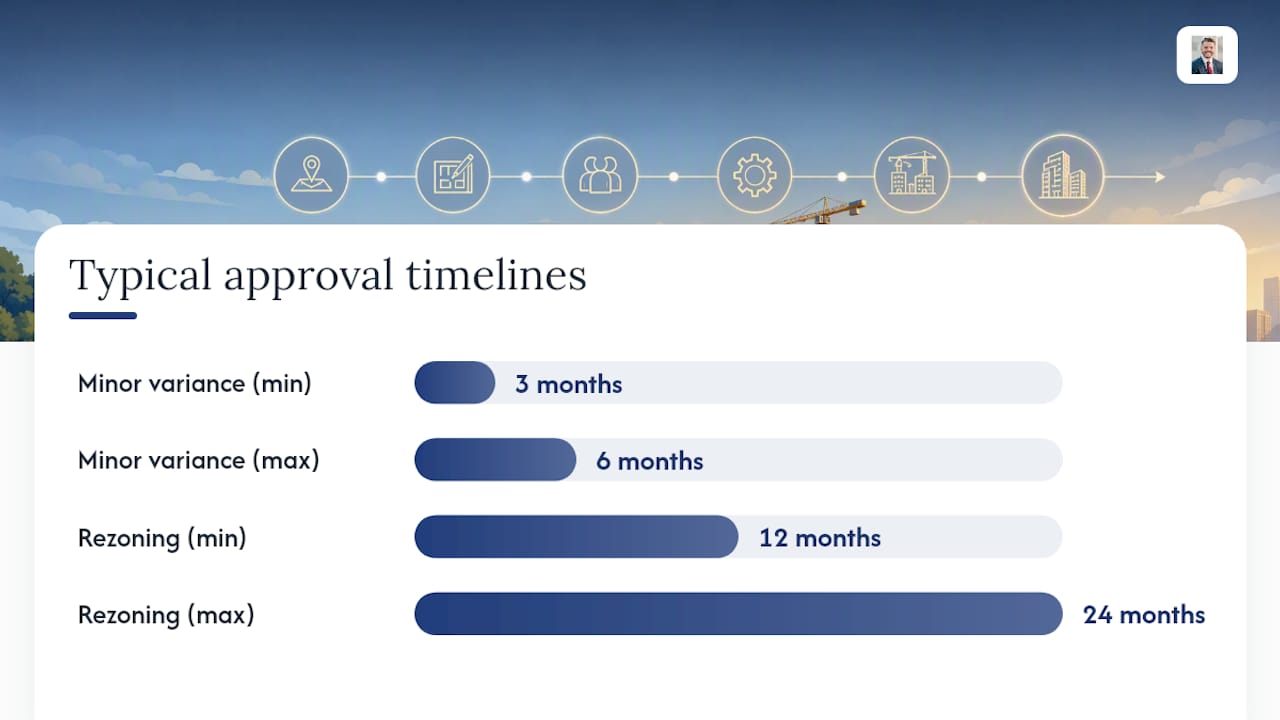
| Know your timeline | Minor variances typically take 3 to 6 months; rezoning applications typically run 12 to 24 months. |
| Check industrial compatibility early | Potential influence areas run up to substantial distances for Class III facilities and can stall approvals late in the process. |
| Get broker and planning support | Michael Law |
Table of Contents
- What zoning is and why it matters for property owners or developers
- What are the essential zoning controls to check before you buy?
- How do I find the zoning for a specific property?
- How do you interpret permitted versus conditional uses in a bylaw?
- What are your options if zoning blocks your development plan?
- Enforcement, non-conforming uses, and compliance risk
- Industrial-specific considerations: compatibility, influence areas and D-6 guidance
- Due-diligence checklist before buying or starting development
- Sources
- FAQ
What zoning is and why it matters for property owners or developers
Zoning bylaws are municipal laws that carve a city into zones and attach legal rules to each one. They aren’t guidelines. A municipality can withhold your building permit outright if your plan doesn’t match the zone’s provisions, regardless of how much money you’ve already spent on drawings.
The legal effects show up in a few consistent places:
- Permitted uses — what you’re allowed to operate as-of-right.
- Conditional uses — uses allowed only with extra approval or conditions attached.
- Development standards — setbacks, height limits, and floor area ratio that shape the physical building.
- Enforceability — non-compliant projects simply don’t get permits, full stop.
Every bylaw sits underneath the municipality’s official plan, and that official plan has to conform with the Provincial Policy Statement and the Planning Act. Councils weigh land suitability, servicing, flood risk, and provincial policy conformity before a bylaw or amendment gets approved. That chain of authority is why a zoning check belongs at the top of any due diligence list, not somewhere after the offer is already firm.
What are the essential zoning controls to check before you buy?
Reading a zoning bylaw properly means checking specific line items, not skimming the summary. Miss one of these and your intended use can collapse after closing.
Use provisions come first: permitted uses, conditional uses, and the definitions that decide which bucket your operation falls into. A single word choice in the definitions section can flip a use from allowed to prohibited.
Physical form controls shape what you can actually build on the lot:
- Setbacks (front, side, and rear yard minimums)
- Maximum building height
- Lot coverage percentage
- Floor space index or floor area ratio
- Minimum lot size and density caps
Operational rules govern how the site runs day to day: parking ratios, loading and access requirements, outdoor storage limits, signage, and permitted hours of operation. Toronto’s employment zoning provisions, for example, include use-specific floor area caps_Zoning.pdf?cbcachex=460714) that cap eating establishments at a set square metreage within certain employment zones, and front setbacks in the range of 3.0 metres are common across industrial and employment areas. Those numbers look minor until they eliminate the mezzanine expansion or the drive-through you’d planned.
How do I find the zoning for a specific property?
Every municipality with a digital zoning map makes this a five-minute check, provided you know where to look and what to save.
- Search the address on the municipal GIS portal. Toronto, Mississauga, Brampton, and most GTA municipalities publish interactive zoning maps. Note the exact zone code and flag any overlays layered on top (heritage, environmental, holding symbols).
- Open the bylaw text itself and search that zone code. Municipal maps show you the zone; the bylaw text tells you what it actually permits, along with any site-specific exceptions that override the general zone rules.
- Confirm with planning staff directly. Online consolidations can lag behind recent amendments, so a quick call or email closes that gap before it becomes your problem.
Pro Tip: Screenshot every map view and PDF page with the date visible, and save the exact URL. If a dispute arises months later over what the zoning showed at the time you looked, a dated screenshot is worth far more than your memory of it.
How do you interpret permitted versus conditional uses in a bylaw?
Start at the zone table. It lists permitted uses, conditional uses, and reference numbers pointing to any conditions or exceptions attached to that zone. That table is your map, but it’s not the whole territory.
Read the definitions section next, every time, without exception. A term that sounds obvious in conversation, like “retail,” often maps to a narrower bylaw definition such as “retail service” or “retail store,” which excludes uses you assumed were covered. This is the single most common way well-intentioned buyers misread a bylaw.
Then check for site-specific provisions layered on top of the base zone:
- Exception chapters that override or modify the general zone rules for that specific parcel
- Holding symbols (often an “H” prefix) that block development until a condition is satisfied
- Overlays for heritage, environmental protection, or special policy areas
Pro Tip: Use your PDF reader’s search function on the zone code and any exception number together. Bylaw documents run hundreds of pages, and searching gets you to the relevant clause in seconds instead of scrolling through chapters that don’t apply.
What are your options if zoning blocks your development plan?
When the current zone won’t support your plan, you have a few realistic paths, and they differ enormously in scope and timeline.
A minor variance covers small departures from dimensional standards, like a setback that’s 0.5 metres short or a parking count slightly under the ratio. A rezoning application is a different animal entirely: a change to the permitted use or the zone category itself, and it moves through council rather than a committee of adjustment.
The typical sequence looks like this:
- Pre-consultation with municipal planning staff
- Submission of the application with required studies and drawings
- Public notice and a statutory comment period
- Staff report and a decision by council or committee
- Possible appeal to the Ontario Land Tribunal if a party objects
Timelines vary by municipality and complexity, but minor variances commonly resolve in 3 to 6 months, while rezoning applications typically run 12 to 24 months from pre-consultation to final approval.
- Minor variance: dimensional relief only, faster process
- Rezoning: use or zone change, slower and more politically exposed
- MZOs (Minister’s Zoning Orders): a provincial override tool, used selectively and usually for larger or priority projects
Pro Tip: Book pre-consultation before you finalize your site plan. Planning staff will flag conflicts early, and that single meeting routinely shaves months off the review by catching problems before they reach a formal submission.
Enforcement, non-conforming uses, and compliance risk
Municipalities enforce zoning through fines, stop-work orders, injunctions, and outright refusal to issue permits. Ontario’s enforcement framework confirms that third parties generally can’t force a municipality to enforce on their behalf, which means compliance sits squarely on the property owner, not on whoever complains first.
A use that predates a bylaw change can often continue as a “legal non-conforming use,” but that protection is narrower than most owners assume. Expand the operation, change the use materially, or discontinue it for too long, and the protection can disappear entirely.
- Fines and statutory orders can halt operations mid-lease
- Environmental liability can attach independently of zoning status
- Legal or planning review is worth the cost whenever the compliance risk is material, not just when a problem has already surfaced
Industrial-specific considerations: compatibility, influence areas and D-6 guidance
Industrial sites carry a layer of complexity that residential and retail zoning don’t: compatibility with nearby sensitive uses. Ontario’s D-6 guidance sets recommended separation distances between industrial facilities and sensitive land uses like homes, schools, and hospitals, based on the facility’s class.
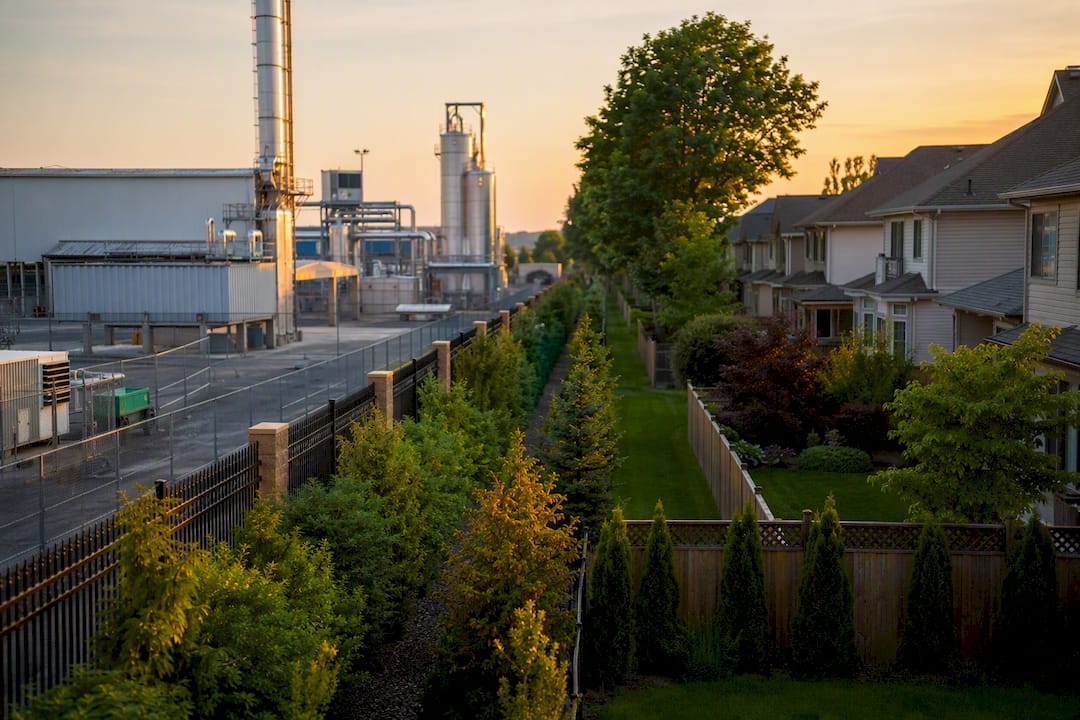
Potential influence areas run from roughly 20 metres for lower-impact Class I operations up to substantial distances for Class III facilities, the heaviest-impact category involving significant noise, odour, or emissions. Developers routinely underestimate how far that influence area extends, and it’s a mistake that can stall an approval late in the process rather than catch it early.
Compatibility matters because noise, truck traffic, emissions, and buffering requirements directly shape whether a municipality approves a site, and how much buffer land you’ll need to set aside. A flexible industrial zone designation can still get bogged down in a compatibility review if a school or residential pocket sits within the influence radius.
Pro Tip: Commission a compatibility or noise study during site selection, not after you’ve made an offer. A study that surfaces a problem before closing gives you negotiating leverage; the same finding after closing just gives you a costly surprise.
Due-diligence checklist before buying or starting development
A property that looks zoned correctly on the surface can still hide problems that only show up once you dig into the bylaw text and title history.
- Confirm the exact zone code and any overlays
- Read the full permitted and conditional use lists
- Check definitions and any site-specific exceptions
- Confirm holding provisions tied to the site
- Review parking and loading requirements against your operation
- Check for heritage or environmental designations
- Order an environmental site assessment for industrial land
- Confirm there’s no outstanding zoning enforcement or order registered on title
Budget realistically for what comes next:
- Zoning confirmation and bylaw review: days, largely free through municipal portals
- Minor variance or site plan approval: months and application fees in the low thousands
- Rezoning with studies (traffic, noise, environmental): a year or more, with consultant fees that can run into the tens of thousands depending on scope
Bring in the right people early: a broker who knows the site selection process for industrial land, a municipal planner, a land-use lawyer, and technical consultants like an engineer or noise specialist when the site calls for it.
Author perspective: practical broker advice from experience in the GTA
Michael Law is Managing Partner at Lennard Commercial and has spent over a decade in GTA industrial brokerage. His advice: check zoning fit before you write the offer, not after. If there’s a gap between what you need and what the zone permits, price the rezoning or variance timeline directly into your conditions, because that timeline is what actually determines whether the deal works.
If you want help: discreet site selection and approvals support
Reading a zoning bylaw is one thing. Getting a rezoning application through council, or negotiating lease terms around a site-specific exception, is a different skill entirely, and it’s where most self-directed searches run into trouble. Michael Law | Lennard Commercial handles site selection, zoning due diligence, rezoning and approvals support, and lease negotiation for industrial tenants and investors across the GTA, which means you’re not piecing together a bylaw interpretation and a lease negotiation as two separate problems.

If you’re evaluating a site in Mississauga, Brampton, Vaughan, or anywhere else across the GTA industrial market, a property review before you make an offer can catch a zoning conflict while you still have room to renegotiate or walk away. Get in touch with Michael Law to review a specific property, or browse current industrial listings to see what’s available across the region.
Sources
Start with the primary sources rather than secondary summaries. Toronto’s Zoning By-law 569-2013 page hosts the interactive map and full bylaw text, while Ontario’s citizen’s guide to land use planning explains how bylaws and the Planning Act interact. For industrial-specific work, review the D-6 compatibility guidance directly. Municipal websites are always the authoritative source, and consolidations can lag amendments, so confirm anything material with planning staff.
This article is general information, not a substitute for advice from a qualified lawyer. Consult a qualified legal professional about your own circumstances before acting on anything here.
- Zoning bylaws | Citizen’s guide to land use planning
- Comparisons | Global Practice Guides | Chambers and Partners
- Zoning By-law 569-2013
FAQ
What are the zoning laws in Ontario?
Ontario zoning laws are set at the municipal level through bylaws that must conform with the Planning Act and the Provincial Policy Statement, and each municipality’s bylaw controls permitted uses, setbacks, height, and density for every zone within its boundaries.
What does R1 zoning mean?
R1 typically designates a low-density residential zone reserved for single detached dwellings, though the exact permitted uses, minimum lot size, and setback requirements vary by municipality, so the bylaw text for that specific jurisdiction is the only reliable source.
What are local zoning requirements?
Local zoning requirements are the specific rules a municipal bylaw attaches to a property’s zone, covering permitted and conditional uses, setbacks, height, lot coverage, parking, and any site-specific exceptions or holding provisions layered on top.
What are zoning laws in Canada?
Zoning in Canada is regulated provincially and applied municipally, meaning each province sets the legal framework (in Ontario, the Planning Act and Provincial Policy Statement) while individual municipalities write and enforce their own zoning bylaws within that framework.
How do I know if my industrial use is permitted?
Check the zone code against the bylaw’s permitted and conditional use list and its definitions section, since industrial zoning varies by municipality and a property that looks industrial may still lack permission for your specific operation.
Recommended

About Michael Law
Managing Partner and Industrial Real Estate Broker at Lennard Commercial Realty. Representing tenants and landlords across Toronto and the GTA for 15+ years. Michael specializes in GTA industrial real estate — connect with Toronto's leading industrial broker at mlawrealestate.com/industrial-broker-toronto.