Real estate consulting companies: a guide for GTA investors
By Michael Law · Industrial Real Estate Broker, Lennard Commercial Realty
TL;DR:
- Real estate consulting firms provide critical analysis and advice that help investors make informed property decisions.
- Engaging these firms early reduces risks and improves outcomes in the competitive GTA industrial market.
Real estate consulting companies are specialised advisory firms that provide analytical, regulatory, and transactional guidance to help investors and business owners make confident property decisions. In the GTA industrial market, where vacancy rates remain historically tight and zoning complexity continues to grow, the difference between a profitable acquisition and a costly mistake often comes down to the quality of advice you receive before you commit capital. Property consulting firms operating in this sector cover the full asset lifecycle, from initial site feasibility through to due diligence, financial modelling, and transaction execution. This article explains what these firms do, how to choose the right one, and what to expect from a well-run consulting engagement in 2026.
What services do real estate consulting companies offer industrial investors?
Real estate investment consulting covers far more ground than most investors initially expect. The core service categories span market intelligence, environmental due diligence, financial underwriting, zoning assessment, and portfolio analysis. Each discipline addresses a different layer of risk in an industrial acquisition or development project.

Market intelligence and site feasibility form the foundation of any credible consulting engagement. A qualified firm will analyse vacancy rates, net rental trends, absorption data, and comparable transactions across specific GTA submarkets such as Vaughan, Brampton, or the Durham Region. That analysis tells you whether a target asset is priced fairly and whether the submarket supports your operational or investment thesis.
Environmental due diligence is non-negotiable for industrial properties. Many GTA industrial sites carry legacy contamination from prior manufacturing or fuel storage uses. A consulting firm with environmental expertise will commission Phase I and Phase II Environmental Site Assessments, interpret the findings, and advise on remediation cost exposure before you close. Skipping this step has cost investors millions in unexpected cleanup liability.
Financial modelling and underwriting translate site data into investment performance projections. Institutional-grade underwriting and scenario modelling improve deal outcomes by stress-testing assumptions around rent growth, vacancy, capital expenditure, and exit cap rates. This work gives you a defensible basis for your offer price and financing structure.
Additional service lines include:
- Zoning and planning pathway assessment: Confirming permitted uses, identifying rezoning requirements, and mapping the municipal approval timeline before you acquire.
- Highest and best use analysis: Determining whether a site is better suited for logistics, manufacturing, land assembly, or intensification, rather than assuming the current use is optimal.
- Portfolio optimisation: For owners with multiple assets, consultants assess which properties to hold, reposition, or dispose of based on current market conditions and capital allocation priorities.
- Regulatory compliance advisory: Navigating Ontario’s Planning Act, the Growth Plan for the Greater Golden Horseshoe, and municipal official plan policies that govern industrial land use.
Consulting services span the full property lifecycle, from concept through completion, to reduce execution risk at every stage. That breadth is what separates a genuine consulting firm from a brokerage that simply calls itself one.
Pro Tip: Ask any consulting firm you are evaluating to show you a sample deliverable, such as a feasibility report or underwriting model, before you engage. The quality of their analytical output tells you more than any sales conversation.
How to choose the right property consulting firm for your project
Selecting the right commercial real estate consulting firm is a project-specific decision, not a generic one. The criteria that matter most depend on your asset type, transaction complexity, and geographic focus.
-
Verify local market expertise. A firm with deep knowledge of GTA industrial submarkets will have current data on net rents, land values, and absorption trends in Mississauga, Markham, or Hamilton. General commercial expertise does not substitute for submarket-level knowledge when you are competing for scarce industrial land.
-
Assess the team’s disciplines. The most effective engagements draw on financial analysts, environmental specialists, planning consultants, and transaction advisors working together. A firm that offers only one discipline will give you an incomplete picture. Multidisciplinary consulting teams are increasingly essential for successful execution in 2026.
-
Clarify the engagement model. Project-based consulting without ongoing retainers allows you to scope analytical work around a specific deal rather than a standardised template. This model suits most industrial investors because it aligns the consultant’s work directly to your transaction timeline and budget.
-
Evaluate transparency and deliverables. A credible firm will define the scope, timeline, and format of every deliverable upfront. If a consultant is vague about what you will receive, that vagueness will show up in the work itself.
-
Check the track record. Ask for references from clients who completed similar transactions in the GTA industrial sector. A firm that has advised on logistics acquisitions in Brampton or industrial sites in Markham will understand the specific regulatory and market dynamics you face.
-
Confirm analytical capabilities. Modern consulting engagements require custom financial simulations, not generic spreadsheet templates. Ask whether the firm builds deal-specific models or applies a one-size-fits-all approach to underwriting.
Understanding zoning in real estate is a baseline requirement for any industrial acquisition. A consulting firm that cannot clearly explain the zoning pathway for your target site is not equipped to protect your interests.
Pro Tip: Request a complimentary scoping call before signing any engagement letter. Many commercial property consultants offer a no-cost initial consultation to assess project fit. Use that session to test the quality of their questions, not just their answers.
What does a consulting project workflow look like?
A well-structured consulting engagement follows a defined sequence of phases. Each phase builds on the last, and skipping any one of them increases execution risk.
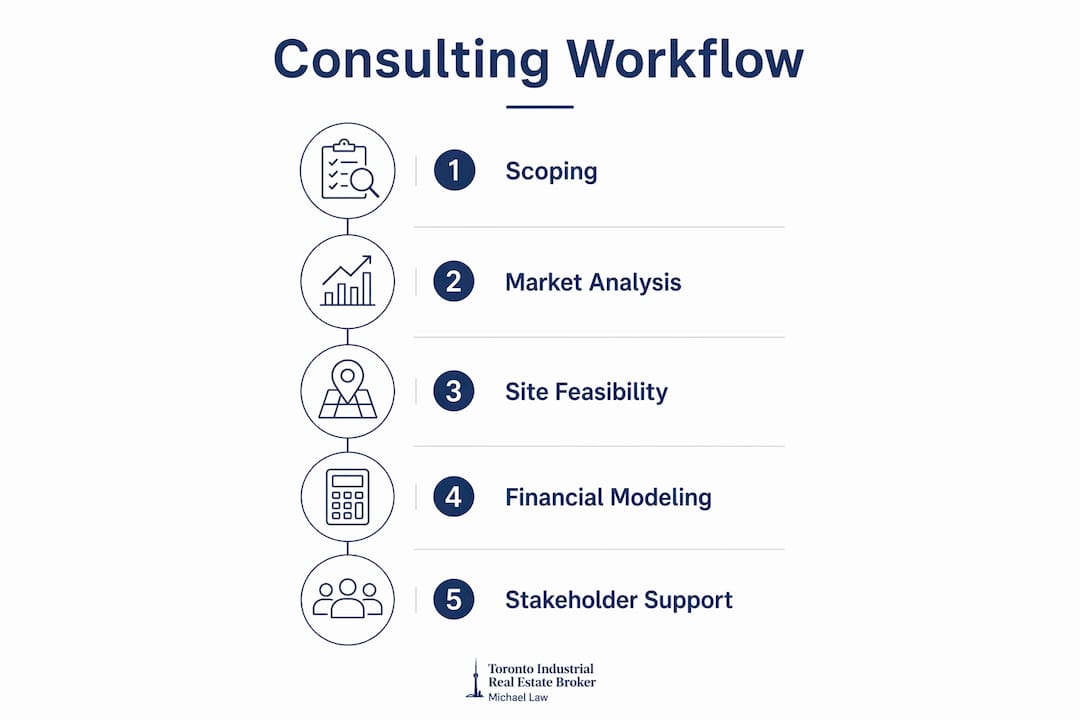
Effective consulting engagements focus on “clarity before commitment,” where advisors help structure execution frameworks and align stakeholders before capital is deployed. That principle shapes every phase of a credible workflow.
Phase 1: Initial scoping. The engagement begins with a consultation, often at no cost, to define project objectives, confirm the asset type and geography, and agree on the scope of analytical work. Many specialised firms offer complimentary initial consultations lasting approximately 30 minutes to assess project feasibility and alignment.
Phase 2: Market analysis. The consulting team pulls current vacancy data, rental comparables, and absorption metrics for the target submarket. This phase answers whether the market conditions support your acquisition thesis before you spend money on site-specific work.
Phase 3: Site feasibility and regulatory assessment. The team assesses the specific property against zoning permissions, environmental risk indicators, servicing capacity, and planning policy constraints. For GTA industrial sites, this often involves reviewing the applicable official plan, employment land policies, and any applicable provincial policy statements.
Phase 4: Financial modelling. The team builds a deal-specific underwriting model incorporating acquisition costs, financing assumptions, operating expenses, and projected returns under multiple scenarios. Market intelligence, feasibility, underwriting, and financial modelling build a foundation on which industrial investors can make confident acquisition decisions.
Phase 5: Stakeholder alignment and transaction support. The consulting team helps align internal decision-makers, lenders, and legal advisors around a shared understanding of the deal structure and risk profile. This phase also covers support during the due diligence period and, where relevant, the municipal approval process.
The table below summarises the five phases and their primary outputs.
| Phase | Primary output |
|---|---|
| Initial scoping | Defined project scope and engagement terms |
| Market analysis | Submarket vacancy, rent, and absorption report |
| Site feasibility and regulatory assessment | Zoning, environmental, and servicing summary |
| Financial modelling | Deal-specific underwriting model with scenario analysis |
| Stakeholder alignment and transaction support | Aligned decision framework and due diligence support |
For a detailed look at what due diligence requires in the GTA industrial context, the commercial due diligence guide from Mlawrealestate covers the critical factors investors need to assess before closing.
What trends are shaping real estate consulting for industrial properties in 2026?
The consulting environment for industrial real estate has shifted considerably in the past two years. Three forces are driving that change: decarbonisation requirements, regulatory complexity, and the growing sophistication of financial modelling tools.
Decarbonisation and energy benchmarking are now material considerations in industrial acquisitions. Ontario’s large building energy and water reporting requirements, combined with increasing lender scrutiny of carbon exposure, mean that a property’s energy profile affects both its operating cost and its long-term asset value. Consulting firms that cannot assess energy benchmarking risk are leaving a significant gap in their advisory work.
Regulatory complexity has increased across every GTA municipality. Changes to employment land policies under the provincial Planning Act, combined with municipal official plan updates and intensification pressures, have made zoning pathway assessment a more specialised and time-consuming discipline than it was five years ago. Investors who rely on general legal advice rather than planning-specific consulting often discover late in the process that their intended use requires an amendment they did not budget for.
Modern commercial real estate projects face complexity due to decarbonisation initiatives, regulatory pressures, and resilient construction requirements. This complexity makes multidisciplinary teams not a luxury but a requirement for successful execution.
“The most effective real estate consulting transforms strategic intent into operational performance, guiding permitting, repositioning, and transaction execution.” The firms that deliver this outcome in 2026 are those that combine environmental, financial, and regulatory expertise within a single, coordinated team rather than treating each discipline as a separate engagement.
Advanced scenario planning is the third major shift. Consulting firms now build dynamic financial models that test multiple rent growth trajectories, interest rate environments, and exit timing assumptions simultaneously. That capability matters most when you are acquiring an asset in a submarket like Burlington’s industrial corridor, where land values have moved significantly and future absorption is less predictable than it was during the pandemic-era demand surge.
Integrated consulting approaches that combine environmental, financial, and regulatory disciplines reduce friction and improve consistency during complex commercial real estate projects. Investors who engage firms with all three capabilities in-house close faster and with fewer surprises.
Key takeaways
Engaging a qualified real estate consulting firm before committing capital is the single most effective way to reduce acquisition risk and improve returns in the GTA industrial market.
| Point | Details |
|---|---|
| Full lifecycle coverage | Consulting services span feasibility, due diligence, financial modelling, and transaction support. |
| Multidisciplinary teams | Firms combining environmental, financial, and planning expertise deliver better outcomes than single-discipline advisors. |
| Project-based engagement | Scope consulting work to a specific deal rather than a long-term retainer to control costs and maintain focus. |
| Clarity before commitment | Define scope and align stakeholders before deploying capital to reduce execution risk. |
| Local market expertise | GTA submarket knowledge, covering vacancy, rents, and zoning, is non-negotiable for industrial acquisitions. |
What I’ve learned about consulting and industrial real estate in the GTA
Most investors I speak with underestimate how much the quality of pre-acquisition analysis affects their long-term returns. They focus on the deal itself, the price, the location, the tenant covenant, and treat consulting as an overhead cost rather than a return driver. That framing is wrong, and I have seen it cost people real money.
The investors who consistently outperform in the GTA industrial market share one habit: they engage advisory support early, before they fall in love with a specific asset. Early engagement means the feasibility work shapes the offer, not the other way around. It means the zoning assessment happens before the deposit goes hard. It means the financial model is built on current submarket data, not assumptions carried over from a deal done two years ago.
The benefits of hiring a real estate advisor are most visible in the deals that do not close. A rigorous feasibility process will kill a bad deal before it consumes your time, your legal budget, and your opportunity cost. That outcome does not show up in a transaction record, but it is often the most valuable thing a consulting engagement delivers.
The GTA industrial market in 2026 is not forgiving of underprepared buyers. Vacancy is low, competition for quality assets is high, and the regulatory environment is more complex than it has ever been. Investors who treat consulting as optional are competing against those who treat it as standard practice. The gap in outcomes between those two groups is widening.
— Michael
How Mlawrealestate supports GTA industrial investors
Mlawrealestate delivers industrial real estate consulting and brokerage services across the GTA, covering every major industrial node from Mississauga and Brampton to Markham, Vaughan, and the Durham Region. The advisory approach is project-based, meaning the work is scoped directly to your acquisition, lease, or development objective without requiring a long-term retainer.
Services include site identification, market feasibility, lease negotiation, investment sales advisory, and land acquisition support. Mlawrealestate operates under the Lennard Commercial Realty platform, providing clients with institutional-grade market data and a proven transaction track record. For investors focused on industrial land in Markham or other high-demand GTA submarkets, the first step is a no-obligation consultation to scope your project and confirm market fit. Reach out directly through mlawrealestate.com to get started.
FAQ
What do real estate consulting companies actually do?
Real estate consulting companies provide analytical and advisory services that help investors and business owners evaluate, acquire, and manage properties. Their work typically includes market analysis, feasibility studies, financial modelling, due diligence, and regulatory assessment.
How is a consulting firm different from a real estate broker?
A broker facilitates transactions, while a consulting firm provides independent analysis and strategic advice. Many firms, including Mlawrealestate, combine both capabilities to support clients from initial feasibility through to deal closing.
Do consulting firms require long-term contracts?
Many commercial property consultants offer project-based engagements with no long-term retainer requirement. This model allows investors to scope the work to a specific transaction and control advisory costs accordingly.
Why is local GTA expertise important in industrial real estate consulting?
GTA industrial submarkets vary significantly in vacancy rates, net rents, zoning permissions, and land values. A consulting firm without current, submarket-level data cannot provide reliable feasibility or underwriting analysis for acquisitions in Brampton, Vaughan, or the Durham Region.
When should I engage a real estate consulting firm?
Engage a consulting firm before you make an offer, not after. Early engagement means feasibility and zoning assessments inform your offer price and conditions, which reduces the risk of costly surprises during due diligence.
Recommended
About Michael Law
Managing Partner and Industrial Real Estate Broker at Lennard Commercial Realty. Representing tenants and landlords across Toronto and the GTA for 15+ years. Michael specializes in GTA industrial real estate — connect with Toronto's leading industrial broker at mlawrealestate.com/industrial-broker-toronto.