
GTA Tenants: 4 Step Checklist and Sample for a Relocation Clause
By Michael Law · Industrial Real Estate Broker, Lennard Commercial Realty
Relocation clauses are enforceable in Ontario when the lease grants that right clearly, but they are also one of the most negotiable provisions on the page. Canadian courts, including decisions touching on cases like Meridian, Bennett, and Millenium, consistently look for precise triggers and preconditions before letting a landlord act. Tenants who push for turn-key substitute premises, landlord-paid relocation costs, real notice periods, and a termination right if the new space falls short, tend to come out whole. If you have received a relocation notice, save it, gather your occupancy records, and call a broker or commercial lawyer before the clock runs on your response window.
TL;DR:
- Tenants should negotiate for clear, measurable relocation standards such as square footage, space features, and defined timelines to prevent vague and potentially costly clauses.
- It is crucial to confirm that all preconditions like permits and objective facts are satisfied before accepting a landlord’s relocation or termination notice.
- Protecting operational needs involves prioritizing landlord-paid costs, turn-key move-in, and termination rights if the new space does not meet agreed standards.
- Most courts scrutinize whether landlords strictly follow the lease language and preconditions when invoking relocation rights, making precise drafting essential.
- Tenants should review lease terms and any notices promptly with legal counsel before responding, to ensure protections and compliance with applicable legal precedents.
Table of Contents
- What a relocation clause in a commercial lease actually does
- When can a landlord actually invoke relocation rights?
- Tenant protections worth fighting for
- Building your negotiation checklist and clause language
- What to do the moment you receive a relocation notice
- What Canadian courts have said about relocation and redevelopment clauses
- Negotiating relocation clauses in the GTA industrial market
- Why the standard advice on relocation clauses misses the point
- Get a lease reviewed before you sign or respond to a notice
- Sources
- FAQ
What a relocation clause in a commercial lease actually does
A relocation clause, sometimes labelled “substitution of premises,” gives a landlord the right to move a tenant from its leased space to another unit within the same building or property, usually with adjusted rent and a notice period attached. You will find these provisions most often in shopping centre leases and multi-tenant office towers, though they appear in industrial parks too, particularly where a landlord anticipates redevelopment or wants flexibility to accommodate a larger anchor tenant.
Landlords include this language for straightforward business reasons: redevelopment plans, renovation phasing, re-merchandising a retail mix, or freeing up contiguous space for expansion by a bigger occupier. Most relocation clauses sit dormant for the life of a lease. Landlords rarely exercise a legitimate business reason to trigger one, but when redevelopment plans firm up, a poorly drafted clause becomes very active very fast, which is exactly when the wording you negotiated years earlier starts to matter.
When can a landlord actually invoke relocation rights?
Legitimate triggers usually fall into a short list: demolition, major renovation, redevelopment of the property, or reconfiguring space to accommodate a larger tenant. Courts scrutinize whether the lease attaches real preconditions to that trigger, not just a broad right to move you whenever convenient.
The preconditions that matter most include a requirement for building permits before notice is valid, objective facts showing the move is actually necessary, a defined geography (same building or property, not “anywhere in the portfolio”), and a fixed timing window. Miller Thomson’s analysis of redevelopment clauses shows Canadian courts have repeatedly examined whether landlords satisfied permit and factual impracticability requirements before accepting a termination or relocation notice as valid.
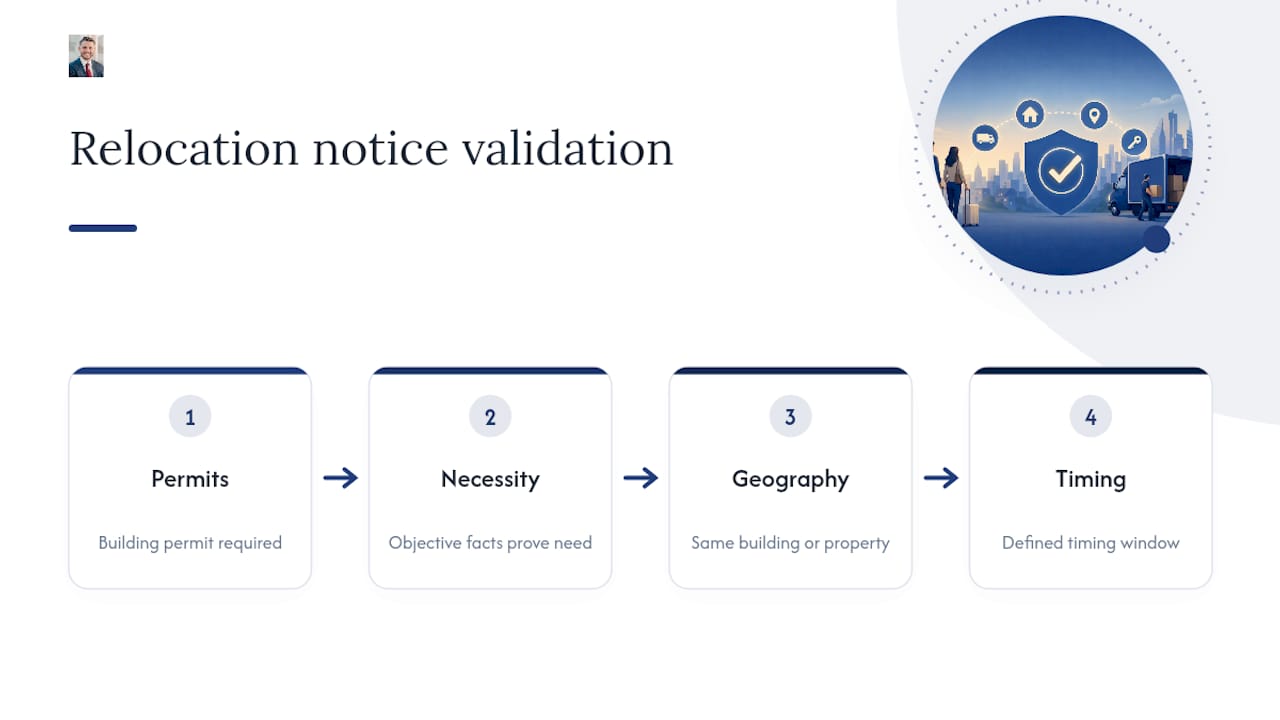
Red flags for tenants reviewing a draft lease: vague trigger language (“landlord may relocate tenant for any reason”), no permit or approval precondition, unlimited geography, or no mechanism describing how the landlord approves or confirms the substitute space.
Tenant protections worth fighting for
Not every protection is worth the same negotiating capital. Rank these by what actually protects your business if the clause is ever triggered.
- Turn-key substitute premises. Require the landlord to complete fit-up in the new space, or stage the move so you never operate from an unfinished unit. Mann Lawyers advises tenants to negotiate for turn-key premises or explicit landlord payment of all relocation and soft costs, and this is the single highest-value ask on the list.
- Full landlord-paid costs, covering the physical move, IT and equipment reinstallation, new signage, stationery, website updates, and documented business interruption. Soft costs like marketing and lost sales are the ones tenants forget to list explicitly, and landlords will not volunteer to cover what the lease does not name.
- Objective comparability criteria: minimum and maximum square footage, comparable visibility and frontage, similar configuration, and for industrial space, matching clear height and dock access.
- Notice and timing limits: a minimum notice period, often a couple of months depending on the space size and buildout complexity, plus blackout dates during peak trading seasons or the first and last year of the term.
- Rent protections: no increase in effective rent purely because of the move, pro-rated adjustments only if square footage genuinely changes, and a cap on any increase tied to relocation.
- A termination or buy-out right if the substitute space fails the objective tests you negotiated, plus an extension of your original term to recover from downtime.
Pro Tip: Never accept “comparable premises” as written. Insist on a defined square footage range, named frontage or dock requirements, and a stated timeline for landlord completion of fit-up. Vague adjectives are where landlords retain all the discretion.
Building your negotiation checklist and clause language
Work through leverage before wording. If you are renewing in a tight submarket, ask whether the landlord even needs this clause in your lease at all, since removal is always the strongest outcome when you have the upper hand.
- Map your leverage. Renewal timing, vacancy rates in the submarket, and how replaceable you are to the landlord all shape what you can realistically win.
- Rank your priorities. Turn-key delivery and full cost coverage first, objective comparability metrics second, notice length and termination rights third.
- Draft measurable standards, not adjectives. Square footage ranges, named dock counts, defined clear heights, and permit requirements as a precondition to any valid notice.
- Insist on a termination remedy if the substitute premises fail your objective tests, giving you an exit rather than a forced downgrade.
A workable definition of comparable premises might read: “Substitute premises shall not be less than [X] square feet nor more than [Y] square feet, shall provide frontage and visibility reasonably comparable to the existing premises, and, for industrial premises, shall include no fewer than [N] shipping doors and a minimum clear height of [Z] feet.”
The landlord shall be solely responsible for all costs of relocation, including but not limited to moving expenses, leasehold improvements to bring the substitute premises to a condition comparable to the existing premises, reinstallation of tenant’s equipment and signage, and documented business interruption, and shall provide not less than [90] days’ written notice, exclusive of any period between [November 1] and [January 15].
Practical Law’s clause library for relocation of leased premises is a reasonable drafting starting point, but every sample needs localizing to Ontario’s case law before it goes into a signed lease.
What to do the moment you receive a relocation notice
- Compare the notice to the lease immediately. Check whether the stated trigger matches the clause’s actual language, and confirm the landlord has satisfied any precondition, such as a building permit, before treating the notice as valid.
- Document everything from day one. Keep the original written notice, photograph your current space and any construction activity, and start a log of lost sales, extra labour, and every communication with the landlord.
- Call your broker and commercial lawyer now, not after you have already responded. Ask the landlord for a written, detailed relocation proposal and request an extension if the timeline is tight.
- Work within realistic timelines. Most notice periods run 30 to 180 days. That window is enough to negotiate cost coverage and comparability standards, but rarely enough to fight a well-drafted clause outright.
- Push for termination or court intervention if the landlord lacks the required permits, the notice looks issued in bad faith, or the substitute space fails the standards your lease actually sets.
What Canadian courts have said about relocation and redevelopment clauses
Canadian case law, including matters referencing Meridian, Bennett, and Millenium, has repeatedly turned on two questions: did the lease’s language actually authorize what the landlord did, and did the landlord meet every precondition attached to that authority? Courts have set aside or scrutinized landlord notices where redevelopment language did not clearly extend to the action taken, or where a demolition clause was invoked without the permits or factual impracticability the clause required.
The drafting lesson is consistent across these decisions: align your notice language with the exact trigger named in the clause, never assume “redevelopment” covers a simple renovation, and always require permits or another objective milestone before a notice is valid. Miller Thomson’s review of redevelopment clause disputes and related commentary on landlord redevelopment rights both point to the same pattern: specificity in drafting is what prevents litigation, and ambiguity is what invites it.
Negotiating relocation clauses in the GTA industrial market
Industrial tenants in the GTA usually have the most leverage at renewal, especially in submarkets where vacancy stays tight and comparable space is scarce. That leverage should go toward the attributes that actually run your operation: dock count, clear height, bay spacing, and column layout, not just square footage.
Practical compromises that still protect a tenant include staged fit-outs so operations never pause, rent adjustments capped at a fixed percentage regardless of any size change, and a documented mechanism for covering relocation costs rather than a vague promise. A tenant representative negotiating assignment and subletting language applies the same discipline to turn-key commitments: get the landlord’s obligations in writing, tied to measurable specifications, before you sign anything.
Why the standard advice on relocation clauses misses the point
Most guidance on this topic tells tenants to “negotiate hard” without saying what to actually prioritize, and that vagueness costs tenants real money. The clause’s existence is not the problem. A relocation right that never triggers costs you nothing. The risk lives entirely in the preconditions and the cost allocation, and that is where most leases fail tenants.
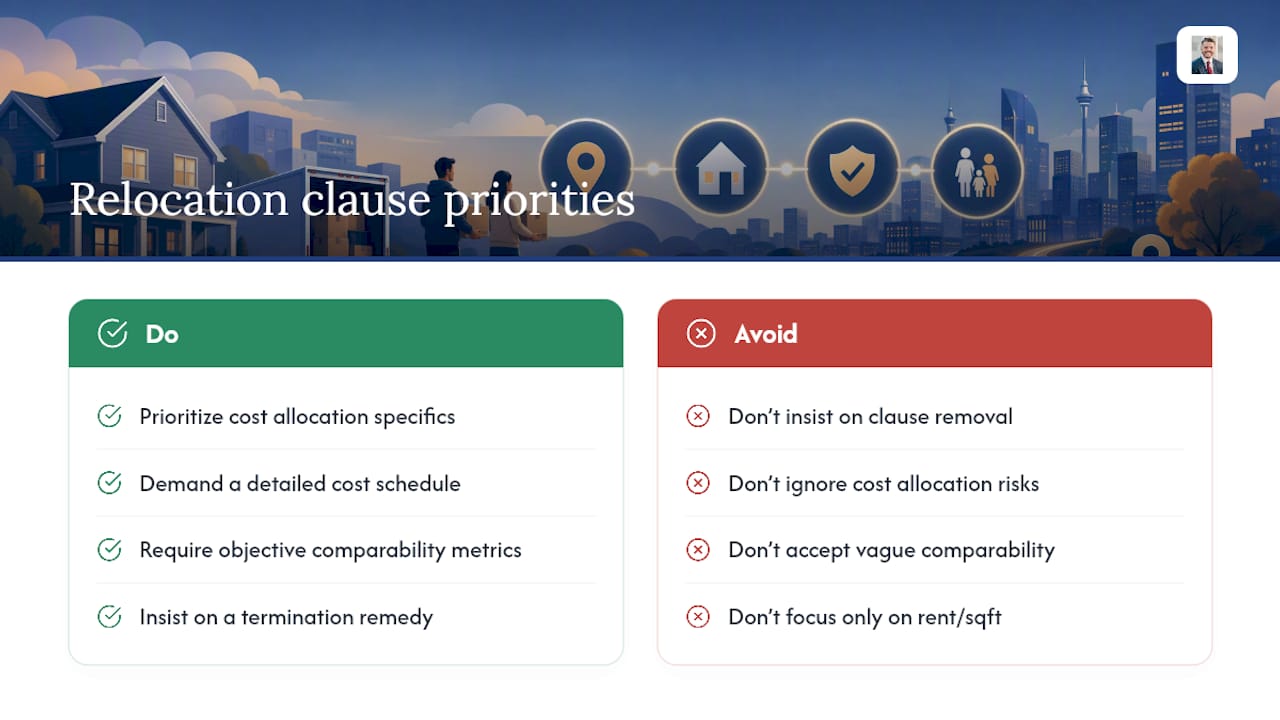
I’d argue the conventional advice overrates clause removal and underrates cost specificity. Landlords with genuine redevelopment plans rarely agree to strike the clause outright, especially in tight GTA industrial submarkets where they hold real leverage. A tenant who spends their negotiating capital demanding removal often walks away with nothing, while a tenant who demands a detailed cost schedule, objective comparability metrics, and a termination remedy usually gets all three. Prioritize the things that protect your business if the clause is ever used, not the fight over whether it exists on paper.
The other gap: tenants focus on rent and square footage while ignoring operational specifics. For an industrial occupier, a substitute space with the wrong clear height or too few dock doors is not comparable no matter what the square footage says.
*— Michael Law
Get a lease reviewed before you sign or respond to a notice
Michael Law | Lennard Commercial represents industrial and commercial tenants across the GTA, and lease review is where most relocation problems get fixed before they ever become a dispute. Rather than discovering a vague relocation clause after a landlord invokes it, bring the lease, any notices already received, your current occupancy data, and a list of must-have protections to a review before you sign a renewal or respond to a redevelopment notice.

Michael Law | Lennard Commercial provides tenant representation and lease negotiation across the GTA, working directly for occupiers rather than landlords, which means every relocation clause gets read with your operational needs as the priority, not the property’s redevelopment timeline. If you occupy or are searching for space in markets like Newmarket, Aurora, or Kitchener, request a lease review before your next renewal deadline or before responding to any relocation notice already in hand.
Sources
- What to Consider when Your Commercial Landlord is Insisting on a Relocation Clause
- Dealing with redevelopment clauses in commercial leases
- Commercial Leases: Relocation of Leased Premises
This article is general information, not a substitute for advice from a qualified lawyer. Consult a qualified legal professional about your own circumstances before acting on anything here.
FAQ
What are the common clauses in a commercial lease?
Beyond relocation provisions, most commercial leases include assignment and subletting terms, rent escalation formulas, repair and maintenance obligations, and early termination or buy-out rights, all of which interact directly with how a relocation clause plays out in practice.
Can a commercial landlord terminate a lease to relocate a tenant?
A landlord can only relocate or terminate for redevelopment when the lease grants that specific right and the required preconditions, such as permits or documented redevelopment plans, are satisfied; Canadian courts have struck down notices that skip those steps.
What are employee relocation rights in Canada?
Employee relocation rights fall under employment law and human rights legislation, not commercial lease law; they are a separate matter from a tenant business being relocated within a leased building under its commercial lease.
How do you break a commercial lease legally in Ontario?
Breaking a commercial lease in Ontario generally requires an early termination clause already in the lease, a negotiated surrender agreement with the landlord, or grounds like landlord default; simply vacating without one of these routes typically leaves the tenant liable for remaining rent.
Is a relocation clause in a commercial lease negotiable?
Yes. Relocation clauses are routinely narrowed, removed, or reinforced with tenant protections during lease negotiations, particularly when a tenant representative identifies real leverage points like renewal timing or tight submarket vacancy.
Recommended

About Michael Law
Managing Partner and Industrial Real Estate Broker at Lennard Commercial Realty. Representing tenants and landlords across Toronto and the GTA for 15+ years. Michael specializes in GTA industrial real estate — connect with Toronto's leading industrial broker at mlawrealestate.com/industrial-broker-toronto.