
Retail broker guide for GTA commercial leasing 2026
By Michael Law · Industrial Real Estate Broker, Lennard Commercial Realty
TL;DR:
- Retail brokers in the GTA represent tenants or landlords in retail leasing, earning commission paid by landlords. They provide specialized services like space analysis, lease negotiation, and market intelligence, especially for off-market opportunities. Choosing a corridor-focused, experienced broker ensures better lease terms, market access, and strategic advantages in a competitive environment.
A retail broker is a licensed commercial real estate professional who represents tenants or landlords in retail space leasing transactions, earning a commission of 5–7% of total lease value, typically paid by the landlord. This role is distinct from residential brokerage and general commercial practice. Retail leasing involves unique lease structures, foot traffic analysis, and percentage rent clauses that demand corridor-specific expertise. For business owners and real estate investors operating in the Greater Toronto Area, engaging the right brokerage professional is one of the most consequential decisions in a commercial leasing cycle. The GTA’s competitive retail corridors make local market intelligence a non-negotiable requirement, not a bonus.
What does a retail broker do in commercial leasing?
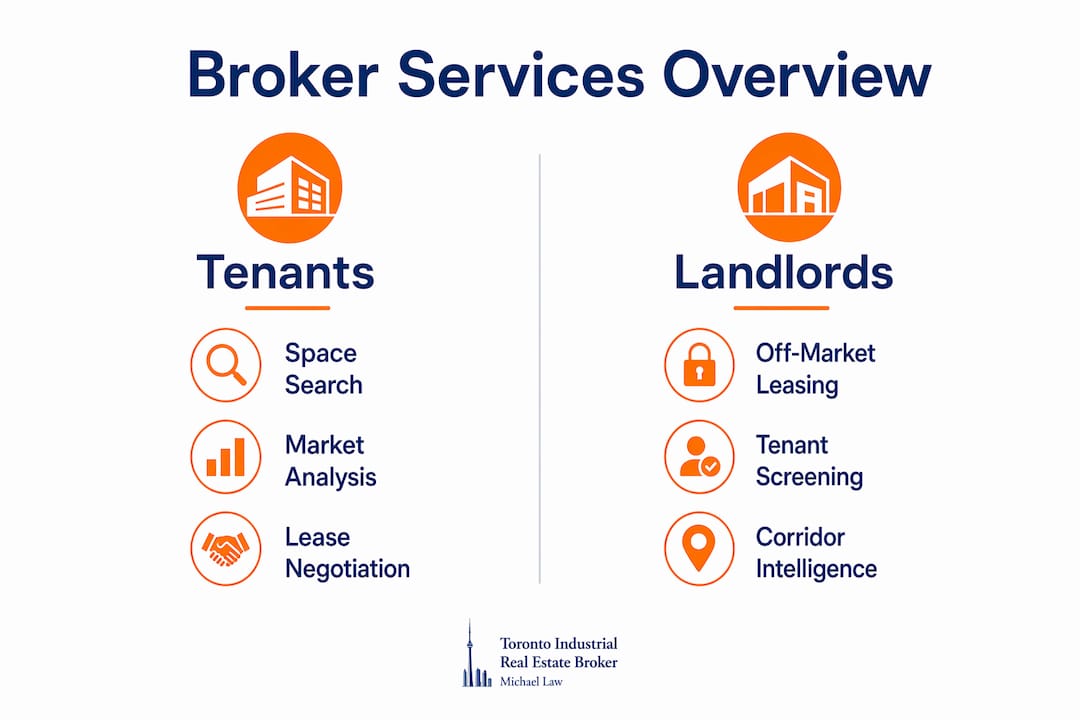
A retail broker acts as a licensed intermediary who handles space identification, property tours, lease negotiation, and transaction management from first showing to lease signing. The industry term for this role is “retail leasing broker,” and the function splits into two distinct sides: tenant representation and landlord representation. Both sides require the same foundational licence, but the work and incentives differ significantly.

Retail leasing brokers specialize in retail lease structures featuring foot traffic analysis and percentage rent clauses, requiring expertise that general commercial brokers do not typically carry. A broker advising a restaurant tenant on a Queen Street West location needs to understand pedestrian counts, co-tenancy clauses, and demolition provisions. A broker leasing a power centre pad site in Mississauga needs to understand anchor tenant dynamics and exclusivity rights. These are not interchangeable skills.
On the tenant side, the broker identifies suitable spaces, conducts market analysis, arranges tours, negotiates lease terms, and coordinates with legal counsel through to execution. On the landlord side, the broker positions the property in the market, qualifies prospective tenants, manages marketing, and handles renewals and build-out coordination. Both functions require deep knowledge of GTA retail corridors, from Yonge and Eglinton in Toronto to Hurontario Street in Mississauga.
Technology now plays a meaningful role in how brokers gather and act on market intelligence. Platforms like Station CRM allow brokers to track deal pipelines, manage tenant relationships, and monitor corridor-specific availability systematically. This kind of structured deal tracking separates high-performing brokers from those relying on informal networks alone.
Pro Tip: When interviewing a potential broker, ask specifically which retail corridors they have closed deals in during the past 18 months. Corridor-specific transaction history is a far more reliable signal than years of general experience.
What services does a retail broker provide to tenants and landlords?
The full scope of retail brokerage services extends well beyond finding a space and signing a lease. Both tenants and landlords receive distinct, structured support throughout the leasing lifecycle.
Services for tenants
- Space identification and shortlisting: The broker filters available inventory against your operational requirements, including size, ceiling height, loading access, and zoning.
- Market analysis: Current asking rents, vacancy trends, and comparable transactions in your target corridor inform your negotiating position before you ever sit across from a landlord.
- Property tours and due diligence: Brokers arrange access, flag physical deficiencies, and assess fit against your business model.
- Lease negotiation: This is where tenant representation delivers the clearest financial value. Negotiating lease terms covers rent-free periods, tenant improvement allowances, renewal options, and demolition clauses.
- Legal coordination: Brokers work alongside your solicitor to align business terms with legal language before execution.
Services for landlords
- Market positioning and pricing: The broker advises on asking rent relative to current corridor benchmarks, reducing vacancy periods.
- Tenant qualification: Screening prospective tenants for financial strength and brand fit protects long-term asset value.
- Marketing and deal management: Brokers manage listing exposure, inbound inquiries, and negotiation through to lease execution.
- Renewals and build-out coordination: Experienced brokers manage lease renewals proactively and coordinate tenant improvement scopes with contractors.
Off-market retail spaces in competitive markets are filled through broker relationships and corridor intelligence, not public listings. This is especially true in dense GTA nodes like Bloor West Village, Kensington Market, and the Scarborough Town Centre area, where desirable units rarely reach public platforms before a qualified tenant is already in conversation.
Pro Tip: Ask your broker to provide a list of off-market transactions they have closed in the past year. If they cannot name at least two or three, their relationship network may not be deep enough for competitive corridors.
How do retail brokers charge for their services?
Retail broker compensation in commercial leasing follows a straightforward structure, though the specifics vary by deal type and market.
Standard commission model in retail leasing
| Fee element | Typical structure | Who pays |
|---|---|---|
| Commission rate | 5–7% of total lease value | Landlord |
| Payment timing | Lease signing and rent commencement | Landlord to both brokers |
| Tenant cost | Generally nil (direct) | Tenant |
| Split | Divided between tenant rep and landlord rep | Per co-op agreement |
Commission is typically 5–7% of the total rent payable over the lease term, and the landlord pays in most transactions. That means a tenant engaging a retail leasing broker pays nothing directly for representation. The landlord’s commission obligation is built into the economics of the deal from the outset.
Commission is paid at two points: lease signing and rent commencement. The total is split between the tenant’s broker and the landlord’s broker under a co-operating brokerage agreement. This structure aligns both brokers’ incentives with completing the transaction.
CPG and product retail broker fees
Consumer packaged goods (CPG) brokers operate under a different model. CPG brokers charge a monthly retainer starting at $2,500 plus a 5% commission on sales generated. This retainer-plus-commission structure funds ongoing account management while the performance commission keeps the broker focused on results. These brokers act as outsourced retail sales teams, managing everything from buyer lists to shelf replenishment.
Contrast with financial brokerage fees
For context, full-service financial brokers charge 1–2% annually on portfolio value, while robo-advisors charge 0.25–0.5%. Discount brokerage services in the financial sector offer minimal advisory support in exchange for lower fees. The choice between discount brokerage and full-service representation in any sector reflects the same trade-off: lower cost versus depth of advisory.
Pro Tip: In retail leasing, never assume the commission structure is fixed. On large or complex deals, commission rates and payment timing are negotiable. A broker who tells you otherwise is either inexperienced or not representing your interests.
What types of retail brokers are there, and how do you choose?
Retail brokerage specialisation falls into three primary categories, and choosing the wrong type for your situation costs money and time.
-
Tenant representation brokers work exclusively for tenants. They have no financial incentive to steer you toward a particular landlord or property. This is the cleanest structure for business owners seeking space, as the broker’s loyalty is undivided. Tenant representation in the GTA covers space identification, market analysis, negotiation, and legal coordination.
-
Landlord representation brokers work for property owners. They market vacant space, qualify tenants, and manage the leasing process on behalf of the asset. Their incentive is to fill the space at the best achievable rent for the landlord.
-
Full-service brokers represent both sides, sometimes on the same transaction. This is called dual agency and requires disclosure. Full-service brokers offer broad market coverage but introduce a potential conflict of interest that tenants and landlords should understand before engaging.
Criteria for selecting the right broker
Broker selection should emphasise corridor-specific deal history, proven tenant or landlord relationships, systematic deal tracking, and communication reliability. Generic experience is not enough in the GTA, where block-specific expertise matters. A broker who has closed five deals on Dundas Street West carries more relevant knowledge than one with 20 years of suburban strip-mall experience.
Portfolio size is a practical concern that most investors overlook. Brokers should cap client portfolios at roughly 10 active accounts per representative to maintain proactive service. An overextended broker misses market windows and fails to follow up on time-sensitive opportunities.
Verify credentials through the Real Estate Council of Ontario (RECO) registry for GTA-based brokers. Confirm their brokerage affiliation, active licence status, and any disciplinary history before signing a representation agreement.
Pro Tip: Request a written list of the broker’s last five completed transactions, including property address, tenant type, and lease term. This single document tells you more about fit than any sales conversation.
What are the practical benefits of engaging a retail broker in the GTA?
Engaging a qualified retail leasing broker delivers measurable advantages for both tenants and landlords, particularly in a market as competitive as the GTA.
- Better lease terms through advocacy: Brokers negotiating on behalf of tenants secure more favourable rent structures, longer rent-free periods, and higher tenant improvement allowances than unrepresented tenants typically achieve. Landlords represented by experienced brokers attract stronger tenants and reduce vacancy periods.
- Access to off-market inventory: The most desirable retail spaces in the GTA are rarely listed publicly. Brokers with deep corridor relationships surface these opportunities before they reach the open market.
- Navigation of complex lease clauses: Percentage rent provisions, co-tenancy requirements, exclusivity clauses, and demolition rights are standard in retail leases. A broker who understands these clauses protects you from costly surprises mid-term.
- Time savings for busy operators: A business owner managing daily operations cannot dedicate the hours required to tour spaces, analyse comparables, and negotiate lease language. A broker absorbs that workload.
- Data-backed site selection: Brokers with access to current vacancy rates, absorption data, and rental trend reports give investors and tenants a factual basis for site decisions rather than intuition.
“The broker’s role is not simply to find a space. It is to position the client to make the best possible decision with the best available information, then execute that decision at the best achievable terms. In a market like the GTA, that combination of intelligence and advocacy is what separates a good deal from a costly one.”
Mlawrealestate operates across all major GTA retail and industrial corridors, including Toronto, Mississauga, Brampton, Vaughan, Markham, and the Durham Region. The platform’s affiliation with Lennard Commercial Realty provides access to institutional-grade market data and a broad network of landlord and tenant relationships. For investors and business owners making leasing decisions in 2026, that depth of local knowledge is a concrete competitive advantage.
Key takeaways
A retail broker’s core value lies in combining corridor-specific market intelligence with disciplined lease negotiation to secure better outcomes for tenants and landlords across the GTA.
| Point | Details |
|---|---|
| Commission structure | Landlords pay 5–7% of total lease value, split between tenant and landlord brokers. |
| Tenant cost | Tenants typically pay nothing directly for retail broker representation. |
| Off-market access | The best GTA retail spaces are filled through broker relationships before public listing. |
| Broker selection | Prioritise corridor-specific deal history and portfolio size over general years of experience. |
| Specialisation matters | Retail leasing requires distinct expertise in percentage rent, co-tenancy, and foot traffic analysis. |
What I have learned about retail brokerage in the GTA
The GTA retail market has become one of the most relationship-driven commercial property environments in Canada. I have watched well-capitalised tenants lose ideal locations to less-funded operators simply because the winning party had a broker with the right corridor relationship. Market intelligence is not a soft advantage. It is the difference between securing a lease and watching someone else sign it.
The trend I find most significant in 2026 is the growing prevalence of off-market transactions. Landlords with quality assets are increasingly reluctant to list publicly, preferring to work through trusted brokers who bring pre-qualified tenants. This means that a tenant without professional representation is effectively excluded from a meaningful portion of the available inventory. That is not a theoretical risk. It is a structural feature of how the GTA retail leasing market operates.
Specialisation is the other factor that separates effective brokers from average ones. A broker who works across every asset class and every corridor is, by definition, not deeply embedded in any of them. The brokers who consistently deliver results for their clients are the ones who know a specific corridor well enough to anticipate what will become available before it does. That kind of knowledge only comes from sustained, focused activity in a defined geography.
My advice to any business owner or investor entering a retail leasing process is direct: hire a specialist, verify their corridor-specific track record, and confirm their current portfolio is not overextended. The commission is paid by the landlord. There is no financial reason to proceed without representation.
— Michael
GTA retail and commercial leasing expertise at Mlawrealestate
Mlawrealestate provides commercial real estate brokerage services across the full GTA, covering Toronto, Mississauga, Brampton, Vaughan, Markham, and the Durham Region. The platform specialises in tenant and landlord representation, site selection, and lease negotiation backed by current market data.

Michael Law’s affiliation with Lennard Commercial Realty gives clients access to one of the most active commercial brokerage networks in Ontario. Whether you are securing a first retail location or managing a multi-site portfolio, the team brings corridor-specific knowledge and a proven transaction record to every engagement. Explore GTA service areas and coverage to connect with a specialist who knows your target market.
FAQ
What is a retail broker in commercial real estate?
A retail broker is a licensed commercial real estate professional who represents tenants or landlords in retail space leasing transactions. They handle space identification, market analysis, lease negotiation, and transaction management through to signing.
Who pays the retail broker commission?
The landlord pays the retail broker commission in most transactions. Commission is typically 5–7% of total lease value, split between the tenant’s broker and the landlord’s broker.
How do I choose a retail broker in the GTA?
Choose a broker with verified corridor-specific deal history, an active RECO licence, and a manageable client portfolio. Ask for a written list of their last five completed transactions to confirm relevant experience.
What is the difference between a tenant rep and a landlord rep broker?
A tenant representation broker works exclusively for the tenant, with no financial incentive tied to any specific property. A landlord representation broker markets the property and represents the owner’s interests in attracting and qualifying tenants.
Do tenants pay retail broker fees directly?
Tenants generally pay nothing directly for retail broker representation. The landlord covers the commission, which means professional tenant representation carries no out-of-pocket cost for the business owner or investor securing space.
Recommended

About Michael Law
Managing Partner and Industrial Real Estate Broker at Lennard Commercial Realty. Representing tenants and landlords across Toronto and the GTA for 15+ years. Michael specializes in GTA industrial real estate — connect with Toronto's leading industrial broker at mlawrealestate.com/industrial-broker-toronto.