
Retail leasing in the GTA: a 2026 guide for tenants
By Michael Law · Industrial Real Estate Broker, Lennard Commercial Realty
TL;DR:
- Retail leasing in the Greater Toronto Area involves detailed agreements that control rent, use, and lease terms. Strong negotiation of clauses like exclusivity and renewal options significantly impacts long-term costs and flexibility. Understanding true all-in costs, market trends, and proper legal review helps tenants protect their investments and adapt as consumer demand evolves.
Retail leasing is the contractual arrangement that gives a business the right to occupy commercial retail space under a legally binding agreement for a defined term. In the Greater Toronto Area, that agreement governs everything from how much rent you pay to whether a competing business can open three doors down. The national median retail rent sits at $26.40 per square foot NNN in 2026, up 14% since 2024. That increase reflects genuine demand pressure, not a temporary spike. Business owners who understand retail lease agreements before signing are far better positioned to control costs and protect their operations.
What types of retail space are available in the GTA?
Retail property leasing in the GTA covers four main space formats. Each carries different cost profiles, foot traffic characteristics, and suitability for specific business models.

Urban storefronts are street-level units in Toronto’s core neighbourhoods, including Queen West, Bloor West Village, and Danforth. These spaces attract high pedestrian counts and strong brand visibility. Rents in prime urban corridors typically run at the upper end of the market, reflecting location scarcity.
Shopping centres and enclosed malls offer climate-controlled environments with anchor tenants that drive traffic. Tenants in these properties often pay percentage rent on top of base rent, which links their lease cost directly to sales performance. The trade-off is higher occupancy costs and stricter landlord control over store presentation and hours.
Strip centres and power centres sit along arterial roads in suburbs like Mississauga, Brampton, and Markham. They offer lower rents than enclosed malls and easier parking access. These formats suit service-oriented retailers, quick-service restaurants, and convenience-driven businesses.
Neighbourhood plazas are smaller multi-tenant properties anchored by a grocery store or pharmacy. They deliver steady, community-driven foot traffic. Rents are generally lower than regional malls, making them a practical choice for independent operators.
| Space type | Typical rent range (NNN) | Best suited for |
|---|---|---|
| Urban storefront | High end of market | Boutiques, cafés, flagship stores |
| Enclosed mall | Mid to high | National chains, fashion, food court |
| Strip or power centre | Mid range | QSR, services, big-box adjacent |
| Neighbourhood plaza | Lower to mid | Grocery-anchored, local services |
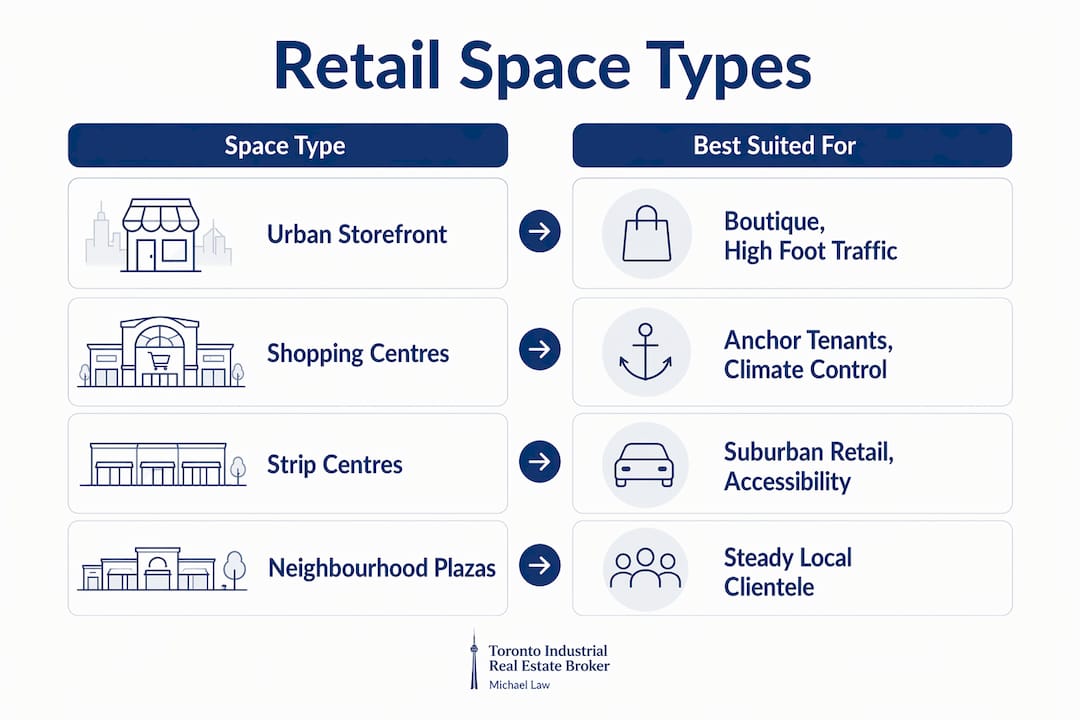
The right format depends on your customer base, your sales model, and your budget for occupancy costs. A boutique clothing brand needs visibility and foot traffic. A medical clinic needs parking and accessibility. Matching your business model to the space type is the first decision that shapes every other leasing term.
Pro Tip: Before touring any space, map your customer’s travel patterns. A location that looks central on a map can be invisible to your actual customer if it sits on the wrong side of a major arterial road.
How are retail leases structured: terms, rent types, and key clauses?
A retail lease agreement is not a standard document. The structure varies by landlord, property type, and negotiation outcome. Understanding the core components before you sit down at the table is non-negotiable.
Lease term length
Typical initial lease terms run five years, often paired with one or two five-year renewal options. That structure allows landlords to amortise fit-out costs and tenant improvement allowances over a predictable period. For tenants, a longer initial term creates negotiating power but also locks in a commitment. Renewal options must be clearly defined in the lease, including the rent formula that applies at renewal.
Rent structures explained
Retail leases use several rent structures, and the differences carry real financial consequences.
- Gross lease: The tenant pays a flat monthly rent. The landlord covers taxes, insurance, and maintenance. This structure is simpler but less common in GTA retail.
- Net lease: The tenant pays base rent plus some operating costs. The split varies by agreement.
- Triple net (NNN) lease: The tenant pays base rent plus property taxes, building insurance, and maintenance costs. NNN leases shift all three cost categories directly to the tenant, which requires close monitoring of annual reconciliations.
- Modified gross lease: A hybrid where certain costs are shared. The specific split is negotiated.
- Percentage rent: Common in high-traffic shopping centres, percentage rent runs 3%–8% of gross sales beyond a defined breakpoint. Restaurants typically fall in the 3%–5% range. Other retail categories land between 5% and 8%.
Critical lease clauses every tenant must understand
- Exclusive use clause. This clause prevents the landlord from leasing nearby units to your direct competitors. Savvy tenants prioritise exclusive use clauses to protect market share within the property. Without it, a landlord can legally place a competing business in the adjacent unit.
- Permitted use clause. This defines exactly what business activities you can conduct in the space. A clause that is too narrow can block you from adding a product line or service. Negotiate for the broadest permitted use your landlord will accept.
- Holdover clause. If your lease expires and you remain in the space without a signed renewal, holdover penalties can triple your rent until a new agreement is executed. This clause is frequently overlooked and consistently expensive.
- CAM reconciliation. Common area maintenance charges are estimated at the start of each year and reconciled against actual costs at year end. Tenants in NNN leases should audit these reconciliations annually.
- Renewal option mechanics. A renewal option has no value if the rent formula at renewal is undefined or set to market rate without a cap. Negotiate a fixed escalation rate or a capped market-rate adjustment.
Pro Tip: Courts enforce commercial leases strictly as written. Retail leases carry none of the implied protections that residential tenants receive. Have a commercial real estate lawyer review every draft before you sign.
What are tenant improvement allowances and what costs should tenants budget for?
Tenant improvement (TI) allowances are funds provided by the landlord to help a tenant build out or renovate a space. The amount depends on whether the space is first-generation or second-generation.
Second-generation spaces are previously occupied units with existing improvements. TI allowances for these spaces typically run $30–$70 per square foot. First-generation or “white-box” spaces are unfinished units delivered with only basic mechanical and electrical rough-ins. TI allowances for white-box spaces run $80–$150 per square foot. Restaurants command even higher allowances because of specialised ventilation, plumbing, and equipment requirements.
The allowance rarely covers the full build-out cost. Any amount spent above the landlord’s allowance comes directly from the tenant’s budget. A 2,000-square-foot restaurant build-out in a white-box space can easily exceed $300,000 in total construction cost. The landlord’s allowance offsets a portion. The tenant funds the rest.
For practical examples of how tenant improvements are structured and costed in the GTA, the specifics vary significantly by municipality and property class.
The all-in cost picture
Base rent is only the starting point. Adding 15%–30% on top of base NNN rent accounts for CAM charges, property taxes, and building insurance. That add-on is not optional in a triple net structure. It is a contractual obligation.
| Cost component | Typical range | Notes |
|---|---|---|
| Base NNN rent | $26.40/SF national median | 14% higher than 2024 |
| CAM, taxes, insurance | 15%–30% add-on | Reconciled annually |
| TI allowance (second-gen) | $30–$70/SF | Landlord-funded |
| TI allowance (first-gen) | $80–$150/SF | Landlord-funded, tenant overage at tenant cost |
| Restaurant build-out premium | Above standard TI | Driven by mechanical and plumbing requirements |
Pro Tip: Build your lease budget using the all-in cost figure, not just the advertised base rent. A space listed at $28/SF NNN can cost $36/SF or more once CAM, taxes, and insurance are added. Model both figures before comparing properties.
How do market trends affect retail leasing decisions in the GTA?
The GTA retail market in 2026 is supply-constrained and demand-driven. The 14% national rent increase since 2024 reflects strong consumer spending and limited quality retail inventory in established nodes. That dynamic shifts negotiating power toward landlords in high-demand corridors.
Data-driven leasing approaches use tools like void analysis and consumer expenditure mapping to identify locations where demand exceeds current retail supply. Void analysis identifies categories of goods or services that local consumers are purchasing outside the trade area. A tenant entering a location with an identified void faces less direct competition and captures spending that is already present.
Understanding how market analysis shapes leasing outcomes is the difference between selecting a site on instinct and selecting one on evidence.
Key factors shaping GTA retail leasing decisions in 2026:
- Suburban corridor growth. Nodes along Highway 7 in Vaughan and Markham, and along Dundas Street in Mississauga, are absorbing demand from population growth in those municipalities.
- Mixed-use intensification. New residential density in areas like North York and Etobicoke is creating ground-floor retail demand in buildings that did not exist five years ago.
- Food and beverage dominance. Restaurant and café tenants continue to drive leasing activity in both urban and suburban formats. Their higher build-out costs are offset by strong consumer spending on food.
- Service retail resilience. Medical, dental, personal care, and financial services tenants are consistently active because their businesses cannot be replicated online.
Tenants who enter a market with documented unmet demand reduce their revenue risk from day one. The site selection process is where most retail businesses either protect or undermine their future profitability.
Monitoring industrial property trends alongside retail data gives a fuller picture of how supply chains and consumer behaviour interact across the GTA.
What steps should tenants take when negotiating a retail lease?
Lease negotiation is where tenants either recover costs or lock in avoidable expenses for five to ten years. The process requires preparation, not improvisation.
Longer lease terms increase negotiating power for rent abatements and tenant improvement allowances. Landlords amortise their concessions over the lease term. A ten-year commitment justifies a larger TI allowance and a longer rent-free period than a five-year term. If your business plan supports a longer commitment, use that as a negotiating tool from the start.
Key steps for tenants entering lease negotiations:
- Define your permitted use broadly. Negotiate a permitted use clause that covers your current business and any adjacent services you may add. A clause limited to “women’s clothing retail” blocks you from adding accessories or footwear without landlord consent.
- Secure an exclusive use clause. Identify your direct competitors and name the categories you want excluded from the property. A well-drafted exclusive use clause is enforceable and protects your revenue.
- Understand the holdover exposure. Know your lease expiry date and begin renewal discussions at least 12 months in advance. Holdover penalties are avoidable with calendar discipline.
- Audit CAM estimates. Request the prior year’s CAM reconciliation for any property you are considering. A large variance between estimated and actual CAM charges signals poor cost management by the landlord.
- Negotiate rent abatement. A rent-free period at the start of the lease, typically covering the build-out period, is standard in most GTA retail transactions. The length depends on the term and the landlord’s vacancy exposure.
Understanding the value a broker brings to lease negotiations is particularly relevant here. An experienced commercial broker has transaction data on comparable deals, knows which landlords are flexible, and can identify concessions that a tenant negotiating alone would not know to request.
Pro Tip: Never sign a retail lease without a commercial real estate lawyer reviewing the final draft. The cost of legal review is a fraction of the cost of a single unfavourable clause enforced over a five-year term.
Key takeaways
Retail leasing decisions made without full cost visibility and legal review consistently produce the most expensive outcomes for GTA business owners.
| Point | Details |
|---|---|
| Know your all-in cost | Add 15%–30% to base NNN rent to estimate true occupancy cost including CAM, taxes, and insurance. |
| Match space type to business model | Urban storefronts, malls, strip centres, and plazas each serve different customer and cost profiles. |
| Negotiate clause by clause | Exclusive use, permitted use, and holdover clauses directly affect revenue and cost exposure over the lease term. |
| Use TI allowances strategically | Longer lease terms unlock larger TI allowances; model the build-out gap before committing to a space. |
| Ground site selection in data | Void analysis and consumer expenditure data identify locations where demand already exists, reducing revenue risk. |
What I have learned about retail leasing that most guides skip
Most articles on retail leasing focus on rent per square foot and lease term length. Those are table stakes. The decisions that actually determine whether a retail business survives its lease are made in the clauses, not the headline numbers.
I have seen tenants sign leases with permitted use clauses so narrow that adding a single product category required written landlord consent and a lease amendment. I have seen holdover situations where a tenant stayed 60 days past expiry and received a rent invoice at three times the monthly rate. These are not edge cases. They are predictable outcomes of leases that were not reviewed carefully before signing.
The shift I see in 2026 is that tenants are becoming more data-aware. The best operators I work with are arriving at lease negotiations with trade area analysis, consumer expenditure reports, and comparable transaction data. That preparation changes the conversation. A landlord who knows you have done your homework negotiates differently than one who assumes you are operating on instinct.
My honest view is that the GTA retail market rewards tenants who treat site selection as a research exercise, not a gut-feel decision. The rent increase environment of the past two years has compressed margins. The tenants who are performing well are the ones who chose locations with documented demand and negotiated leases with enough flexibility to adapt their business model as consumer behaviour evolves.
Lease flexibility is not a luxury. In a market where consumer preferences shift faster than a five-year lease term, the ability to sublease, assign, or expand within a property is a genuine competitive advantage. Negotiate for it from the start, even if you do not expect to use it.
For GTA tenants, working with an advisor affiliated with Lennard Commercial Realty gives you access to transaction data and landlord relationships that are not available through public listings alone.
— Michael
GTA retail leasing advisory from Mlawrealestate
Mlawrealestate works with business owners and retail tenants across the Greater Toronto Area, from Toronto’s urban core to suburban nodes in Mississauga, Brampton, Vaughan, and Markham.

The advisory process covers site selection, lease negotiation, TI allowance structuring, and clause-by-clause review support. Every engagement is grounded in current market data, not general advice. If you are evaluating commercial retail space in the GTA or preparing to negotiate a lease renewal, view available GTA properties and connect with the team for a market-specific consultation. The right lease structure protects your business for the full term. Getting it right at the start costs far less than correcting it later.
FAQ
What is retail leasing in commercial real estate?
Retail leasing is a contractual arrangement where a business rents commercial retail space from a landlord for a defined term under specific financial and operational conditions. The lease governs rent, permitted use, and tenant obligations for the full term.
What is a typical retail lease term in the GTA?
Typical retail leases run an initial term of five years, often with one or two five-year renewal options. Longer terms generally unlock better tenant improvement allowances and rent abatements.
What is a triple net lease and how does it affect my costs?
A triple net (NNN) lease requires the tenant to pay base rent plus property taxes, building insurance, and maintenance costs. Budget an additional 15%–30% on top of base rent to estimate your true all-in occupancy cost.
What is percentage rent and when does it apply?
Percentage rent is an additional rent charge calculated as a percentage of gross sales above a defined breakpoint. It typically runs 3%–8% depending on the retail category, and is most common in high-traffic shopping centres.
Do I need a lawyer to sign a retail lease?
Yes. Commercial leases are enforced strictly as written with no implied tenant protections. A commercial real estate lawyer can identify unfavourable clauses before they become binding obligations.
Recommended

About Michael Law
Managing Partner and Industrial Real Estate Broker at Lennard Commercial Realty. Representing tenants and landlords across Toronto and the GTA for 15+ years. Michael specializes in GTA industrial real estate — connect with Toronto's leading industrial broker at mlawrealestate.com/industrial-broker-toronto.
Related Articles



More Toronto Industrial Real Estate Insights
Articles & Analysis
GTA Industrial Rent Trends: What Drives the Market
Read →GTA Finance: Operating Cost Reconciliation and GST/HST ITC Rules
A GTA playbook for operating cost reconciliation: step-by-step checks, a reconciliation checklist, sample journal entries, CRA GST/HST ITC guidance and...
Read →2–3x Rent Gap: Secure a Compliant GTA Outside Storage Lease
GTA tenants: secure a compliant outside storage lease with zoning and environmental checks, clear site improvement priorities, and off market sourcing.
Read →Catch Hidden Additional Rent: GTA Industrial Lease Audit
Broker led lease audits help GTA industrial tenants spot hidden additional rent, make good liabilities, and negotiation levers at the offer stage before...
Read →GTA Industrial Due Diligence Before You Buy
Read →Common Questions
What is a sale-leaseback in industrial real estate?
A sale-leaseback is a transaction in which an industrial property owner sells their building to an investor and simultaneously signs a long-term lease to remain in the property as a tenant. The seller unlocks the capital tied up in their real estate while retaining full operational use of the facility. The buyer acquires a tenanted investment property with immediate cash flow from a known occupant.
Read →What is a dock-to-grade ratio in industrial real estate?
Dock-to-grade ratio in industrial real estate refers to the number of dock-level loading doors relative to the building's floor area, typically expressed as one dock door per X,000 square feet. It is a key specification for distribution and warehousing tenants because it determines how many trucks can load and unload simultaneously and therefore the building's throughput capacity.
Read →What is clear height in a warehouse or distribution centre?
Clear height in a warehouse or distribution centre refers to the usable vertical space from the finished floor to the lowest overhead obstruction — typically the bottom of the roof structure, sprinkler heads, or HVAC equipment. It is the single most important building specification for warehouse tenants because it determines how many racking levels can be installed and therefore how much product can be stored per square foot of floor space.
Read →