
Step by step commercial lease exit: GTA tenant guide
By Michael Law · Industrial Real Estate Broker, Lennard Commercial Realty
TL;DR:
- A structured commercial lease exit involves a thorough review, negotiation, and formal documentation process to ensure a clean termination.
- Tenants must understand lease clauses like break rights, assignment, subletting, and personal guarantees, and prepare proper proof packets before negotiations.
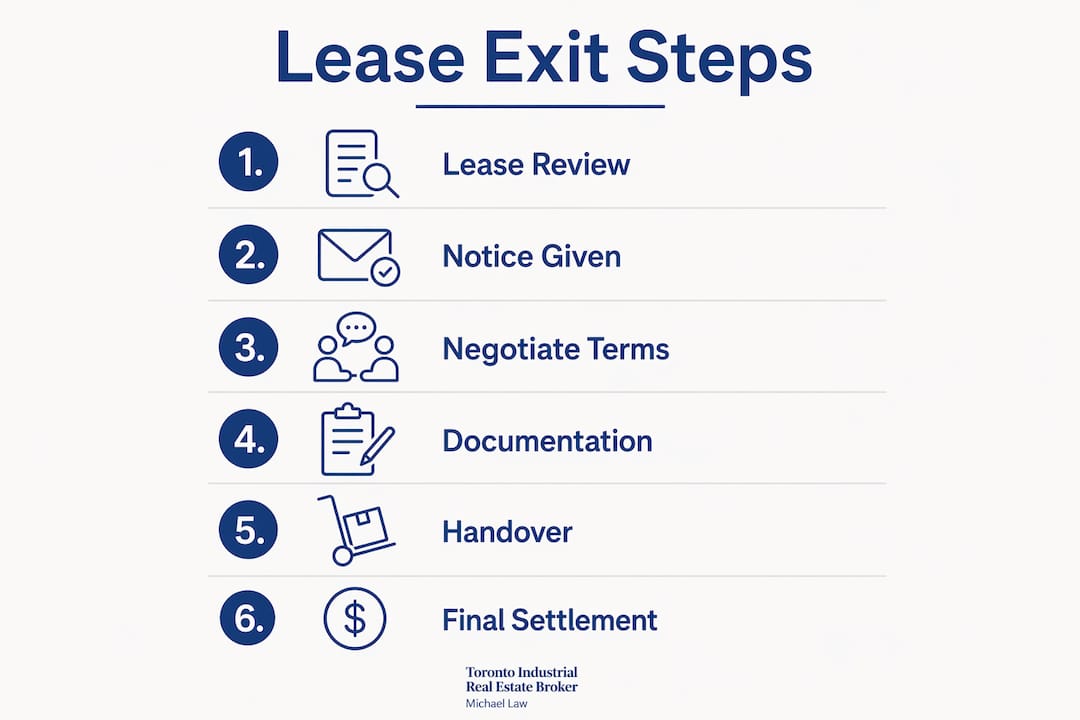
A step by step commercial lease exit is the structured process by which a business tenant formally ends a commercial lease, meets all contractual obligations, and secures a written release from the landlord. The industry term for this process is “lease surrender” or “lease termination,” and both phrases apply depending on whether you exit early or at the natural lease end. Most tenants underestimate how many steps are involved. Treating termination as a singular event rather than a documented process is the most common reason tenants face disputes, financial penalties, and prolonged liability. This guide covers every stage of the commercial lease exit process, from initial lease review through to final handover, with specific attention to GTA industrial real estate norms in 2026.
What are the initial prerequisites before starting a commercial lease exit?
The first step in any commercial lease exit is a thorough review of the lease document itself. You cannot negotiate, plan, or act until you know exactly what your lease permits. Three clauses carry the most weight: break clauses, assignment and subletting provisions, and personal guarantee terms.

Break clauses give you a contractual right to exit before the lease expires. Break clause exercise requires strict adherence to notice periods, typically 6–12 months ahead of the termination date, or the right is permanently lost. Missing that window by even one day means you remain bound to the lease. In GTA industrial leases, which often run 5–10 years, a missed break clause can cost a business hundreds of thousands of dollars in unwanted rent.
Assignment and subletting provisions matter when you want to transfer your lease obligations to another party. Many GTA industrial leases allow assignment with landlord consent, which cannot be unreasonably withheld. Subletting is another option, where you retain the head lease but bring in a subtenant to cover your costs. Both paths require landlord approval and formal documentation.
Personal guarantees are the clause most tenants overlook. If you signed a personal guarantee when the lease began, that obligation does not disappear when you vacate the premises. Personal guarantees often remain in effect post-surrender unless explicitly released in writing. Confirm the guarantee terms before you take any exit steps.
Build a proof packet before approaching your landlord. This packet should include:
- A copy of the signed lease with all amendments and side agreements
- Rent payment history showing no arrears
- Correspondence records with the landlord
- Any prior consent letters for alterations or assignments
- Insurance certificates and maintenance records
Pro Tip: Request a certified copy of your lease from your solicitor or the landlord’s office before starting any exit discussions. Tenants frequently work from incomplete versions that are missing critical schedules or amendments.
GTA industrial tenants should also check whether their lease falls under Ontario’s commercial tenancy legislation, which sets out specific notice and termination requirements. Security of tenure provisions in some jurisdictions can prevent automatic lease expiry and trigger unintended renewal rights. Ontario’s Commercial Tenancies Act governs many of these situations, and a local solicitor familiar with GTA industrial leasing should confirm your statutory position before you serve any notice.
How do you negotiate with your landlord for an early lease exit?
Negotiation is where most tenants either save significant money or make costly mistakes. The landlord holds the stronger legal position if your lease contains no break clause. Without early termination rights, surrender requires the landlord’s voluntary agreement and often payment of a surrender premium. That premium compensates the landlord for lost rent, re-leasing costs, and any unamortised tenant improvement allowances.
Prepare a formal written proposal before any conversation. A verbal agreement to exit carries no legal weight and creates ambiguity for both parties. Your written proposal should address:
- Your proposed exit date, with at least 90 days of lead time where possible
- The financial settlement you are offering, including any surrender premium
- Your commitment to leave the premises in the agreed condition
- A request for a full release from the lease and any personal guarantee
- A timeline for executing the formal surrender documentation
Financial terms in GTA industrial lease exits follow a recognisable pattern. Early termination fees typically include unamortised tenant improvement allowances, leasing commissions, plus 3–6 months of base rent as a penalty. That range reflects the landlord’s real cost of finding a replacement tenant in a competitive market. In Brampton, Mississauga, and Vaughan, where industrial vacancy rates have tightened considerably, landlords with strong re-leasing prospects may accept lower premiums. In softer submarkets, expect to pay closer to the higher end.
Your negotiation leverage depends on three factors: the remaining lease term, the current market demand for your space, and the landlord’s own financial position. A landlord who already has a replacement tenant lined up will negotiate harder. A landlord sitting on a vacant building in a slow submarket has more incentive to cooperate. Understanding GTA industrial leasing conditions before you sit down at the table gives you a measurable advantage.
Pro Tip: Never frame your exit request as a financial hardship unless you have documented evidence. Landlords who sense desperation often increase their demands. Present the exit as a mutual business decision with a clear financial offer on the table.
Avoid implied surrender at all costs. Implied surrender occurs when a tenant’s actions, such as handing back keys or vacating without formal agreement, suggest the lease has ended. Courts treat implied surrender as legally ambiguous, and it can trigger default remedies rather than a clean exit. Always wait for a signed agreement before vacating.
What documentation is essential for a clean commercial lease termination?
A clean commercial lease termination requires three core documents: a Deed of Surrender, a written guarantee release, and a final rent reconciliation statement. Each one closes a specific legal obligation.
The Deed of Surrender is the primary document. It formally ends the lease on a specified date, confirms the tenant’s obligations up to that date, and releases both parties from future claims. Simply handing back keys creates legal ambiguity and risk. A formal Deed of Surrender removes that ambiguity entirely. The deed should specify:
- The exact termination date
- The condition in which the premises are returned
- Any agreed dilapidations payment or reinstatement obligations
- Confirmation of all rent, service charges, and insurance payments to the termination date
- Release of the tenant and any guarantors from future liability
The guarantee release is a separate written document. Failing to release personal guarantees in writing after exit leaves tenants personally liable post-lease. The release must be signed by the landlord and should reference the original guarantee by date and parties. Do not accept a verbal assurance that the guarantee is discharged.
The final rent reconciliation covers all outstanding amounts: base rent to the termination date, any service charge balances, utility arrears, and the return of the security deposit if applicable. Deposits are typically returned within 30 days of the termination date, subject to any deductions for dilapidations.
The following checklist covers the documentation phase:
- Deed of Surrender drafted and reviewed by a solicitor
- Personal guarantee release signed by the landlord
- Final rent and service charge statement agreed in writing
- Security deposit return confirmed in writing
- Any landlord consent letters for alterations formally withdrawn or confirmed as accepted
- Copies of all signed documents retained by both parties
Pro Tip: Have your solicitor review the Deed of Surrender before you sign. Landlords’ solicitors draft these documents to protect the landlord’s interests. A single poorly worded clause can leave you liable for dilapidations claims years after you vacate.
The table below compares the two most common exit documentation approaches for GTA industrial tenants:
| Approach | Best suited for | Key risk |
|---|---|---|
| Deed of Surrender | All early exits and negotiated terminations | Must be drafted carefully to cover all obligations |
| Assignment of lease | Tenants with a willing assignee | Tenant may retain secondary liability if assignee defaults |
How do you manage the physical and administrative handover?
The physical handover is the final operational step in the commercial lease exit process. A poorly managed handover can trigger dilapidations claims, deposit disputes, and delays in receiving your guarantee release. Treat it as a formal process, not a moving day.
-
Commission a pre-exit survey. Hire an independent building surveyor to assess the property’s condition at least 60 days before your exit date. This gives you time to carry out any required repairs before the landlord’s surveyor conducts their own inspection. Disagreements over dilapidations are the most common source of post-exit disputes in GTA industrial properties.
-
Document the condition with photographs and video. Walk every area of the premises with a camera on the day you hand over. Photograph loading docks, office areas, washrooms, mechanical rooms, and any areas where alterations were made. Date-stamp all images and store them securely.
-
Return all access items in writing. Keys, fobs, alarm codes, parking passes, and gate remotes must all be returned and acknowledged in a signed receipt. A verbal confirmation that keys were received is not sufficient. The signed receipt should list every item returned and confirm the date and time of handover.
-
Close or transfer all utilities. Notify hydro, gas, water, and telecommunications providers of your vacate date. Request final meter readings on the handover day. Failure to close utility accounts can result in ongoing charges billed to your name after you have left the building.
-
Obtain written confirmation of the vacate date. The landlord must confirm in writing that the premises were returned on the agreed date and in the agreed condition. This written confirmation, combined with your Deed of Surrender, forms the complete record of your exit.
GTA property managers typically conduct a formal walkthrough within 48 hours of key return. Attend that walkthrough in person. Any deficiencies identified at that stage are far cheaper to address immediately than to dispute through legal channels later. Mlawrealestate has guided tenants through industrial space downsizing situations across Brampton, Mississauga, and Vaughan, and the pattern is consistent: tenants who attend the final walkthrough resolve disputes faster and at lower cost.
What common mistakes should tenants avoid during a commercial lease exit?
The most expensive mistakes in a commercial lease exit are procedural, not financial. They happen because tenants treat the exit as an informal process rather than a legal transaction.
“Most tenants fail by treating termination as singular events rather than a documented process. Missing one deadline or skipping one release can expose a business to liability that outlasts the lease itself.”
The following errors appear most frequently in GTA industrial lease exits:
- Missing the break clause notice deadline. Break clause rights are almost exclusively negotiated at lease signing. Modification later requires landlord consent, which is rarely given. If you miss the notice window, the break right is gone.
- Vacating without a signed surrender agreement. Handing keys back without formal surrender can trigger lease abandonment status and default remedies rather than a clean exit. Never vacate until the Deed of Surrender is signed.
- Ignoring the personal guarantee. Tenants who focus entirely on the lease and forget the guarantee face personal liability for rent arrears and dilapidations long after the business has moved on.
- Failing to settle all financial obligations before exit. Outstanding rent, service charges, or insurance contributions give the landlord grounds to withhold the guarantee release and pursue recovery.
- Engaging the landlord informally. Email threads and phone calls do not constitute binding agreements. Every commitment made during negotiations must be confirmed in a signed document.
Working with a specialist broker and a commercial solicitor from the outset reduces all of these risks. The value of expert brokerage in a lease exit is not just negotiation skill. It is knowing which mistakes to avoid before they happen.
Key takeaways
A successful commercial lease exit depends on completing every step in sequence, from lease review through to written confirmation of handover, with no shortcuts on documentation.
| Point | Details |
|---|---|
| Review the lease first | Identify break clauses, notice periods, and personal guarantee terms before taking any action. |
| Negotiate in writing | Submit a formal written proposal with a clear financial offer and proposed exit date. |
| Execute a Deed of Surrender | A signed deed is the only document that cleanly ends the lease and releases both parties. |
| Release the personal guarantee | Obtain a written guarantee release from the landlord before considering the exit complete. |
| Document the handover | Return all access items with a signed receipt and attend the final walkthrough in person. |
What I have learned from watching tenants exit GTA industrial leases
The tenants who exit cleanly share one habit: they start the process earlier than they think they need to. Most assume a 90-day notice period is enough time. In practice, negotiating a surrender premium, drafting a Deed of Surrender, resolving dilapidations, and closing utilities takes 4–6 months when done properly. Tenants who start late end up rushing, and rushed exits produce disputes.
The second pattern I have observed is that tenants consistently underestimate their own negotiating position. A landlord in Mississauga or Brampton who has a strong pipeline of prospective tenants will negotiate. They would rather take a surrender premium today than manage a vacant building for six months. Tenants who understand the local market walk into those conversations with real leverage. Those who do not often overpay.
Documentation is where I have seen the most painful outcomes. A client once vacated a Vaughan warehouse on a handshake agreement with the property manager. The property manager left the company three months later. The new management team had no record of the agreed exit terms and pursued the tenant for 18 months of rent. The tenant eventually settled, but the legal costs and stress were entirely avoidable. A signed Deed of Surrender would have ended the matter on day one.
My advice is direct: engage a commercial solicitor and a specialist industrial broker before you contact your landlord. The lease negotiation best practices that apply to new leases apply equally to exits. Preparation, documentation, and local market knowledge determine the outcome. Everything else is noise.
— Michael
GTA industrial lease exits: how Mlawrealestate supports tenants
Mlawrealestate specialises in industrial tenant representation across the GTA, including Mississauga, Brampton, Vaughan, Markham, and the Durham Region. When a business needs to exit a commercial lease, the advisory process covers lease review, landlord negotiation, and coordination with legal counsel to produce a clean, documented termination.

Mlawrealestate’s transaction record includes Brampton logistics portfolio exits, Mississauga distribution centre negotiations, and complex multi-site lease restructurings across the GTA’s most active industrial corridors. Michael Law is affiliated with Lennard Commercial Realty and brings institutional-grade market intelligence to every tenant mandate. For a consultation on your lease exit options, visit mlawrealestate.com or review Michael’s full advisory profile at Lennard Commercial Realty.
FAQ
What is a commercial lease exit strategy?
A commercial lease exit strategy is a planned process for ending a lease before or at its expiry, covering notice requirements, financial settlements, and formal documentation such as a Deed of Surrender.
How much does it cost to exit a commercial lease early?
Early termination fees typically include 3–6 months of base rent plus recovery of unamortised tenant improvement allowances and leasing commissions paid by the landlord.
How much notice do I need to give to exit a commercial lease?
Break clause notice periods are typically 6–12 months before the termination date. Missing that deadline forfeits the break right entirely.
What is a Deed of Surrender in a commercial lease?
A Deed of Surrender is a signed legal document that formally ends a commercial lease on a specified date and releases both the tenant and landlord from future obligations under the lease.
Can a landlord refuse to let me exit my commercial lease early?
Yes. Without a contractual break clause, the landlord is not legally required to agree to an early exit. Surrender requires the landlord’s voluntary consent and typically involves payment of a surrender premium to compensate for vacancy losses.
Recommended

About Michael Law
Managing Partner and Industrial Real Estate Broker at Lennard Commercial Realty. Representing tenants and landlords across Toronto and the GTA for 15+ years. Michael specializes in GTA industrial real estate — connect with Toronto's leading industrial broker at mlawrealestate.com/industrial-broker-toronto.
Related Articles



More Toronto Industrial Real Estate Insights
Common Questions
What is a sale-leaseback in industrial real estate?
A sale-leaseback is a transaction in which an industrial property owner sells their building to an investor and simultaneously signs a long-term lease to remain in the property as a tenant. The seller unlocks the capital tied up in their real estate while retaining full operational use of the facility. The buyer acquires a tenanted investment property with immediate cash flow from a known occupant.
Read →What is a dock-to-grade ratio in industrial real estate?
Dock-to-grade ratio in industrial real estate refers to the number of dock-level loading doors relative to the building's floor area, typically expressed as one dock door per X,000 square feet. It is a key specification for distribution and warehousing tenants because it determines how many trucks can load and unload simultaneously and therefore the building's throughput capacity.
Read →What is clear height in a warehouse or distribution centre?
Clear height in a warehouse or distribution centre refers to the usable vertical space from the finished floor to the lowest overhead obstruction — typically the bottom of the roof structure, sprinkler heads, or HVAC equipment. It is the single most important building specification for warehouse tenants because it determines how many racking levels can be installed and therefore how much product can be stored per square foot of floor space.
Read →