Toronto industrial vacancy rate: what the 2026 numbers mean
By Michael Law · Industrial Real Estate Broker, Lennard Commercial Realty
Greater Toronto’s industrial vacancy rate sat at 2.7% at mid‑2026, down from 3.1% at year‑end 2025, and central Toronto came in even tighter at 2.3%, according to the 2Q26 Toronto industrial market report. That is still one of the tightest industrial markets in North America, and it means fewer available options, faster‑moving negotiations, and continued upward pressure on asking rents for modern space.
If you’re an occupier, the practical move is simple: widen your search radius now, confirm what’s actually coming through the supply pipeline in your target submarket, and lock in expansion options before renewal. If you’re an investor, underwrite conservatively and weight your assumptions toward the submarkets where vacancy is structurally tight rather than temporarily low.
- Broaden your site search beyond central Toronto into Peel, York or Halton if you need clear height and modern loading.
- Confirm what’s under construction or newly delivered in your submarket before assuming today’s vacancy holds.
- Secure renewal options or expansion rights now, while landlords still have some flexibility to negotiate.
Key Takeaways
| Point | Details |
|---|---|
| GTA vacancy tightened | Vacancy fell to 2.7% at mid‑2026 from 3.1% at year‑end 2025, with 4.4% availability. |
| Central Toronto diverges | Vacancy sits at 2.3% but net absorption was negative with zero deliveries. |
| Submarket spread is wide | York leads at 2.0% vacancy; Durham trails at 4.4%, a 2.4‑point gap. |
| Flight to quality drives obsolescence | Occupiers are leaving older central stock for modern clear‑height buildings in Peel, York and Halton. |
| Watch supply, rates and trade risk | Delayed completions, rate cuts and tariff exposure in automotive and steel are the key indicators for the rest of 2026. |
Primary reports and client links
- Industrial Market Overview — Greater Toronto Area 2Q26: source for headline vacancy and submarket data.
- Michael Law | Lennard Commercial: local advisory contact for GTA industrial leasing.
Table of Contents
- Toronto industrial vacancy rate 2026: the mid‑year snapshot
- Why some GTA submarkets are looser than others
- What tightening vacancy means for rents, leases and valuations
- What could move the Toronto industrial vacancy rate before year‑end
- How investors and occupiers should act on today’s numbers
- Michael Law’s perspective on the 2026 vacancy numbers
- Sources
- FAQ
Toronto industrial vacancy rate 2026: the mid‑year snapshot
Net absorption across the GTA hit roughly 5.3 million square feet in the first half of 2026, nearly triple the pace of new deliveries, which totalled about 1.9 million square feet. Demand is absorbing space faster than developers are building it, and that imbalance is the single biggest reason vacancy keeps compressing.
Central Toronto tells a different story. That combination, low vacancy paired with negative absorption, signals tenants leaving older infill buildings faster than anyone is building replacements, not booming demand.
Submarket spreads across the region are wide enough to change a site selection decision on their own:
- York Region: 2.0% vacancy, the tightest in the GTA.
- Toronto (central): 2.3% vacancy, 3.4% availability.
- Peel Region: 2.8% vacancy.
- Halton Region: 3.9% vacancy.
- Durham Region: 4.4% vacancy, the loosest submarket in the region.
| Submarket | Mid‑2026 vacancy |
|---|---|
| York Region | 2.0% |
| Toronto (central) | 2.3% |
| Peel Region | 2.8% |
| Halton Region | 3.9% |
| Durham Region | 4.4% |
A gap of 2.4 percentage points between York and Durham is large enough to change whether you renew in place, relocate, or hold off entirely.
Why some GTA submarkets are looser than others
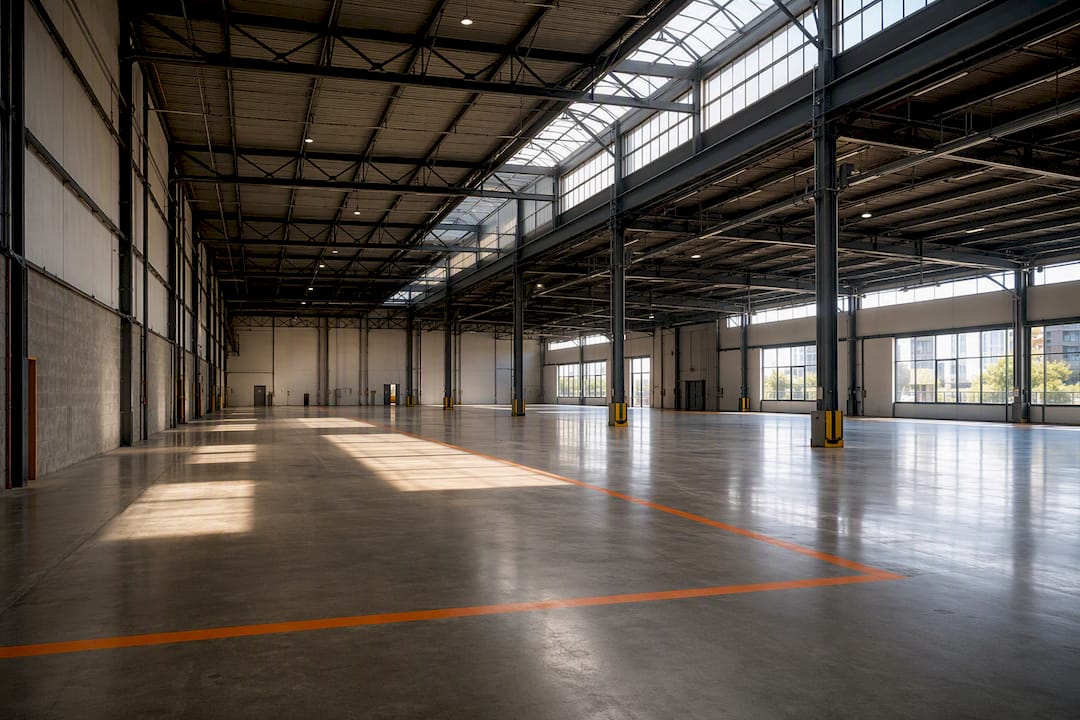
Central Toronto’s negative absorption isn’t a demand problem. It’s a flight‑to‑quality problem. Tenants who once accepted older, low‑clearance buildings near the core are increasingly relocating to newer facilities in Peel, York and Halton that offer 32 to 40‑foot clear heights, ESFR sprinkler systems, and enough trailer parking to run a modern distribution operation. Land constraints and the cost of assembling infill sites mean central Toronto simply cannot deliver that replacement product at scale, so vacancy there can rise even while the GTA overall stays historically tight.
This is a structural shift, not a cyclical dip. Older multi‑tenant buildings built in the 1970s and 1980s were never designed for today’s automated racking or e‑commerce throughput, and no amount of demand recovery brings that stock back into favour. A logistics tenant outgrowing 60,000 square feet of 24‑foot clear space in North York, for example, often finds it cheaper and more efficient to relocate to a new 150,000 square foot facility in Vaughan or Milton than to retrofit what they have.
- Clear height, dock door ratio, and yard depth now drive leasing decisions more than proximity to the 401.
- Sublease space in older buildings is one of the clearest early signals of tenant rightsizing.
- Central Toronto’s zero deliveries in 1H26 confirm land, not demand, is the binding constraint.
Pro Tip: Before you sign a renewal on older central product, get a real quote on relocation costs to Peel or York. The rent premium for modern space is often smaller than the productivity loss from working around an obsolete floor plate.
What tightening vacancy means for rents, leases and valuations
Vacancy this tight for modern industrial product does three predictable things: it shortens leasing timelines, it lifts achievable rents, and it shifts negotiating leverage toward landlords for well‑located, high‑clear assets. Average asking rents across the GTA reflect that pressure, with the 2Q26 market report showing meaningful variation by submarket and building class. Analyst commentary from Marcus & Millichap’s 2Q26 Toronto report expects that as construction eases, tightened availability of modern product will keep favouring owners of newer, well‑located assets over the remainder of the year.
For investors, this changes how you should model cap rates and yield assumptions. A blanket GTA‑wide vacancy figure flatters underwriting on an older central asset that is actually losing tenants to newer peripheral stock. Build submarket‑specific spreads into your proforma rather than relying on the regional average.
For occupiers and landlords negotiating leases right now, the practical levers are:
- Tenants can still negotiate meaningful tenant improvement allowances and staged occupancy on larger deals, particularly in Peel and Halton where more product is coming online.
- Landlords should time renewals carefully, since resetting rents to market on a 2.7% vacancy market can mean a step‑up well above the prior term’s escalations.
- Both sides should treat sublease space as a genuine negotiating variable, since it often trades at a discount to direct space even in a tight overall market.
What could move the Toronto industrial vacancy rate before year‑end
- Supply pipeline: watch how many of the projects currently under construction actually deliver on schedule versus slipping into 2027, since delayed completions keep vacancy compressed longer than models assume.
- Interest rates: construction financing costs directly affect how much new supply breaks ground, and a rate cut cycle could accelerate the projects currently sitting on the sidelines.
- Trade and tariff exposure: Toronto’s occupier base carries real concentration in automotive, steel, and manufacturing, sectors flagged by the Institutional Property Advisors 2Q26 report as a downside risk if tariff conditions worsen.
- Sublease volume: rising sublease listings in older multi‑tenant buildings are usually the first sign of softening, well before headline vacancy moves.
None of these are reasons to freeze decision‑making. They’re reasons to build a six‑month review checkpoint into whatever lease or acquisition strategy you commit to now.
How investors and occupiers should act on today’s numbers
The mid‑2026 data supports a fairly clear playbook, and it splits cleanly by role.
- Investors: prioritize modern, high‑clear assets in York, Peel and Halton over older central stock, and underwrite each submarket separately rather than applying the GTA blended rate across your whole portfolio.
- Occupiers: expand your search into Peel, York or Halton if your current building can’t deliver modern clear height and yard depth, and start that search well ahead of your lease expiry given how quickly quality space is leasing.
- Both: negotiate TI budgets, renewal option caps, and phased occupancy terms now, while there is still enough competitive product in the pipeline to give you leverage.
Three quick decision rules cut through most of the noise:
- Renew if your building has modern clear height and your rent is below the current submarket average.
- Relocate if you’re in older central stock and the productivity cost of staying outweighs the rent premium elsewhere.
- Expand now if you anticipate growth in the next 18 months. Waiting into a tighter market usually costs more than moving early.
Pro Tip: Run your renewal negotiation and your relocation search in parallel, not sequentially. Landlords negotiate very differently when they know you have a credible alternative already in hand.
Methodology and local sourcing
These figures come from the 2Q26 Toronto industrial market report, covering the reporting window through mid‑2026, alongside commentary from Marcus & Millichap and Institutional Property Advisors.
GTA‑wide averages can mask real divergence at the submarket level, and central Toronto’s rising availability alongside falling regional vacancy is exactly the kind of pattern a blended figure hides.
- Vacancy and availability are computed from tracked inventory across the GTA’s industrial base, roughly 960 million square feet.
- Submarket‑level detail (by building, tenant, or specific asset) sits beyond public report granularity. Michael Law and Lennard Commercial can provide deeper local data on request.
Michael Law’s perspective on the 2026 vacancy numbers
Most commentary on GTA industrial vacancy treats the region as one market. That’s the biggest mistake I see investors and occupiers make right now.
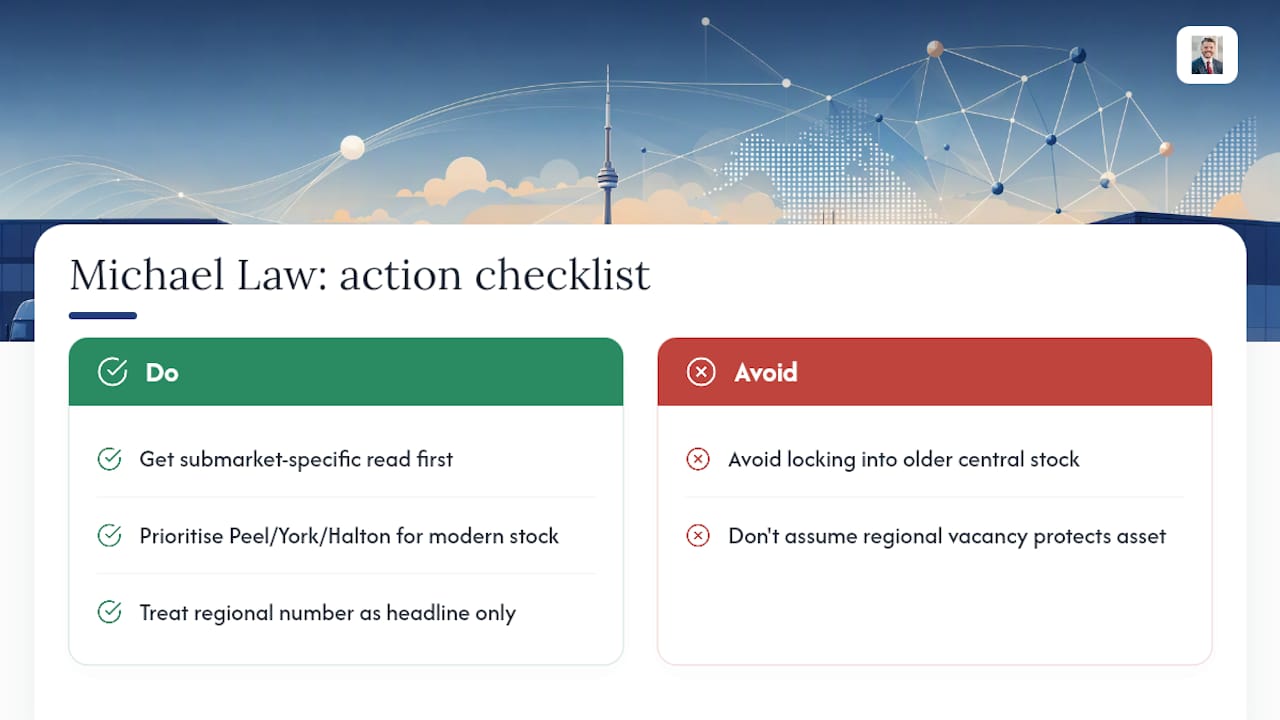
The conventional advice, “vacancy is tight, so lock in space fast,” is only half right. It’s the right instinct for modern product in Peel, York and Halton. It’s the wrong instinct for older central buildings, where negative absorption tells you tenants are already voting with their feet. If you’re holding older infill stock as an owner, don’t assume low headline vacancy protects your asset value.
What I’d prioritize first: get a submarket‑specific read before you touch a proforma or a renewal letter. The regional number is a headline. The submarket number is the decision.
— Michael Law
Sources
- Industrial Market Overview — Greater Toronto Area 2Q26 (market report)
- Toronto 2Q 2026 industrial market report — Marcus & Millichap
- Toronto 2Q 2026 industrial market report — Institutional Property Advisors
FAQ
Should occupiers renew or relocate in this market?
Renew if your building offers modern clear height at a below‑market rent; relocate if you’re in older central stock where the productivity cost outweighs the rent premium of moving.
What could push GTA vacancy higher later in 2026?
Delayed construction completions, rising sublease volume, and downside risk from interest rates and trade‑exposed sectors like automotive and steel are the main indicators to track.
Recommended

About Michael Law
Managing Partner and Industrial Real Estate Broker at Lennard Commercial Realty. Representing tenants and landlords across Toronto and the GTA for 15+ years. Michael specializes in GTA industrial real estate — connect with Toronto's leading industrial broker at mlawrealestate.com/industrial-broker-toronto.
Related Articles

More Toronto Industrial Real Estate Insights
Common Questions
What is a sale-leaseback in industrial real estate?
A sale-leaseback is a transaction in which an industrial property owner sells their building to an investor and simultaneously signs a long-term lease to remain in the property as a tenant. The seller unlocks the capital tied up in their real estate while retaining full operational use of the facility. The buyer acquires a tenanted investment property with immediate cash flow from a known occupant.
Read →What is a dock-to-grade ratio in industrial real estate?
Dock-to-grade ratio in industrial real estate refers to the number of dock-level loading doors relative to the building's floor area, typically expressed as one dock door per X,000 square feet. It is a key specification for distribution and warehousing tenants because it determines how many trucks can load and unload simultaneously and therefore the building's throughput capacity.
Read →What is clear height in a warehouse or distribution centre?
Clear height in a warehouse or distribution centre refers to the usable vertical space from the finished floor to the lowest overhead obstruction — typically the bottom of the roof structure, sprinkler heads, or HVAC equipment. It is the single most important building specification for warehouse tenants because it determines how many racking levels can be installed and therefore how much product can be stored per square foot of floor space.
Read →