Vaughan industrial rents: what tenants should budget for now
By Michael Law · Industrial Real Estate Broker, Lennard Commercial Realty
Vaughan Class A industrial space is leasing at roughly C$16 to C$22 per square foot net, with additional rent (TMI) running about C$4.50 to C$6.50 per square foot on top. That puts most tenants into a gross occupancy range in the low-to-high twenties per square foot once you account for current GTA and York Region rent bands.
Here’s what that means on the ground. A 10,000 square foot unit at C$19 net plus C$5.50 TMI runs about C$245,000 a year, or roughly C$20,400 a month. Scale that to 50,000 square feet and you’re looking at roughly C$1.225 million annually, or about C$102,000 a month, before utilities, insurance, and fit-out costs.
- Net rent: C$16 to C$22/sf
- TMI: C$4.50 to C$6.50/sf
- Gross occupancy: roughly C$21 to C$29/sf total
- Vacancy in premium corridors: tight, often under 3%
Vacancy in the tightest Vaughan corridors sits below 3%, so landlords aren’t in a rush to negotiate on price alone. If you’re touring space this quarter, get the last two years of TMI invoices before you sign anything, and call a tenant representative before you fall for the sticker price on the listing sheet.
Key takeaways
Vaughan industrial rents run C$16 to C$22 net per square foot, and gross occupancy cost, not headline rent, determines whether a deal actually fits your budget.
| Point | Details |
|---|---|
| Know the real rent band | Vaughan Class A net rents run C$16 to C$22/sf, with premium corridors reaching C$18.50 to C$22/sf. |
| Convert net to gross | Add TMI of C$4.50 to C$6.50/sf before comparing any two listings against each other. |
| Watch vacancy tightness | Premium corridors sit under roughly 3% vacancy, which limits landlord flexibility on base rent. |
| Negotiate TIA and free rent | TIAs commonly range C$5 to $25/sf; push here when base rent won’t move. |
| Verify TMI history first | Request two years of TMI invoices before signing, since escalations compound over the term. |
| Get representation early | Michael Law |
Table of Contents
- Vaughan industrial rents market snapshot: asking rents, vacancy and trends
- How to read asking rents: lease structures, TMI and gross occupancy cost
- Which Vaughan submarkets cost more, and why
- How to build your budget and the negotiation points that move the economics
- Operational due diligence checklist before you sign
- Michael Law on what tenants should ask before they sign
- Legal considerations and tenant protections specific to Ontario industrial leases
- How Michael Law and Lennard Commercial help Vaughan tenants negotiate better leases
- Sources
- FAQ
Vaughan industrial rents market snapshot: asking rents, vacancy and trends
Vaughan doesn’t trade at the GTA average, and the gap is not small. Recent regional data pegs the broader Toronto-area industrial market at roughly C$16.9 per square foot net, while York Region, which includes Vaughan, runs closer to C$17.8. Premium Vaughan locations push higher still: local market commentary places net asking rents in the strongest pockets between C$18.50 and C$22.00 per square foot, which lines up with what we’re seeing on active listings across the municipality.
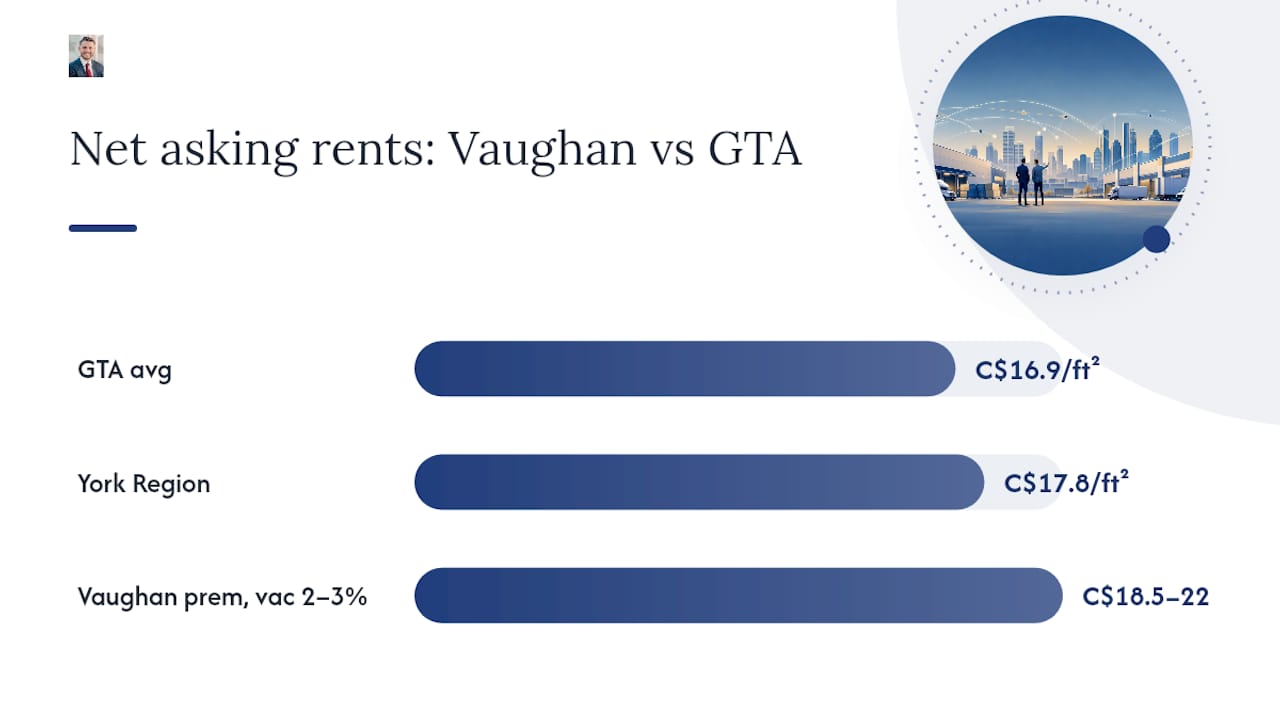
Vacancy is the other half of the story, and it explains why landlords hold the upper hand on price even as they get more flexible on terms. Premium corridors are tracking vacancy under roughly 2 to 3 percent, which is tight by any national standard. Rates haven’t moved much quarter over quarter, but the composition of demand has shifted slightly toward smaller bay users and away from the mega-box tenants who dominated 2021 and 2022.
Why does Vaughan command a premium over other GTA submarkets in the first place? Three pieces of infrastructure explain most of it:
- Highway 400 and Highway 407 access. Trucks can reach both corridors within minutes from most Vaughan business parks, cutting drive times to Pearson and the 401 corridor.
- Pearson International Airport proximity. Vaughan sits close enough to the airport lands that air cargo and time-sensitive logistics operators pay to be nearby.
- CN MacMillan Yard. The rail yard gives intermodal users direct access to container traffic without the drayage costs tenants elsewhere in the GTA absorb.
Buildings sitting near these three assets consistently draw higher bids than functionally similar space ten minutes further out. Appraisers who value Vaughan industrial assets weight interchange proximity and rail access heavily precisely because those features drive demand that doesn’t soften even when broader market sentiment cools.
If you’re comparing Vaughan against nearby submarkets, it’s worth reading how GTA industrial vacancy trends affect pricing and investment value more broadly. Vacancy and rent don’t move in lockstep everywhere, but in Vaughan’s case, tight availability and infrastructure access reinforce each other.
How to read asking rents: lease structures, TMI and gross occupancy cost
The advertised rent on a listing sheet almost never tells you what you’ll actually pay. Ontario commercial leases come in a handful of structures, and the difference between them changes your monthly bill by thousands of dollars.
A gross lease bundles everything (rent, taxes, insurance, maintenance) into one number. A single or double net lease shifts some of those costs to the tenant. A triple net lease, which is standard for industrial space in Ontario, pushes property taxes, insurance, and common area maintenance onto the tenant as additional rent, on top of base net rent. A modified gross lease splits the difference, with the landlord absorbing some costs and passing through others.
Here’s how that plays out in real numbers:
- 10,000 sf at C$19/sf net + C$5.50/sf TMI = C$245,000/year, or about C$20,417/month gross.
- 50,000 sf at C$18.50/sf net + C$5.00/sf TMI = C$1,175,000/year, or about C$97,917/month gross.
- 10,000 sf at C$21/sf net + C$6.50/sf TMI (premium Vaughan location) = C$275,000/year, or about C$22,917/month gross.
TMI isn’t static. Most leases include an escalation clause tied to a base year, meaning your TMI in year one might be C$5.00/sf, but by year five it could sit closer to C$6.00 once property tax reassessments and insurance renewals work through the numbers. This is exactly why understanding occupancy costs in GTA industrial leases before you sign matters more than comparing headline net rents across buildings.
Pro Tip: Always request the landlord’s TMI reconciliation statements from the past two years before you sign. If a landlord won’t share historical TMI, treat that as a red flag, not a formality.
Which Vaughan submarkets cost more, and why
Not all Vaughan addresses cost the same, and the differences track functional access more than they track distance from Toronto proper.
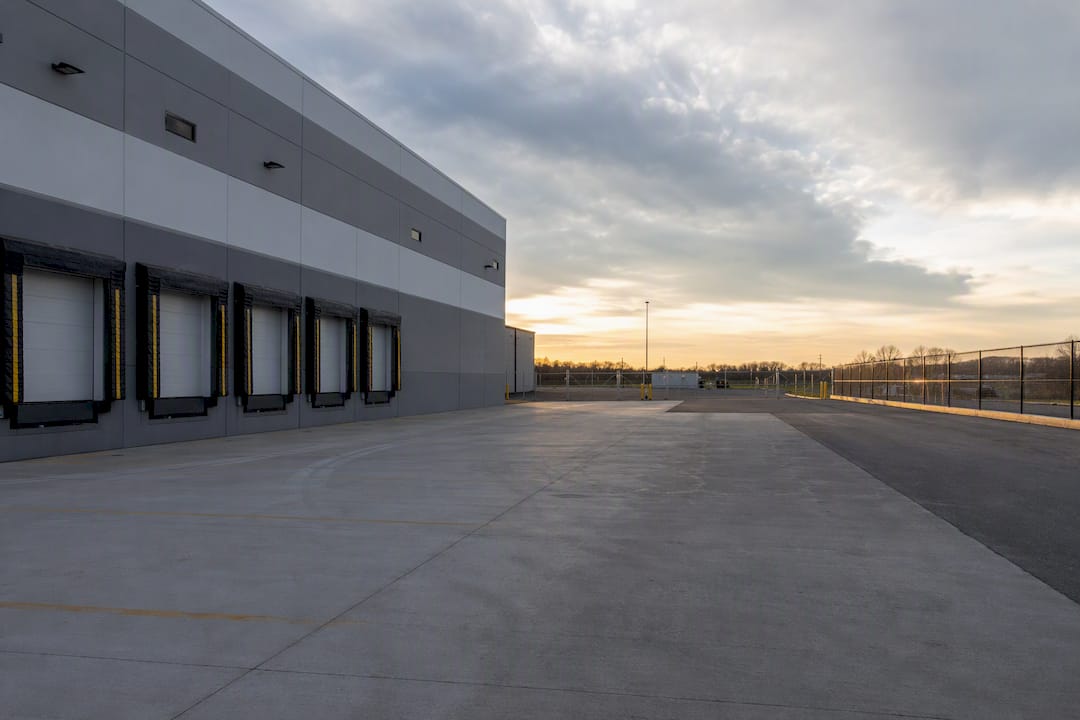
Concord dominates the large-scale logistics tier. Wide, deep lots with strong truck-court depth and highway access make it the default choice for distribution operators moving full trailer loads daily. Rents here sit at or above the Vaughan average.
Vaughan Metropolitan Centre (VMC) skews toward mixed-use, office, and flex space rather than pure warehousing. It’s the wrong fit if you need heavy trailer traffic, but it works for hybrid operations that pair a small warehouse footprint with showroom or office space.
Woodbridge serves smaller flex and SME users well. Bay sizes tend to run smaller than Concord’s big-box product, and rents are generally more accessible for tenants who don’t need 32-foot clear heights or ESFR sprinkler systems.
Northern corridors near the Highway 400/427 interchange area carry some of the steepest premiums in the municipality, largely because of interchange proximity and yard configuration.
What actually drives the premium within these submarkets? A few specific features:
- Proximity to a Highway 400 interchange often adds a noticeable premium to asking rent within two kilometres.
- Rail or intermodal access, particularly near CN MacMillan Yard
- Truck-court depth deep enough for 53-foot trailers to manoeuvre without staging elsewhere
- Exclusive yard rights, which matter more to cross-dock and last-mile operators than square footage alone
Truck-court depth and clear height are the two specs appraisers weight most when valuing Vaughan industrial assets, according to firms that appraise Vaughan industrial properties for lending and acquisition purposes. If your operation depends on efficient trailer turns, that spec is worth more to you than a marginally lower headline rent three kilometres further from the highway.
How to build your budget and the negotiation points that move the economics
A realistic industrial budget includes more line items than most first-time tenants expect. Before you sign a letter of intent, build out these categories:
- Base net rent — the per-square-foot figure quoted on the listing.
- TMI (additional rent) — taxes, insurance, and common area maintenance, typically C$4.50 to C$6.50/sf.
- Utilities — separately metered in almost all industrial buildings, so get consumption estimates from the current tenant if possible.
- Insurance — tenant’s own liability and contents coverage, distinct from the landlord’s building insurance included in TMI.
- Amortized tenant improvement allowance (TIA) — if the landlord fronts fit-out costs, they often recover it through slightly higher effective rent over the term.
- Moving and fit-out costs — racking, dock equipment, signage, and any work not covered by the TIA.
Once the budget is built, the real work starts: negotiation. TIAs on 5 to 10 year deals in the GTA commonly range from C$5 to $25 per square foot depending on how much fit-out work the space needs. Landlords have grown more willing to offer TIAs and flexible terms compared to the tight 2021 to 2023 peak, particularly for creditworthy tenants signing longer terms.
Beyond the TIA itself, three levers consistently move the economics of a deal: rent-free weeks during fit-out (typically one to three months on a five-year term), caps on annual TMI increases (protecting you from an uncapped pass-through), and term length trade-offs (a longer term usually buys a bigger allowance, but locks you in longer).
Pro Tip: If a landlord won’t budge on base rent, push on the TIA and rent-free period instead. Those two levers often move faster than the headline rent number, especially in a market where landlords compete for creditworthy tenants. Practical tactics for structuring these asks are covered in more depth in this guide to negotiating GTA industrial leases.
Know when to walk. If a landlord won’t share TMI history, won’t cap escalations, or won’t put verbal promises about yard access into the lease, that’s usually a sign to keep touring rather than force a deal.
Operational due diligence checklist before you sign
A building that looks right on a floor plan can still be wrong for your operation. Verify these specs on site, not from a listing sheet:
- Clear height — measure it yourself; some older Vaughan stock advertises “clear height” that includes sprinkler drops or beam obstructions.
- Loading configuration — count actual dock doors versus drive-in doors, and check dock depth against your trailer fleet.
- Trailer parking — confirm exclusive versus shared yard rights in writing.
- ESFR sprinklers — required for most modern racking configurations; older buildings may lack it.
- Floor load capacity — critical if you’re running heavy equipment or high-density racking.
- Power supply — confirm amperage against your equipment needs before you assume an upgrade is simple.
Legal and environmental checks matter just as much as the physical walkthrough. Confirm zoning permits your intended use, ask whether a Phase I environmental assessment exists, and check municipal truck-routing restrictions that might limit access hours or vehicle size. These factors, along with outdoor storage rights and electrical capacity, are exactly what due diligence guides for industrial leasing in Ontario flag as the items tenants skip and later regret.
Pro Tip: Request the roof and HVAC inspection reports along with service contracts before you sign. A five-year-old roof with a documented maintenance history is worth more to you than a landlord’s verbal assurance.
Michael Law on what tenants should ask before they sign
Vaughan’s tight vacancy means landlords rarely need to compete on price, but they still compete on terms when a tenant asks the right questions.
Ask a listing broker three things on first contact: what’s the base year TMI, is there flexibility on the TIA, and what’s the true clear height measured to the lowest obstruction. Vague answers to any of those tell you as much as a clear answer would.
As Managing Partner at Lennard Commercial, a CoStar Power Broker recognition holder, and someone who has spent over a decade negotiating industrial leases across the GTA, I’ve seen tenants leave six figures on the table by negotiating rent alone while ignoring TMI caps and TIA structure. Representation earns its fee by catching those gaps before they cost you.
Legal considerations and tenant protections specific to Ontario industrial leases
Ontario’s Commercial Tenancies Act governs the landlord-tenant relationship, but here’s the part most tenants miss: a signed commercial lease generally takes precedence over most of the Act’s default provisions. Unlike residential tenancies, there’s no rent control on commercial leases in Ontario, and no standard form lease that protects you if you sign something poorly drafted.
That means the lease document itself is your primary protection, not the statute sitting behind it. If the lease is silent on an issue, the Act may fill the gap, but if the lease explicitly addresses something (a TMI escalation formula, a right of first refusal, a demolition clause), that language usually governs.
A few areas deserve particular attention before signing:
- Assignment and subletting rights. Confirm whether you can assign the lease or sublet space if your operational needs change mid-term.
- Default and remedy clauses. Understand what triggers a default and what remedies the landlord can pursue, since these vary significantly between standard-form leases.
- Demolition or relocation clauses. Some landlords retain the right to terminate early for redevelopment. If Vaughan’s ongoing intensification near the VMC affects your building, this clause matters more than it might elsewhere.
- Renewal options. A lease without a clearly defined renewal formula can leave you negotiating from a weaker position at expiry, particularly in a market this tight.
Because the Act defers heavily to the lease itself, having someone review the document before signature, ideally someone who negotiates these clauses regularly, is worth more in Ontario’s industrial market than in jurisdictions with stronger statutory tenant protections.
A brief note on negotiating in today’s Vaughan market
What I’m seeing right now: landlords hold firm on headline rent but move faster on TIAs and free rent than they did two years ago. If you’re touring this quarter, verify TMI history first and get a broker involved before your third site visit, not after your first offer.
How Michael Law and Lennard Commercial help Vaughan tenants negotiate better leases
Touring listings on your own means comparing headline rents without knowing which landlords will actually move on TIA, free rent, or TMI caps. Michael Law | Lennard Commercial closes that gap for Vaughan tenants by handling site selection, lease negotiation, and TMI verification as part of one engagement, so you’re not the only one at the table without market data.

Tenant representation typically delivers larger TIAs than tenants negotiate solo, caps on TMI escalation written into the lease itself, and a faster path to shortlist Vaughan buildings that actually match your clear height, power, and yard requirements. Because Michael Law works exclusively for tenants, not landlords, there’s no conflict of interest in what gets recommended.
If you’re evaluating industrial space in Vaughan this quarter, start with a no-obligation lease review through industrial tenant representation in Toronto and the GTA, or explore current Vaughan industrial listings and market services to see what’s actually available before you commit to a number.
Sources
For lease-specific legal context, the Ontario government’s guidance on renting commercial property explains how the Commercial Tenancies Act interacts with signed lease terms. Market figures throughout this article draw from the 2Q26 Toronto Ontario industrial market report and the Ontario warehouse leasing guide for TIA and TMI ranges.
- 2Q26 Toronto Ontario industrial market report (summary)
- The Complete Ontario Warehouse Leasing Guide (2026) | WarehouseIndex
- Commercial lease Ontario 2026 guide: terms, process and tips
FAQ
Are there industrial warehouses available for rent in Vaughan right now?
Contact a tenant representative or check active listing portals rather than relying on outdated postings.
What are the average commercial rent rates in the GTA and Vaughan?
GTA industrial net rents average around C$16.9/sf, while York Region, including Vaughan, tracks closer to C$17.8/sf, with premium Vaughan locations reaching C$18.50 to C$22.00/sf. Add typical TMI of C$4.50 to C$6.50/sf to estimate gross occupancy cost.
What is the average cost of living in Vaughan, Ontario?
Vaughan’s cost of living reflects its position in the GTA’s northern suburbs, with housing and commercial real estate costs generally running below downtown Toronto but above many outer-ring municipalities. For business owners, the more relevant figure is industrial occupancy cost, which runs roughly C$21 to C$29/sf gross once TMI is included.
How much does it cost to do a commercial lease?
Upfront costs typically include first and last month’s rent, a security deposit, legal fees for lease review, and any tenant-funded portion of fit-out beyond the landlord’s TIA. Ongoing costs include base rent, TMI, utilities, and insurance, all of which should be modelled before you sign a letter of intent.
When should I hire a tenant representative for a Vaughan lease?
Engage representation before your first site tour, not after you’ve already toured buildings, since early involvement lets a broker negotiate TIA, TMI caps, and term length as part of the original offer rather than as a late-stage request.
Recommended

About Michael Law
Managing Partner and Industrial Real Estate Broker at Lennard Commercial Realty. Representing tenants and landlords across Toronto and the GTA for 15+ years. Michael specializes in GTA industrial real estate — connect with Toronto's leading industrial broker at mlawrealestate.com/industrial-broker-toronto.
Related Articles

More Vaughan Industrial Real Estate Insights
Common Questions
What is clear height in a warehouse or distribution centre?
Clear height in a warehouse or distribution centre refers to the usable vertical space from the finished floor to the lowest overhead obstruction — typically the bottom of the roof structure, sprinkler heads, or HVAC equipment. It is the single most important building specification for warehouse tenants because it determines how many racking levels can be installed and therefore how much product can be stored per square foot of floor space.
Read →What is a letter of intent (LOI) in industrial real estate?
A letter of intent (LOI) in industrial real estate is a non-binding document that outlines the key business terms a tenant and landlord have agreed to in principle before a formal lease is drafted. It covers the essential deal points — rent, term, free rent, TI allowance, options — and signals mutual intent to proceed to a binding lease. While generally non-binding on the business terms, LOIs often include binding exclusivity or confidentiality provisions.
Read →What is CAM (common area maintenance) in industrial real estate?
CAM, or common area maintenance, refers to the costs a tenant pays — on top of base rent — for the upkeep and operation of shared areas in a multi-tenant industrial building. In a typical GTA industrial net lease, CAM is one component of the operating cost recovery alongside property taxes and building insurance, and is charged on a per-square-foot basis proportional to the tenant's share of the building.
Read →