What is highest and best use in real estate: 2026 guide
By Michael Law · Industrial Real Estate Broker, Lennard Commercial Realty
TL;DR:
- Highest and best use (HBU) identifies a property’s most valuable, legal, and feasible use based on four sequential criteria: legal permissibility, physical possibility, financial feasibility, and maximum productivity. It considers land as vacant and existing improvements separately, comparing redevelopment costs against land value to determine the optimal use; current use may not always reflect HBU. Regular reassessment is essential as market conditions, zoning, and infrastructure developments in the GTA influence a property’s most advantageous, risk-adjusted use over time.
Highest and best use is defined by the Appraisal Institute as the reasonably probable and legal use of a property that is physically possible, financially feasible, and results in the highest value. This concept sits at the core of every credible property valuation and investment decision. For real estate professionals, investors, and business owners operating in the Greater Toronto Area, understanding highest and best use is not optional. It determines whether a property is priced accurately, whether a development makes financial sense, and whether an acquisition will generate the returns you expect. This guide explains the four criteria, the vacant versus improved distinction, common misconceptions, and how to apply the analysis in practice.
What is highest and best use and why does it matter?
Highest and best use (HBU) is the foundational appraisal concept that identifies a property’s most valuable, legal, and feasible use at a specific point in time. The term is standard vocabulary within the Appraisal Institute’s guidelines and the Uniform Standards of Professional Appraisal Practice (USPAP), both of which govern appraisal work across North America, including Ontario.
The practical importance of HBU is straightforward. A property’s market value is not based on what it currently does. It is based on what it could do under its most productive use. An underutilised warehouse in Brampton may carry a book value tied to its current lease income, but its HBU might be a multi-tenant logistics facility generating significantly higher net operating income. Valuing it at current use understates its market value and misleads every stakeholder in the transaction.
Monitoring real estate trends is directly tied to HBU reassessment. As market conditions shift, the highest and best use of a property shifts with them. The GTA industrial market has seen this play out repeatedly as e-commerce growth, zoning amendments, and infrastructure investment have repositioned entire corridors.
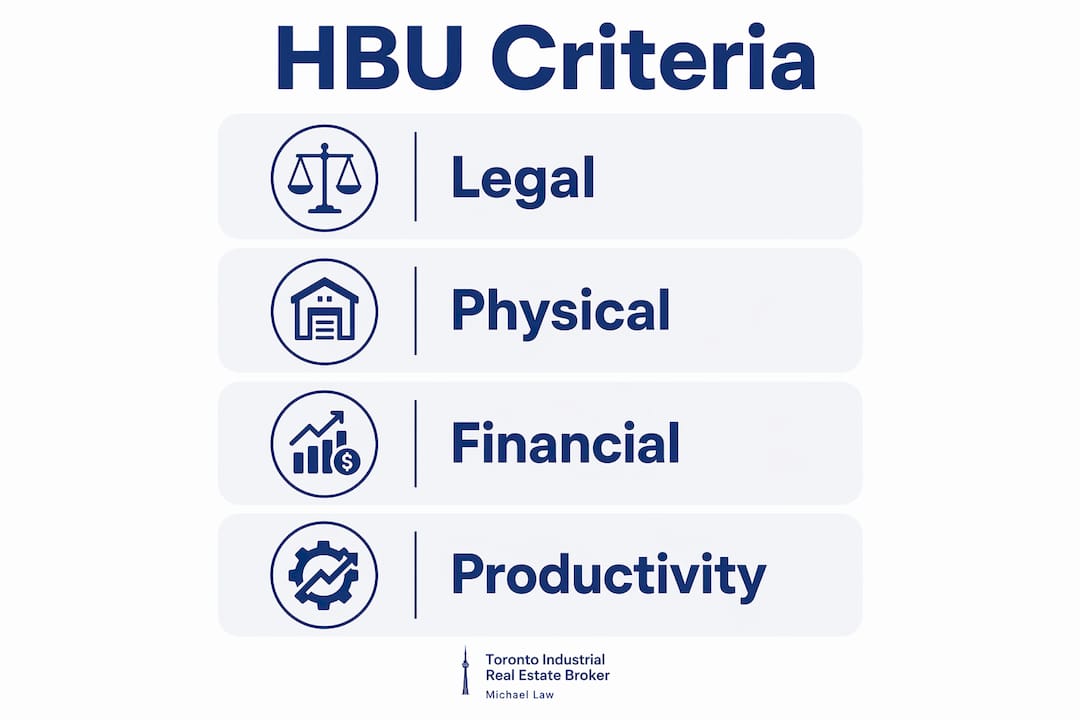
What are the four criteria for highest and best use?
HBU analysis is sequential, meaning each criterion acts as a filter. A use that fails any single test is eliminated immediately, without proceeding further. This prevents speculative valuations and keeps the analysis grounded in reality.
Legal permissibility
A use must be permitted under current zoning, land use regulations, environmental restrictions, and any easements or covenants registered on title. In the GTA, this means checking municipal zoning by-laws in cities like Mississauga, Vaughan, or Hamilton, as well as provincial policies under the Planning Act. A site zoned for employment use cannot be valued as residential simply because residential would generate a higher price. Legal permissibility is the first gate, and it is non-negotiable.
Physical possibility
The site’s size, shape, topography, soil conditions, and access to infrastructure must support the proposed use. A 1.5-acre parcel in Ajax with irregular geometry and limited truck access cannot physically accommodate a 200,000-square-foot distribution centre, regardless of what zoning permits. If a use is physically impossible for the lot’s characteristics, it is discarded immediately without proceeding to financial feasibility testing. This step keeps analysis realistic and avoids wasted effort on infeasible scenarios.
Financial feasibility
A use must generate sufficient income or value to justify the cost of development or conversion. This requires analysing construction costs, market rents, absorption rates, vacancy assumptions, and required returns. In the GTA industrial market, where land values in Mississauga and Brampton have risen sharply, financial feasibility analysis must account for both development cost escalation and the income potential of the finished asset. A use that is legally permitted and physically possible but cannot produce a market-rate return fails this test.

Maximum productivity
Among all uses that pass the first three tests, the one that produces the highest value or best risk-adjusted return is the highest and best use. The use with the highest gross revenue is not always the winner. Appraisers prioritise risk-adjusted returns, factoring in permitting difficulty, community resistance, and market uncertainty. A lower-revenue use with predictable cash flow and straightforward approvals may rank above a higher-revenue use with significant execution risk.
The table below summarises the four criteria and their practical application.
| Criterion | Key question | Example in GTA context |
|---|---|---|
| Legal permissibility | Is the use allowed under zoning and law? | Employment-zoned land in Vaughan cannot be valued as residential |
| Physical possibility | Can the site physically support the use? | Irregular parcel in Ajax cannot accommodate large-format logistics |
| Financial feasibility | Does the use generate adequate returns? | Industrial conversion in Brampton must clear development cost hurdles |
| Maximum productivity | Which feasible use produces the highest value? | Multi-tenant warehouse outperforms single-tenant on risk-adjusted basis |
Pro Tip: When reviewing a property for acquisition, run the four criteria as a written checklist before engaging an appraiser. This surfaces deal-breakers early and sharpens the brief you give your valuation team.
How does HBU differ for vacant land versus improved property?
The appraisal process analyses land as vacant and property as improved separately, then compares the two conclusions to determine the final HBU. This distinction is one of the most misunderstood aspects of the methodology.
Vacant land analysis asks: if this site were bare today, what would be the highest and best use? This analysis considers all potential uses that pass the four criteria and identifies the one that maximises land value. It is the baseline against which any existing improvement is measured.
Improved property analysis asks: given the existing structure, does retaining it, renovating it, or demolishing it produce the highest value? This requires a rigorous comparison of three scenarios.
The steps in a typical improved property HBU analysis are:
- Establish the value of the land as if vacant, using comparable land sales and the four-criteria framework
- Estimate the value of the property in its current improved condition, accounting for physical depreciation and functional obsolescence
- Calculate the cost of demolition and site preparation required to redevelop the land to its vacant HBU
- Compare demolition costs against value gains to determine whether redevelopment is justified. If demolition cost exceeds the incremental gain from redevelopment, the current use remains the HBU
- Assess renovation scenarios where partial improvement or repositioning may bridge the gap between current value and vacant land value
In the GTA, this analysis is particularly relevant for older industrial properties in Toronto’s inner suburbs. A 1970s-era single-storey manufacturing building on a large Employment Industrial lot in North York may have a vacant land HBU of a modern multi-storey logistics facility. However, if demolition and site remediation costs are substantial, retaining and upgrading the existing structure may remain the financially superior path. Industrial property upgrades that improve clear heights, dock access, and power capacity can close much of the value gap without triggering full redevelopment costs.
The key discipline here is objectivity. Owners with emotional or operational attachment to existing buildings frequently underweight demolition scenarios. A credible HBU analysis forces the comparison regardless of sentiment.
What are common misconceptions about highest and best use?
The most persistent misconception in real estate is that the current use of a property is automatically its highest and best use. Investors often mistakenly assume the current use is the HBU, when effective analysis frequently reveals value in pivoting to alternative asset classes. This error is particularly costly in a market like the GTA, where zoning amendments, infrastructure investment, and demographic shifts regularly create new HBU opportunities.
A second misconception is that HBU is a one-time determination. HBU is a dynamic, temporal calculation that evolves with local market changes, making periodic reassessment critical for portfolio optimisation. A property’s HBU in 2018 may be entirely different in 2026 given changes to the GTA’s employment land policies, transit expansion, and the structural shift in retail demand.
The e-commerce effect on suburban retail is the clearest current example. Suburban retail malls are increasingly identified as having a highest and best use for industrial, logistics, or multi-family housing due to e-commerce impacts. This shift has created significant redevelopment activity across the GTA, with former big-box sites in Mississauga, Brampton, and Oshawa being repositioned for last-mile logistics or mixed-use intensification.
A third misconception is that maximum revenue always equals maximum value. Risk matters enormously. A use that requires lengthy rezoning, faces community opposition, or depends on optimistic absorption assumptions carries execution risk that reduces its risk-adjusted value below a simpler, lower-revenue alternative.
The common misconceptions that distort HBU conclusions include:
- Assuming current use equals highest and best use without running the four-criteria analysis
- Ignoring zoning amendment potential because the current designation appears restrictive
- Treating HBU as permanent rather than reassessing it as market conditions evolve
- Selecting the highest gross revenue use without discounting for execution risk and permitting uncertainty
- Overlooking demolition and remediation costs when comparing vacant land value to improved property value
Pro Tip: Before committing to a repositioning strategy, stress-test your HBU conclusion against a realistic downside scenario. If the analysis only works under optimistic assumptions, the current use may still be the defensible HBU.
A 2026 adaptive reuse project in the United States demonstrated the practical value of rigorous HBU analysis. A former Target store was repurposed into a school at approximately $8 million, roughly half the cost of new construction. The HBU conclusion that an institutional use outperformed continued retail or demolition-and-rebuild generated direct, measurable savings. This is the kind of outcome that disciplined HBU methodology produces.
How to apply highest and best use analysis in practice
Applying HBU analysis effectively requires integrating legal, physical, and financial data into a structured process. The following steps reflect current best practice for GTA real estate professionals and investors.
- Define the scope. Clarify whether you are analysing land as vacant, property as improved, or both. Establish the purpose of the analysis, whether for acquisition pricing, development feasibility, or portfolio review.
- Conduct legal due diligence. Review the current zoning designation, applicable official plan policies, and any site-specific restrictions. In the GTA, consult municipal zoning by-laws and the relevant regional official plan. Identify rezoning potential and the realistic timeline and cost of achieving it.
- Assess physical characteristics. Commission a site survey if one is not current. Evaluate lot size, configuration, topography, environmental conditions, and servicing capacity. Confirm that the proposed uses are physically supportable.
- Build a financial feasibility model. For each use that passes the first two tests, model development or conversion costs, projected income, market rents, vacancy rates, and capitalisation rates. Use current market analysis data to anchor your assumptions. In the GTA industrial market, this means referencing current net asking rents by submarket, absorption trends, and comparable land sales.
- Apply risk adjustment. Discount each feasible use for execution risk, including permitting timelines, community opposition, financing availability, and market absorption uncertainty. The use with the highest risk-adjusted value is the HBU conclusion.
- Engage qualified professionals. Collaborate with a certified appraiser (AACI designation in Canada), a land use planner, and a commercial broker with submarket expertise. Each brings a distinct analytical lens that strengthens the overall conclusion.
- Document and defend the conclusion. A credible HBU conclusion is supported by comparable evidence, market data, and a clear logical chain through the four criteria. This documentation matters for financing, litigation, and regulatory submissions.
The table below outlines the data inputs required at each stage of the analysis.
| Analysis stage | Key data inputs | Primary sources |
|---|---|---|
| Legal permissibility | Zoning by-law, official plan, title search | Municipal planning departments, land registry |
| Physical possibility | Site survey, environmental report, servicing study | Licensed surveyors, environmental consultants |
| Financial feasibility | Construction costs, market rents, cap rates | Appraisers, brokers, cost consultants |
| Maximum productivity | Risk-adjusted returns, absorption data, comparable sales | Market reports, appraisal firms, brokers |
Ongoing monitoring is as important as the initial analysis. Industrial zoning in the GTA changes regularly, and a property’s HBU conclusion from three years ago may no longer reflect current conditions. Build a reassessment trigger into your portfolio review cycle, particularly when zoning amendments are proposed in your submarket, when a major infrastructure project is announced nearby, or when a comparable property transacts at a price that implies a different use.
Why HBU analysis is the sharpest tool in a GTA investor’s kit
I have worked through enough GTA industrial transactions to say this with confidence: the investors who consistently outperform are the ones who treat HBU analysis as a discipline, not a formality. Most buyers glance at current zoning, confirm the building works for their purposes, and move on. The ones who dig deeper, who ask what this site could become under a different use or a different ownership structure, are the ones who find value that others miss.
The GTA market in 2026 is full of these opportunities. Employment land supply is constrained. Zoning amendments that unlock intensification or mixed-use potential are moving through approvals in Mississauga, Brampton, and the Durham Region. Older single-storey industrial buildings on large lots in Toronto’s inner suburbs are sitting on land values that their current improvements do not reflect. A rigorous HBU analysis surfaces these gaps and gives you a defensible basis for pricing, negotiating, and structuring a deal.
What I see most often is the sunk-cost problem. An owner has operated from a building for twenty years, has depreciated it fully, and cannot bring themselves to consider demolition. The HBU analysis says the land is worth more vacant than improved. The owner’s attachment to the existing structure costs them real money at disposition. My advice is always the same: the analysis does not care about history. It cares about what the market will pay for the best possible use of the site today.
The other pattern worth flagging is the risk-adjustment blind spot. Clients see a rezoning opportunity and immediately price the property at its rezoned value, ignoring the two to four years of carrying costs, planning risk, and financing uncertainty that stand between today and that outcome. A proper HBU conclusion discounts for that risk. It produces a number that is defensible to a lender, a partner, and a buyer, not just to an optimistic spreadsheet.
— Michael
How Mlawrealestate supports your HBU analysis in the GTA

Mlawrealestate provides industrial real estate advisory services across the GTA’s most active corridors, from Mississauga and Brampton in the west to Markham, Pickering, and Oshawa in the east. Whether you are evaluating an acquisition, planning a disposition, or reassessing your portfolio’s land value, the team brings submarket-specific data and transaction experience to every HBU question you face. Michael Law’s affiliation with Lennard Commercial Realty adds institutional depth to every assignment, including access to comparable transaction data, planning intelligence, and a network of appraisers and land use planners across Ontario. Browse current GTA industrial listings or reach out directly to discuss how HBU analysis applies to your specific property or portfolio.
FAQ
What is the highest and best use definition in appraisal?
Highest and best use is defined as the reasonably probable and legal use of a property that is physically possible, financially feasible, and results in the highest value. The Appraisal Institute and USPAP both recognise this four-criteria framework as the standard for property valuation.
What are the four criteria for determining highest and best use?
The four criteria are legal permissibility, physical possibility, financial feasibility, and maximum productivity. They are applied sequentially, and a use that fails any single criterion is eliminated from further analysis.
How does highest and best use apply to vacant land versus improved property?
For vacant land, HBU identifies the most productive use if the site were bare. For improved property, the analysis compares retaining, renovating, or demolishing the existing structure against the vacant land value, with demolition costs factored into the redevelopment scenario.
Can the highest and best use of a property change over time?
Yes. HBU is a dynamic determination that must be reassessed as zoning regulations, market conditions, and community preferences evolve. In the GTA, e-commerce growth and employment land policy changes have shifted the HBU of many suburban retail and older industrial properties within the past five years.
Is the highest-revenue use always the highest and best use?
No. Risk-adjusted returns determine HBU, not gross revenue. A use with lower revenue but straightforward permitting, strong market demand, and predictable cash flow can rank above a higher-revenue use that carries significant execution risk or community opposition.
Key takeaways
Highest and best use analysis is the most reliable method for determining a property’s true market value, requiring sequential evaluation of legal, physical, financial, and productivity criteria before any valuation conclusion is defensible.
| Point | Details |
|---|---|
| Four criteria are sequential | Legal permissibility, physical possibility, financial feasibility, and maximum productivity must each be satisfied in order. |
| Vacant versus improved analysis | Appraisers compare land-as-vacant value against improved property value, factoring in demolition costs before concluding HBU. |
| Current use is not always HBU | Investors who assume current use equals HBU frequently miss value creation opportunities in alternative asset classes. |
| HBU requires periodic reassessment | Zoning changes, market shifts, and infrastructure investment regularly alter a property’s highest and best use conclusion. |
| Risk-adjusted returns determine HBU | The use with the highest gross revenue is not always the winner. Execution risk, permitting timelines, and market uncertainty all reduce a use’s effective value. |
Recommended

About Michael Law
Managing Partner and Industrial Real Estate Broker at Lennard Commercial Realty. Representing tenants and landlords across Toronto and the GTA for 15+ years. Michael specializes in GTA industrial real estate — connect with Toronto's leading industrial broker at mlawrealestate.com/industrial-broker-toronto.