Market InsightsMarch 20, 2026
What is net lease: a practical guide for GTA investors
By Michael Law · Industrial Real Estate Broker, Lennard Commercial Realty
Mlawrealestate
← Back to blog
What is net lease: a practical guide for GTA investors
March 20, 2026
On this page
Table of Contents
Key Takeaways
What is a net lease and how does it work?
Types of net leases and how they differ
Common challenges and nuances in net lease agreements
How to evaluate and negotiate net leases in the GTA industrial market
Discover expert commercial real estate services in GTA
Frequently asked questions
What costs are typically included in a triple net lease?
How often are true-up reconciliations done in net leases?
What does audit rights mean in a commercial lease?
Can tenants negotiate which expenses they pay under a net lease?
How does vacancy affect expense prorations?
Recommended
Many investors and tenants in the Greater Toronto Area industrial market face unexpected costs when they sign net leases without fully understanding expense allocations. The confusion around who pays property taxes, insurance, and maintenance often leads to budget surprises and strained landlord-tenant relationships. This guide clarifies net lease structures, explains the differences between single, double, and triple net leases, and provides actionable strategies to evaluate and negotiate these agreements effectively in GTA industrial properties.
Table of Contents
Key takeaways
What is a net lease and how does it work?
Types of net leases and how they differ
Common challenges and nuances in net lease agreements
How to evaluate and negotiate net leases in the GTA industrial market
Discover expert commercial real estate services in GTA
Frequently asked questions
Key Takeaways
Point
Details
Cost shifting basics
Net leases move property taxes, insurance and maintenance costs from the landlord to the tenant, affecting the total occupancy costs.
Lease type differences
Single, double and triple net leases allocate expenses differently, so compare total occupancy costs rather than base rent alone.
CAM charges clarity
Always request a detailed three year CAM breakdown to spot spikes and negotiate exclusions.
Budget alignment strategies
Evaluate proposals by normalising costs to a fully serviced equivalent rate to avoid inflated expense pass through.
What is a net lease and how does it work?
A net lease is a commercial lease
where the tenant pays base rent plus some or all of property taxes, insurance, and maintenance costs. This structure shifts operating expenses from landlord to tenant, fundamentally changing the financial dynamics of the tenancy. Unlike gross leases where landlords absorb all property operating costs, net leases make tenants responsible for specific expense categories beyond their monthly rent payments.
The mechanics work through a combination of base rent and additional charges. Tenants pay a lower base rent compared to gross leases, but they also receive monthly or quarterly invoices for their share of operating expenses. These additional costs typically include property taxes, building insurance premiums, and common area maintenance charges. The allocation method depends on whether the property houses a single tenant or multiple tenants, with multi-tenant buildings using proration formulas based on each tenant's occupied square footage.
In GTA industrial properties, net leases dominate the market because they provide landlords with predictable income streams while protecting them from rising operating costs. For example, a warehouse tenant in Mississauga might pay base rent of $8 per square foot annually, plus their proportionate share of property taxes averaging $3 per square foot, insurance at $0.50 per square foot, and maintenance costs of $2 per square foot. This transparency allows tenants to budget accurately, but only if they thoroughly understand what expenses the lease includes.
The relationship between base rent and additional charges varies significantly across different net lease structures. Some landlords price base rent aggressively low to attract tenants, then recover profits through operating expense charges. Others maintain market-rate base rents with reasonable expense pass-throughs. This variation makes comparing lease proposals challenging without normalising all costs to a fully serviced equivalent rate.
Common components in net leases extend beyond the basic trio of taxes, insurance, and maintenance. Depending on the lease type, tenants may also pay for utilities, janitorial services, snow removal, landscaping, security, and building management fees.
Commercial real estate expertise
becomes essential when evaluating which expenses are reasonable and market-standard versus which represent landlord cost-shifting.
Pro Tip: Always request a detailed breakdown of CAM charges for the previous three years before signing a net lease. This historical data reveals expense trends and helps you identify unusual spikes or non-standard charges that warrant negotiation or exclusion from your lease agreement.
Types of net leases and how they differ
Net leases exist in three primary forms, each allocating different expense responsibilities between landlord and tenant. Understanding these distinctions helps you assess the true cost of occupancy and compare proposals accurately across
industrial property listings
in the GTA market.
Lease type
Tenant pays
Landlord pays
Common in
Single net (N)
Property taxes
Insurance, maintenance, repairs
Older properties, transitional arrangements
Double net (NN)
Property taxes, insurance
Maintenance, structural repairs
Multi-tenant industrial buildings
Triple net (NNN)
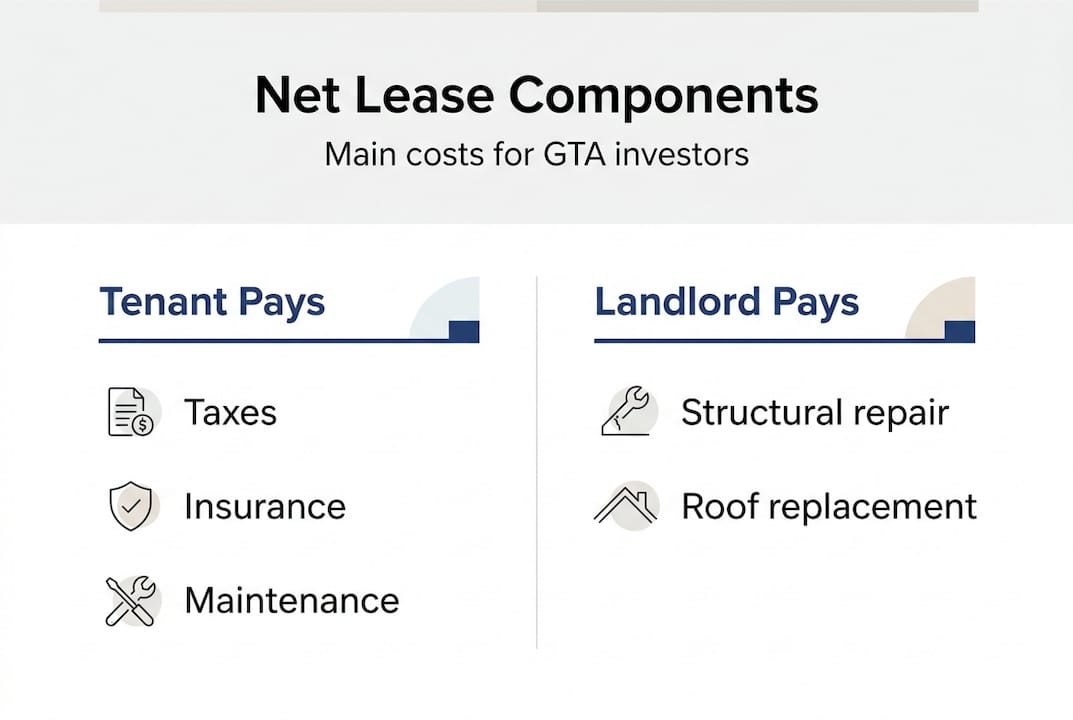
Property taxes, insurance, maintenance
Structural repairs (roof, foundation)
Most GTA industrial properties
Absolute NNN
All expenses including structural
Nothing
Build-to-suit, sale-leaseback transactions
Single net leases represent the most landlord-friendly structure among the three main types. Tenants pay only property taxes beyond base rent, while landlords retain responsibility for insurance premiums and all maintenance costs. This arrangement rarely appears in modern GTA industrial leases because landlords prefer greater expense protection. You might encounter single net structures in older buildings where landlords maintain tight control over property management or in short-term transitional leases.
Double net leases add insurance premiums to the tenant's expense burden. Beyond base rent and property taxes, tenants now cover the building's insurance costs while landlords handle maintenance and repairs. This structure appears more frequently in multi-tenant industrial properties where landlords want to protect against insurance rate increases but maintain control over building upkeep quality. The challenge lies in verifying that insurance premiums reflect actual coverage costs rather than inflated charges.
Triple net leases dominate the GTA industrial market, with
tenants paying property taxes, insurance, and maintenance costs
alongside base rent. Landlords typically retain responsibility only for major structural repairs like roof replacement or foundation work, though lease language varies significantly. Monthly estimates for these expenses create predictable cash flow, with annual true-up reconciliations adjusting for actual costs incurred. Proration by gross leasable area ensures fair allocation in multi-tenant buildings, though vacancy exclusions and gross-up provisions add complexity.
True-up reconciliations occur annually, comparing estimated payments against actual expenses. If estimates exceeded actual costs, landlords refund the difference. If actual costs surpassed estimates, tenants pay the shortfall. This process requires detailed accounting and creates opportunities for disputes if landlords include inappropriate expenses or miscalculate prorations. Escalation clauses further complicate matters by increasing base rent or expense estimates annually through fixed percentages or Consumer Price Index adjustments.
Here's how expense calculations and reconciliations typically work:
Landlord...

About Michael Law
Managing Partner and Industrial Real Estate Broker at Lennard Commercial Realty. Representing tenants and landlords across Toronto and the GTA for 15+ years. Michael specializes in GTA industrial real estate — connect with Toronto's leading industrial broker at mlawrealestate.com/industrial-broker-toronto.
More Toronto Industrial Real Estate Insights