
What is net operating income in real estate?
By Michael Law · Industrial Real Estate Broker, Lennard Commercial Realty
TL;DR:
- Net operating income (NOI) measures a property’s operational profitability by subtracting recurring operating expenses from effective gross income plus ancillary income. It excludes debt service, taxes, depreciation, and capital expenditures, allowing for accurate property comparisons and valuation using the cap rate. Proper calculation and regular reconciliation of NOI are crucial for investors and lenders to assess true earning power and asset value.
Net operating income (NOI) is defined as a property’s total revenue from operations minus all recurring operating expenses, excluding debt service, income taxes, depreciation, and capital expenditures. It is the single most foundational metric in commercial real estate analysis, used by investors, lenders, and brokers across the GTA to measure a property’s true earning power before financing decisions enter the picture. Whether you are evaluating a logistics facility in Mississauga, a warehouse in Brampton, or a multi-tenant industrial building in Vaughan, NOI is the number every serious investor calculates first. The core NOI formula is: NOI = (Gross Operating Income + Ancillary Income) minus Operating Expenses.
How is net operating income calculated in real estate?

NOI calculation begins with gross operating income, which is the total potential rent revenue a property can generate at full occupancy. From there, you adjust downward for vacancy and credit losses to arrive at effective gross income. Then you add ancillary income and subtract recurring operating expenses to reach the final figure.
Breaking down the formula step by step
The full formula reads: NOI = (Gross Operating Income + Ancillary Income) minus Operating Expenses. Each component carries specific meaning.
Gross operating income is your scheduled base rent across all tenants, assuming full occupancy. For a 50,000 square foot industrial building in Brampton leased at $14 per square foot net, that is $700,000 in potential gross income annually.
Effective gross income adjusts that figure for realistic vacancy and credit loss. If you apply a 5% vacancy allowance, effective gross income drops to $665,000. Distinguishing potential from effective gross income is one of the most commonly skipped steps in NOI analysis, and skipping it inflates profitability estimates.
Ancillary income includes all non-rent revenue the property generates. Parking fees, signage licences, antenna leases, and storage charges all count. On a well-positioned industrial property near Highway 401 in Mississauga, ancillary income can add $15,000 to $40,000 annually to the revenue line.
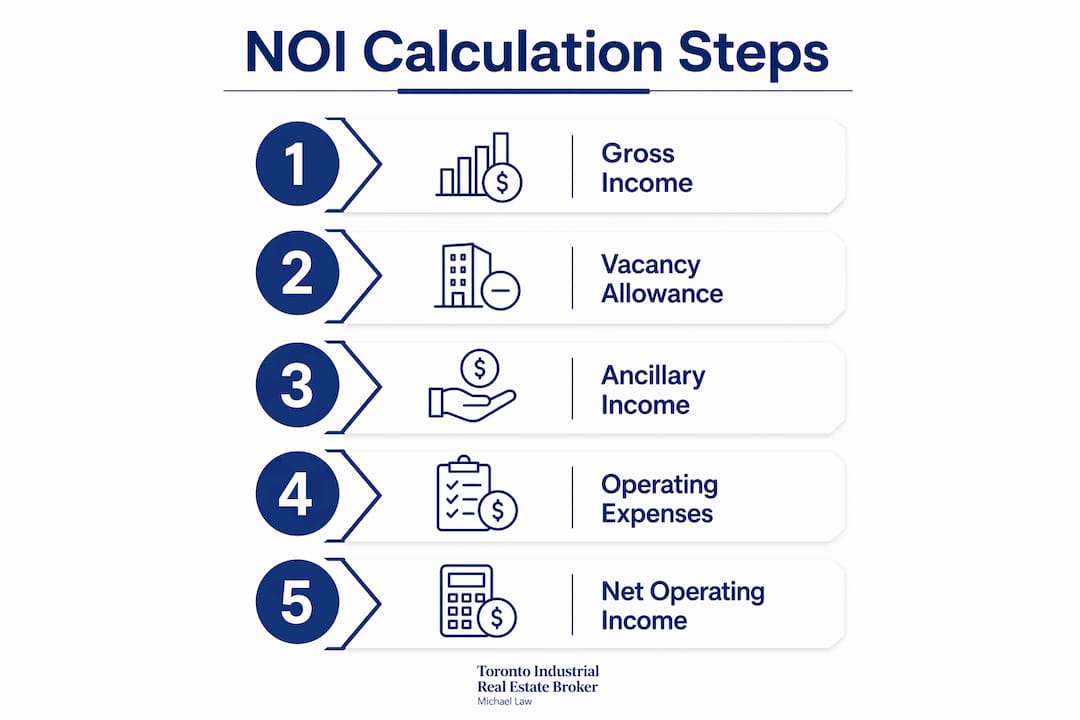
Operating expenses are the recurring costs required to run the property. These typically include property taxes, insurance, utilities, property management fees, maintenance, and administrative costs. The defining characteristic is recurrence. A roof replacement is not an operating expense. Routine HVAC servicing is.
Here is a simplified example for a GTA industrial property:
- Potential gross income: $700,000
- Less vacancy and credit loss (5%): ($35,000)
- Effective gross income: $665,000
- Plus ancillary income: $20,000
- Total revenue: $685,000
- Less operating expenses: ($185,000)
- Net operating income: $500,000
Pro Tip: Before finalising your NOI, conduct a recovery audit against your lease agreements. A recovery audit can add 3 to 8% to the revenue figure on properties with billing gaps, particularly in industrial net leases where tenants reimburse property taxes, insurance, and maintenance. Understanding net lease structures is critical to getting this right.
What does net operating income exclude and why?
NOI excludes four categories of costs by design: debt service, income taxes, depreciation, and capital expenditures. Each exclusion serves a specific analytical purpose.
Capital expenditures and depreciation are excluded because they are non-recurring costs that would distort the measurement of operational efficiency. A roof replacement or a loading dock upgrade extends the asset’s useful life. Including it in NOI would make a well-maintained property look less profitable than a neglected one, which is the opposite of useful analysis.
Debt service is excluded because it reflects the owner’s financing decision, not the property’s performance. Two investors can buy the same Vaughan industrial building at the same price. One pays cash. The other finances 70% of the purchase. Their NOI is identical. Their net income after debt service is not. NOI strips out financing influences so you can compare properties on an operational footing, regardless of how they were acquired.
Income taxes are excluded for the same reason. Tax obligations vary by ownership structure, jurisdiction, and individual circumstances. Keeping taxes out of NOI makes the metric universally comparable.
How NOI compares to related metrics
| Metric | What it includes | What it excludes |
|---|---|---|
| Gross income | All revenue | Nothing deducted |
| Net operating income | Revenue minus operating expenses | Debt service, taxes, depreciation, capex |
| EBITDA | Earnings before interest, taxes, depreciation, amortisation | Interest, taxes, depreciation, amortisation |
| Net income | All revenues minus all costs | Nothing excluded |
NOI and EBITDA are often confused, but they serve different purposes. EBITDA is a corporate earnings metric. NOI is a property-level metric. EBITDA may include non-property income streams and corporate overhead. NOI does not.
Pro Tip: If a seller’s NOI figure looks unusually high, check whether capital expenditures have been reclassified as operating expenses. This is one of the most common ways NOI gets manipulated in sale presentations. A commercial property evaluation by a qualified appraiser will catch this quickly.
Why is NOI important for real estate investors and lenders?
NOI is described by financial analysts as the “single most important number” in commercial real estate. Every major downstream metric in property analysis depends on it. Errors in NOI calculation skew every other investment metric that follows.
Here are the five most practical applications of NOI for GTA industrial investors and property owners:
-
Capitalisation rate (cap rate) calculation. Cap rate equals NOI divided by property value. A property generating $750,000 NOI acquired for $12.5 million carries a 6% capitalisation rate. This is the primary tool for comparing industrial assets across Mississauga, Brampton, and Hamilton without being distracted by financing structures.
-
Property valuation. Reverse the cap rate formula and you get value. If market cap rates for GTA industrial properties sit at 5%, a property generating $500,000 NOI is worth $10 million. Improving NOI by $50,000 through better lease management or ancillary income adds $1 million to the asset’s value at a 5% cap rate. That is the direct financial case for NOI optimisation.
-
Debt Service Coverage Ratio (DSCR). Lenders use DSCR to assess whether a property generates enough income to cover its debt obligations. DSCR is calculated by dividing NOI by annual debt service. A property with $750,000 NOI and $600,000 in annual debt payments carries a 1.25x DSCR. Most institutional lenders require a minimum of 1.20x to 1.25x DSCR for industrial acquisitions in the GTA.
-
Benchmarking across properties. NOI allows you to compare a 30,000 square foot facility in Ajax against a 75,000 square foot facility in Oakville on a per-square-foot basis. This normalised view reveals which asset is performing better operationally, independent of size or price.
-
Lease negotiation and renewal strategy. Understanding how each lease clause affects NOI gives you leverage in renewal discussions. A tenant paying below-market rent on a long-term lease directly suppresses NOI and, by extension, the property’s appraised value. Broker expertise in lease negotiations can recover significant value here.
Common mistakes in calculating and interpreting NOI
Errors in NOI are more common than most investors admit, and they tend to cluster around the same recurring problems.
-
Ignoring vacancy and credit loss. Using potential gross income instead of effective gross income is the most frequent error. A GTA industrial building with a single anchor tenant may appear fully occupied, but a realistic 3 to 5% vacancy allowance still belongs in the model. Inflated profitability estimates from skipping this step mislead buyers and lenders alike.
-
Including capital expenditures as operating costs. Roof repairs, dock leveller replacements, and HVAC system overhauls are capital expenditures. They extend asset life and belong on the balance sheet, not in the operating expense line. Including them in NOI understates profitability and distorts cap rate calculations.
-
Overlooking ancillary income. Parking revenue, signage fees, and storage income are frequently omitted from NOI calculations, particularly on properties where these streams are informal or undocumented. On a Markham industrial property with a large paved yard, parking revenue alone can represent $20,000 to $50,000 annually.
-
Skipping the reconciliation audit. Many operators leave 2 to 5% of potential revenue in unbilled recoveries because they never reconcile actual billings against lease entitlements. In industrial net leases, where tenants are responsible for property taxes, insurance, and maintenance, this gap can be substantial.
-
Misreading lease structures. Gross leases, net leases, and modified gross leases each treat operating expense recovery differently. A gross lease means the landlord absorbs operating costs. A net lease passes them to the tenant. Confusing the two when building an NOI model produces fundamentally incorrect results. This distinction matters enormously across the GTA industrial market, where net leases dominate.
-
Using unaudited figures from the seller. Seller-provided income and expense statements are a starting point, not a conclusion. Always verify rent rolls against executed leases, confirm actual tax assessments, and reconcile management fee structures before accepting any NOI figure at face value.
Key takeaways
Net operating income is the definitive measure of a property’s operational profitability, and every valuation, lending, and investment decision in commercial real estate flows directly from it.
| Point | Details |
|---|---|
| NOI formula | NOI equals effective gross income plus ancillary income, minus all recurring operating expenses. |
| Key exclusions | Debt service, income taxes, depreciation, and capital expenditures are excluded by design to isolate operational performance. |
| Cap rate connection | Dividing NOI by property value gives the capitalisation rate, the primary valuation benchmark for GTA industrial assets. |
| DSCR reliance | Lenders calculate DSCR from NOI. A minimum 1.20x to 1.25x ratio is standard for institutional industrial financing. |
| Common errors | Skipping vacancy adjustments, misclassifying capital expenditures, and omitting ancillary income are the three most damaging NOI mistakes. |
Why I think most investors underestimate what NOI actually tells you
After years of advising on industrial acquisitions and leasing transactions across the GTA, I have seen a consistent pattern. Investors who treat NOI as a simple arithmetic exercise miss most of what the number is actually communicating.
NOI is not just a profitability figure. It is a diagnostic tool. When I review a property’s NOI alongside its lease roll, I am looking for compression points. Where is the gap between potential and effective gross income? Are recoveries being billed correctly? Is ancillary income being captured or left on the table? These questions reveal operational quality, not just financial performance.
In the GTA industrial market specifically, where net leases are the norm and tenants bear most operating costs, the NOI calculation is heavily dependent on lease accuracy. A single unbilled recovery line in a multi-tenant Brampton facility can represent $30,000 to $80,000 in annual revenue that simply disappears from the NOI figure. That is not a rounding error. At a 5% cap rate, that gap represents $600,000 to $1.6 million in lost asset value.
My advice to every investor I work with is this: treat NOI as a living number, not a static one. Audit it annually. Reconcile it against your leases. And never accept a seller’s NOI without independent verification. The investors who do this consistently are the ones who buy at the right price, finance at the right terms, and hold assets that perform as modelled.
NOI should also never be used in isolation. Pair it with cap rate trends, DSCR analysis, and a clear view of the local market before making any acquisition or disposition decision. At Mlawrealestate, every investment advisory engagement starts with a rigorous NOI review, because everything else follows from it.
— Michael
How Mlawrealestate helps GTA investors optimise property income

Mlawrealestate specialises in industrial real estate advisory across the GTA, from Mississauga and Brampton to Markham, Hamilton, and the Durham Region. Whether you are acquiring an income-producing industrial asset, renegotiating a lease to improve your NOI, or evaluating a disposition, the team at Mlawrealestate brings transaction-tested expertise to every engagement. Michael Law is also affiliated with Lennard Commercial Realty, one of Canada’s leading commercial brokerages, providing clients with institutional-grade market intelligence and deal execution capability. Browse current GTA industrial listings or connect directly to discuss how a professional NOI review can sharpen your investment strategy.
FAQ
What is the net operating income formula?
NOI equals gross operating income plus ancillary income, minus all recurring operating expenses. It excludes debt service, income taxes, depreciation, and capital expenditures.
How does NOI differ from gross income?
Gross income is total revenue before any deductions. NOI subtracts vacancy allowances, credit losses, and all recurring operating expenses from gross income to reflect actual operational profitability.
What is a good NOI for an industrial property in the GTA?
There is no single benchmark, but a property generating a 5 to 6% cap rate on its NOI is broadly considered market-rate for GTA industrial assets in 2026. The specific figure depends on location, lease term, and tenant quality.
Why do lenders care about NOI?
Lenders use NOI to calculate the Debt Service Coverage Ratio (DSCR). A DSCR of 1.25x means the property generates 25% more income than required to cover debt payments, which is the standard minimum for most institutional industrial lenders.
Can NOI be negative?
Yes. If operating expenses exceed gross income, NOI is negative. This signals that the property is not generating enough revenue to cover its basic operating costs, which is a serious red flag for any investor or lender reviewing the asset.
Recommended

About Michael Law
Managing Partner and Industrial Real Estate Broker at Lennard Commercial Realty. Representing tenants and landlords across Toronto and the GTA for 15+ years. Michael specializes in GTA industrial real estate — connect with Toronto's leading industrial broker at mlawrealestate.com/industrial-broker-toronto.