Commercial real estate Sacramento: 2026 investor and tenant guide
By Michael Law · Industrial Real Estate Broker, Lennard Commercial Realty
Commercial real estate Sacramento: 2026 investor and tenant guide
TL;DR:
- Sacramento’s commercial real estate market faces higher vacancy levels, especially in industrial properties.
- Tenant leverage increases due to rising vacancy, with lease costs heavily influenced by structure and concessions.
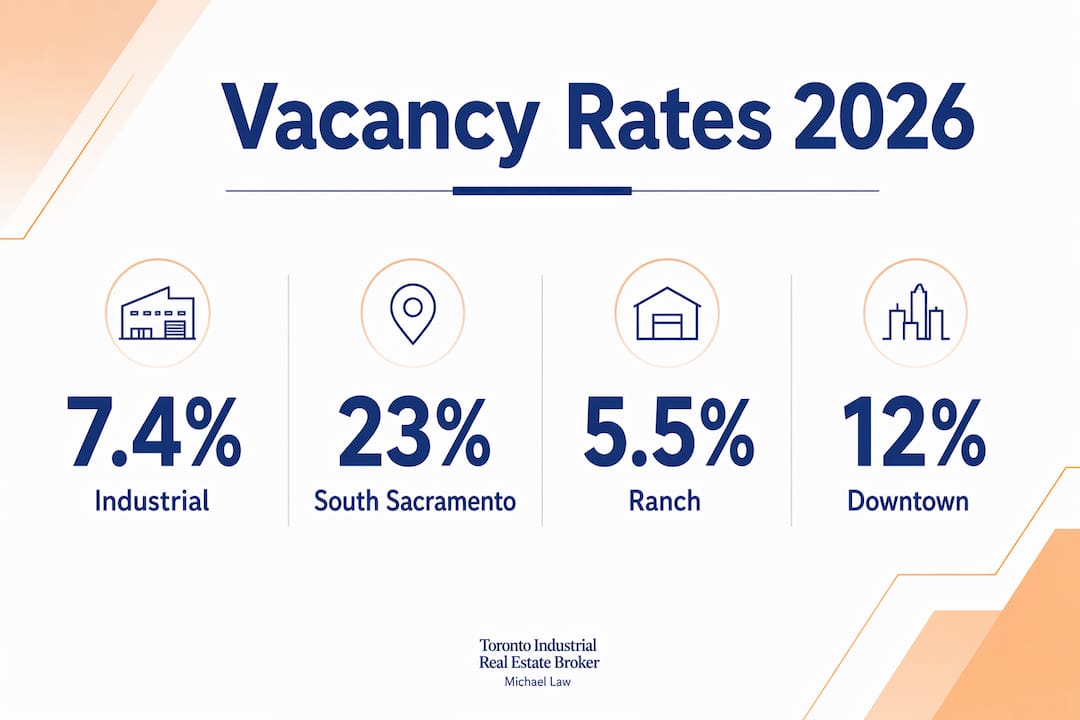
Commercial real estate in Sacramento is defined by three distinct asset classes — industrial, office, and retail — each with its own vacancy dynamics, lease structures, and submarket performance that directly shape investment returns and occupancy costs. The Sacramento market entered 2026 under pressure, with industrial vacancy at 7.4%, the highest level in nearly a decade. Investors, business owners, and corporate tenants who understand the submarket differences and lease economics will find real opportunity here. This guide covers the data, the deal structures, and the location decisions that matter most for Sacramento commercial properties in 2026.
What are the current commercial real estate Sacramento market conditions?
Sacramento’s industrial sector is the clearest signal of where the broader market stands. Vacancy rose to 7.4% in 2026, driven by 1.4 million square feet of new deliveries arriving into a market with softening demand. Net absorption turned negative, meaning more space was vacated than leased. That shift matters because it gives tenants negotiating power they have not had in years.
Rent growth followed the same direction. Industrial asking rents declined by 0.5% year over year, a modest drop in absolute terms but a meaningful reversal after years of increases. Sublet space now represents 1.7% of total inventory, adding further pressure on landlords competing for a smaller pool of active tenants.
The office and retail segments tell a different story. Office space in Sacramento continues to face structural headwinds from hybrid work patterns, with downtown corridors seeing elevated availability. Retail leasing in Sacramento has held up better in high-traffic corridors, particularly where daily-needs tenants anchor the centre.
Key market indicators for 2026:
- Industrial vacancy: 7.4%, highest in nearly a decade
- Rent trend: Negative 0.5% year over year for industrial
- New supply: 1.4 million SF delivered in the most recent cycle
- Sublet availability: 1.7% of total industrial inventory
- Natomas industrial availability: 13.8% vacancy with asking rents at $0.80/SF
Pro Tip: Track sublet space separately from direct vacancy. Sublet listings often carry more flexible terms and lower effective rents, making them the best starting point for tenants with near-term requirements.
The gap between submarkets is significant. Vacancy rates vary widely across Sacramento, with South Sacramento direct vacancy exceeding 23% while tighter nodes hold below 10%. That spread means a single market-wide number tells you very little. Submarket-level underwriting is the only way to make a sound decision.
How do lease structures and costs impact tenants and investors?
The lease type determines your total cost exposure before you ever negotiate a single dollar of rent. Sacramento commercial spaces are predominantly leased on a triple net (NNN) basis, meaning the tenant pays base rent plus property taxes, insurance, and common area maintenance (CAM). Confirming the lease structure is the first step in any cost analysis, because gross rent and NNN rent are not comparable without a full reconciliation.

What does a NNN lease actually cost in Sacramento?
Average CAM expenses for Sacramento industrial properties run approximately $10.50 per square foot annually. Property taxes under California’s Proposition 13 carry an effective rate of roughly 1.1%–1.2% of assessed value. For a tenant leasing a 20,000 SF industrial building, CAM alone can add $210,000 per year on top of base rent. That number is not theoretical. It shows up in the annual reconciliation statement.
NNN cap rates for credit-tenant industrial properties in Sacramento currently range from 5.5% to 7.5%, with typical lease terms of 5–10 years. Investors underwriting acquisitions at the lower end of that range are pricing in stable, long-term income. Those buying at the higher end are accepting more risk or shorter remaining lease term.
| Lease type | Tenant pays | Landlord pays | Best for |
|---|---|---|---|
| Gross | Base rent only | All operating costs | Tenants wanting cost certainty |
| Modified gross | Base rent + some utilities | Most operating costs | Smaller office or retail users |
| Net (N) | Base rent + property tax | Insurance and CAM | Mid-size commercial tenants |
| NNN | Base rent + tax, insurance, CAM | Structure and roof only | Investors, logistics tenants |
CAM reconciliation is the most common source of disputes in Sacramento commercial leases. Landlords estimate CAM charges at the start of each year, then reconcile actual costs at year end. If actual costs exceed estimates, tenants receive a bill. CAM reconciliation requires tenants to budget for year-end true-ups and to negotiate audit rights before signing.
Pro Tip: Negotiate a CAM cap of 3%–5% annual increase on controllable expenses. Without a cap, CAM charges can increase significantly year over year, eroding the value of any rent concession you negotiated at lease signing.
Landlords in Sacramento currently prefer offering free rent periods and tenant improvement (TI) allowances over reducing face rents. That preference matters for how you model a deal. A 6-month free rent period on a 5-year lease reduces your effective annual rent by roughly 10%. Focusing only on the asking rate misses that value entirely.
What are the key Sacramento submarkets and property types?
Sacramento’s commercial market is not one market. It is a collection of distinct nodes, each with different vacancy profiles, tenant demand, and investment characteristics. Understanding which submarket fits your operational or investment criteria is the single most important location decision you will make.
Major submarkets compared
Submarket vacancy varies dramatically across Sacramento, requiring tailored analysis for each location.
| Submarket | Primary asset type | Vacancy profile | Key tenant profile |
|---|---|---|---|
| Natomas | Industrial, logistics | ~13.8% availability | Distribution, e-commerce |
| South Sacramento | Industrial, flex | Over 23% direct vacancy | Manufacturing, storage |
| Downtown Sacramento | Office, retail | Elevated, hybrid-driven | Professional services, food and beverage |
| Roseville | Retail, office | Stable, suburban demand | Healthcare, retail chains |
| Rancho Cordova | Industrial, flex | Moderate | Government contractors, tech |
| Elk Grove | Industrial, retail | Growing supply | Logistics, big-box retail |
Natomas is the most active industrial corridor for logistics and distribution users. The average asking rate of $0.80/SF in Natomas reflects a market where landlords are holding rents while offering concessions to attract tenants. South Sacramento carries significantly higher vacancy, which creates opportunities for tenants willing to accept older building stock or less central locations.
Building size also shapes leasing risk. Small-bay and multi-tenant industrial buildings carry lower vacancy rates than large big-box logistics facilities. That pattern reflects the depth of the local small-business tenant base versus the narrower pool of large-format logistics users. Investors targeting multi-tenant industrial in Sacramento face less re-leasing risk than those holding single-tenant big-box assets.
Retail leasing in Sacramento rewards location specificity. The property at 1800 Arden Way illustrates this clearly. With traffic counts exceeding 55,000 vehicles per day and SC-R-PUD zoning allowing multiple commercial uses, the site commands a premium over comparable properties on lower-traffic corridors. Visibility, parking, and zoning flexibility drive retail value as much as the rent rate itself.
The Railyards development near Downtown Sacramento is the most significant future supply event in the market. The 240-plus acre mixed-use project includes planned retail, office space, and hotel rooms, with the Paint Shop phase expected to open in 2028. Stadium-driven foot traffic will reshape leasing demand in the surrounding corridors. Tenants and investors evaluating Downtown Sacramento properties today should factor Railyards competition into their 5-year projections.
How should investors and tenants approach Sacramento transactions?
The current Sacramento market favours tenants and buyers who do their homework before entering negotiations. Negative net absorption and rising vacancy give occupiers real leverage, but only if they understand the full cost picture before sitting down at the table.
-
Confirm the lease structure first. Before comparing any two properties, establish whether each is quoted on a gross, modified gross, or NNN basis. A $1.20/SF NNN quote and a $1.80/SF gross quote may represent identical all-in costs once you add CAM, taxes, and insurance to the NNN option.
-
Model all-in occupancy costs. Base rent is the starting point, not the finish line. Add CAM at the current Sacramento benchmark, property tax at the Prop 13 effective rate, insurance, and utilities. Use the occupancy cost breakdown framework to stress-test your budget against year-end reconciliation scenarios.
-
Negotiate concessions, not just face rent. Landlords in Sacramento are protecting their asking rates while offering free rent and TI allowances. Push for the longest free rent period and the highest TI allowance the deal will support. Those concessions reduce your effective rent without changing the landlord’s reported lease rate.
-
Secure CAM audit rights in writing. CAM reconciliation is the greatest risk point for tenants. Negotiate the right to audit the landlord’s operating expense records annually. Without that right, you have no recourse if the reconciliation statement contains errors or inflated charges.
-
Evaluate operational factors beyond price per square foot. For retail and office users, traffic counts, parking ratios, and zoning flexibility determine whether a location performs. For industrial users, clear height, dock doors, and proximity to Highway 50 or Interstate 80 matter more than the asking rate alone.
Pro Tip: Use a tenant representation broker for any lease over 5,000 SF. The broker’s fee is paid by the landlord in most Sacramento transactions, so you access professional negotiation support at no direct cost. Off-market listings and pre-market opportunities are almost exclusively available through broker relationships.
Investors should apply submarket-specific cap rate underwriting rather than using a single market-wide rate. The cap rate range of 5.5%–7.5% for NNN industrial properties reflects meaningful differences in credit quality, lease term, and location. A 10-year lease to a national credit tenant in Natomas warrants a tighter cap rate than a 3-year lease to a local operator in South Sacramento. Pricing those deals the same way is how investors overpay.
Key takeaways
Sacramento’s commercial real estate market in 2026 rewards tenants and investors who analyse submarkets individually and model total occupancy costs rather than relying on headline rent figures.
| Point | Details |
|---|---|
| Industrial vacancy is elevated | Sacramento industrial vacancy reached 7.4% in 2026, giving tenants real negotiating leverage. |
| Submarket differences are large | South Sacramento vacancy exceeds 23% while tighter nodes hold below 10%, requiring location-specific analysis. |
| NNN costs add significantly to base rent | CAM alone averages $10.50/SF annually in Sacramento, making all-in cost modelling non-negotiable. |
| Concessions beat face rent reductions | Landlords prefer free rent and TI allowances, so tenants should negotiate total lease economics, not just the asking rate. |
| Railyards will reshape downtown demand | The 240-plus acre mixed-use Railyards project opens its Paint Shop phase in 2028, affecting nearby retail and office leasing. |
What the Sacramento market taught me about reading between the lines
I spend most of my time in the GTA industrial market, but the dynamics playing out in Sacramento in 2026 are a near-perfect mirror of what happens in any market when new supply outpaces demand. The lesson I keep coming back to is this: vacancy numbers are lagging indicators. By the time a market reports 7.4% vacancy, the deals that will define the next cycle are already being negotiated quietly.
The concession-versus-rent-cut dynamic is the most misunderstood part of a soft market. Tenants who focus on the face rent are leaving money on the table. The real value is in free rent periods, TI allowances, and flexible termination rights. A landlord who will not move on rent will often give you six months free and a $50 per square foot TI budget if you know how to ask. That is where the economics actually live.
The Railyards development is the wildcard I would watch most carefully. A 240-plus acre mixed-use project with stadium-driven traffic is not just a real estate story. It is a demand-creation event for the entire downtown corridor. Tenants who position themselves in the surrounding blocks before 2028 will benefit from foot traffic patterns that do not yet exist. That is the kind of asymmetric opportunity that rarely announces itself clearly.
For investors, the 5.5%–7.5% cap rate range in Sacramento NNN industrial tells you the market is pricing risk honestly right now. That spread is wide enough to find value if you underwrite each deal on its own merits. The mistake is applying a blended rate to assets with fundamentally different risk profiles. Do the submarket work. Model the lease economics. The numbers will tell you where the real opportunity sits.
— Michael
Commercial real estate listings and advisory from Mlawrealestate
Mlawrealestate brings institutional-grade analysis to industrial and commercial real estate transactions across North America. Whether you are a tenant evaluating Sacramento commercial properties, an investor assessing NNN acquisition targets, or a business owner weighing a lease renewal, the process starts with the right data and the right representation.

Mlawrealestate’s commercial property listings cover industrial, office, and retail assets with full lease economics, submarket context, and transaction support. For investors and tenants who want to go deeper on lease negotiation strategy, Michael Law’s profile at Lennard Commercial Realty outlines a transaction track record built on exactly the kind of submarket-specific, data-backed advisory this market demands. The right deal starts with the right adviser.
FAQ
What is the current industrial vacancy rate in Sacramento?
Sacramento industrial vacancy reached 7.4% in 2026, the highest level in nearly a decade, driven by 1.4 million square feet of new supply and negative net absorption.
What does NNN mean in a Sacramento commercial lease?
NNN stands for triple net. The tenant pays base rent plus property taxes, insurance, and CAM on top of the base rate, with CAM averaging approximately $10.50 per square foot annually in Sacramento.
Which Sacramento submarket has the lowest industrial vacancy?
Vacancy varies significantly by submarket. South Sacramento direct vacancy exceeds 23%, while tighter nodes such as Rancho Cordova and parts of Natomas hold considerably lower availability rates.
How do I negotiate a better commercial lease in Sacramento?
Focus on total lease economics rather than face rent alone. Negotiate free rent periods, TI allowances, CAM caps, and audit rights. Landlords in Sacramento currently prefer concessions over rent reductions, which creates room to improve the all-in deal value.
What is the Railyards development and why does it matter?
The Railyards is a 240-plus acre mixed-use development near Downtown Sacramento with planned retail, office, and hotel space. Its Paint Shop phase is expected to open in 2028, and stadium-driven traffic will materially affect leasing demand in the surrounding downtown corridors.
Recommended

About Michael Law
Managing Partner and Industrial Real Estate Broker at Lennard Commercial Realty. Representing tenants and landlords across Toronto and the GTA for 15+ years. Michael specializes in GTA industrial real estate — connect with Toronto's leading industrial broker at mlawrealestate.com/industrial-broker-toronto.