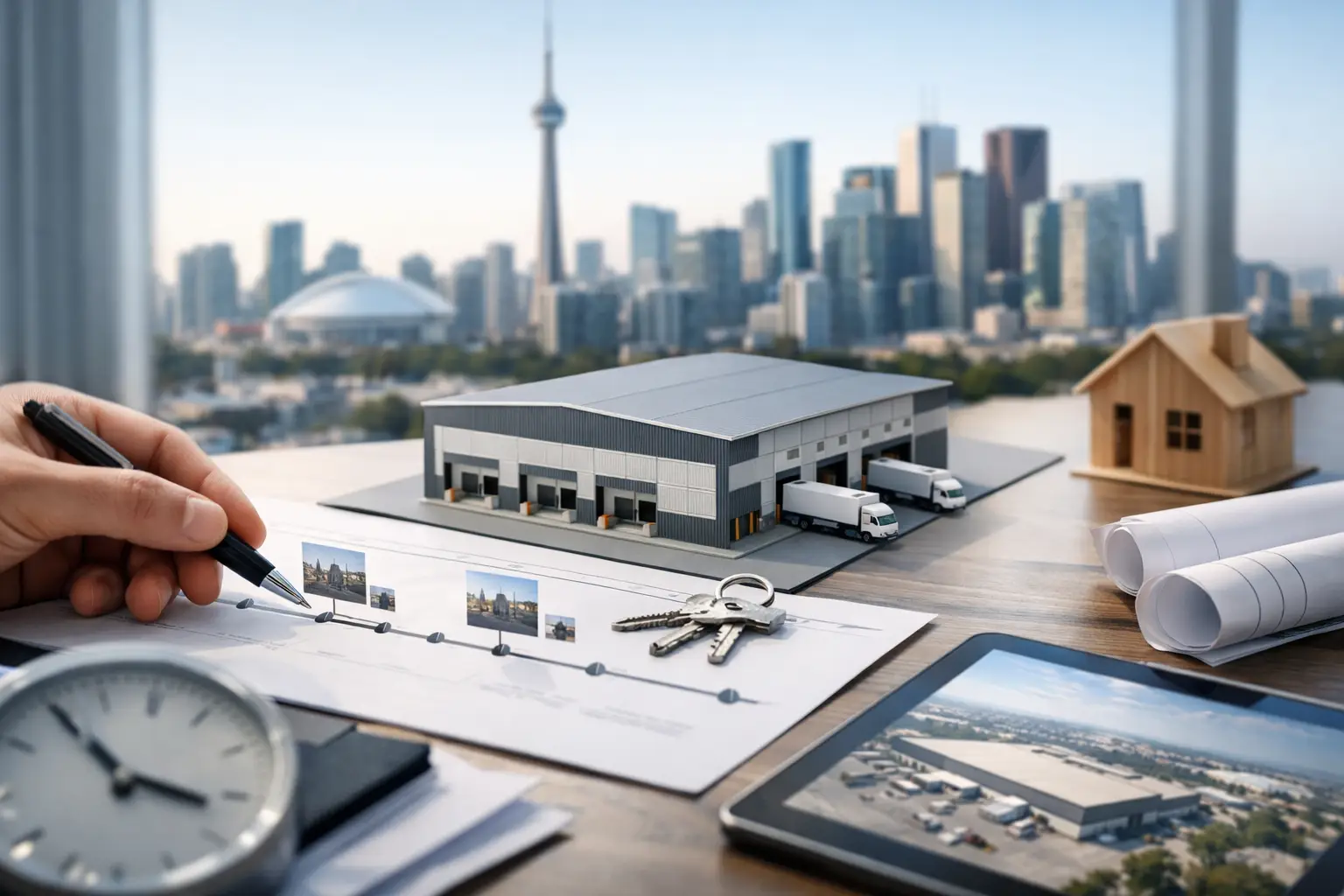
Toronto Industrial Transaction Timeline Explained
By Michael Law · Industrial Real Estate Broker, Lennard Commercial Realty
An industrial purchase can appear straightforward until the offer is accepted. The Toronto industrial transaction timeline is shaped by more than price and possession date: financing, environmental risk, title matters, zoning, tenant obligations, and operational requirements can each change the pace of a deal. For owners, investors, and business operators, the goal is not simply to close quickly. It is to close on terms that hold up after possession.
A conventional industrial sale in Toronto or the GTA often takes 45 to 90 days from an accepted agreement to closing. A clean, all-cash transaction may move faster. A property with financing, a complicated lease structure, environmental concerns, or redevelopment potential may require longer. The right timeline depends on what is being bought, how it will be used, and which risks need to be resolved before money changes hands.
The Toronto Industrial Transaction Timeline at a Glance
Most industrial transactions move through five connected stages: preparation, offer and negotiation, conditional due diligence, removal of conditions, and closing. These stages overlap at times, particularly when a buyer begins lender discussions or preliminary inspections before submitting an offer.
For a seller, preparation can begin weeks or months before a property is marketed. For a buyer, the active timeline usually begins when a suitable property is identified. In either case, delay most often occurs when a material issue is discovered late. That is why organized documents and early professional review are usually more valuable than an artificially short condition period.
Before the Offer: Preparing the Property and the Buyer
A seller who prepares thoroughly can reduce friction once an offer arrives. This means assembling a current survey, tax information, utility details, building plans if available, environmental reports, lease documents, rent rolls, service contracts, and records of major repairs or capital improvements. If the property is owner-occupied, the seller should also be ready to explain which equipment, inventory, fixtures, or business assets are included or excluded.
The price strategy should reflect more than building size. Clear height, shipping configuration, power, site circulation, parking, zoning, office finish, access to major highways, and potential for outside storage all affect marketability. In tight industrial submarkets, a functional building can attract strong interest quickly, but buyers still need enough information to make a defensible decision.
Buyers should establish acquisition criteria before touring properties. Required square footage, shipping needs, power capacity, location, budget, and occupancy date are obvious considerations. Less obvious issues include future expansion, employee access, trailer parking, municipal restrictions, and whether the intended operation is permitted under current zoning. A buyer who has lender discussions, corporate approvals, and a clear deposit plan in place is better positioned when the right opportunity appears.
The Offer Stage: Days 1 Through 5
An industrial offer typically addresses purchase price, deposit, closing date, included assets, representations and warranties, access for inspections, and conditions. It also sets the rules for what happens if a condition is not satisfied. This is where a disciplined offer can prevent confusion later.
A deposit is generally due shortly after acceptance and is held in trust according to the agreement. The amount varies with the transaction, but it should demonstrate commitment without creating unnecessary exposure before due diligence is complete. Deposit timing and condition wording deserve careful attention because they affect a buyer's practical ability to investigate the property and exit if a material issue cannot be resolved.
Negotiation may be completed in a day when both sides are aligned. It can take longer where there are tenants, multiple decision-makers, unusual equipment, vendor financing, or a seller who needs a leaseback after closing. A fast acceptance is helpful, but vague terms often create more work during the condition period.
Due Diligence: Usually 15 to 30 Days
The due diligence period is the most consequential part of the industrial transaction timeline. The buyer is testing whether the property, its income, and its legal status support the agreed price and intended use. The length should be realistic. A 10-day condition period may work for a familiar, owner-occupied building with no financing contingency, but it can be too aggressive for an investment asset or a property with environmental history.
Physical and Environmental Review
A building inspection can identify roof, HVAC, electrical, structural, drainage, sprinkler, and loading concerns. Industrial users should pay particular attention to power capacity, clear height, floor condition, shipping doors, fire protection, and the practical movement of trucks and trailers on site. A building may meet a size requirement on paper while failing to support a specific operation efficiently.
Environmental review is equally important. A Phase I Environmental Site Assessment is common, especially where there has been manufacturing, automotive, fuel, dry-cleaning, waste handling, or other potentially contaminating use. If the Phase I identifies concerns, a Phase II may be recommended. That can extend the timeline, but proceeding without clarity can expose a buyer to a cost far greater than a delayed closing.
Title, Zoning, and Lease Review
The buyer's lawyer reviews title, easements, rights-of-way, restrictive covenants, and registered agreements that may limit use or development. A survey can reveal encroachments, access issues, or discrepancies between the legal boundaries and the property as used.
Zoning should be reviewed against the intended business activity, not merely the broad industrial designation. Permitted uses, outdoor storage, parking requirements, signage, loading, and future expansion can all matter. Where a purchaser plans a specialized operation, municipal confirmation may be necessary before conditions are removed.
For leased industrial assets, due diligence also includes leases, renewals, security deposits, tenant estoppels where appropriate, arrears, operating expenses, and service contracts. A building with a strong tenant may justify a different timeline and valuation approach than one with near-term vacancy risk. The purchaser needs to understand not just current rent, but the quality and duration of the income.
Financing and Appraisal
Financing conditions often run alongside property due diligence. Lenders may require an appraisal, environmental reports, borrower financial information, rent rolls, leases, and insurance details. A lender's underwriting process can be the longest item on the critical path, particularly for a first-time commercial buyer, a specialized property, or an asset with a vacant component.
Buyers should avoid treating loan approval as a formality. An appraisal that comes in below the purchase price, a change in lender requirements, or an environmental finding can alter the equity required to close. Early communication between the buyer, lender, broker, and legal team helps identify gaps before the condition deadline.
Removing Conditions and Preparing to Close
Once the buyer is satisfied, conditions are waived or fulfilled in writing under the agreement. This is a major commitment point. The deposit generally becomes firmly at risk if the buyer later fails to complete the purchase, subject to the specific contract terms.
The period between condition removal and closing is used to finalize financing, legal requisitions, insurance, closing adjustments, and any agreed repairs or documentation. Sellers need to provide required closing deliverables and maintain the property in the agreed condition. Buyers should confirm that no material change has occurred, arrange utilities and insurance, and prepare for operational possession.
A final visit shortly before closing is prudent. It is not a substitute for due diligence, but it can confirm that the building remains substantially as expected, included equipment is present, and no new damage or occupancy issue has emerged.
Closing Day and the First Week After Possession
On closing day, lawyers exchange documents and funds, title is transferred, and possession occurs according to the agreement. In a tenanted property, the practical handoff also includes tenant notices, rent direction, keys, access codes, service contacts, and records needed to operate the building.
For an owner-user, the first week after possession should be treated as an operational transition. Confirm utility accounts, security access, insurance coverage, municipal contacts, and maintenance responsibilities. If renovations or equipment installation are planned, coordinate permits and contractors well before the closing date whenever possible.
What Commonly Extends an Industrial Deal
The most common delays are not administrative. They are unresolved risks: financing that is not fully underwritten, environmental findings, title defects, missing lease information, appraisal gaps, zoning uncertainty, and seller documentation that arrives late. Each is manageable when identified early. Each becomes expensive when discovered at the end of a short condition period.
Michael Law Commercial Real Estate approaches transaction timing as part of deal strategy, not an afterthought. The right sequence protects leverage, keeps decision-makers informed, and gives each party a clear path to closing.
A realistic schedule does not make an industrial transaction slower. It gives the buyer time to verify the asset and gives the seller a better chance of reaching a firm closing without last-minute concessions.

About Michael Law
Managing Partner and Industrial Real Estate Broker at Lennard Commercial Realty. Representing tenants and landlords across Toronto and the GTA for 15+ years. Michael specializes in GTA industrial real estate — connect with Toronto's leading industrial broker at mlawrealestate.com/industrial-broker-toronto.
Related Articles


More Toronto Industrial Real Estate Insights
Articles & Analysis
Toronto Industrial Market Forecast for 2026
Read →Before Leasing in the GTA: Hazmat Checks Warehouse Managers Must Ask
Canada-focused checklist for warehouse managers: confirm supplier labels and current SDSs, check flammable-quantity triggers, and verify hazardous-waste...
Read →Dual Agency in Toronto Industrial Deals: Michael Law’s Case Examples
How dual agency works in Toronto industrial deals, when written disclosure and consent are required, and how brokers handle confidentiality and conflicts.
Read →Avoid 60–90 Day Delays: GTA Yard Storage Zoning for Occupiers
This GTA checklist explains outdoor yard storage zoning, stormwater approvals, 60–90 day timelines, and broker support to speed permitting.
Read →GTA Early Access Clauses: 30 Days to 4–6 Months and Sample Wording
Practical GTA guide to drafting early access clauses for industrial leases. Covers 30 days to 4–6 months fixturing, sample clause language, permit...
Read →Common Questions
What is a sale-leaseback in industrial real estate?
A sale-leaseback is a transaction in which an industrial property owner sells their building to an investor and simultaneously signs a long-term lease to remain in the property as a tenant. The seller unlocks the capital tied up in their real estate while retaining full operational use of the facility. The buyer acquires a tenanted investment property with immediate cash flow from a known occupant.
Read →What is a dock-to-grade ratio in industrial real estate?
Dock-to-grade ratio in industrial real estate refers to the number of dock-level loading doors relative to the building's floor area, typically expressed as one dock door per X,000 square feet. It is a key specification for distribution and warehousing tenants because it determines how many trucks can load and unload simultaneously and therefore the building's throughput capacity.
Read →What is clear height in a warehouse or distribution centre?
Clear height in a warehouse or distribution centre refers to the usable vertical space from the finished floor to the lowest overhead obstruction — typically the bottom of the roof structure, sprinkler heads, or HVAC equipment. It is the single most important building specification for warehouse tenants because it determines how many racking levels can be installed and therefore how much product can be stored per square foot of floor space.
Read →