
What is warehouse automation: a 2026 guide for GTA logistics
By Michael Law · Industrial Real Estate Broker, Lennard Commercial Realty
What is warehouse automation: a 2026 guide for GTA logistics
TL;DR:
- Warehouse automation combines mechanical, robotic, and software systems to enhance efficiency and reduce manual labor in fulfillment tasks. It offers significant benefits like cost savings, high order accuracy, space optimization, and improved safety, especially critical in the competitive GTA market. Successful implementation requires phased strategies, appropriate property specifications, and flexible solutions like RaaS; many operators now treat automation as an essential, integrated part of their real estate and operational decisions.
Warehouse automation is defined as the use of integrated mechanical, robotic, and software systems to perform warehousing tasks, including receiving, storage, picking, packing, and shipping, with minimal manual labour. Industry professionals refer to this discipline as automated warehousing, and it sits at the intersection of physical engineering and digital intelligence. For logistics managers and business owners operating in the Greater Toronto Area, understanding these systems is no longer optional. The shift to e-commerce fulfilment has increased the labour content of each order by three to five times, making automation a financial necessity rather than a luxury upgrade. Key technologies driving this change include Warehouse Management Systems (WMS), Automated Storage and Retrieval Systems (ASRS), and Autonomous Mobile Robots (AMRs).
What is warehouse automation and how does it work?
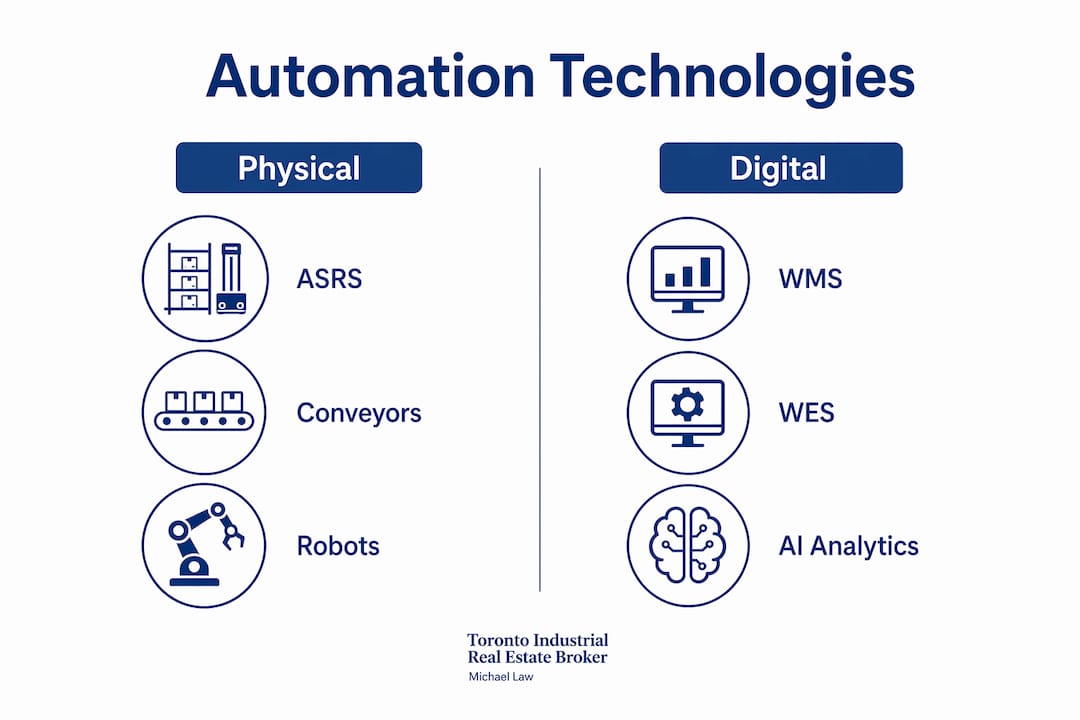
Warehouse automation works by replacing or augmenting manual tasks with technology that operates faster, more accurately, and across longer hours than human workers alone. The industry distinguishes between two broad categories: physical automation and digital automation. Both must work together for a facility to realise meaningful gains.

Physical automation covers the hardware layer. Conveyor belts and sortation systems move goods through a facility without manual handling. ASRS units, including vertical lift modules and carousel systems, store and retrieve inventory on demand. AMRs and Automated Guided Vehicles (AGVs) transport totes and pallets across the warehouse floor. Robotic picking arms, supplied by manufacturers such as Fanuc, ABB, and Symbotic, handle individual item selection at speeds no human picker can sustain across a full shift.
Digital automation covers the software layer. A Warehouse Management System (WMS) such as Manhattan Associates, Blue Yonder, or SAP Extended Warehouse Management tracks inventory location, order status, and labour allocation in real time. A Warehouse Execution System (WES) sits between the WMS and the physical hardware, directing traffic across conveyors, robots, and pick stations. A Warehouse Control System (WCS) communicates directly with individual machines. Software orchestrates physical hardware in a coordinated workflow, and when that orchestration breaks down, the entire operation slows.
The distinction between goods-to-person (G2P) and person-to-goods systems is worth understanding clearly. In a person-to-goods model, human pickers walk the aisles to retrieve items. Manual pickers walk 15 to 20 km per shift but spend only 15 to 20 per cent of that time actually picking. In a G2P model, ASRS or AMR systems bring the inventory to a stationary picker or robotic arm, eliminating most of that travel time and dramatically increasing throughput.
Pro Tip: When evaluating automation vendors, ask specifically whether their WES integrates natively with your existing WMS or requires a custom middleware layer. That integration gap is where most implementation timelines and budgets overrun.
The table below compares the core automation technologies by function and best-fit application.
| Technology | Primary function | Best-fit application |
|---|---|---|
| ASRS (vertical lift modules, carousels) | Dense storage and rapid retrieval | High-SKU, space-constrained facilities |
| AMRs / AGVs | Autonomous goods transport | Large floor-plate distribution centres |
| Robotic picking arms | Item-level order fulfilment | High-volume e-commerce and retail |
| Conveyor and sortation systems | High-speed goods movement | Parcel, postal, and retail distribution |
| WMS (Manhattan, Blue Yonder, SAP) | Inventory and order management | All facility types |
| WES | Real-time execution orchestration | Multi-system automated facilities |
What are the benefits of warehouse automation for GTA operations?
The advantages of warehouse automation are measurable and well-documented across labour, accuracy, space, and safety. For GTA logistics managers operating in one of Canada’s most competitive industrial markets, these gains translate directly into occupancy cost efficiency and competitive positioning.
Labour cost reduction is the most cited benefit. Robotic picking systems reduce labour costs by 20 to 40 per cent by increasing picking speeds and enabling extended operational hours without overtime premiums. Industrial robot costs have also dropped approximately 50 per cent over the past decade, meaning the return-on-investment timeline has shortened considerably for mid-market operators.
Order accuracy is the second major gain. Automated scan-verified workflows achieve pick accuracy rates exceeding 99.9 per cent. To understand why that matters, consider that approximately 23 per cent of online returns result from wrong items being delivered due to manual errors. Every incorrect shipment carries a reverse logistics cost, a customer service cost, and a reputational cost. Eliminating most of those errors through automation pays for itself in ways that rarely appear on a single line of a cost-benefit analysis.
Space utilisation is the third lever. Smart storage solutions like vertical lift modules free up to 90 per cent of warehouse floor space compared to conventional racking. In the GTA, where industrial vacancy rates remain tight and net rental rates in Mississauga, Brampton, and Vaughan continue to reflect strong demand, squeezing more throughput from a smaller footprint has direct dollar value. A 50,000-square-foot automated facility can often match the output of a 90,000-square-foot conventional one.
Safety and liability costs round out the picture. Injury-related costs represent three to five per cent of total labour costs in high-activity warehouses. Automating repetitive lifting, reaching, and walking tasks removes workers from the highest-risk activities, reducing Workers’ Compensation Board claims and improving retention in a tight labour market.
| Benefit | Measurable impact |
|---|---|
| Labour cost reduction | 20 to 40% savings through robotic picking |
| Order accuracy | Pick accuracy exceeding 99.9% with scan verification |
| Floor space savings | Up to 90% space recovery with vertical lift modules |
| Injury cost reduction | 3 to 5% of labour costs eliminated through task automation |
| Operational hours | Extended throughput without overtime premiums |
How does warehouse automation work in practice?
Implementation is where most automation projects succeed or fail. The most common mistake is treating automation as a single large-scale project rather than a phased programme of targeted improvements. Start by targeting specific bottlenecks rather than pursuing a full-scale robotic overhaul. This approach lowers risk, accelerates ROI on the first phase, and builds internal capability before the next investment.
A practical implementation sequence for a mid-size GTA distribution centre looks like this:
- Audit and map current operations. Identify the three highest-cost or highest-error processes. Picking, putaway, and shipping verification are the most common candidates.
- Select the right technology for the bottleneck. A facility with a high-SKU, slow-moving inventory profile benefits most from ASRS. A high-volume, fast-moving operation benefits from AMRs and conveyor sortation.
- Integrate software before deploying hardware. Deploy or upgrade the WMS first. Hardware without accurate software direction creates new bottlenecks rather than solving existing ones.
- Pilot at limited scale. Run the automated process in parallel with the manual process for four to eight weeks. Measure accuracy, throughput, and exception rates before full cutover.
- Scale and iterate. Use data from the pilot to refine the next phase. A multi-year automation roadmap with defined milestones outperforms a single large deployment in both cost control and operational stability.
The financial model you choose matters as much as the technology. Robotics-as-a-Service (RaaS) allows businesses to treat automation as an operational expense rather than a capital expenditure. Providers including Locus Robotics and 6 River Systems offer RaaS models that include hardware, software, maintenance, and upgrades under a per-unit or per-pick fee structure. For mid-market operators who cannot absorb a multi-million-dollar capital outlay, RaaS removes the single largest barrier to entry.
Integration complexity is the other major implementation challenge. Legacy warehouse management systems often lack the APIs needed to communicate with modern robotics platforms. Before committing to any hardware vendor, confirm that their system integrates with your existing WMS or that a credible integration pathway exists. SAP, Manhattan Associates, and Blue Yonder all publish certified integration catalogues for major robotics vendors, which is a useful starting reference.
Pro Tip: Avoid the total automation trap. Resilient warehouses adopt automation selectively, preserving manual flexibility for irregular or seasonal SKU profiles that robots handle poorly. A hybrid model almost always outperforms a fully automated one in real-world GTA operations.
How does automation shape GTA industrial real estate decisions?
Warehouse automation does not happen in a vacuum. It places specific physical demands on the building that houses it, and those demands directly affect site selection, lease negotiations, and property valuations across the GTA. Understanding the connection between automation technology and real estate specifications is a competitive advantage for any logistics operator evaluating space in Mississauga, Brampton, Vaughan, or the Durham Region.
The building specifications that matter most for automated warehousing include:
- Clear ceiling height. ASRS and vertical lift modules require a minimum of 32 to 40 feet of clear height. Many older GTA industrial buildings offer only 24 to 28 feet, which rules out the highest-density storage systems. New construction in Brampton and Milton regularly delivers 36 to 40 feet clear, making these submarkets preferred for automation-intensive users.
- Floor load capacity. ASRS systems, robotic picking stations, and dense racking create point loads that standard warehouse floors cannot always support. A floor rated at 6,000 to 8,000 pounds per square foot is the baseline for most automated systems.
- Dock door ratios and truck court depth. Automated inbound and outbound processing requires sufficient dock doors to prevent receiving bottlenecks. A ratio of one dock door per 5,000 to 7,000 square feet is typical for high-throughput automated facilities.
- Power supply. Automated systems draw significantly more electrical power than manual operations. Confirm available amperage and transformer capacity before signing a lease.
- Column spacing. Wide-bay construction with column spacing of 50 feet or greater allows flexible racking and robot navigation without structural interference.
These specifications directly influence industrial property values and the premium tenants are willing to pay for automation-ready buildings. Landlords who invest in floor upgrades, power upgrades, and dock improvements to meet automation specifications consistently achieve higher net rents and lower vacancy periods. For tenants, understanding these criteria before beginning a site search saves significant time and avoids costly retrofits mid-lease.
The site selection process for an automated warehouse also involves labour market proximity, transportation network access, and municipal permitting timelines for electrical upgrades. GTA submarkets differ meaningfully on all three dimensions, which is why working with an advisor who understands both automation requirements and local market conditions produces better outcomes than a generic property search.
Key takeaways
Warehouse automation delivers measurable gains in labour cost, accuracy, and space efficiency, but only when software integration and phased implementation are treated as the foundation rather than afterthoughts.
| Point | Details |
|---|---|
| Core definition | Warehouse automation integrates mechanical, robotic, and software systems to reduce manual labour across all fulfilment tasks. |
| Top benefit | Robotic picking reduces labour costs by 20 to 40% while achieving order accuracy above 99.9%. |
| Implementation approach | Target one bottleneck process first; scale on a multi-year roadmap to control risk and maximise ROI. |
| Financial access | RaaS models convert capital expenditure to operational expense, making automation accessible for mid-market operators. |
| Real estate impact | Automation-ready buildings require 32 to 40 feet clear height, high floor load ratings, and upgraded power supply. |
My perspective on automation and GTA industrial real estate
I have spent years advising logistics operators, investors, and developers across the GTA on industrial real estate decisions, and the single biggest shift I have observed in the past three years is how automation has moved from a future consideration to a present-day lease requirement. Tenants are now asking about clear heights, floor load ratings, and power capacity before they ask about rent. That is a fundamental change in how industrial space is evaluated.
What I find most interesting is the gap between what operators say they want and what they actually need. Many clients come to me describing a desire for “full automation,” but when we map their actual SKU velocity, order profiles, and seasonal peaks, a hybrid model almost always makes more operational and financial sense. The warehouses that perform best in the GTA are not the ones with the most robots. They are the ones where the automation investment was matched precisely to the workflow.
The RaaS model has genuinely changed the conversation for mid-market clients. Three years ago, a $3 million capital commitment for AMRs was a non-starter for a privately held logistics company. Today, the same capability is available at a per-pick fee that fits inside an operating budget. That shift is bringing automation to a much wider range of GTA operators than most people realise.
My honest observation is that the real estate decision and the automation decision need to happen simultaneously, not sequentially. Signing a 10-year lease on a building with 24-foot clear height and then deciding to deploy ASRS two years later is an expensive mistake. The operators who get this right treat building specifications and technology roadmaps as a single integrated decision. That is the approach I advocate for every client I work with, whether they are leasing in Mississauga or acquiring a freestanding facility in Oshawa.
You can review my full transaction background and advisory approach at Lennard Commercial Realty.
— Michael
Find automation-ready industrial space in the GTA
Selecting the right building for an automated warehouse operation is as consequential as selecting the right technology. The wrong facility forces costly retrofits, limits your automation options, and locks you into a lease that constrains growth.
Mlawrealestate specialises in matching logistics and e-commerce operators with GTA industrial properties that meet the specific physical requirements of automated warehousing, including clear height, floor load capacity, power supply, and dock configurations. Whether you are leasing in Brampton, acquiring in Vaughan, or evaluating options across the Durham Region, the advisory team at Mlawrealestate brings transaction experience and market intelligence to every mandate. Contact us to discuss your automation-ready space requirements.
FAQ
What is warehouse automation in simple terms?
Warehouse automation is the use of robots, conveyor systems, and software to perform tasks like picking, packing, and inventory tracking with minimal human involvement. The goal is faster throughput, fewer errors, and lower labour costs.
How does a Warehouse Management System (WMS) fit into automation?
A WMS is the software brain of an automated warehouse, directing inventory location, order sequencing, and labour allocation in real time. Without an accurate WMS, physical automation hardware cannot operate efficiently.
What does warehouse automation cost for a mid-size operation?
Costs vary widely based on technology mix and facility size, but RaaS models allow operators to access AMR and robotic picking systems as an operational expense rather than a capital outlay, significantly lowering the entry point.
How does automation affect industrial lease requirements in the GTA?
Automated warehousing requires buildings with 32 to 40 feet of clear height, high floor load ratings, upgraded electrical capacity, and adequate dock door ratios. These specifications are now standard criteria in GTA site selection for logistics tenants.
Is full warehouse automation the right goal for most businesses?
Full automation suits very few operations. Most GTA logistics operators achieve better results by automating specific high-cost or high-error processes first, then scaling on a multi-year roadmap that preserves manual flexibility for irregular SKU profiles.
Recommended

About Michael Law
Managing Partner and Industrial Real Estate Broker at Lennard Commercial Realty. Representing tenants and landlords across Toronto and the GTA for 15+ years. Michael specializes in GTA industrial real estate — connect with Toronto's leading industrial broker at mlawrealestate.com/industrial-broker-toronto.
Related Articles


More Toronto Industrial Real Estate Insights
Articles & Analysis
What Is Tenant Improvement Allowance?
Read →How to underwrite industrial property: a GTA investor's guide
Discover how to underwrite industrial property in the GTA. This investor’s guide covers key metrics, specs, and tips for success.
Read →How to Evaluate Industrial Investment Property
Read →Red flags in industrial leases: 2026 GTA guide
Discover the key red flags in industrial leases for 2026 in the GTA. Avoid costly mistakes and empower your leasing decisions today!
Read →What an Industrial Property Broker Actually Does
Read →Common Questions
What is a sale-leaseback in industrial real estate?
A sale-leaseback is a transaction in which an industrial property owner sells their building to an investor and simultaneously signs a long-term lease to remain in the property as a tenant. The seller unlocks the capital tied up in their real estate while retaining full operational use of the facility. The buyer acquires a tenanted investment property with immediate cash flow from a known occupant.
Read →What is a dock-to-grade ratio in industrial real estate?
Dock-to-grade ratio in industrial real estate refers to the number of dock-level loading doors relative to the building's floor area, typically expressed as one dock door per X,000 square feet. It is a key specification for distribution and warehousing tenants because it determines how many trucks can load and unload simultaneously and therefore the building's throughput capacity.
Read →What is clear height in a warehouse or distribution centre?
Clear height in a warehouse or distribution centre refers to the usable vertical space from the finished floor to the lowest overhead obstruction — typically the bottom of the roof structure, sprinkler heads, or HVAC equipment. It is the single most important building specification for warehouse tenants because it determines how many racking levels can be installed and therefore how much product can be stored per square foot of floor space.
Read →