Brampton warehouse rents in 2026: what tenants need to budget
By Michael Law · Industrial Real Estate Broker, Lennard Commercial Realty
Modern distribution space in Brampton is leasing for roughly $16 to $22 per square foot net, with buildings near Highway 410 and Highway 407 commanding the top of that range.
- Net rent for high-clear, 53’-capable distribution buildings: $16–$22/sf net
- Peel Region vacancy closed near 2.8% in H1 2026, with overall availability widening to 5.3%
- Next step: get a broker shortlisting sites and negotiating terms before landlords tighten concessions further
If you’re budgeting a lease or comparing sites right now, Michael Law | Lennard Commercial can pull current comparables and run the numbers with you before you sign anything.
Key Takeaways
Brampton warehouse rents for modern distribution space run $16 to $22 per square foot net in 2026, with proximity to Highway 410, Highway 407, and Pearson driving the premium end of that range.
| Point | Details |
|---|---|
| Core rent range | Modern, high-clear distribution space nets $16–$22/sf, with older sub-22-foot buildings trading at a discount. |
| Vacancy is tight | Peel Region vacancy sits near 2.8%, though sublease space has pushed total availability to 5.3%. |
| Location drives price | Buildings within about two kilometres of a Highway 410 interchange command a measurable rent premium. |
| Budget for extra costs | Add roughly $3.50–4.00/sf in TMI to net rent to estimate total occupancy cost. |
| Get representation early | Michael Law |
Table of Contents
- How have Brampton warehouse rents changed since 2020?
- Is Brampton cheaper than Mississauga or Vaughan?
- Will infrastructure projects push Brampton rents higher?
- When should tenants call in representation?
- Get tenant representation before your Brampton lease renews
- Sources
- FAQ
How have Brampton warehouse rents changed since 2020?
Brampton’s industrial rents increased significantly during the early 2020s amid strong demand driven by e-commerce and third-party logistics growth, before stabilizing at elevated levels. Landlords went from offering incentives to holding firm on asking rates within a matter of quarters.
That run cooled through 2023 and 2024 as interest rates rose and some occupiers paused expansion plans. Rents didn’t crash, but growth flattened, and a modest amount of sublease space entered the market for the first time in years. By 2025, absorption steadied again, driven by manufacturers reshoring supply chains and logistics operators locking in space near Toronto Pearson International Airport ahead of anticipated capacity constraints.
Heading into 2026, Brampton sits in a mature, second phase of that cycle. Older buildings that once anchored the market, many built before 1990 with clear heights under 22 feet, are increasingly bypassed in favour of newer stock with 28-foot-plus clearances. That divergence between Class A and older Class B and C product is the defining trend shaping rents today, not a single uniform rate across the city. Tenants who don’t account for that split often anchor their budget to an outdated average.
Is Brampton cheaper than Mississauga or Vaughan?
Brampton generally lands in the middle of the GTA West pricing spectrum, cheaper than the tightest nodes but no longer a bargain market. GTA West as a whole averaged $16.88 per square foot net in asking rents as of Q1 2026, and Brampton’s modern distribution stock trades within that band, often at the upper end when the building sits near Highway 410.
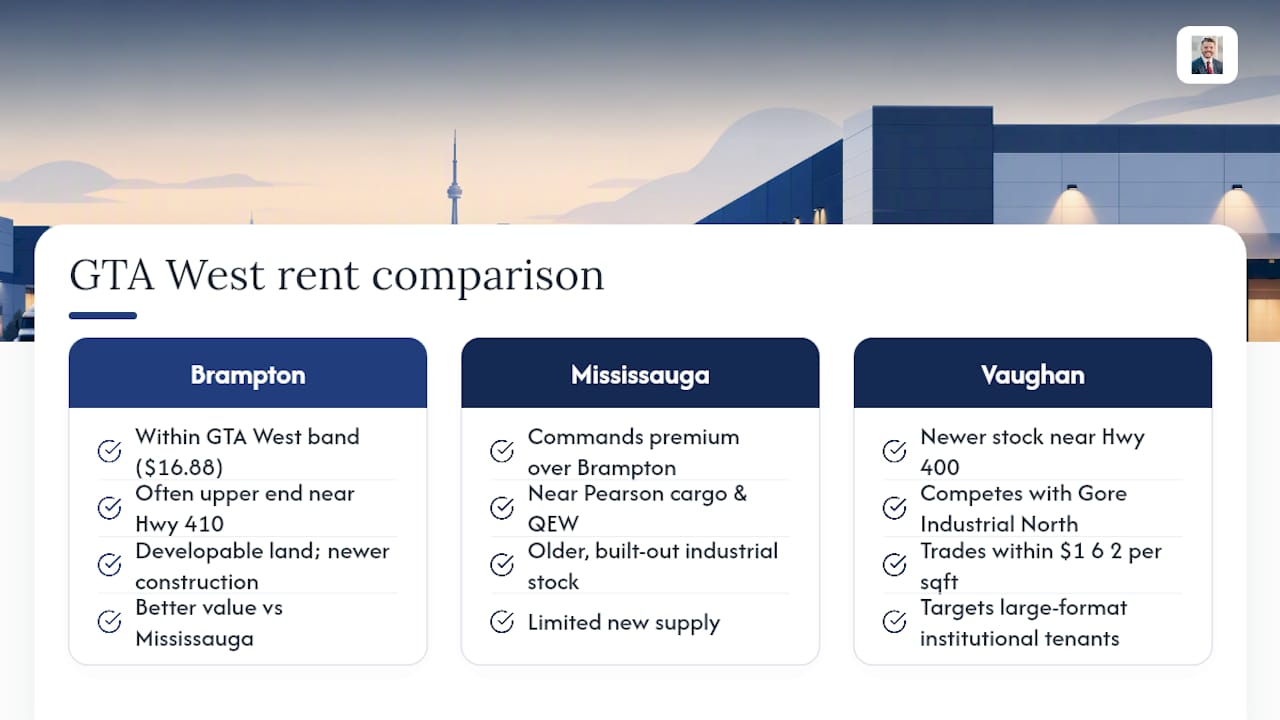
Mississauga typically commands a premium over Brampton because of its proximity to Pearson’s cargo operations and the QEW, and its industrial inventory skews older and more built out, which limits new supply. Vaughan, by contrast, has newer stock concentrated around Highway 400 and competes more directly with Brampton’s Gore Industrial North for institutional tenants seeking large-format, high-clear buildings. The two markets often trade within a dollar or two of each other per square foot.
The practical takeaway for a tenant comparing markets: Brampton offers better value than Mississauga for equivalent building quality, mainly because Brampton still has developable land and newer construction coming online. If your logistics network can flex between the two, running the comparison against Mississauga inventory before committing is worth the exercise, especially for larger footprints where a small per-square-foot gap compounds fast.
Will infrastructure projects push Brampton rents higher?
Every major rent driver in Brampton traces back to three things: Highway 410, Highway 407 ETR, and Pearson. Properties within roughly two kilometres of a 410 interchange consistently command higher values than interior locations, and that premium shows no sign of narrowing.
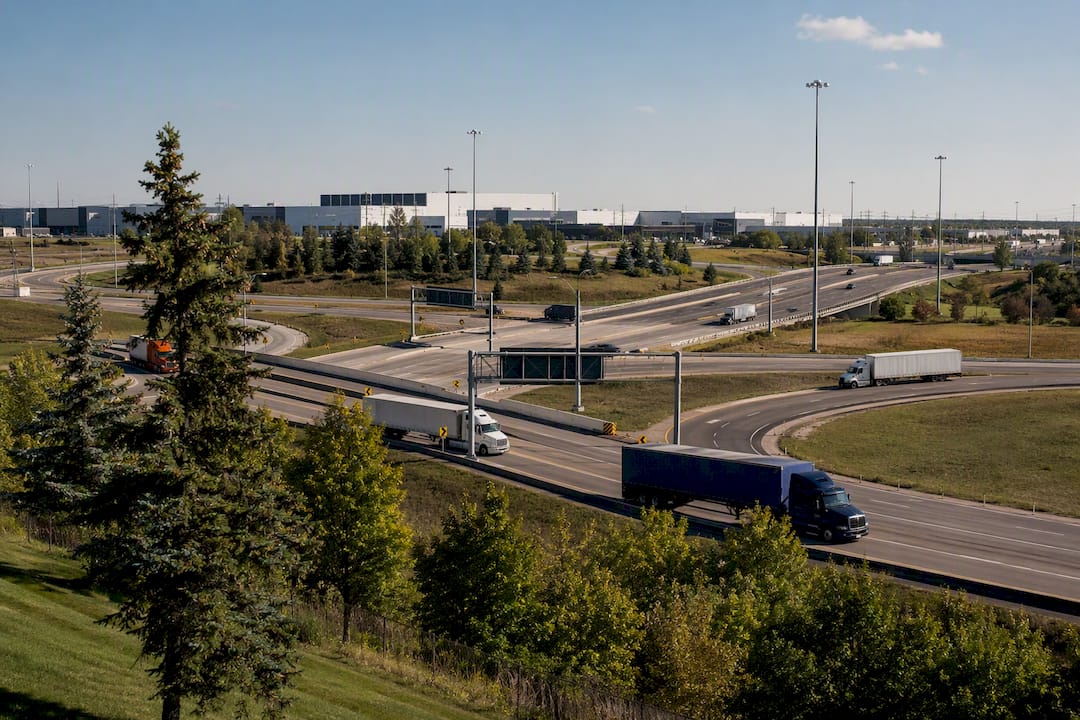
Planned upgrades to regional transit and continued freight growth through Pearson are likely to reinforce that premium rather than dilute it.
Institutional capital has already priced this in. Cap rates in prime nodes like Gore Industrial North have compressed to roughly 4.0% to 6.5% depending on asset quality, which signals investors expect rent growth to continue rather than plateau. For tenants, that’s a warning sign: if pension funds and institutional buyers are paying up for these buildings now, rents on renewal are unlikely to soften. Locking in term length on a well-located site today is generally cheaper than renegotiating from a weaker position in two or three years.
When should tenants call in representation?
Institutional demand and cap-rate compression aren’t abstract numbers. They’re the reason landlords in Brampton’s tightest nodes have stopped negotiating on price the way they did in 2023. Once vacancy in a submarket drops under 3%, as it has near Highway 410 and 407, leverage shifts to whoever has the best information on what’s actually available before it hits the open market.
Tenants should engage representation when the footprint exceeds 10,000 square feet, when 53’ trailer access or cold-chain infrastructure is non-negotiable, or when timelines are tight enough that a bad site decision can’t be corrected later. With over a decade advising occupiers across Ontario’s industrial sector, Michael Law has seen how quickly a tenant’s negotiating position erodes once a landlord knows there’s no comparable alternative on the shortlist.
Get tenant representation before your Brampton lease renews
Michael Law | Lennard Commercial gives Brampton tenants something most landlords don’t want them to have: a real-time view of every comparable building before the landlord’s asking rent becomes the only number on the table.
The service covers site selection, lease negotiation, and market benchmarking against actual closed deals, not just listed asking rents, so you know whether $18 or $21 per square foot net is a fair number for the building in front of you. Whether you need 10,000 square feet in Bramalea West or a large-format distribution site near the Gore, Michael Law’s Brampton industrial team can shortlist options and run the numbers before you commit to a landlord’s first offer. For occupiers ready to start the search, book time with the tenant representation team to review your space needs and timeline.
Sources
- 2Q26 Toronto Ontario industrial market report (NMRK)
- Houseindex
- Toronto industrial market report | Warehouse rents Q1 2026 (WareCRE)
FAQ
What is the average net rent for warehouse space in Brampton?
Modern distribution buildings with 28-foot-plus clear heights and 53’ trailer access are leasing at roughly $16 to $22 per square foot net, depending on proximity to major highways.
How much does TMI add to Brampton warehouse rent?
TMI (taxes, maintenance, and insurance) typically adds $3.50 to $4.00 per square foot on top of net rent, so total occupancy cost usually lands in the low-to-mid twenties per square foot.
Which Brampton submarket has the lowest vacancy?
Gore Industrial North runs the tightest, favoured by institutional buyers for its newer, high-clear buildings, followed closely by Bramalea West and Steeles Industrial for smaller and mid-sized units.
Is Brampton or Mississauga better for warehouse leasing?
Brampton generally offers better value for equivalent building quality since it still has developable land, while Mississauga trades at a premium tied to its proximity to Pearson and the QEW.
When should I hire a tenant representative for a Brampton warehouse?
Bring in representation once your footprint exceeds 10,000 square feet, or when 53’ trailer access, cold-chain infrastructure, or a tight timeline is involved. Michael Law | Lennard Commercial works these deals daily and can shortlist options before they hit the open market.
Recommended

About Michael Law
Managing Partner and Industrial Real Estate Broker at Lennard Commercial Realty. Representing tenants and landlords across Toronto and the GTA for 15+ years. Michael specializes in GTA industrial real estate — connect with Toronto's leading industrial broker at mlawrealestate.com/industrial-broker-toronto.