Commercial real estate Dallas: 2026 market guide
By Michael Law · Industrial Real Estate Broker, Lennard Commercial Realty
TL;DR:
- Dallas’s industrial sector leads in demand with 9.4 million square feet of absorption, supporting strong rental growth. Meanwhile, the office market faces high vacancy at 25.4%, with a shift toward Class A property driven by tenant upgrades. Submarket selection is critical for investment success, favoring Uptown, South Dallas, and Denton.
Commercial real estate in Dallas is defined as income-producing property across office, industrial, retail, and multifamily asset classes within the Dallas/Fort Worth metropolitan area, one of the fastest-growing commercial markets in North America. As of Q1 2026, the Dallas commercial property market presents a study in contrasts: office vacancy sits at a cycle-high 25.4% while industrial absorption reached 9.4 million square feet, signalling that capital and tenants are not retreating from Dallas but rather concentrating in specific asset types and locations. For investors and corporate occupiers evaluating the commercial real estate market in Dallas, understanding these diverging fundamentals is the difference between a well-timed acquisition and an expensive miscalculation.
What are the current trends in Dallas commercial real estate?
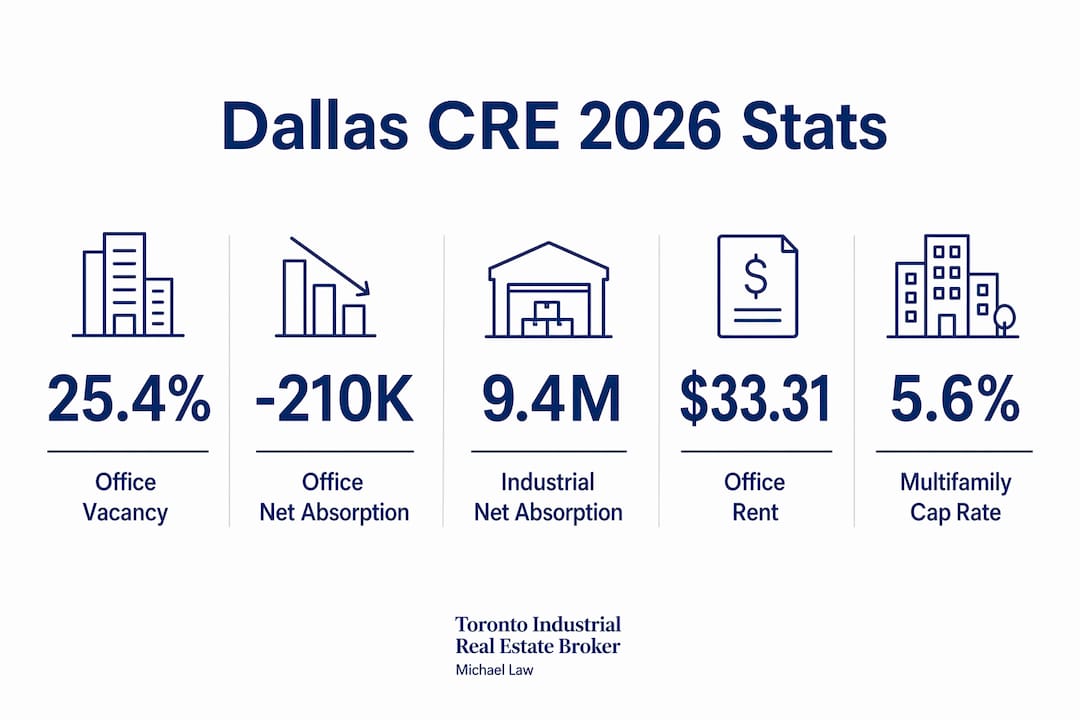
The Dallas office market recorded a vacancy rate of 25.4% in Q1 2026, with negative net absorption of 210,199 square feet despite leasing activity climbing 43.6% quarter-over-quarter. That divergence is the defining story of the Dallas office sector right now. Tenants are signing leases, but they are downsizing, consolidating, or not yet occupying, which means headline leasing volume overstates actual occupancy recovery.
Average gross rental rates for Dallas office rose 3.0% quarterly to reach $33.31 per square foot, with Class A office rents hitting a record $37.47 per square foot. Rents have grown 6.0% annually, and the Uptown submarket commands the highest rates in the city. This tells you that quality is being rewarded even as the broader market struggles.
The Dallas/Fort Worth industrial sector tells a different story entirely. Net absorption reached 9.4 million square feet in Q1 2026, with vacancy holding at 8.7% and asking rents averaging $10.24 per square foot, representing 3.8% annual growth. With 39.2 million square feet under construction and 6.2 million square feet delivered in the same quarter, the pipeline is substantial but demand is absorbing it.
| Sector | Vacancy rate | Net absorption | Avg. asking rent |
|---|---|---|---|
| Office | 25.4% | -210,199 sq. ft. | $33.31/sq. ft. |
| Industrial | 8.7% | +9.4M sq. ft. | $10.24/sq. ft. |
| Multifamily | 4.6% | Stable | N/A |
Dallas multifamily recorded a cap rate averaging 5.6% with vacancy at 4.6% in Q1 2026, projected to rise marginally to 5.1% by Q3. That marginal increase reflects new supply entering the market rather than weakening demand, which is a meaningful distinction for underwriting purposes.
Pro Tip: When reviewing Dallas commercial property data, always cross-reference leasing velocity with net absorption figures. A market showing strong leasing but negative absorption is signalling tenant consolidation, not recovery. Partners Real Estate and Matthews both publish quarterly reports that provide this level of granularity.
How do Dallas submarkets and property types compare for investment?
Not all Dallas commercial real estate performs equally, and submarket selection is arguably more important than asset class selection in the current cycle. Uptown commands the highest office rents in the city and has demonstrated positive absorption even as the broader market contracts. Las Colinas and Preston Center serve established corporate tenants but face pressure from tenants right-sizing their footprints. Suburban office submarkets carry the highest vacancy risk, particularly for Class B and Class C product.

The class divergence in the office sector is stark. Class A offices recorded positive net absorption of +283,282 square feet in Q1 2026, while Class B offices saw negative absorption of 493,481 square feet. This is not a temporary blip. It reflects a structural shift in tenant preference toward amenity-rich, well-located buildings with modern mechanical systems and flexible floor plates. Older Class B product in secondary locations is functionally obsolete for many corporate users.
On the industrial side, demand concentrates in large-format logistics facilities in outer submarkets including Denton, South Dallas, and Royce City. Buildings above 500,000 square feet capture the majority of leasing activity, driven by e-commerce fulfilment operators and third-party logistics providers. Smaller infill industrial assets in inner-ring locations still trade, but they attract a different buyer profile and carry different risk characteristics.
| Submarket | Primary asset type | Relative vacancy | Rent positioning |
|---|---|---|---|
| Uptown | Class A office | Low | Premium |
| Las Colinas | Office/flex | Moderate | Mid-range |
| South Dallas | Bulk industrial | Low | Growing |
| Denton | Bulk industrial | Low | Growing |
| Royce City | Logistics | Low | Competitive |
| Preston Center | Office | Moderate to high | Mid-range |
Understanding industrial property types and how they map to tenant demand is a transferable skill across markets. The same logic that applies to bulk logistics in the GTA applies in Dallas: location relative to highway infrastructure, clear height, dock door ratios, and power availability determine which buildings lease first.
Pro Tip: When evaluating Dallas commercial property for acquisition, prioritise assets with remaining lease term above three years and tenants in sectors with structural tailwinds, specifically logistics, healthcare, and technology. Avoid speculative Class B office unless you have a credible repositioning thesis and the capital to execute it.
What are the best strategies to buy commercial real estate in Dallas?
Buying commercial real estate in Dallas in 2026 requires a disciplined approach to underwriting that accounts for both the opportunity and the risk embedded in each asset class. The first principle is to separate leasing velocity from occupancy reality. Leasing activity increased 43.6% quarter-over-quarter in the Dallas office market, yet net absorption remained negative. Investors who underwrite based on leasing headlines rather than absorption data will overpay for assets that are not recovering as quickly as the surface metrics suggest.
For industrial acquisitions, the data supports a clear thesis. Investment activity in Dallas industrial reached $369 million in sales volume in Q1 2026, with an average price per square foot of $147 and cap rates around 6.2%. Investors are prioritising stabilised buildings with long-term leases and minimal lease-up risk. That preference reflects rational capital allocation in an environment where refinancing costs remain elevated and lenders scrutinise cash flow coverage carefully.
The following criteria define a well-positioned Dallas commercial acquisition in the current cycle:
- Absorption alignment: The asset’s submarket shows positive net absorption over the trailing four quarters.
- Tenant credit quality: Tenants carry investment-grade or near-investment-grade credit profiles, reducing default risk.
- Lease term: Weighted average lease expiry of three years or more, providing income stability through the hold period.
- Building specification: For industrial, clear heights above 32 feet, ESFR sprinkler systems, and adequate trailer parking. For office, post-2010 construction or recently renovated mechanical systems.
- Location relative to infrastructure: Proximity to Interstate 35, Interstate 20, or Interstate 30 for industrial. Proximity to DART light rail or major employment nodes for office.
- Off-market sourcing: Direct-to-seller transactions reduce competitive bidding pressure and can yield 5% to 10% better entry pricing than broadly marketed deals.
For corporate occupiers evaluating office space Dallas rentals, the current market actually favours tenants. Landlords of Class B product are offering significant concessions including free rent periods of six to twelve months and generous tenant improvement allowances to retain or attract occupiers. Class A landlords in Uptown are less flexible but still negotiating on term and improvement packages.
Pro Tip: Off-market industrial deals in outer Dallas submarkets like Denton and South Dallas are often sourced through direct owner outreach rather than broker listings. Building a pipeline of direct relationships with owners of stabilised assets in these corridors gives you access to deals before they are broadly marketed. Mlawrealestate applies this same direct-sourcing discipline in the GTA industrial market with measurable results for clients.
Conducting thorough commercial due diligence before any acquisition is non-negotiable. Environmental assessments, lease abstracts, operating expense reconciliations, and capital expenditure reviews each surface risks that are invisible in a broker’s offering memorandum.
How is Dallas’s economy shaping commercial real estate demand?
Dallas commercial real estate investment is underpinned by one of the strongest demographic and economic growth stories in the United States. The DFW metropolitan area is projected to add approximately 40,000 net new jobs in 2026, with growth concentrated in technology, financial services, healthcare, and logistics sectors. Each of those sectors translates directly into demand for specific commercial property types.
Population migration into DFW continues at a pace that outstrips most North American metros. That inflow drives multifamily demand, supports retail spending, and creates the labour pool that logistics operators require to staff large-format distribution centres. The connection between population growth and industrial real estate demand is direct and well-documented across multiple market cycles.
The industrial supply pipeline is tightening in a way that benefits existing owners. DFW’s industrial vacancy tightened to 8.9% in Q1 2026, with the construction pipeline projected to reach its lowest annual total since 2013. When new supply contracts while demand grows, vacancy falls and rents rise. Owners of well-located industrial assets in Dallas are positioned to benefit from that dynamic over the next two to three years.
Key economic drivers shaping the Dallas real estate investment outlook for 2026 and beyond include:
- Continued corporate relocations from higher-cost states, particularly California and Illinois, bringing headquarters and regional office demand.
- E-commerce penetration driving sustained need for last-mile and bulk logistics space across the DFW metro.
- Infrastructure investment in highway expansion and intermodal rail capacity supporting outer submarket industrial growth.
- A relatively business-friendly regulatory environment in Texas reducing friction for development and occupier expansion.
- Population growth sustaining multifamily absorption even as new supply enters the market.
Tracking market trends in 2026 is not optional for serious investors. The gap between a well-timed entry and a poorly timed one in a market moving as quickly as Dallas can represent years of return compression.
Key takeaways
Dallas commercial real estate in 2026 rewards investors who focus on industrial bulk logistics and Class A office while avoiding undifferentiated Class B office product in secondary submarkets.
| Point | Details |
|---|---|
| Industrial leads all sectors | Net absorption of 9.4M sq. ft. and rising rents make DFW industrial the strongest asset class in the market. |
| Office class divergence is structural | Class A absorbed +283,282 sq. ft. while Class B shed 493,481 sq. ft., reflecting a permanent tenant preference shift. |
| Submarket selection is critical | Uptown, South Dallas, and Denton outperform; suburban Class B office and secondary retail carry the highest risk. |
| Economic fundamentals support demand | 40,000 projected net new jobs and continued population inflows sustain industrial and multifamily absorption. |
| Off-market sourcing improves returns | Direct-to-seller transactions in stabilised industrial assets consistently deliver better entry pricing than marketed deals. |
What I’ve learned watching Dallas from the outside
I spend most of my time in the GTA industrial market, but I follow Dallas closely because the two markets share a structural logic that most commentators miss. Both are benefiting from the same macro forces: population growth, e-commerce expansion, and a corporate migration away from higher-cost jurisdictions. The difference is that Dallas has more land, more highway infrastructure, and a development community willing to build at scale. That creates a market where the industrial opportunity is real but also more competitive than it appears from the headline vacancy numbers.
The Q1 2026 data from Partners Real Estate and Matthews tells a story that I find genuinely interesting. Leasing is up sharply in the Dallas office market, but absorption is still negative. I have seen this pattern before. It typically means tenants are upgrading their space, not expanding. They are moving from Class B to Class A, signing leases in Uptown while vacating older product in Addison or North Dallas. The net effect is that Class A landlords win, Class B landlords lose, and the aggregate vacancy number stays elevated even as the best buildings fill up.
For industrial, the tightening pipeline is the most important data point in the market right now. When construction starts fall to their lowest level since 2013 while demand holds firm, you get a vacancy compression cycle. Investors who bought stabilised bulk logistics assets in South Dallas or Denton in 2024 and 2025 are sitting on significant unrealised gains. The window to buy at reasonable cap rates is narrowing.
My honest view is that the biggest risk in Dallas commercial real estate right now is not the office market. Everyone already knows office is challenged. The real risk is overpaying for industrial assets in a market where competition for stabilised product is intense and some buyers are underwriting rent growth that the market may not deliver uniformly across all submarkets. Discipline on entry pricing matters more than market selection at this point in the cycle.
— Michael
Work with Mlawrealestate on your next commercial real estate move
Mlawrealestate brings institutional-grade market intelligence and transaction expertise to commercial real estate clients across North America. Whether you are evaluating industrial acquisitions, structuring a lease for a logistics operation, or seeking off-market investment opportunities, the advisory approach at Mlawrealestate is built on the same data-driven discipline that the Dallas market demands.

Michael Law and the team at Mlawrealestate specialise in industrial leasing, investment sales, and tenant representation for clients who require more than a listing search. With deep expertise across GTA industrial corridors and a network that extends to major North American markets, Mlawrealestate delivers the market intelligence and negotiating leverage that moves transactions forward. Connect with the team at mlawrealestate.com to explore current listings and advisory services.
FAQ
What is the current office vacancy rate in Dallas?
Dallas office vacancy reached 25.4% in Q1 2026, with negative net absorption of 210,199 square feet despite a 43.6% increase in leasing activity, according to Partners Real Estate.
Is Dallas industrial real estate a good investment in 2026?
Dallas/Fort Worth industrial is ranked the third-strongest industrial market in the United States, with net absorption of 9.4 million square feet, vacancy at 8.7%, and a construction pipeline projected to reach its lowest level since 2013.
Which Dallas neighbourhoods are best for businesses?
Uptown commands the highest office rents and strongest Class A absorption in Dallas. For industrial operations, South Dallas, Denton, and Royce City offer the largest available facilities and the strongest logistics infrastructure.
What are typical cap rates for Dallas commercial property?
Dallas industrial cap rates averaged approximately 6.2% in Q1 2026, while Dallas multifamily cap rates averaged 5.6%, reflecting relative stability compared to other major Texas metros.
How do Class A and Class B offices differ in Dallas?
Class A Dallas offices recorded positive net absorption of +283,282 square feet in Q1 2026, while Class B offices shed 493,481 square feet. Tenants are consolidating into higher-quality space, making Class B product the primary risk in the Dallas office market.
Recommended

About Michael Law
Managing Partner and Industrial Real Estate Broker at Lennard Commercial Realty. Representing tenants and landlords across Toronto and the GTA for 15+ years. Michael specializes in GTA industrial real estate — connect with Toronto's leading industrial broker at mlawrealestate.com/industrial-broker-toronto.