Commercial real estate in Madison, WI: 2026 market guide
By Michael Law · Industrial Real Estate Broker, Lennard Commercial Realty
TL;DR:
- Madison’s industrial market is highly tight with a vacancy rate of 3.8%, driven by strong rent growth and limited quality availability. The office sector faces higher vacancy and cautious investment, while retail and multifamily properties remain stable and growing due to demographic demand. Successful investors prioritize building functionality, early planning, and local market knowledge, supported by programs like Madison’s Commercial Ownership Assistance.
Commercial real estate in Madison, WI refers to the buying, selling, leasing, and investing in industrial, office, retail, and multifamily properties within Wisconsin’s capital city. Madison’s market stands apart from most mid-sized American cities because of its unusually stable economic base. The University of Wisconsin-Madison, Epic Systems, and a dense cluster of healthcare and insurance employers anchor tenant demand across every property type. The result is a market where industrial vacancy sits at 3.8% and investment sales volumes are climbing sharply. Investors and business owners who understand the sector-by-sector dynamics here make better decisions, faster.
What are the current market conditions in Madison’s commercial real estate sectors?
Madison’s commercial property market in 2026 is not uniform. Each sector tells a different story, and treating them as one market leads to poor decisions.

Industrial: the tightest sector in the city
Madison’s industrial market is exceptionally tight, with a 3.8% vacancy rate translating to roughly 2.4 million square feet of available space across the entire metro. That figure sounds large until you account for how much of it is functionally unsuitable for modern tenants. Year-over-year rent growth in the industrial sector sits at 4.0%, and cap rates range from 5.25%–6.00%. Those cap rates reflect strong investor confidence and limited acquisition opportunities.
Industrial sales reached $233.8 million in 2025, more than doubling 2024 volumes, with median prices rising approximately 50%. That kind of price acceleration in a single year signals a market where buyers are competing hard for a shrinking pool of quality assets.
Office: a sector under pressure
The Madison office market tells a contrasting story. Office vacancy stands at 16.2%, with cap rates ranging from 6.75%–7.75%. Higher cap rates reflect investor caution and the longer lease-up timelines that come with surplus space. Suburban office corridors on the West Side and near the Beltline Highway face the steepest challenges, while Class A space in the Capitol Square area retains stronger demand.
Retail and multifamily: stable and growing
Madison’s retail sector defies the national narrative. Experience-based retail centres remain stable because of the city’s demographic mix of students, young professionals, and healthcare workers. The so-called retail apocalypse has not arrived here. Multifamily continues to attract capital as population growth and the university’s enrolment cycle sustain rental demand year after year.
Key market metrics at a glance
| Sector | Vacancy Rate | Cap Rate Range | Trend |
|---|---|---|---|
| Industrial | 3.8% | 5.25%–6.00% | Rising rents, low supply |
| Office | 16.2% | 6.75%–7.75% | Elevated vacancy, cautious buyers |
| Retail | Stable | Not publicly listed | Demand supported by demographics |
| Multifamily | Low | Not publicly listed | Consistent growth |
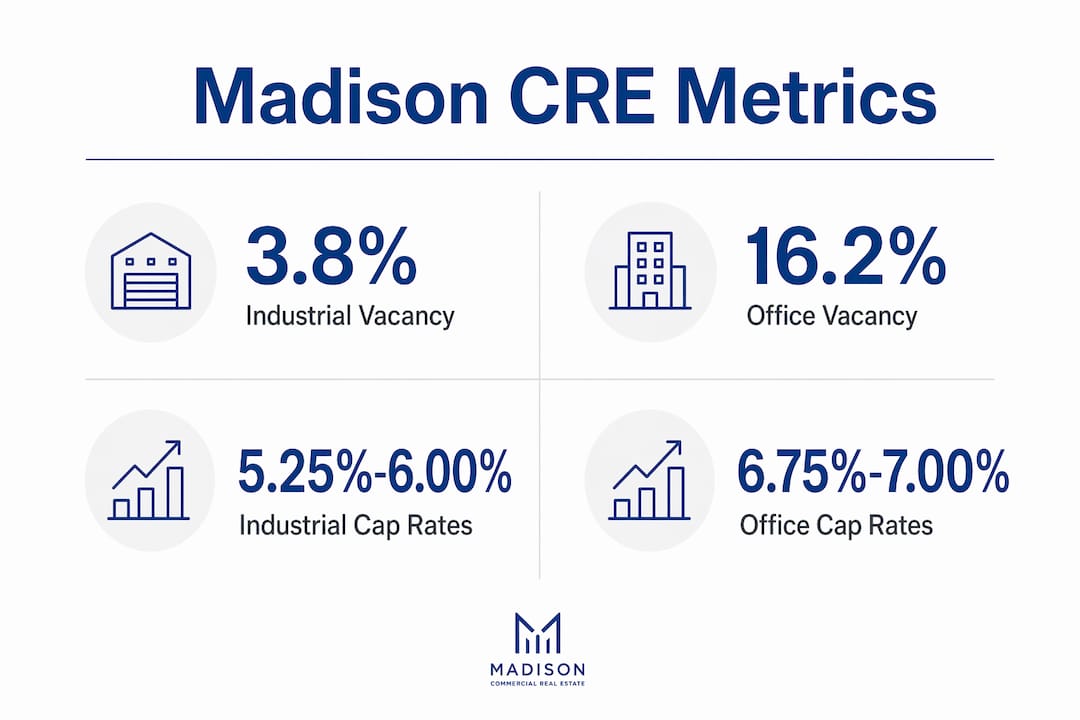
The gap between industrial and office cap rates is significant. It tells you where institutional capital is flowing and where risk premiums are being demanded.
How should investors assess commercial properties in Madison?
Vacancy rates are a starting point, not a conclusion. The real question is whether available space actually meets tenant requirements.
Why functional utility matters more than availability
Vacant industrial buildings frequently lack adequate ceiling height, loading docks, or sufficient electrical capacity. A building that shows up as “available” in a listing database may be functionally obsolete for the tenant who needs 28-foot clear height and four dock doors. This distinction separates experienced buyers from those who overpay for space they cannot use or lease.
Evaluating building functionality means assessing loading configuration, clear height, power supply, parking ratios, and proximity to Highway 12, Highway 18, or Interstate 90/94. These factors determine whether a property commands premium rents or sits vacant despite a tight overall market.
Pro Tip: Before making an offer on any Madison industrial property, commission a highest-and-best-use analysis. A building that looks like a warehouse may have stronger value as a flex industrial or R&D facility given Madison’s biotech and tech tenant base.
Investor-type acquisitions versus owner-user needs
The two buyer profiles in Madison’s commercial market have very different priorities. Investors acquiring income-producing assets focus on lease term, tenant credit quality, and cap rate relative to financing costs. Owner-users buying space for their own operations prioritise functional fit, expansion capacity, and total occupancy cost compared to leasing.
Owners should tailor their strategy to asset type. A leased building with a stable tenant and five years remaining on the lease is a fundamentally different asset from a vacant building that requires repositioning. Conflating the two leads to mispriced offers and missed opportunities.
Building features by buyer profile
| Feature | Investor Priority | Owner-User Priority |
|---|---|---|
| Lease term remaining | Critical | Less relevant |
| Clear height and docks | Affects tenant pool | Directly affects operations |
| Power capacity | Tenant-dependent | Operational requirement |
| Expansion land | Optional | Often critical |
| Location and highway access | Affects rent | Affects logistics costs |
What programs and timing strategies support commercial ownership in Madison?
Buying commercial property in Madison requires preparation well before you make an offer. The market moves quickly, and underprepared buyers lose deals.
The City of Madison’s Commercial Ownership Assistance Program
The City of Madison offers forgivable loans through its Commercial Ownership Assistance Program (COA) to help business owners transition from renting to owning. Eligibility requires at least two years of operating experience. The programme targets business owners who have demonstrated viability as tenants and are ready to build equity through ownership. For qualifying buyers, this programme reduces the capital required at closing and lowers the financial barrier to ownership in a market where prices have risen sharply.
Pro Tip: Apply for COA programme eligibility before you identify a specific property. Pre-approval shortens your due diligence timeline and signals to sellers that your financing is structured.
Acquisition timing and planning horizon
Planning acquisitions 6–12 months ahead of your target occupancy date improves negotiation leverage significantly. In a market where industrial prices rose roughly 50% in a single year, buyers who wait until they urgently need space pay a premium and negotiate from weakness.
The practical steps for a well-timed acquisition include:
- Engage a commercial broker with active Madison market knowledge at least 12 months before your target date
- Obtain financing pre-approval or a lender letter of intent before touring properties
- Define your functional requirements in writing: size, clear height, dock count, power, and parking
- Investigate zoning and permitted uses for any property before entering due diligence
- Review lease expiry dates if you are currently a tenant, and plan for lease expirations 12–24 months in advance to preserve negotiating power
- Budget for environmental assessment, building inspection, and title review as standard costs
Buyers who complete these steps before the search begins close faster and on better terms. Those who skip them often lose their preferred property to a more prepared competitor.
Which Madison submarkets offer the strongest investment opportunities?
Madison’s commercial property market is not geographically uniform. Submarket selection determines your tenant pool, your exit options, and your long-term appreciation potential.
Downtown Madison and Capitol Square
Downtown Madison, centred on Capitol Square and State Street, attracts law firms, government agencies, and financial services tenants. Key Madison submarkets including the Capitol Square corridor retain demand for Class A office and ground-floor retail because of foot traffic from state government employees and university-adjacent activity. Retail on State Street benefits directly from the student population and the tourism draw of the Capitol building. Investors targeting value-add retail or mixed-use assets find the most activity in this corridor.
Near West Side and Verona
The Near West Side and Verona corridor has emerged as one of the most watched submarkets in Madison’s commercial property market. Epic Systems, headquartered in Verona, employs tens of thousands of workers and generates demand for office, flex industrial, and ancillary retail within commuting distance of its campus. Madison’s diversified economy, which spans education, technology, healthcare, and insurance, concentrates heavily in this western corridor. Investors acquiring flex industrial or R&D space near the Epic Systems ecosystem benefit from a tenant base that is both large and financially stable.
East Side industrial corridors
The East Side, particularly along the Stoughton Road and Highway 51 corridors, houses much of Madison’s traditional industrial base. Distribution, light manufacturing, and logistics tenants cluster here because of highway access and land availability relative to the more constrained West Side. For investors focused on acquiring industrial assets in the sub-$10 million range, the East Side offers more options than the Verona corridor, though functional quality varies considerably between buildings.
Multifamily and biotech opportunities
Value-add multifamily properties near the University of Wisconsin-Madison campus represent a consistent investment category. Enrolment cycles create predictable demand, and the student population turns over annually, giving owners regular opportunities to reset rents to market. The biotech and life sciences sector, anchored by university research programmes and spin-off companies, drives demand for specialised R&D space that commands rents well above standard office rates. Investors who can source or develop lab-ready space in proximity to the university’s research facilities occupy a niche with very limited competition.
Key takeaways
Madison’s commercial real estate market rewards investors who understand sector-specific conditions, functional asset quality, and submarket demand drivers rather than relying on headline vacancy figures alone.
| Point | Details |
|---|---|
| Industrial market is tight | A 3.8% vacancy rate and 4.0% rent growth make industrial the most competitive sector for buyers. |
| Office requires caution | A 16.2% vacancy rate and cap rates of 6.75%–7.75% signal higher risk and longer lease-up timelines. |
| Functional utility drives value | Ceiling height, dock count, and power capacity determine real suitability beyond what vacancy statistics show. |
| Early planning improves outcomes | Starting the acquisition process 6–12 months ahead gives buyers better leverage in a fast-moving market. |
| Submarket selection is critical | The Verona corridor, East Side industrial, and Downtown retail each serve distinct tenant bases and investment profiles. |
What I have learned from watching tight industrial markets up close
Madison’s industrial market in 2026 reminds me of what I see regularly in the Greater Toronto Area: a market where the headline vacancy number flatters the actual availability. When you dig into what is actually on the market, a significant portion of the listed space does not meet the functional requirements of the tenants who need it most. The 3.8% vacancy figure in Madison is real, but the number of buildings that can accommodate a modern logistics or manufacturing tenant is considerably smaller.
The investors who do well in markets like this are not the ones chasing every listing. They are the ones who have defined their criteria precisely, secured their financing early, and built relationships with brokers who know which properties are coming to market before they are listed. In the GTA, I have watched buyers lose properties they wanted because they spent three weeks getting their financing in order after finding the asset. In Madison, with prices having risen roughly 50% in a single year, that delay is even more costly.
The COA programme from the City of Madison is a genuine advantage for qualifying business owners, and I would encourage anyone who meets the eligibility criteria to pursue it before they begin their property search. Pre-approved financing changes how sellers perceive your offer. It signals seriousness and reduces the seller’s risk, which translates directly into negotiating leverage.
My broader observation is this: the investors who treat commercial real estate as a financial instrument first and a physical asset second consistently underperform those who understand the building. Knowing what a tenant actually needs, and whether a specific building can deliver it, is the skill that separates good acquisitions from expensive mistakes.
— Michael Law
Working with an experienced commercial real estate broker
Navigating a market where industrial prices doubled in a single year and functional availability is far tighter than vacancy statistics suggest requires more than a listing search.

Michael Law | Lennard Commercial brings over a decade of experience advising business owners and investors on industrial leasing, tenant representation, and property acquisitions across some of North America’s most competitive markets. Whether you are evaluating your first commercial purchase or repositioning an existing asset, the right advisory relationship changes your outcomes. Explore industrial tenant representation services or review the industrial property investment approach to understand how a structured process applies to your situation. Contact Michael Law | Lennard Commercial directly through mlawrealestate.com to start the conversation.
FAQ
What is the current industrial vacancy rate in Madison, WI?
Madison’s industrial vacancy rate is 3.8% as of Q1 2026, with year-over-year rent growth of 4.0% and cap rates between 5.25%–6.00%.
What is the Commercial Ownership Assistance Program in Madison?
The City of Madison’s COA programme provides forgivable loans to business owners with at least two years of operating experience to help them transition from renting to owning commercial space.
How far in advance should I plan a commercial property acquisition in Madison?
Planning 6–12 months ahead of your target occupancy date gives you the best negotiating position, particularly in a market where prices and competition have risen sharply.
Which Madison submarket is best for industrial investment?
The East Side corridors along Stoughton Road and Highway 51 offer the most industrial options in the sub-$10 million range, while the Verona corridor near Epic Systems attracts flex industrial and R&D tenants with strong credit.
Why does Madison’s retail market remain stable despite national trends?
Madison’s retail sector stays stable because its demographic base of students, healthcare workers, and professionals sustains demand for experience-based retail that is less vulnerable to e-commerce displacement.
Recommended

About Michael Law
Managing Partner and Industrial Real Estate Broker at Lennard Commercial Realty. Representing tenants and landlords across Toronto and the GTA for 15+ years. Michael specializes in GTA industrial real estate — connect with Toronto's leading industrial broker at mlawrealestate.com/industrial-broker-toronto.