
Commercial real estate Memphis: 2026 investor's guide
By Michael Law · Industrial Real Estate Broker, Lennard Commercial Realty
TL;DR:
- Memphis’s commercial real estate market heavily relies on logistics infrastructure, driving demand across property classes. Investors must conduct thorough due diligence on taxes, seismic risk, and infrastructure to succeed. Tightening supply and careful underwriting favor disciplined, local market-aware investors in 2026.
Commercial real estate Memphis refers to the market of income-producing properties, including industrial warehouses, office buildings, and retail spaces, that investors and businesses acquire or lease across Memphis and its surrounding Shelby County submarkets. Memphis sits at the intersection of interstates I-40 and I-55, five Class I railroads, the Mississippi River port, and the FedEx World Hub, making it one of North America’s most active logistics corridors. That infrastructure concentration drives sustained demand across every commercial property class. For investors and business owners evaluating Memphis commercial properties in 2026, the market rewards disciplined underwriting and local knowledge in equal measure.
How is the commercial real estate market in Memphis performing in 2026?
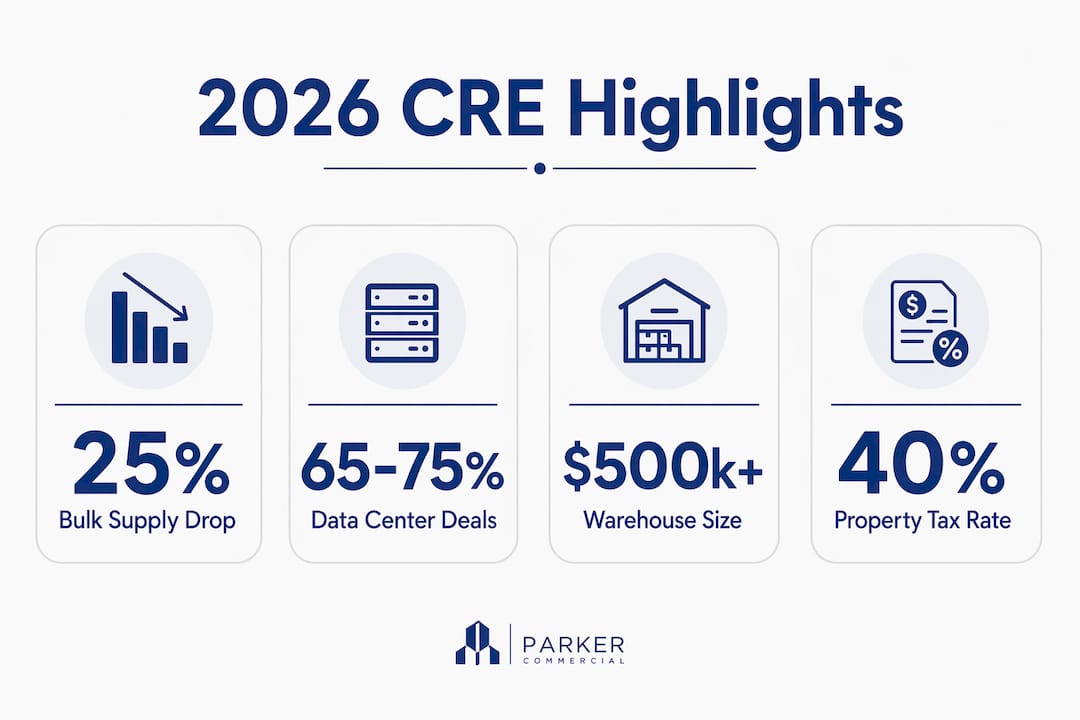
The Memphis industrial market is tightening faster than most investors anticipated. Bulk industrial supply of 500,000 square feet or more has dropped from 25 available options to just 8 in a single year. That contraction signals a structural shift, not a temporary fluctuation.

Data centres are the primary driver behind this compression. Data centre and related storage deals accounted for 65–75% of industrial market activity, generating approximately 4 million square feet of net absorption. That level of demand from a single sector reshapes how landlords price remaining inventory and how tenants must approach lease negotiations.
Manufacturing is also tightening. The sector recorded 200 basis points of vacancy compression over the past year, and large-bay leasing grew by 60% in the same period. Both figures point to occupiers expanding footprints rather than consolidating, which is a meaningful signal for investors evaluating long-term hold strategies.
Key market indicators for 2026 include:
- Bulk supply (500,000+ sq ft) reduced from 25 to 8 available options
- Data centre deals driving approximately 4 million sq ft of net absorption
- Manufacturing vacancy compressed by 200 basis points year over year
- Large-bay leasing activity up 60% compared to the prior year
- Leasing rates remain below the national average, giving tenants competitive positioning
Price appreciation across commercial sectors has been steady but measured. Investors who chased broad appreciation plays in 2024 and 2025 saw thinner returns than those who focused on neighbourhood-level operational efficiency. That pattern is accelerating in 2026 as the market matures.
What should investors consider when buying commercial real estate in Memphis?
Buying commercial real estate in Memphis requires attention to several factors that do not appear in a standard property listing. Investors who skip this layer of due diligence consistently underperform those who build it into their underwriting from day one.
Tax jurisdiction differences across Shelby County
Tennessee assesses commercial property at 40% of appraised value, but the effective tax burden varies significantly depending on whether the property sits within Memphis city limits or in suburbs like Germantown or Collierville. That gap can meaningfully alter a property’s net operating income. Investors must build forward-looking tax projections into every pro forma, accounting for reassessment risk as values rise.
Seismic risk and PML studies
Memphis sits above the New Madrid Seismic Zone, one of the most active seismic zones in North America. Probable Maximum Loss studies are mandatory underwriting tools for industrial and multifamily assets in this market. A PML study quantifies the expected damage to a building under a defined seismic event, and lenders increasingly require them before closing. Identifying insurance cost drivers early prevents surprises at the financing stage.
Hidden infrastructure risks
Old sewer infrastructure is a serious financial risk in Memphis, particularly in downtown and revitalised commercial districts like Broad Avenue. Sewer repair costs in these areas frequently exceed $12,000 to $20,000 per repair, driven by shared laterals, difficult access, and aging clay pipe systems. Sewer lines add no value to a property but can destroy returns if they fail post-acquisition.
Pro Tip: Order a commercial sewer scope before finalising any offer on a Memphis property built before 1980. The inspection costs a few hundred dollars. A failed lateral after closing can cost twenty times that amount.
A disciplined approach to buying commercial real estate in Memphis follows these steps:
- Confirm the tax jurisdiction and obtain a five-year tax projection from a local assessor or tax consultant.
- Commission a PML study from a licensed geotechnical engineer before approaching lenders.
- Conduct a commercial sewer scope on all properties in older districts, regardless of visible condition.
- Build conservative rent growth assumptions into the pro forma, validated against current submarket comparables.
- Review deal packaging strategies used in comparable tightening markets to stress-test your underwriting.
Realistic pro formas that incorporate tax differentials, seismic insurance costs, and conservative rent assumptions close faster and perform better over the hold period. That is not a theoretical observation. It is the consistent pattern among top brokers and investors active in this market.
Where are the most promising submarkets for Memphis investment properties?
Memphis divides into distinct commercial corridors, each with different risk and return profiles. Knowing which submarket fits your investment thesis saves significant time and capital.
Industrial corridors along I-40 and I-55
The strongest industrial demand concentrates along the I-40 and I-55 corridors, within proximity to the FedEx World Hub and the Memphis International Airport intermodal facilities. These locations attract logistics operators, e-commerce fulfilment users, and data centre developers who need fibre-dense, power-ready sites. Automation and robotics adoption is accelerating among tenants in these corridors, which increases demand for clear-height buildings of 36 feet or more.
Tennessee’s tax exemption on inventory stored in-state gives Memphis-based distribution operators a direct cost advantage over facilities in neighbouring states. That exemption is a genuine differentiator when tenants are comparing site options across the Mid-South region.
Residential and mixed-use commercial submarkets
For investors focused on DSCR lending and mixed commercial or multifamily plays, ZIP codes 38104, 38118, and 38111 represent the strongest balance of rent-to-purchase basis in 2026. These cover Midtown/Core, Parkway Village, and East Memphis respectively. ZIP codes 38128 (North Memphis) and 38109 (South Memphis) carry higher risk and require rent verification before committing capital.
| Submarket | Property type | Investment profile |
|---|---|---|
| I-40/I-55 corridor | Industrial, bulk warehouse | High demand, tightening supply, data centre growth |
| FedEx Hub proximity | Distribution, fulfilment | Long-term logistics demand, build-to-suit activity |
| Midtown/Core (38104) | Mixed commercial, retail | Revitalisation momentum, sewer risk in older stock |
| East Memphis (38111) | Office, medical, retail | Stable demand, lower vacancy, professional tenant base |
| Parkway Village (38118) | Multifamily, light industrial | Solid rent-to-basis ratio for DSCR investors |
Class A office space in Memphis clusters near the medical district and the East Memphis professional corridor. Class B and C office stock in the urban core is experiencing conversion pressure as remote work patterns reduce traditional office demand. Investors targeting office assets should focus on medical-adjacent locations where tenant demand remains structurally supported.
What are the current leasing trends for Memphis commercial properties?
The leasing market for Memphis commercial properties in 2026 favours tenants in most sectors, with one important exception: bulk industrial. Tenants seeking large-format industrial space face a market with limited speculative development and rising build-to-suit inquiries. That combination compresses options and shifts negotiating leverage toward landlords for the first time in several years.
For smaller industrial and flex users, leasing rates remain below the national average. That gap gives Memphis a competitive advantage for businesses comparing occupancy costs across multiple markets. Tenants who move decisively on well-located mid-bay space in 2026 will likely face higher rents at renewal as vacancy continues to tighten.
Current leasing conditions include:
- Build-to-suit inquiries rising as bulk supply shrinks
- Speculative new development remains limited, constraining future supply
- Industrial rent growth is steady but conservative underwriting remains appropriate
- CMBS, regional banks, and agency lenders are all active across property types
- Buyer negotiating leverage is strongest in retail and Class B office sectors
Pro Tip: If you are negotiating a large-bay industrial lease in Memphis right now, move faster than you think you need to. The drop from 25 to 8 bulk options happened in twelve months. The next twelve months will not reverse that trend.
Financing conditions in 2026 support deal activity across property types. CMBS lenders are active on stabilised industrial and retail assets. Regional banks remain the primary source for value-add plays and smaller transactions. Agency lenders cover multifamily with competitive terms. Understanding which lender type fits your asset class before approaching the market saves weeks in the financing process. Reviewing industrial leasing strategies from comparable tightening markets provides useful context for structuring Memphis deals.
Successful investors in Memphis prioritise disciplined negotiation and verified rent comparables over assumptions about future appreciation. That discipline separates consistent performers from those who rely on market momentum to cover underwriting gaps.
Key takeaways
Memphis commercial real estate rewards investors who combine local submarket knowledge with disciplined underwriting, particularly on tax, seismic, and infrastructure risks.
| Point | Details |
|---|---|
| Bulk supply is tightening fast | Available options of 500,000+ sq ft dropped from 25 to 8 in one year, compressing options for large-format users. |
| Tax jurisdiction matters significantly | Tennessee assesses at 40% of appraised value, but effective rates vary between Memphis city and suburbs like Germantown. |
| Seismic and sewer risks are real costs | PML studies and sewer scopes are non-negotiable due diligence steps that protect returns on older Memphis assets. |
| Best industrial submarkets follow infrastructure | I-40, I-55, and FedEx Hub proximity drive the strongest sustained demand for warehouse and distribution space. |
| Conservative underwriting outperforms appreciation plays | Validated rent growth, accurate tax projections, and submarket-specific data produce more reliable returns than broad market bets. |
What I have learned from watching tightening industrial markets
Memphis is a market that punishes lazy underwriting and rewards preparation. I have watched the same pattern play out in Ontario’s industrial market over the past decade, and the Memphis signals in 2026 are familiar: bulk supply contracting sharply, data-driven demand replacing traditional logistics users, and investors who did their homework on tax and infrastructure closing deals while others are still revising their models.
The seismic risk factor is the one that catches outside investors most off guard. A PML study is not a formality. It directly affects your insurance premium, your lender’s appetite, and your exit cap rate. Skipping it to save time is one of the more expensive shortcuts an investor can make in this market.
The tax jurisdiction issue is equally underestimated. The difference between a Memphis city address and a Germantown address on the same type of asset can be meaningful over a five-year hold. I have seen pro formas that looked compelling until someone ran the actual tax numbers for the correct jurisdiction. That single correction changed the investment decision entirely.
My practical advice is straightforward. Focus on cash flow stability over appreciation. Verify every rent assumption against current comparables, not trailing twelve-month data. Commission the sewer scope and the PML study before you are under contract, not after. And pay attention to which submarket you are actually in, because Memphis is not one market. It is several markets with different risk profiles sharing a postal code.
The investors who perform consistently in Memphis are the ones who treat it like the specific, nuanced market it is, rather than a generic Sun Belt play.
— Michael Law
Working with an industrial real estate specialist
Memphis investors who want a framework for navigating tightening industrial markets can draw on the same principles that drive results in Canada’s most competitive commercial corridors.

Michael Law | Lennard Commercial specialises in industrial tenant representation and deal structuring for occupiers and investors in complex, supply-constrained markets. The same rigorous approach to pro forma preparation, submarket analysis, and lease negotiation that works in the GTA applies directly to markets like Memphis where supply is tightening and due diligence separates good deals from costly ones. Browse commercial property listings and market reports, or reach out directly to discuss how disciplined underwriting and local market knowledge translate into better outcomes across industrial and commercial asset classes.
FAQ
What is commercial real estate in Memphis?
Commercial real estate in Memphis includes industrial warehouses, office buildings, retail centres, and multifamily properties used for income-producing purposes. The market is defined by its logistics infrastructure, including the FedEx World Hub, interstates I-40 and I-55, and five Class I railroads.
Why is Memphis a strong industrial real estate market?
Memphis is one of the most active logistics hubs in North America due to its position at the intersection of major interstates, rail lines, the Mississippi River port, and the FedEx World Hub. Data centre demand alone drove approximately 4 million square feet of net absorption in the most recent market cycle.
What due diligence is required when buying commercial real estate in Memphis?
Investors must commission a Probable Maximum Loss study for seismic risk, conduct a commercial sewer scope on older properties, and obtain accurate tax projections that account for Shelby County jurisdiction differences. These three steps protect against the most common sources of unexpected cost in Memphis commercial transactions.
Which Memphis submarkets offer the best investment opportunities?
The I-40 and I-55 industrial corridors near the FedEx World Hub offer the strongest demand fundamentals for industrial investors. For DSCR-focused investors, ZIP codes 38104 (Midtown/Core), 38118 (Parkway Village), and 38111 (East Memphis) provide the best rent-to-purchase balance in 2026.
Are Memphis commercial leasing rates competitive nationally?
Memphis industrial leasing rates remain below the national average, giving tenants and investors a cost advantage relative to comparable logistics markets. That advantage is narrowing as bulk supply tightens and build-to-suit demand increases.
Recommended

About Michael Law
Managing Partner and Industrial Real Estate Broker at Lennard Commercial Realty. Representing tenants and landlords across Toronto and the GTA for 15+ years. Michael specializes in GTA industrial real estate — connect with Toronto's leading industrial broker at mlawrealestate.com/industrial-broker-toronto.