
Defining warehouse classifications: a 2026 GTA guide
By Michael Law · Industrial Real Estate Broker, Lennard Commercial Realty
TL;DR:
- Warehouse classification categorizes storage facilities based on ownership, function, storage needs, and technology levels, directly influencing lease decisions and operational efficiency. The GTA market features diverse types such as distribution centres, fulfilment centres, cold storage, bonded, and cross-dock facilities, each suited to specific supply chain functions and locations. Risk and technology levels are increasingly critical, with regulatory classifications and automation capabilities shaping long-term asset value and tenant suitability.
Warehouse classification is the systematic categorisation of storage and distribution facilities based on four core dimensions: ownership model, operational function, storage requirements, and technology level. Over 10 distinct warehouse types exist globally, with public, private, bonded, distribution centres, cold storage, and automated facilities forming the recognised industry framework. For logistics professionals, real estate investors, and businesses operating in the Greater Toronto Area, understanding these categories is not an academic exercise. It directly shapes lease negotiations, capital allocation, operational efficiency, and long-term asset value across GTA industrial corridors from Mississauga to Markham.
What are the primary dimensions used to define warehouse classifications?
Defining warehouse classifications begins with four measurable dimensions that together determine which facility type fits a given operation. Each dimension answers a different strategic question, and together they form a complete picture of what a warehouse is built to do.
Ownership asks who controls the facility. Function asks what the warehouse is designed to accomplish. Storage requirements ask what conditions the goods demand. Technology level asks how much automation governs operations. These four lenses, applied together, produce the classification frameworks used by logistics managers, 3PL providers, and industrial real estate advisors across Canada.
The table below summarises the four dimensions and the warehouse types they produce:
| Dimension | Category | Typical warehouse type |
|---|---|---|
| Ownership | Public | Shared-use, pay-per-use facility |
| Ownership | Private | Company-owned or long-term leased |
| Ownership | Contract / 3PL | Third-party operated, dedicated space |
| Function | Distribution | High-throughput, short dwell time |
| Function | Fulfilment | Order picking, packing, last-mile |
| Function | Bonded | Duty-deferred import/export storage |
| Function | Cross-dock | Transfer without long-term storage |
| Storage requirement | Cold storage | Refrigerated or frozen goods |
| Storage requirement | Hazardous materials | Regulated, risk-classified facility |
| Storage requirement | Ambient | Standard temperature, general goods |
| Technology level | Manual | Labour-intensive, low automation |
| Technology level | Automated | Conveyor systems, AS/RS, robotics |
| Technology level | Smart | IoT-connected, data-driven operations |
The functional dimension is where most classification decisions become consequential. Distribution centres prioritise rapid throughput over long-term retention, which means their physical design, lease structures, and location requirements differ fundamentally from a traditional storage warehouse. A fulfilment centre serving an e-commerce brand in Brampton needs dock-heavy layouts, high-bay racking, and proximity to Highway 410 or 427. A bonded warehouse near Toronto Pearson International Airport serves an entirely different operational mandate.
Pro Tip: When assessing a facility, map your operation against all four dimensions before signing a lease. A mismatch on even one dimension, particularly storage requirements or technology level, creates costly retrofits that erode any rental savings.
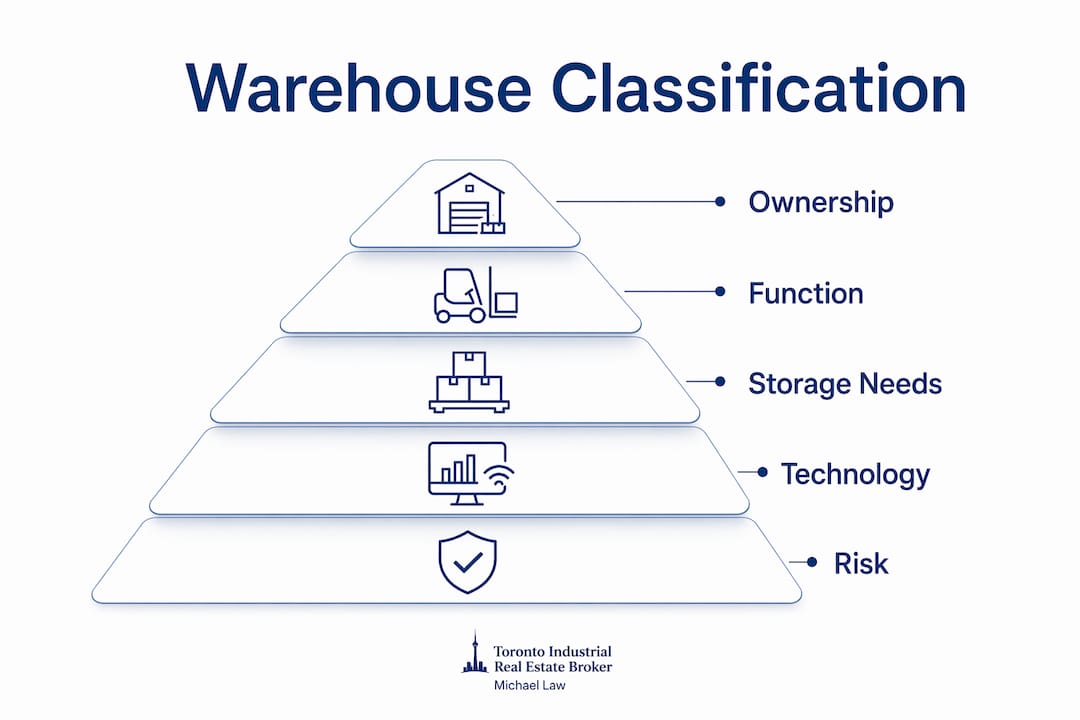
Storage requirements are increasingly driving classification decisions in the GTA. Cold chain demand has grown sharply alongside grocery e-commerce and pharmaceutical distribution, pushing refrigerated warehouse rents in Mississauga and Vaughan above standard ambient rates. Hazardous materials storage adds a regulatory layer that affects both leaseability and insurance costs, a point covered in detail in Section 5.
How do public, private, and contract warehouses differ?
Ownership classification is the first decision most businesses face when selecting a facility. The three models represent a spectrum from maximum flexibility to maximum control, and each carries distinct financial and operational implications.
-
Public warehouses operate on a shared-use model where multiple tenants pay for space, labour, and services on a variable basis. This structure suits seasonal businesses, startups scaling quickly, and companies entering new markets without committing to fixed infrastructure. The trade-off is limited control over operations, scheduling, and security protocols.
-
Private warehouses give a company full operational authority over a dedicated facility, either owned outright or leased on a long-term basis. Private warehousing suits large enterprises with stable, high-volume demand where the capital investment is justified by consistent throughput. A major grocery retailer or automotive parts manufacturer with predictable volumes and specific racking configurations is the textbook candidate.
-
Contract warehouses, often operated by third-party logistics providers (3PLs) such as Purolator Logistics, Geodis, or XTL Transport, offer a middle path. The 3PL operates a dedicated facility on the client’s behalf, providing scalability without the full capital burden of private ownership. This model has grown significantly in the GTA as e-commerce operators seek dedicated space without long-term real estate commitments.
-
The cost structure differs sharply across all three. Public warehouses carry the lowest fixed costs but the highest per-unit rates at volume. Private warehouses carry the lowest per-unit costs at scale but hidden operational expenses including maintenance, specialised staffing, and security frequently exceed initial projections. Contract warehouses sit between these two extremes, offering predictable costs with moderate flexibility.
-
The scalability question is decisive for GTA operators. Industrial vacancy in the GTA has tightened considerably over recent years, making long-term private commitments riskier for businesses with uncertain growth trajectories. Contract and public models allow companies to right-size their footprint as demand shifts.
Pro Tip: Before committing to a private warehouse, build a five-year total cost of ownership model that includes maintenance reserves, staffing overhead, and technology upgrades. Many businesses discover that a well-structured contract warehouse arrangement delivers better unit economics at volumes below 200,000 square feet.
The ownership decision also carries real estate investment implications. Private warehouse assets held by owner-users in Vaughan or Milton represent a different risk profile than income-producing properties leased to 3PL operators. Investors evaluating GTA industrial investment strategies need to understand how ownership classification affects tenant covenant strength and lease term expectations.
What functional warehouse types matter most in the GTA market?
The GTA industrial market is one of the most active in Canada, and functional classification directly determines where a facility should be located, how it should be designed, and what lease terms are appropriate. Five functional types dominate the current market.
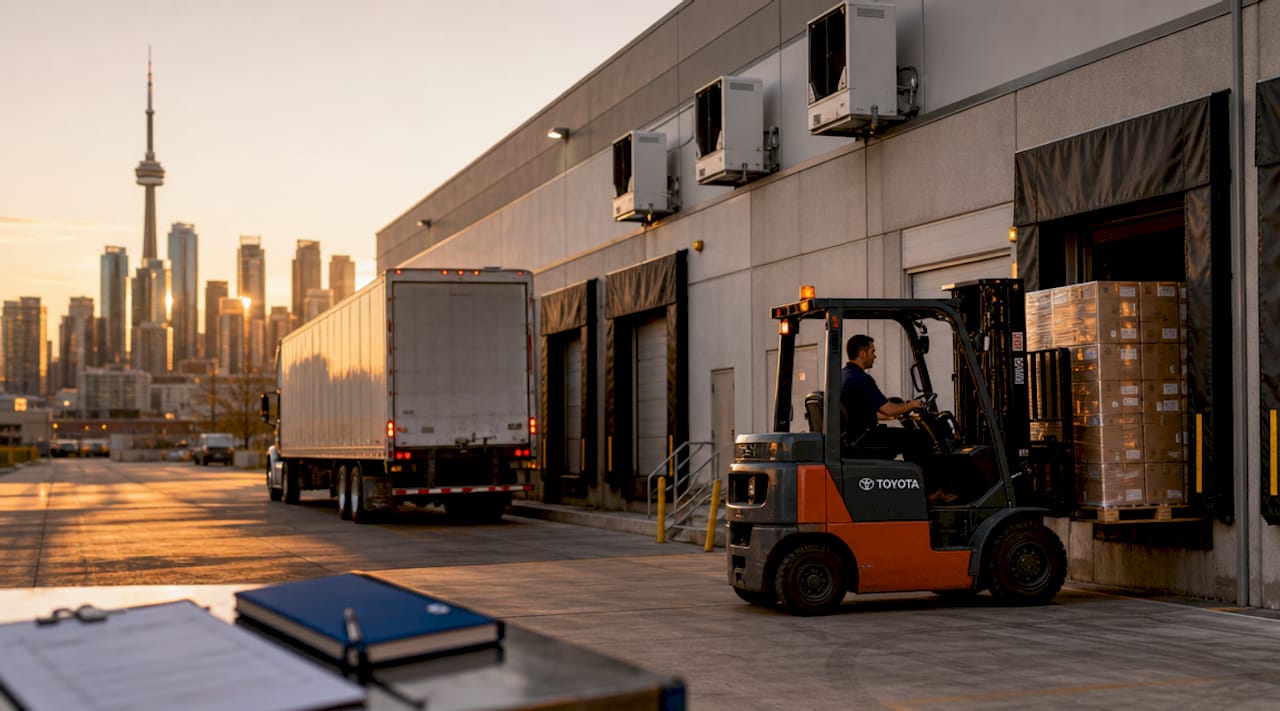
Distribution centres are the backbone of the GTA’s logistics infrastructure. Located along Highway 400, 401, and 427 corridors, these facilities prioritise speed. The key distinction between a warehouse and a distribution centre is dwell time: goods move through a distribution centre in hours or days, not weeks. Amazon, Walmart Canada, and Canadian Tire all operate large distribution centre networks across Brampton, Mississauga, and Ajax that reflect this model.
Fulfilment centres are a specialised evolution of the distribution centre, optimised for individual order processing rather than pallet-level throughput. They require more labour, more sophisticated warehouse management systems (WMS), and layouts that support pick-and-pack operations. In the GTA, fulfilment centres cluster near population centres in Scarborough, North York, and Mississauga to support same-day and next-day delivery commitments.
Cold storage facilities represent one of the fastest-growing segments in GTA industrial real estate. Grocery delivery platforms, pharmaceutical distributors, and food manufacturers all require temperature-controlled environments that command a significant premium over ambient space. Cold storage construction costs run substantially higher than standard industrial builds, which limits new supply and keeps vacancy rates tight in nodes like Brampton and Burlington.
Bonded warehouses serve a specific but critical function for GTA businesses engaged in international trade. Bonded facilities allow duty deferral on imported goods until they are released for domestic sale, which improves cash flow for high-value importers. The proximity of several GTA industrial nodes to Toronto Pearson International Airport makes Mississauga and Brampton natural locations for bonded warehouse operations.
Cross-dock facilities eliminate long-term storage entirely. Goods arrive from suppliers, are sorted, and depart to final destinations within the same shift. This model suits grocery distributors and parcel carriers operating in time-sensitive supply chains. Cross-dock facilities require a high ratio of dock doors to floor area and are typically located at major highway intersections within the GTA.
The following table summarises functional types relevant to GTA operators and investors:
| Functional type | Primary use | Typical GTA location | Key lease consideration |
|---|---|---|---|
| Distribution centre | Pallet throughput, regional supply | Brampton, Mississauga, Ajax | Clear height, dock count, trailer parking |
| Fulfilment centre | Order picking, last-mile | Scarborough, Mississauga | Labour access, WMS compatibility |
| Cold storage | Temperature-controlled goods | Brampton, Burlington | Power capacity, refrigeration infrastructure |
| Bonded warehouse | Duty-deferred imports | Mississauga (Pearson corridor) | CBSA compliance, security requirements |
| Cross-dock | Transfer without storage | Highway 400/401 nodes | Dock-to-floor ratio, yard depth |
How are risk and technology reshaping warehouse classification systems?
Modern warehouse classification systems now extend well beyond ownership and function. Two forces are reshaping how facilities are categorised, valued, and leased: risk-based regulatory frameworks and technology integration levels.
Risk-based classification has become a mandatory consideration in many jurisdictions. Regulators now divide warehouses into eight distinct risk levels based on the materials stored, with each level carrying specific civil defence, environmental, and insurance requirements. A facility storing lithium-ion batteries, aerosols, or flammable liquids falls into a higher risk category than one storing consumer electronics or apparel. This classification directly affects:
- Building code requirements and fire suppression specifications
- Environmental compliance obligations and spill containment standards
- Insurance premiums and coverage eligibility
- Municipal zoning approvals and operating permits
- Leaseability to certain tenant types
For GTA investors and landlords, risk classification now dictates leaseability as much as location does. A facility built to accommodate hazardous materials storage commands higher rents but also carries greater regulatory burden. Investors acquiring industrial assets in Hamilton or Oshawa need to verify the risk classification of existing tenants before completing due diligence.
Technology classification runs on a separate but equally important axis. Manual warehouses rely on human labour for all picking, packing, and inventory management functions. Automated warehouses incorporate conveyor systems, automated storage and retrieval systems (AS/RS), and robotic picking. Smart warehouses layer Internet of Things (IoT) sensors, real-time data analytics, and warehouse management systems across the entire operation.
Automated and smart warehouses reduce labour costs and improve accuracy, but the upfront capital investment is substantial. For GTA investors, this creates a tenant improvement consideration: a landlord who contributes to automation infrastructure may attract a stronger tenant covenant and a longer lease term, improving asset value. The operational savings from smart warehouses justify the investment for high-volume operations, but smaller operators often find that a well-configured manual or semi-automated facility delivers better returns per square foot.
Pro Tip: When evaluating a GTA industrial property for acquisition, request the current tenant’s warehouse management system specifications and automation level. Facilities already wired for AS/RS or IoT integration command a premium on re-leasing and attract institutional-grade tenants.
The intersection of risk classification and technology is particularly relevant for cold storage and hazardous materials facilities. Automated cold storage, for example, reduces the human exposure risk that drives higher insurance costs in manually operated refrigerated environments. This combination of risk mitigation and operational efficiency is increasingly influencing how developers design new industrial product across the GTA.
What steps should GTA logistics professionals and investors take when selecting a warehouse?
Selecting the right warehouse type requires a structured decision process that accounts for operational goals, financial constraints, regulatory obligations, and market conditions. The following framework applies whether you are a logistics operator seeking space or an investor evaluating an acquisition.
-
Define your primary operational goal. A business focused on same-day delivery needs a fulfilment centre near population centres. A manufacturer with stable output needs a private or contract warehouse with long-term lease security. Clarifying the primary function prevents misalignment between facility type and business need.
-
Assess your volume stability. High, predictable volumes justify private warehousing. Variable or seasonal demand points toward public or contract models. A single facility often serves multiple roles simultaneously, so focus on the dominant operational need rather than trying to classify every function.
-
Map your storage requirements. Identify whether your goods require ambient, refrigerated, frozen, or hazardous materials storage. This step determines which facilities are physically eligible and which risk classifications apply to your operation.
-
Evaluate technology requirements against budget. Determine whether your throughput volume justifies automation investment. For operations below 50,000 square feet, a well-designed manual facility with a capable WMS often outperforms a partially automated one. For operations above 150,000 square feet, automation economics become compelling.
-
Conduct risk classification due diligence. Verify that the facility’s risk classification matches your materials and that all civil defence, environmental, and insurance requirements are met. This step is non-negotiable for hazardous materials operators and is increasingly scrutinised by GTA municipal authorities.
-
Analyse total cost of ownership, not just base rent. Factor in tenant improvements, technology infrastructure, staffing costs, insurance premiums, and lease flexibility. A facility with a lower base rent but high improvement costs may deliver worse economics than a higher-rent property that is move-in ready.
Pro Tip: In the GTA market, where industrial vacancy remains tight and new supply is constrained, the best facilities are often leased before they are publicly listed. Working with an advisor who has direct relationships with landlords across Brampton, Vaughan, and the Durham Region gives you access to off-market opportunities that never appear on listing platforms.
For investors, the classification framework also informs acquisition strategy. Facilities with strong functional classifications, such as cold storage or bonded warehouses, carry higher replacement costs and attract tenants with longer lease commitments. Reviewing GTA industrial space optimisation strategies helps investors understand how classification affects both operational performance and long-term asset value.
Key takeaways
Warehouse classification is the single most important framework for aligning facility selection with operational goals, financial performance, and regulatory compliance in the GTA industrial market.
| Point | Details |
|---|---|
| Four core dimensions | Ownership, function, storage requirements, and technology together define every warehouse type. |
| Ownership trade-offs | Public warehouses offer flexibility; private offers control; contract warehouses balance both without full capital commitment. |
| Functional type drives location | Distribution centres, fulfilment centres, cold storage, and bonded warehouses each require distinct GTA locations and lease structures. |
| Risk classification is mandatory | Eight regulatory risk levels now govern leaseability, insurance, and compliance for GTA industrial properties. |
| Technology investment requires scale | Automated and smart warehouses deliver long-term savings but require high-volume operations to justify upfront costs. |
What I have learned about warehouse classification in the GTA
After years of advising logistics operators and investors across the GTA, the most common mistake I see is treating warehouse classification as a bureaucratic formality rather than a strategic tool. Businesses spend months negotiating lease rates and almost no time verifying that the facility’s functional classification actually matches their supply chain model. A distribution centre lease signed for a business that needs fulfilment-centre capabilities creates operational friction from day one.
The second pattern I observe is what I call classification paralysis. Operators become so focused on finding the “perfect” category that they delay decisions in a market where good facilities disappear quickly. The reality is that most warehouses serve multiple roles simultaneously. A high-bay facility in Brampton can function as both a distribution hub and a storage warehouse depending on how you configure the racking and manage inbound flows. The classification framework is a starting point, not a constraint.
On the technology side, I consistently see investors underestimate the value of automation-ready infrastructure. A facility with adequate power capacity, clear heights above 36 feet, and a concrete floor rated for automated guided vehicles (AGVs) commands a meaningful premium on re-leasing. These specifications are worth paying for at acquisition because they expand your tenant pool and support longer lease terms.
The risk classification dimension is the one that surprises most investors. A property that looks attractive on a cap rate basis can carry significant hidden liability if the current tenant’s materials push the facility into a higher risk category that the building was not designed to accommodate. I always recommend a full risk classification review as part of industrial due diligence, particularly for properties in Hamilton, Oshawa, and the Highway 400 corridor where industrial uses are diverse.
My advice: use the four-dimension framework as your first filter, engage an advisor who knows the specific GTA submarket you are targeting, and move decisively when the right facility appears. The GTA industrial market rewards preparation and speed in equal measure.
— Michael
How Mlawrealestate supports your warehouse selection in the GTA
Mlawrealestate provides industrial real estate advisory services across all major GTA industrial corridors, including Mississauga, Brampton, Vaughan, Markham, and the Durham Region. Whether you are a logistics operator seeking the right functional facility type or an investor evaluating industrial acquisitions, the team at Mlawrealestate brings transaction experience and market intelligence to every mandate.
Michael Law operates through Lennard Commercial Realty, one of Canada’s established commercial real estate firms, providing clients with institutional-grade market data and direct landlord relationships across the GTA. If you are ready to match your operational requirements to the right warehouse classification and secure the best available space, contact Michael Law directly to discuss your specific needs.
FAQ
What is the standard definition of warehouse classification?
Warehouse classification is the categorisation of storage facilities based on ownership model, operational function, storage requirements, and technology level. These four dimensions together determine which facility type aligns with a given business or investment objective.
What are the main types of warehouses in Canada?
The primary types include public, private, and contract warehouses by ownership, and distribution centres, fulfilment centres, cold storage, bonded warehouses, and cross-dock facilities by function. Each type serves a distinct role in the supply chain.
How does risk classification affect warehouse leasing in the GTA?
Risk classification divides warehouses into eight regulatory categories based on the materials stored, and this directly affects insurance premiums, municipal permits, and leaseability. GTA investors and landlords must verify that a facility’s risk classification matches its tenant’s operational profile before completing a transaction.
When does a private warehouse make financial sense?
Private warehousing delivers the best economics for large enterprises with stable, high-volume demand where the capital investment is offset by lower per-unit costs over time. Businesses with variable demand or uncertain growth trajectories typically achieve better results through contract or public warehouse arrangements.
What is the difference between a distribution centre and a fulfilment centre?
A distribution centre handles pallet-level throughput with short dwell times, typically serving retail replenishment or regional supply chains. A fulfilment centre processes individual customer orders through pick-and-pack operations, making it the preferred model for e-commerce businesses requiring same-day or next-day delivery.
Recommended

About Michael Law
Managing Partner and Industrial Real Estate Broker at Lennard Commercial Realty. Representing tenants and landlords across Toronto and the GTA for 15+ years. Michael specializes in GTA industrial real estate — connect with Toronto's leading industrial broker at mlawrealestate.com/industrial-broker-toronto.
Related Articles


More Toronto Industrial Real Estate Insights
Articles & Analysis
Tenant Improvements: Plan Costs and Lease Terms
Read →Guide to Commercial Property Disposition
Read →How to Reduce Warehouse Vacancy in the GTA
Read →Markham Industrial Rents 2026: Tenant Rep Says Budget C$22 PSF
Tenant focused 2026 Markham industrial rent snapshot from a GTA tenant rep. Expect C$16–22 net and about C$22 gross; negotiation levers, cost checks, and...
Read →Brampton Warehouse Lease Negotiation Tactics
Read →Common Questions
What is a sale-leaseback in industrial real estate?
A sale-leaseback is a transaction in which an industrial property owner sells their building to an investor and simultaneously signs a long-term lease to remain in the property as a tenant. The seller unlocks the capital tied up in their real estate while retaining full operational use of the facility. The buyer acquires a tenanted investment property with immediate cash flow from a known occupant.
Read →What is a dock-to-grade ratio in industrial real estate?
Dock-to-grade ratio in industrial real estate refers to the number of dock-level loading doors relative to the building's floor area, typically expressed as one dock door per X,000 square feet. It is a key specification for distribution and warehousing tenants because it determines how many trucks can load and unload simultaneously and therefore the building's throughput capacity.
Read →What is clear height in a warehouse or distribution centre?
Clear height in a warehouse or distribution centre refers to the usable vertical space from the finished floor to the lowest overhead obstruction — typically the bottom of the roof structure, sprinkler heads, or HVAC equipment. It is the single most important building specification for warehouse tenants because it determines how many racking levels can be installed and therefore how much product can be stored per square foot of floor space.
Read →