Markham Industrial Rents 2026: Tenant Rep Says Budget C$22 PSF
By Michael Law · Industrial Real Estate Broker, Lennard Commercial Realty
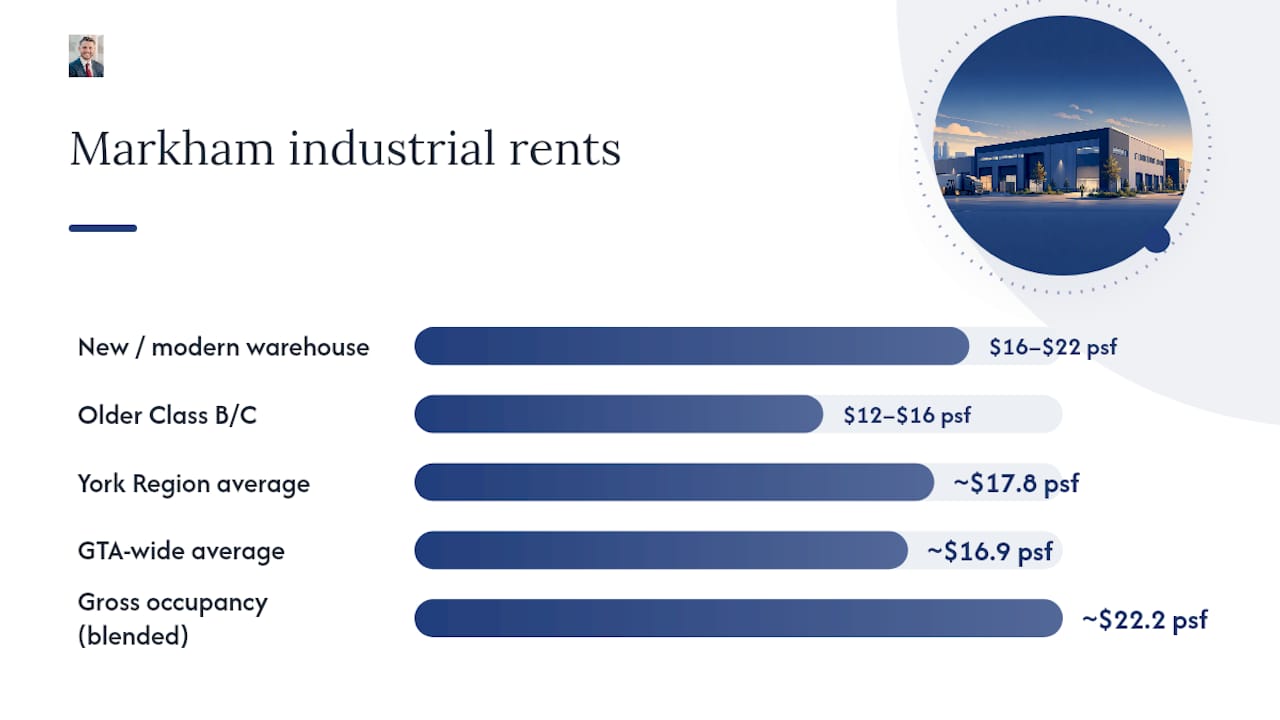
Net asking rents for Markham industrial space sit roughly between $16 and $22 per square foot for newer buildings, and $12 to $16 for older Class B/C stock. Add additional rent, and gross occupancy costs land closer to $22 per square foot on average across the region. That’s above the broader GTA average, reflecting York Region’s tight supply. The exact number depends heavily on building class and whether a quote is net or gross.
TL;DR:
- Markham industrial net rents range from $12 to $22 per square foot depending on building age and quality, with newer buildings asking the top end.
- Limited land availability and high demand for large footprints drive rental premiums, with new-builds commanding higher rents due to scarcity.
- Tenants should focus on negotiating total occupancy costs, operating expense escalation, and lease terms rather than just headline rent figures.
- Cross-check asking rates against market reports and clarify whether quotes are net or gross to avoid underestimating actual lease expenses.
Table of Contents
- What are current Markham industrial rents and lease rates?
- Why Markham industrial rents keep climbing
- How should tenants budget and negotiate a Markham lease?
- Where to find Markham industrial listings and read them correctly
- What tenant representation actually changes in this market
- The market read tenants keep getting wrong
- Get a Markham market brief before you sign
- Sources
- FAQ
What are current Markham industrial rents and lease rates?
York Region, which includes Markham, posted average estimated asking rents of about C$17.8 per square foot in the second quarter of 2026, ahead of the broader GTA average of roughly C$16.9 per square foot. That premium isn’t new. Markham has consistently traded above the Toronto industrial average for years, largely because there’s so little land left to build on.
Layer in additional rent, which covers property taxes, common area maintenance, and utilities, and the picture changes fast. GTA-wide additional rents averaged around C$5.3 per square foot in the same period, pushing gross occupancy costs to roughly C$22.2 per square foot on a blended basis. A tenant quoted “$17 net” isn’t paying $17. They’re paying closer to $22 once the full bill lands.
Within Markham itself, the range widens by building vintage. Newer distribution and warehouse product, the kind with 32 to 40 foot clear heights and modern loading, typically asks $16 to $22 per square foot net. Older Class B and C buildings, often smaller bays with lower clear heights, run closer to $12 to $16.
| Building type | Net asking rent (per sq ft) | Notes |
|---|---|---|
| New/modern warehouse and distribution | $16 to $22 per square foot | High clear height, modern loading, limited availability |
| Older Class B/C industrial | $12 to $16 per square foot | Smaller bays, lower clear heights, more negotiable |
| York Region average (all classes) | about C$17.8 per square foot | Highest among GTA submarkets in 2Q26 |
| GTA-wide average (all classes) | about sixteen dollars and ninety cents | Benchmark for comparison |
Pro Tip: Always ask whether a quoted rate is net or gross before comparing two listings. A “$15 gross” space and a “$15 net plus $5 additional rent” space are not the same deal, even though the headline number looks identical.
Vacancy in the region has stayed tight, based on inventory and vacancy data tracked by the City of Markham’s economic profile. But headline vacancy can be misleading. Sublease space rarely shows up in that top-line figure, and shadow supply from corporate downsizing can appear and disappear quickly. Rent growth has moderated from the double-digit jumps seen in 2021 and 2022, but it’s still moving upward, not sideways.
Why Markham industrial rents keep climbing
Markham’s rent story is really a land story. There’s very little greenfield industrial land left to develop, and most new supply now comes from intensification or redevelopment of older sites rather than fresh construction on open land, according to Aion Appraisals. That scarcity is the single biggest reason new-build rents sit at a premium to older stock.
Demand hasn’t slowed to match. Logistics operators, e-commerce fulfillment companies, and tech-adjacent manufacturers continue to compete for space in York Region because of its highway access and proximity to Toronto’s northern suburbs. When you have limited new supply meeting steady demand from multiple industries at once, rents move in one direction.
A few things compound the pressure:
- Large contiguous footprints, especially anything over 100,000 square feet, are scarce and often require a design-build project or a move to a newer industrial node outside Markham.
- Construction lead times for new industrial buildings routinely stretch past 18 months once permitting, servicing, and financing are factored in.
- Rising land prices get baked directly into asking rents for anything built or redeveloped in the last three years.
- Occupiers who need scale increasingly look at industrial land availability options in Markham well before their lease expires, because waiting narrows the field fast.
Pro Tip: If your business needs more than 75,000 square feet, start tracking municipal land servicing and site plan approvals a year before you need to move. By the time a listing goes live, the good options are usually already spoken for.
How should tenants budget and negotiate a Markham lease?
Start with the full cost, not just the headline rent. A realistic Markham budget adds net rent to additional rent, then builds in a contingency for operating cost increases over the lease term. Here’s the sequence that actually works:
- Calculate gross occupancy cost first. Take the net asking rent, add the landlord’s estimated additional rent (commonly $4.90 to $5.30 per square foot across the GTA), and multiply by your square footage to get an annual number before you even look at a floor plan.
- Request three years of operating cost history. Landlords will often share this if asked directly. A pattern of steep annual increases is a red flag worth negotiating around.
- Ask for direct vs. sublease inventory separately. Sublease space can undercut asking rents but usually comes with a shorter remaining term and less flexibility on improvements.
- Negotiate term length against rent-free periods and tenant improvement allowances. Landlords in a tight market like Markham will trade term commitment for upfront concessions more readily than for a lower base rent.
- Build in a realistic timeline. Site selection through occupancy in Markham commonly takes four to eight months for existing space, longer for anything requiring buildout.
Key questions to put directly to the landlord or listing broker:
- Who is responsible for capital repairs to the roof, HVAC, and structure during the term?
- Is the rent escalation fixed, or tied to an index?
- How much of the tenant improvement allowance is available in cash versus applied credit?
- What’s the actual current vacancy in the building, including any subleased floors?
For a deeper walkthrough of negotiation tactics specific to this market, see this breakdown of strategies for better GTA industrial leases.
Where to find Markham industrial listings and read them correctly
Most tenants start their search on commercial listing portals or directly on brokerage property pages, but the number on the page rarely tells the whole story.
- Cross-check any listed asking rent against the City of Markham’s economic profile or a current market report before assuming it’s representative of the wider market.
- Confirm whether the quoted figure is net or gross. Net quotes require you to add additional rent separately; gross quotes already include it.
- Filter by the specifics that actually matter for operations: clear height, number of loading doors (dock vs. drive-in), sprinkler coverage, and power capacity.
- Ask explicitly whether a listing is direct from the landlord or a sublease, since sublease terms and improvement responsibilities differ substantially.
- Compare Markham pricing against nearby GTA industrial submarkets if your operation has location flexibility, since a 15 minute drive can sometimes mean a meaningfully lower rate.
A broker who works this market daily will usually catch discrepancies between advertised and negotiable rent faster than a self-directed search, particularly on subleases that never get formally listed.
What tenant representation actually changes in this market
Michael Law, Managing Partner at Lennard Commercial, has spent over a decade advising occupiers on lease negotiations and site selection across the GTA industrial market, including Markham and the wider York Region corridor. That vantage point matters because asking rent is only ever the opening number.
The decision to pay a premium for new-build space in Markham only makes sense when location genuinely drives revenue, whether that’s proximity to a labour pool, a highway interchange, or existing customers. If location isn’t doing real work for the business, the smarter move is often pushing harder on tenant improvements or term flexibility in an older building rather than chasing a shiny new box at the top of the range.
Tenants who understand this trade-off going in negotiate very differently than tenants who anchor on the first number a landlord offers. For more on how Michael Law approaches occupier strategy across the region, his firm’s market pages track this in more depth.
The market read tenants keep getting wrong
Most advice on industrial leasing treats rent as a single number to compare across buildings. That’s backwards in a market like Markham, where the gap between net and gross quotes, and between direct and sublease availability, routinely swings the real cost by several dollars per square foot.
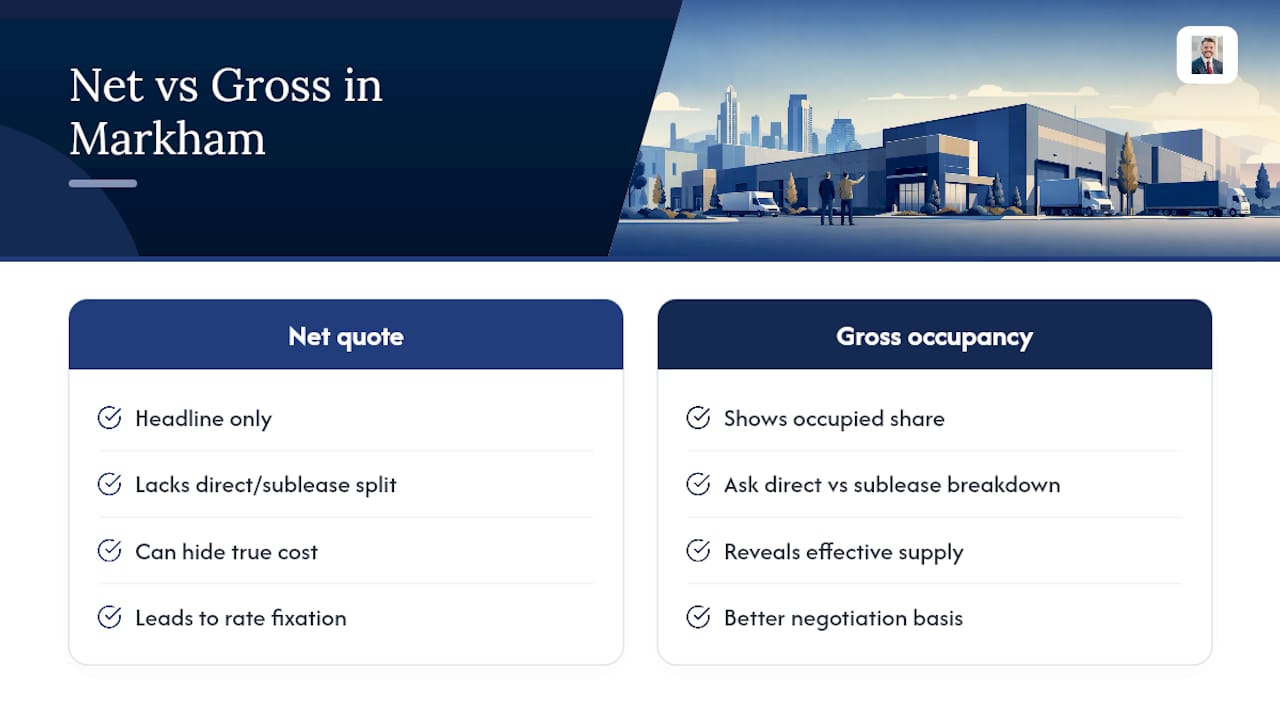
The conventional wisdom says vacancy rate tells you how much leverage you have. It doesn’t, not fully. Headline vacancy in Markham looks tighter than the effective supply tenants can actually access, because sublease space rarely gets counted cleanly. A tenant who only checks the published vacancy number and skips asking for a direct versus sublease breakdown is negotiating with half the information.
If there’s one thing to prioritize first, it’s this: get the gross occupancy number before you fall in love with a net rent quote. Building class, term length, and land scarcity will keep pushing new-build rents upward through 2026. That’s not going to reverse on its own. But tenants who negotiate on term, tenant improvements, and escalation structure, rather than fixating on the headline rate, consistently land better deals than those who don’t.
— Michael Law
Get a Markham market brief before you sign
Comparing asking rents across listings only gets you so far when net versus gross quotes and hidden sublease inventory can shift the real cost by several dollars a square foot. Tenant representation services are structured to focus negotiation strategies around occupancy costs of tenants rather than landlords’ rent rolls.
Whether you’re evaluating a lease renewal, a relocation, or a first industrial footprint in York Region, industrial tenant representation from Michael Law | Lennard Commercial means someone reviews operating cost history, benchmarks your quote against current Markham data, and negotiates the improvement allowance and escalation terms before you sign anything. Request a Markham market brief or book an initial consultation through the Location page to get a straight read on where your target space actually sits against current asking rents.
Sources
- 2Q26 Toronto Ontario industrial market report
- Markham economic profile — January 2026
- Industrial property appraisal in Markham — Aion Appraisals
FAQ
Where can I find industrial space for lease in Markham?
Commercial listing portals and brokerage property pages, including Michael Law | Lennard Commercial’s Markham page, carry current listings. Always cross-check the asking rent against a municipal or market report before comparing options.
What are the average commercial rent rates in the Toronto area?
The GTA-wide average estimated asking rent was about C$16.9 per square foot in 2Q26, while York Region, including Markham, averaged closer to C$17.8. Additional rent adds roughly C$5.3 more on top.
Is it expensive to rent industrial space in Markham?
Markham runs above the GTA average because of limited industrial land and steady demand. Net asking rents range from about $12 to $16 per square foot for older buildings up to $16 to $22 for newer stock, before additional rent.
How much does it cost to rent a warehouse in Ontario?
Costs vary widely by region and building age, but across the GTA gross occupancy costs, meaning net rent plus additional rent, average around twenty-two dollars and twenty cents per square foot. Markham typically sits at or above that blended average.
Should I negotiate rent-free periods or tenant improvement allowances in Markham?
Both are worth pursuing, and landlords in a tight market often prefer offering concessions over cutting the base rent. Which one matters more depends on whether the space needs buildout or is close to move-in ready.
Recommended

About Michael Law
Managing Partner and Industrial Real Estate Broker at Lennard Commercial Realty. Representing tenants and landlords across Toronto and the GTA for 15+ years. Michael specializes in GTA industrial real estate — connect with Toronto's leading industrial broker at mlawrealestate.com/industrial-broker-toronto.