
GTA Industrial Option to Renew Lease: Legal Risks and Broker Timing
By Michael Law · Industrial Real Estate Broker, Lennard Commercial Realty
An option to renew only protects you if your lease actually grants one, and even then, only if you exercise it exactly as written. Miss the notice window or hedge your wording, and Ontario courts have consistently sided with landlords. The one thing to do right now: pull your lease, find the renewal clause, and calendar the deadline with a buffer of at least 30 days.
TL;DR:
- Renewal clauses only protect tenants if properly exercised within the exact notice window specified in the lease, and missed deadlines generally result in losing the right to renew.
- A renewal creates a new lease that does not automatically carry over personal covenants like guarantees or rights of first refusal unless explicitly stated in the lease.
- Tenants should start renewal preparations 9 to 24 months before expiry, including market research and legal review of notice wording, to avoid forfeiting renewal options.
- Strict compliance with notice procedures is enforced by courts, so sending clear, unambiguous notices through the required method at least 30 days early is essential.
- In a tight GTA industrial market, having credible alternatives and early engagement with brokers significantly improves negotiating leverage over landlords.
Table of Contents
- Renewal versus extension: what each means and why tenants should care
- How an option to renew works in Canada: notice, wording, and delivery
- Common legal pitfalls and what court decisions signal about strict compliance
- How renewal rent is set and the levers you can pull
- Practical checklist: what to do 18, 12, 9, and 6 months before expiry
- A GTA industrial broker’s take on timing and leverage
- Sample wording for exercising an option to renew
- Renewal options in the GTA industrial market: what’s different
- Pitfalls unique to Canadian commercial and industrial leases
- When to exercise versus when to reopen the market
- How Michael Law | Lennard Commercial can help with your renewal
- Sources
- FAQ
Renewal versus extension: what each means and why tenants should care
A renewal creates a brand new lease. An extension continues the existing one. That distinction sounds like lawyer semantics, but it changes what survives past the original term.
When you renew, you sign a fresh temporal term, which can sever privity of contract for personal covenants tied to the original agreement. Guarantees, rights of first refusal, and exclusivity clauses do not automatically carry forward into a renewed lease unless the document expressly says they do, according to Terra Law Corp’s analysis of renewals versus extensions. An extension avoids that problem because it is legally the same lease running longer, so personal rights generally stay intact.
For industrial occupiers, this matters most when a guarantor backed the original lease or when the tenant negotiated a right of first refusal on adjacent space. Advisors increasingly recommend negotiating extension language over renewal language specifically to preserve those rights, according to Parlee McLaws LLP’s breakdown of renewal and extension clauses. If your lease uses the word “renew,” check whether it also carries forward the covenants you actually care about.
How an option to renew works in Canada: notice, wording, and delivery
Ontario has no statutory right to lease renewal for commercial tenants. Renewal exists only if your lease contract creates it, according to Hadri Law’s review of Ontario renewal clauses. Everything about how you exercise that right is governed by the four corners of the document, not by any general tenant protection.
Notice windows vary by lease, but industrial and commercial agreements commonly require between six and 24 months’ advance written notice, with larger or specialized spaces often on the longer end. The lease controls the exact period, not convention, so never assume a “standard” window applies to your deal.
To exercise the option correctly:
- Locate the exact clause and copy its required language into your notice rather than paraphrasing.
- Confirm who is entitled to exercise it. Many leases restrict the right to the original named tenant and exclude assignees unless the assignment agreement expressly transferred the option.
- Deliver notice using the method the lease specifies (courier, registered mail, or personal delivery), not just email, unless the lease permits electronic notice.
- Keep proof of delivery and a dated copy of the notice itself.
- Confirm receipt with the landlord in writing, separate from your notice document.
Pro Tip: Send your renewal notice at least 30 days before the earliest permitted date in the window, never the latest. Courier delays and landlord mailroom backlogs have cost tenants their option before.
Common legal pitfalls and what court decisions signal about strict compliance
Ontario courts require strict compliance with renewal notice clauses. That phrase sounds abstract until you see how narrowly it’s applied. In 1305 Dundas, the Ontario Court of Appeal confirmed that courts expect unequivocal exercise of the option within the exact window, and they routinely reject notices that hedge or blur the tenant’s intent, according to the Court of Appeal case summary.
The failures that keep showing up:
- Sending an email that discusses renewal terms instead of clearly stating the option is being exercised
- Trying to negotiate rent before confirming the option is exercised, which courts can read as conditional acceptance rather than exercise
- Missing the window by even a few days, then arguing the landlord should have reminded the tenant
- Assuming a phone call or verbal confirmation satisfies a written notice requirement
Landlords have no duty to remind tenants of an approaching deadline, and courts seldom grant relief from forfeiture when a tenant simply forgot, according to Hadri Law. Some recent commentary suggests courts may weigh equity factors in narrow circumstances, but practitioners still warn tenants not to rely on judicial sympathy, according to RS&R Law’s analysis of equity and strict compliance. Strict compliance remains the only guaranteed protection.
How renewal rent is set and the levers you can pull
Most industrial leases set renewal rent through one of three mechanisms: a fixed formula agreed at signing, a CPI-indexed adjustment, or fair market rent (FMR) determined at the time of renewal. Fixed formulas give certainty but can lag behind market conditions. CPI indexing tracks inflation but not necessarily industrial demand, which has outpaced general inflation in several GTA submarkets. FMR exposes you to full market pricing, which cuts both ways depending on vacancy at renewal time.
Rent caps, base year protections, and audit rights on Tenant Municipal and Insurance (TMI) charges all limit downside risk regardless of which formula applies. Advisors recommend negotiating a rent cap even when the lease uses FMR, since it puts a ceiling on exposure without eliminating market-based pricing entirely.
Levers worth using at renewal:
- Start comparables research early so you can challenge an inflated FMR estimate with real data
- Quantify what you’re giving up (tenant improvement allowances, free rent) if the landlord expects “as is” renewal terms
- Ask for an arbitration or appraisal clause if FMR is disputed, and prepare evidence in advance rather than after a dispute starts
Pro Tip: Pull three to five comparable industrial lease transactions from the past 12 months before you sit down with the landlord. Anecdotal “market rate” claims from either side collapse quickly against actual data.
Practical checklist: what to do 18, 12, 9, and 6 months before expiry
- At 18 months: Diarise the exact notice window from the lease and set cascading reminders at 12, 9, and 6 months out using lease expiration alerts to protect revenue and avoid holdover.
- At 12 months: Begin market scans and shortlist alternative sites to build real negotiating leverage, particularly for larger or specialized industrial facilities where relocation takes longer to execute.
- At 9 months: Confirm assignability, guaranty status, and whether any lease clause could nullify the option before you rely on it.
- At 6 months: Draft and test the exact notice wording against the lease clause, instruct legal counsel to review it, and confirm the delivery method falls within the permitted window.
A GTA industrial broker’s take on timing and leverage
Engage a broker 12 to 24 months before expiry, especially for industrial sites with specific requirements around clear height, power capacity, or loading access. That runway lets a broker pull market comparables, source alternative sites, and control negotiation timing rather than reacting to a landlord’s opening offer.
The GTA industrial market rewards tenants who create real alternatives. A landlord negotiating with a tenant who has toured three viable backup sites behaves very differently than one negotiating with a tenant who has nowhere else to go.
Pro Tip: If your facility depends on specific power capacity or clear height above 32 feet, start your site search even earlier than 24 months. Those features are scarce across Mississauga, Brampton, and Vaughan, and qualified alternatives take longer to identify.
Sample wording for exercising an option to renew
The safest approach is to mirror the lease’s own language, not to write something original. If your lease says the tenant “may renew by written notice delivered not less than nine months prior to the expiry of the term,” your notice should track that phrasing closely.
A defensible structure looks like this:
Avoid conditional language. Never write “the Tenant wishes to discuss renewal” or “the Tenant would like to explore its option,” since both have been read by courts as insufficiently clear exercise. State the exercise as a completed act, not a proposal.
If the renewal rent will be set by fair market value later, say so in the notice only if the lease requires it. Otherwise, keep the notice narrow: confirm exercise, cite the clause, and leave rent-setting mechanics to the process the lease already describes. Practical Law Canada’s templates outline common clause structures and drafting traps worth reviewing before you finalize wording, particularly around delivery method and who is authorized to sign.
Have legal counsel review the final notice before delivery, even when you’re confident in the wording. A single ambiguous phrase has been enough for courts to find an option was not properly exercised.
Renewal options in the GTA industrial market: what’s different
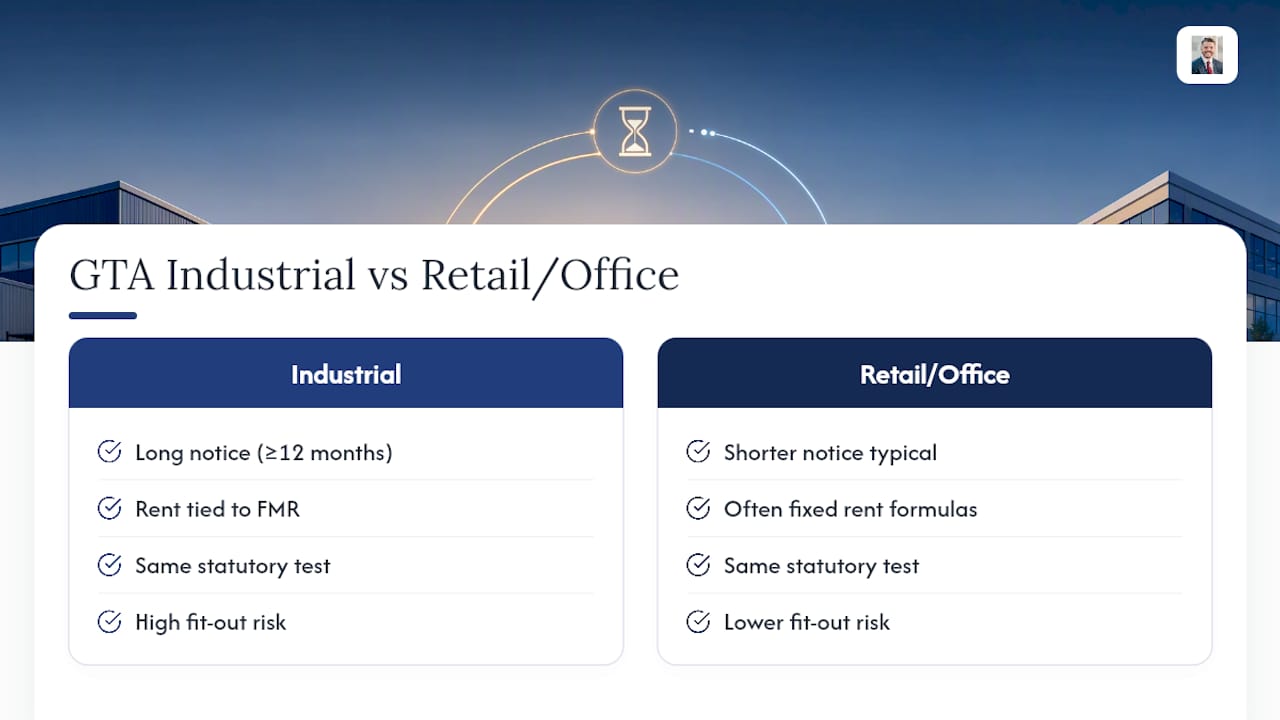
Industrial leases across Mississauga, Brampton, Vaughan, and the broader GTA tend to carry longer notice windows than retail or office leases, often 12 months or more, because industrial tenants typically have larger fit-out investments and landlords want earlier certainty on space availability. Renewal clauses in this asset class also more frequently tie rent to fair market value rather than fixed formulas, given how sharply industrial rents have moved in recent leasing cycles.
Ontario’s Commercial Tenancies Act does not distinguish between industrial, retail, or office leases when it comes to renewal rights. All commercial renewal is contractual, and the same strict compliance standard from cases like 1305 Dundas applies regardless of asset class. What changes is the practical stakes: an industrial tenant with racking systems, dock doors, and specialized power infrastructure has far more to lose by mishandling notice than a tenant in a standard office suite.
Municipalities across the GTA, including Milton, Burlington, and Markham, have seen industrial vacancy stay historically tight, which shifts negotiating leverage toward landlords at renewal unless the tenant has done real market testing. That makes early engagement and alternative site sourcing more valuable here than in softer markets, since a credible walk-away option is often the only real counterweight to a landlord’s FMR position.
Pitfalls unique to Canadian commercial and industrial leases
Industrial leases carry structural complexity that retail and office leases often don’t, and that complexity creates renewal traps specific to this asset class.
Assignment history is the biggest one. If the space changed hands through an assignment or sublease at any point, confirm whether the renewal option transferred with it. Many leases restrict the option to the original named tenant, which means a current occupier who took over through assignment may have no renewal right at all, regardless of how long they’ve operated the space.
Fit-out investment creates a second trap. Tenants who spent heavily on racking, refrigeration, or specialized flooring sometimes assume that investment gives them leverage or an implied right to stay. It gives neither. Quantifying total occupancy cost, meaning base rent plus TMI plus any incentives forfeited by renewing, against net effective rent elsewhere is the only way to know if staying actually makes financial sense, according to WarehouseIndex’s Ontario warehouse leasing analysis.

Exercising the option can also forfeit leasing incentives entirely. Renewing tenants often accept the space “as is” with no fresh tenant improvement allowance or free rent period, according to NAIBC’s review of renewal pitfalls, which can make relocation more attractive than it first appears once incentive value is factored in.
When to exercise versus when to reopen the market
Exercise the option when your location is operationally critical, when you’ve sunk heavy money into fit-out that can’t move economically, or when viable alternatives simply don’t exist in your submarket. Reopen the market when conditions have softened, when you need fresh tenant allowances the landlord won’t offer on renewal, or when the likely rent outcome looks worse than what a competing landlord would offer to win your tenancy.
The quick heuristic: if walking away costs you more than staying, exercise early and decisively; if staying costs you more than a credible alternative, use that alternative as leverage before you exercise anything.
— Michael Law
How Michael Law | Lennard Commercial can help with your renewal
A lease renewal decision made without market comparables is a guess, not a negotiation. Michael Law | Lennard Commercial gives GTA industrial tenants what a landlord’s renewal offer never includes on its own: real comparable data, sourced alternative sites, and a broker who controls timing instead of reacting to it.

Michael Law | Lennard Commercial provides tenant representation, market analysis, lease negotiation, and site selection focused specifically on industrial occupiers across Toronto and the GTA, including Mississauga, Brampton, Vaughan, Milton, and Markham. The right time to reach out is 12 to 24 months before your lease expires, giving enough runway to test the market properly. If you’ve already missed a notice deadline, contact the firm immediately. Some options carry limited flexibility depending on landlord relationship and lease terms, and early advice matters even after a deadline has passed.
Explore industrial tenant representation services or review current industrial listings across the GTA to see what alternative space looks like in your submarket before you commit to a renewal decision.
This article is general information, not a substitute for advice from a qualified lawyer. Consult a qualified legal professional about your own circumstances before acting on anything here.
Sources
- Renewal Clauses in Ontario Commercial Leases - Hadri Law
- 1305 Dundas (Ontario Court of Appeal) — case summary
- Renewing or terminating the lease — CMHC
FAQ
Can a landlord choose not to renew a lease in Ontario?
Yes. Ontario commercial landlords have no obligation to renew unless the lease itself grants the tenant an option to renew, and even then the landlord’s only obligation is to honour a properly exercised option, according to Hadri Law.
Can a landlord choose not to renew a lease in Quebec?
Commercial leases in Quebec follow the same general principle as Ontario: renewal is a matter of contract, not statute, so a landlord can decline to renew unless the lease specifically creates a renewal right for the tenant.
Do leases automatically renew in Ontario?
No. Commercial leases in Ontario do not automatically renew unless the lease explicitly says so; without an express renewal or holdover clause, the tenancy simply ends at the term’s expiry, per CMHC’s guidance on lease renewal and termination.
What’s the difference between a lease renewal and a lease extension?
A renewal creates a new lease and can sever personal covenants like guarantees unless expressly carried forward, while an extension continues the original lease and its terms without interruption, according to Terra Law Corp.
How early should I start negotiating a commercial lease renewal in the GTA?
Start 9 to 18 months before expiry for most commercial spaces, and 12 to 24 months out for larger or specialized industrial facilities, to allow time for market comparables and alternative site sourcing, according to JKLeiman’s negotiation guidance.
What happens if I miss my lease renewal notice deadline?
You generally lose the right to renew. Ontario courts require strict compliance with notice windows and rarely grant relief from forfeiture, even when the tenant simply forgot, as shown in the 1305 Dundas decision.
Recommended

About Michael Law
Managing Partner and Industrial Real Estate Broker at Lennard Commercial Realty. Representing tenants and landlords across Toronto and the GTA for 15+ years. Michael specializes in GTA industrial real estate — connect with Toronto's leading industrial broker at mlawrealestate.com/industrial-broker-toronto.
Related Articles



More Toronto Industrial Real Estate Insights
Common Questions
What is a sale-leaseback in industrial real estate?
A sale-leaseback is a transaction in which an industrial property owner sells their building to an investor and simultaneously signs a long-term lease to remain in the property as a tenant. The seller unlocks the capital tied up in their real estate while retaining full operational use of the facility. The buyer acquires a tenanted investment property with immediate cash flow from a known occupant.
Read →What is a dock-to-grade ratio in industrial real estate?
Dock-to-grade ratio in industrial real estate refers to the number of dock-level loading doors relative to the building's floor area, typically expressed as one dock door per X,000 square feet. It is a key specification for distribution and warehousing tenants because it determines how many trucks can load and unload simultaneously and therefore the building's throughput capacity.
Read →What is clear height in a warehouse or distribution centre?
Clear height in a warehouse or distribution centre refers to the usable vertical space from the finished floor to the lowest overhead obstruction — typically the bottom of the roof structure, sprinkler heads, or HVAC equipment. It is the single most important building specification for warehouse tenants because it determines how many racking levels can be installed and therefore how much product can be stored per square foot of floor space.
Read →