Secure 30–90 Days on Your Fixturing Period Lease in the GTA
By Michael Law · Industrial Real Estate Broker, Lennard Commercial Realty
A fixturing period is a block of time before rent starts where a tenant gets access to the space to build out fixtures, install equipment, and prepare to open, usually without paying base rent. It is never automatic. Negotiate it explicitly at the Offer-to-Lease stage, and lock the terms into a signed delivery or commencement letter before you sign the lease, because tenants who wait until lease execution lose most of their leverage to get it.
TL;DR:
- Negotiating an explicit fixturing period at the Offer-to-Lease stage is crucial, as signing the lease later diminishes your leverage to extend buildout time.
- During fixturing, tenants pay no base rent but still cover utilities, insurance, and sometimes taxes and maintenance, with the period typically lasting 30 to 90 days depending on the build complexity.
- The fixturing clock begins at specific triggers like possession or substantial completion, and rent should be tied to the later of a fixed date or actual readiness, to avoid premature rent obligations.
- Landlords may try to limit the value of fixturing by defining “rent” broadly or starting the rent clock early; tenants should push for clear carve-outs and day-for-day tolling language.
- Proper insurance, permit approvals, and a well-drafted work letter protect against delays and liability, making early negotiation and expert support essential for a successful fixturing arrangement.
Table of Contents
- What is a fixturing period lease clause, and how is it different from free rent?
- What tenants pay and provide during a fixturing period
- How long does a fixturing period usually last?
- How and when should you negotiate the fixturing period?
- What are the common fixturing traps tenants should watch for?
- What should a fixturing clause or work letter include?
- Michael Law’s practitioner perspective: negotiating fixturing in the GTA
- How does the fixturing period affect your operational readiness?
- Who carries insurance and liability risk during fixturing?
- Are there tax considerations tied to the fixturing period?
- Does the fixturing period affect your deposit or guaranty?
- Why the standard fixturing advice misses the point
- How Michael Law | Lennard Commercial supports your fixturing negotiation
- Key resources and primary reading
- Sources
- FAQ
What is a fixturing period lease clause, and how is it different from free rent?
A fixturing period is a licence to occupy and build, granted before your lease obligations formally begin. Free rent, or an abatement, is a different mechanism entirely: it waives base rent for a set stretch after the lease has already commenced. The two get bundled together so often that tenants assume they are the same concession. They are not, and the difference has real legal teeth.
During fixturing, you typically hold a licence rather than a tenancy. That distinction matters because a licence gives the landlord and tenant a narrower, more limited set of rights and remedies than a full leasehold interest carries. You are there to prepare the space, not to operate your business, and if you open for trade before the fixturing period officially ends, you can trigger full rent obligations early, according to Steinbergs LLP’s analysis of fixturing clauses.
Key contrasts worth knowing before you negotiate:
- Fixturing period: pre-rent access for construction and installation, base rent usually waived, ends on possession, substantial completion, or opening (whichever the lease specifies).
- Free rent / abatement: a rent holiday that starts only after the lease term has begun, often used as a landlord concession to offset the cost of tenant improvements.
- Legal status: fixturing is generally a licence; free rent occurs within an active tenancy, with the full set of leasehold rights already in place.
What tenants pay and provide during a fixturing period
Base rent goes to zero, but the bills do not stop entirely. Most Ontario landlords still expect tenants to cover metered utilities, carry proper insurance, and in some leases, a share of taxes, maintenance, and common area costs (TMI/CAM) even while no rent is owed.
Before handing over keys, landlords typically require proof of commercial general liability coverage, a builder’s risk policy for the construction period, approved architectural and mechanical plans, and any building permits your municipality requires. LegalClarity’s overview of fixturing periods confirms this is standard practice, not a landlord being difficult: nobody wants uninsured contractors on site during a build-out.
Watch the lease definition of “rent” closely. Some landlords draft it broadly enough to capture TMI, utilities, or administrative fees even during a period that is supposed to be rent-free. If the clause defines “rent” as anything beyond base rent, push back and get an explicit carve-out in writing.
Pro Tip: Ask your lawyer to confirm the lease’s definition section for “Rent” and “Additional Rent” separately. A single overbroad definition can quietly erase the value of your fixturing concession.
Typical costs during fixturing:
- Metered hydro, gas, and water
- Tenant’s own liability and builder’s risk insurance
- TMI or CAM charges, unless specifically waived in your Offer to Lease
- Security deposit installments, if your lease structures them that way
Fixturing periods across the GTA typically run 30 to 90 days, with complex builds needing far more runway.
How long does a fixturing period usually last?
Thirty to ninety days covers most standard industrial and retail build-outs. Restaurant conversions, medical clinics, and heavily serviced spaces routinely need 120 days or more once you factor in mechanical, electrical, and health-inspection requirements. In a tight GTA industrial market, landlords have less incentive to hand out generous fixturing windows, since demand for space gives them the upper hand on timing.
The fixturing clock starts and stops on specific, contractually defined triggers, not on a vague sense of “when the work is done.” Common triggers include:
- Possession or delivery date: the day the landlord physically hands over keys, usually documented with a signed delivery certificate.
- Substantial completion: the point at which the landlord’s base building work is done enough for the tenant to begin its own improvements.
- Opening for business: the day the tenant starts operating, which often ends fixturing and starts rent, even if the stated fixturing period has not technically expired.
- A fixed calendar date: some leases simply set a hard end date regardless of construction progress.
The safest drafting practice ties rent commencement to whichever comes later: a fixed outside date or substantial completion. That protects you from paying rent on a space you cannot yet legally occupy for business.
How and when should you negotiate the fixturing period?
Raise fixturing terms at the Offer-to-Lease or letter-of-intent stage, full stop. Once the formal lease is drafted and signed, your leverage to add or expand this concession collapses, a point Steinbergs LLP makes directly. Landlords are far more willing to negotiate before they have a signed deal in hand.
Work through these steps with your broker or lawyer before you sign anything:
- Separate the concessions. Ask for a stated number of fixturing days and a separate number of free-rent months. Do not let the landlord fold them into one blended “rent-free period,” since that language often shortchanges you on both. TDS Law’s guidance on Offers to Lease makes this exact point.
- Name the waivers explicitly. State in writing whether CAM, TMI, and utilities are waived during fixturing, or only base rent.
- Confirm prerequisites up front. Get the insurance, permit, and approved-plans requirements in the Offer to Lease so you are not blindsided later.
- Expect trade-offs. Landlords may ask for a longer lease term, a small rent premium, or an extra deposit installment in exchange for a longer fixturing window.
- Coordinate your timeline. Line up TI approval, permit applications, and contractor scheduling before your fixturing clock starts, so you are not burning free days waiting on paperwork.
Pro Tip: Bring your contractor’s realistic build timeline to the negotiating table, not your optimistic one. Landlords respect a number backed by a quote; they discount a guess.
Reviewing tenant improvement examples for GTA industrial spaces before you negotiate gives you a realistic sense of how many fixturing days comparable build-outs actually need.
What are the common fixturing traps tenants should watch for?
Some lease drafting quietly strips the value out of a fixturing period. Watch for clauses that start the rent clock on possession rather than substantial completion, that collapse fixturing days into your free-rent months, or that impose continuous-operation penalties if you are not open by an arbitrary date.
The fix is day-for-day tolling: if the landlord delivers the space late or delays permits, your fixturing period extends by the same number of days lost, with no penalty to you. Treadstone Law’s review of Ontario fixturing practices recommends building in termination rights if delays stretch past 60 to 120 days, giving you an exit if the landlord simply cannot deliver.
If delivery is late, protect yourself in three steps:
- Send written notice the moment a delay occurs, referencing the delivery certificate terms.
- Track and document every cost the delay causes you, from storage fees to staff you hired ahead of schedule.
- Escalate through your broker or lawyer rather than letting informal assurances substitute for a signed amendment.
What should a fixturing clause or work letter include?
A tight work letter or construction rider protects both the timeline and the money. Practical Law’s sample fixturing-period clause is a reasonable starting template for counsel to adapt to Ontario practice.
At minimum, the clause should cover:
- A clear possession/delivery definition, backed by a signed delivery certificate.
- A precise definition of “substantial completion” tied to the rent commencement trigger.
- An explicit list of what’s waived during fixturing (base rent, CAM, utilities, if negotiated).
- Tolling language for landlord, permit, or force majeure delays.
- Contractor access terms, insurance minimums, and permit requirements.
Two more items your lawyer should confirm in sequence:
- TI allowance timing and the approval mechanics for draws or reimbursement.
- A defined process for handling landlord-caused delays, including notice periods and remedies.
Requiring a signed delivery certificate that records the condition of the space at handover removes most of the ambiguity that leads to disputes later.
Michael Law’s practitioner perspective: negotiating fixturing in the GTA
In the GTA industrial market, landlords grant generous fixturing windows when vacancy is loose and resist them when space is tight. The script Michael Law uses is simple: ask for fixturing days and free rent as two separate line items in the Offer to Lease, before either side has emotional investment in the deal. If your build-out involves specialized mechanical or racking work, bring your contractor’s quote to that conversation, not a rough estimate. Engage a broker or real estate lawyer as soon as you are comparing more than one space; the value they add shows up in the clause language, not just the headline rent number. Learn more about Michael Law’s tenant representation work.
How does the fixturing period affect your operational readiness?
Fixturing runway is really business-planning runway. Every day of it is a day you can install racking, run cabling, train staff, and get inspections done without a rent clock running against you. Underestimate the timeline and you either open late (eating into your projected revenue) or open on time but incomplete, which creates its own operational headaches.
Coordinate three tracks in parallel from day one of possession: contractor scheduling, permit and inspection sequencing, and your own staffing and inventory timeline. A step-by-step GTA fit-out planning guide is useful here because permit delays are the single most common reason fixturing days get burned without any construction progress to show for it.
Build in a buffer. If your contractor says 45 days, negotiate for 60. Landlords expect this padding request and it costs you nothing to ask, especially when the alternative is opening for business before the space is genuinely ready and triggering rent early on a half-finished store or facility. Treat your fixturing period as a project plan with milestones, not an open-ended grace period, and review progress against those milestones weekly rather than assuming things are on track.
Who carries insurance and liability risk during fixturing?
Liability allocation during fixturing is one of the most misunderstood parts of the whole arrangement. The tenant, not the landlord, is generally responsible for insuring the space, the contractors, and the work being done, even though base rent is not yet flowing.
Landlords typically require, before handing over access:
- Commercial general liability insurance naming the landlord as an additional insured.
- Builder’s risk insurance covering the construction period specifically.
- Proof that your contractors carry their own liability coverage and Workplace Safety and Insurance Board coverage where applicable.
This isn’t a formality landlords add to pad paperwork. If a contractor is injured or causes property damage during your fixturing period, the landlord wants documented coverage in place before that risk becomes their problem too. Confirm your insurance broker can turn around certificates quickly, because insurance delays are a common, avoidable reason fixturing access gets pushed back.
One caveat that applies with equal weight here as it does to any other high-risk construction period: any work involving structural changes, life-safety systems, or specialized equipment installation should proceed only with your insurer’s and the landlord’s written sign-off on coverage, not a verbal assurance from your contractor.
Are there tax considerations tied to the fixturing period?
Tenant improvements made during fixturing generally fall under leasehold improvement rules for tax purposes, and the timing of when costs are incurred can affect how and when they’re deducted. This is a question for your accountant, not your broker, but it’s worth flagging early because the fixturing period is exactly when most of that spending happens.
Two practical points worth raising with a tax professional before your build-out starts: first, how a landlord’s tenant improvement allowance is treated (as a reduction in improvement cost versus taxable inducement income can vary by structure), and second, how HST applies to construction invoices and contractor billing during the fixturing window. Getting this wrong doesn’t just cost money; it can complicate your bookkeeping for the life of the lease.
Since tax treatment depends on your business structure, the nature of the improvements, and how the lease characterizes the TI allowance, get accounting advice specific to your situation rather than relying on general assumptions from a previous lease or a different tenant’s experience.
Does the fixturing period affect your deposit or guaranty?
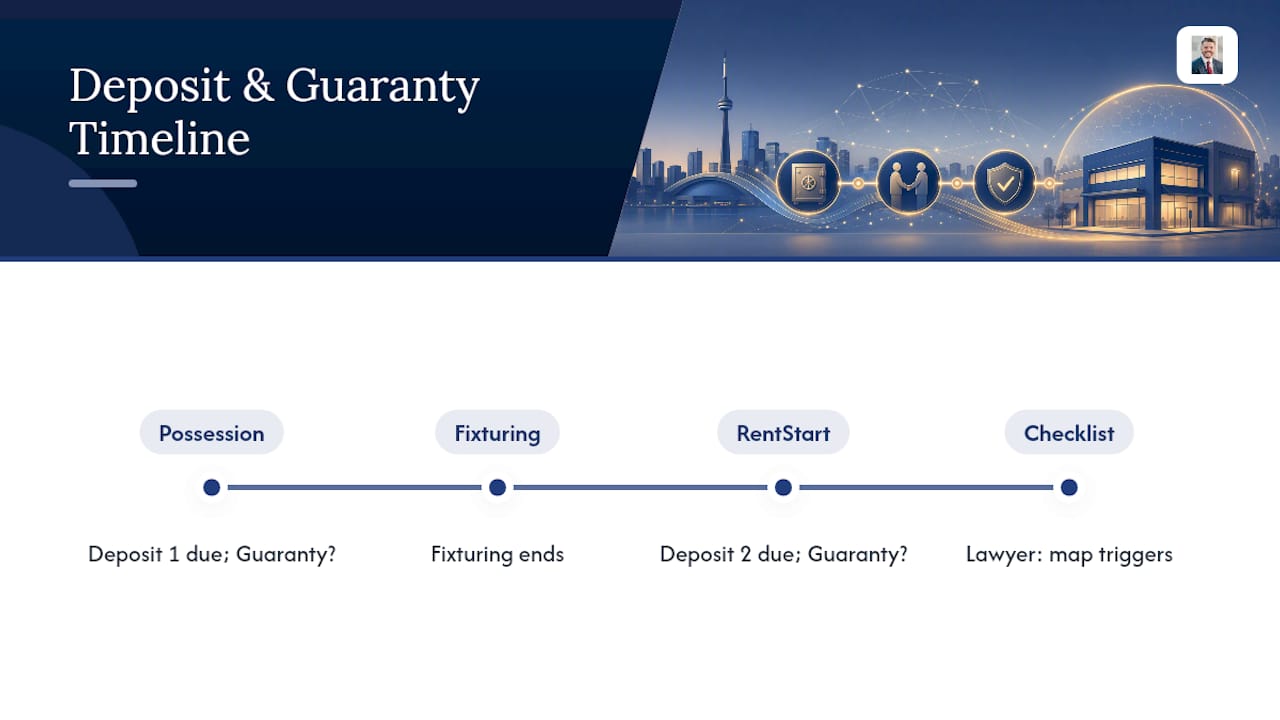
Security deposits and personal or corporate guaranties are often structured around lease milestones, and fixturing is frequently one of those trigger points. Some landlords require the first deposit instalment on possession, with a second due at rent commencement, meaning your fixturing period is also when a chunk of your deposit obligation lands.
If your lease includes a personal guaranty, confirm exactly when it becomes enforceable. In some drafting, the guarantor’s obligation starts the moment you take possession for fixturing, not when rent begins, which is a meaningfully earlier and riskier trigger point than most tenants expect. Negotiate this explicitly if a principal is signing personally.
Ask your lawyer to map every deposit and guaranty trigger against the fixturing and rent commencement dates in your specific lease, side by side, before you sign. A one-page timeline showing possession date, fixturing end date, rent commencement, and each deposit instalment due date takes an hour to build and prevents the kind of surprise invoice that shows up mid-build-out when cash flow is already tight.
Why the standard fixturing advice misses the point
Most of what gets written about fixturing periods treats it as an abstract legal concept: licence versus tenancy, waiver versus abatement, the kind of distinction that matters in a courtroom but does nothing for a tenant sitting across the table from a landlord’s leasing agent next week. The research backs a different priority. Timing beats terminology. A tenant who raises fixturing at the Offer-to-Lease stage with a specific number of days, backed by a contractor’s quote, gets a better outcome than one who understands the legal theory perfectly but raises it after the lease is drafted.
The other thing conventional advice underplays is tolling. Everyone focuses on getting more fixturing days upfront, and far fewer tenants insist on day-for-day extensions when the landlord causes delays, which is often where the real value leaks out. A 60 day fixturing period with solid tolling language protects you better than a 90 day period with none.
Prioritize the clause language over the headline number. Get the delivery certificate, the substantial completion definition, and the tolling terms right, and the day count matters far less than most tenants assume.
— Michael Law
How Michael Law | Lennard Commercial supports your fixturing negotiation
Getting fixturing terms right on your own means chasing landlord’s counsel, your own lawyer, and a contractor’s timeline all at once, usually while running your business. Broker representation can handle coordination: negotiating the fixturing days and free-rent months as separate line items in your Offer to Lease, drafting work letter language that protects your build-out runway, and managing the back and forth on TI approvals and permitting so you are not the one chasing three parties for updates.

An initial consultation starts with a review of your space requirements, target GTA submarkets, and rough build-out timeline, then moves into active site selection and negotiation once you have a shortlist. Broker representation on a lease this complex reduces the risk of losing fixturing days to a vague clause or an unexpected cost that surfaces after you have already signed. If you are planning a move or renewal anywhere across Toronto, Mississauga, Brampton, Vaughan, or the wider GTA, reach out through Michael Law’s industrial tenant representation page or check locations served to start the conversation.
Key resources and primary reading
For deeper reading, see Practical Law’s sample fixturing clause, FedDev Ontario’s lease primer, and TDS Law’s Offer to Lease guidance.
Sources
- Negotiate free rent while you improve your newly leased premises! The importance of negotiating an adequate fixturing period.
- Commercial Leases: Fixturing Period (Practical Law)
- What is a fixturing period in a commercial lease? (LegalClarity)
- Understanding your business lease - FedDev Ontario
FAQ
What does fixturing period mean in a commercial lease?
It is a pre-rent block of time granted so a tenant can build out fixtures and prepare a space to open, typically without paying base rent though other costs like insurance and utilities often still apply.
Can a tenant get out of a fixed-term lease early?
Generally only through specific lease provisions (a break clause, assignment, or sublease right) or a negotiated surrender with the landlord; there is no automatic early exit right under a standard commercial lease.
Can a landlord choose not to renew a lease in Ontario?
Yes. Commercial leases in Ontario are not automatically renewed unless the lease itself grants a renewal or extension option, so tenants who want that right need to negotiate it into the lease at signing.
What’s the best way to protect against losing fixturing days to delay?
Negotiate day-for-day tolling for landlord, permit, or force majeure delays, and tie rent commencement to the later of a fixed outside date or substantial completion, ideally with help from a broker like Michael Law | Lennard Commercial who negotiates these terms regularly in the GTA market.
Recommended

About Michael Law
Managing Partner and Industrial Real Estate Broker at Lennard Commercial Realty. Representing tenants and landlords across Toronto and the GTA for 15+ years. Michael specializes in GTA industrial real estate — connect with Toronto's leading industrial broker at mlawrealestate.com/industrial-broker-toronto.