GTA warehouse site selection tips for tenants in 2026
By Michael Law · Industrial Real Estate Broker, Lennard Commercial Realty
Choose the site that minimises your total delivery time and labour risk, not the one with the lowest rent. In a market where GTA industrial vacancy sits at 2.7% and asking rents average C$16.9/sf, the wrong location costs far more in drayage, overtime, and turnover than any rent saving recovers.
Before you tour a single building, lock down these four non-negotiables:
- Highway access and ramp drive time to your top delivery postal codes
- Labour pool depth within a 30-minute commute of the site
- Zoning and 24/7 operation permissions confirmed at the municipal level
- Electrical and utility capacity sufficient for your automation or cold-storage load
Pro Tip: Run a drive-time heatmap for your top 10 delivery postal codes before booking any tours. The centre-of-gravity approach consistently eliminates half the shortlist before you spend a dollar on due diligence.
Key takeaways
Choosing the right GTA warehouse site requires mapping freight flows and confirming operational permissions before comparing rents, with total cost to serve as the decisive metric.
| Point | Details |
|---|---|
| Map freight flows first | Use a centre-of-gravity model to shortlist submarkets before evaluating asking rents. |
| Confirm utilities before LOI | Electrical upgrade timelines of 12–24 months can delay occupancy if discovered late. |
| Verify 24/7 permissions | Municipal bylaws on truck routing and curfews vary across Brampton, Mississauga, and Vaughan. |
| Model sublease exposure | Mid-2026 GTA vacancy is 2.7%; approximately 6.3 MSF of sublease stock carries re-leasing risk. |
| Engage Michael Law | Lennard Commercial early |
Table of Contents
- What building specs should you verify before signing?
- Does truck access and municipal routing affect your daily operations?
- How do community impacts create operational risk?
- What environmental checks protect you from hidden costs?
- How do you assess crime risk at a warehouse location?
- Does proximity to customers and suppliers actually lower your costs?
- What technology infrastructure do you need to confirm on-site?
- What tenants consistently get wrong about GTA site selection
- Working with Michael Law | Lennard Commercial on your next site
- Sources
- FAQ
What building specs should you verify before signing?
Clear height is the number most tenants fixate on, and rightly so: modern GTA distribution requires 36–40 ft clear minimum for racked storage. Column spacing of 50 ft or wider keeps aisle layouts flexible. Floor load ratings matter most for manufacturing and heavy racking; 6,000 lb/sf is a common threshold for mid-weight operations.

Dock configuration drives throughput. Count the ratio of dock doors to floor area, confirm dock leveller capacity, and check whether the building has grade-level doors for van or LTL access. Yard depth of 130 ft or more lets 53-ft trailers manoeuvre without blocking traffic. ESFR sprinkler systems are now standard in Class A product and required by most insurers for high-pile storage. If you need refrigeration or controlled atmosphere, confirm HVAC tonnage and insulation specs early — retrofitting is expensive and slow. A practical industrial amenities checklist covers these items in detail.
Does truck access and municipal routing affect your daily operations?
Yes, and it catches tenants off guard more than almost any other factor. Road geometry around the site — turning radii, overhead clearances, weight-restricted roads — determines whether a 53-ft B-train can actually reach your dock without a detour. Confirm trailer parking count on-site; many older GTA buildings have fewer than 10 stalls, which forces drivers to queue on public roads.
Research on Toronto-area logistics firms shows that 24/7 operation permissions and cut-off time reliability are stronger retention factors than rent. Check municipal truck routing bylaws, curfew hours, and noise bylaws before the Letter of Intent. Brampton, Mississauga, and Vaughan each have distinct rules; what is permitted in one submarket may require a variance in another.
How do community impacts create operational risk?
Residential encroachment is the fastest-growing constraint in the GTA’s older industrial nodes. Sites abutting residential zones face noise complaints, idling restrictions, and lighting bylaws that can effectively prohibit night shifts. Canadian logistics location research identifies lack of expansion land and community friction as primary push factors that drive firms to relocate.
Mitigation steps include acoustic fencing, LED lighting with cut-off shields, and a community liaison protocol before operations begin. Emissions from diesel fleets are increasingly scrutinised; some municipalities now require air quality studies for new industrial approvals near residential areas.
What environmental checks protect you from hidden costs?
A Phase I Environmental Site Assessment is standard practice before any lease or purchase. If the Phase I flags prior industrial use, fuel storage, or dry-cleaning operations, a Phase II soil and groundwater assessment follows. Contamination liability can transfer to a tenant under certain lease structures, so legal review of the environmental indemnity clause is non-negotiable.
Brownfield sites in Hamilton, Oshawa, and parts of east Toronto can offer lower rents, but budget 6–18 months for remediation if contamination is confirmed. Flood plain mapping and stormwater management capacity are also worth checking, particularly for sites near the Credit River or Humber River corridors.
How do you assess crime risk at a warehouse location?
Cargo theft is a real cost in the GTA, concentrated along the Highway 400 and 427 corridors and near Pearson Airport. Before committing to a site, review local police division crime statistics and speak with neighbouring tenants about their experience. Physical security features to evaluate include perimeter fencing height and condition, lighting coverage, camera infrastructure, and whether the building has a monitored alarm system already wired in.
Trailer drop yards with poor lighting and no perimeter control are high-risk. If the landlord cannot demonstrate recent security upgrades, factor remediation costs into your occupancy cost model.
Does proximity to customers and suppliers actually lower your costs?
Consistently, yes. Modelling evidence shows that facility location materially affects total cost to serve, and that optimising for network centrality rather than lowest rent produces better operational outcomes. For last-mile operators, a site 20 minutes closer to downtown Toronto can recover its rent premium through reduced driver hours within a single year.
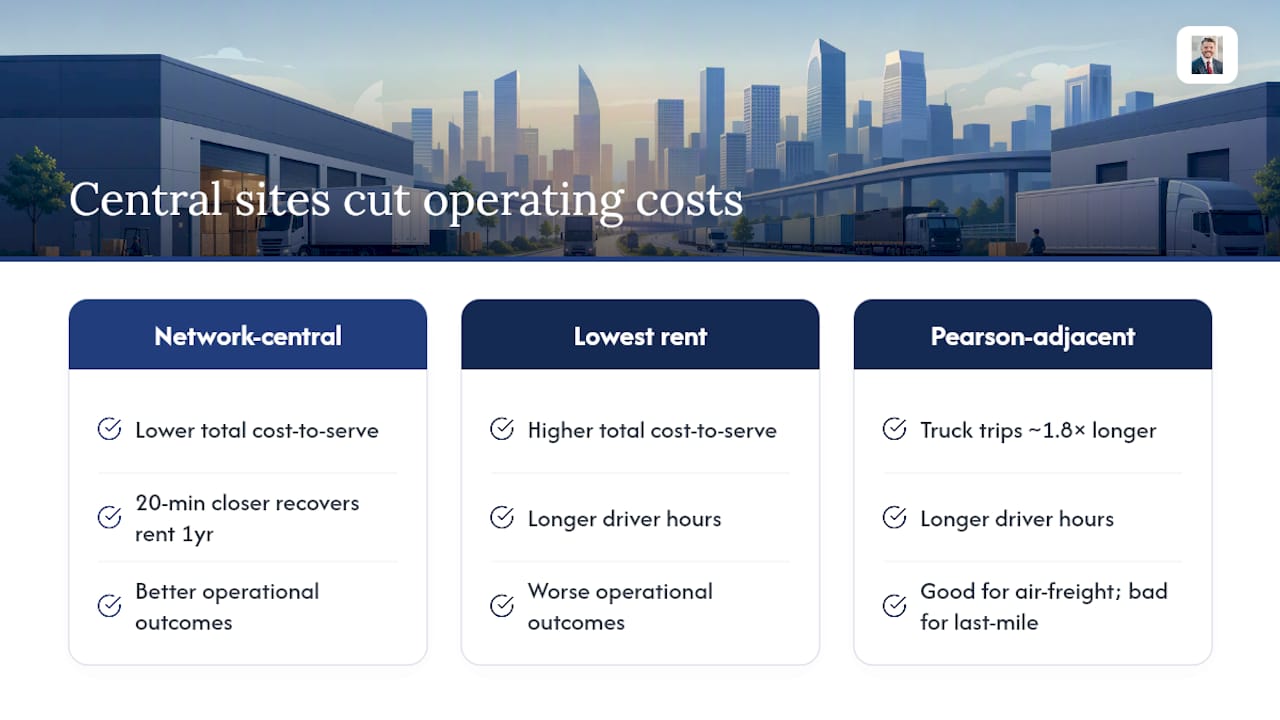
Airport proximity is more nuanced. A University of Toronto study found that warehouses near Pearson generate truck trips roughly 1.8 times longer than the regional average, because inbound freight volumes push outbound routes further out. Pearson adjacency suits air-freight-dependent importers; it is less advantageous for last-mile distribution.
What technology infrastructure do you need to confirm on-site?
Fibre availability and redundancy are now baseline requirements for any warehouse running a WMS, automated conveyor, or real-time inventory system. Confirm the internet service provider options at the civic address — not just the building, because fibre availability varies by unit in multi-tenant complexes. Ask for the existing conduit infrastructure and whether the landlord has a telecom room with sufficient rack space.
Power capacity is the bigger constraint. Automation, EV charging for forklifts, and cold storage all draw significant amperage. Utility capacity checks should happen before the LOI, not after — Hydro One and Toronto Hydro upgrade timelines can run 12–24 months, which will delay your occupancy if discovered late.
What tenants consistently get wrong about GTA site selection
The most common mistake is leading with rent. Tenants shortlist by asking rate, tour buildings in the cheapest submarket, and only then discover the site fails on labour access, truck routing, or power capacity. By that point, months have been lost and the better sites have been leased.
The corrective sequence is straightforward:
- Map freight flows first. Identify your centre of gravity before comparing any rents.
- Confirm electrical specs before the LOI. An upgrade requirement discovered post-LOI gives the landlord leverage.
- Check 24/7 permissions at the municipal level. Zoning approval does not automatically mean night operations are permitted.
- Model sublease risk. Mid-2026 GTA data shows approximately 6.3 MSF of sublease availability; older Class B/C stock carries higher sublease concentration and re-leasing risk.
- Engage a broker before shortlisting, not after. Market comps, landlord history, and submarket dynamics are not visible from a listing portal.
- Run a total-cost-to-serve model. Rent plus occupancy costs plus drayage plus labour is the real number. Rent alone is noise.
Working with Michael Law | Lennard Commercial on your next site
Tenant representation covers the full process: submarket shortlisting, building tours, market comps, LOI drafting, lease negotiation, and due diligence coordination. With GTA vacancy at 2.7% and asking rents near C$16.9/sf, the difference between a well-negotiated lease and a reactive one is significant. Most site searches in the current market take 6–12 months from first brief to occupancy; engaging representation at month one rather than month four preserves your options.
Request a site evaluation and market briefing from Michael Law | Lennard Commercial to get submarket vacancy data, a shortlist of available properties, and a negotiation strategy built around your operation, not the landlord’s asking price.
Sources
The sources below support the checklist and market figures in this article.
- How to Choose the Right Warehouse Location in the GTA | WarehouseIndex
- The role of airport proximity on warehouse location and associated truck trips: Evidence from Toronto, Ontario
- Logistics industry perspectives on facility location (CTRFPaper)
- Optimal warehouse location and size in practice (International Journal of Operational Research, 2023)
For market signals, start with the Newmark quarterly report. For transportation modelling, the CTRF and ScienceDirect papers provide the empirical grounding. For step-by-step due diligence, the site selection process overview and GTA vacancy analysis on the Michael Law | Lennard Commercial blog are practical starting points.
FAQ
What is the most important GTA warehouse site selection criterion?
Freight flow mapping and labour pool access consistently outweigh rent in total-cost-to-serve models. Confirm highway ramp drive times and 24/7 zoning permissions before comparing asking rates.
How tight is the GTA industrial market in 2026?
GTA industrial vacancy reached 2.7% at mid-year 2026, with asking rents averaging C$16.9/sf and approximately 6.3 MSF of sublease space still available in older stock.
Does Pearson Airport proximity help or hurt distribution operations?
It depends on your freight model. Research found airport-proximate warehouses generate truck trips roughly 1.8 times longer than the regional average, making Pearson adjacency more suitable for air-freight importers than last-mile operators.
When should a GTA tenant engage a broker for site selection?
At the start of the search, not after shortlisting. Engaging tenant representation before touring buildings preserves negotiating leverage and surfaces off-market options that listing portals do not show.
How long does a GTA warehouse site search typically take?
Most searches run 6–12 months from initial brief to occupancy, depending on size requirements and submarket availability. Starting early is the single most effective way to avoid signing under pressure.
Recommended

About Michael Law
Managing Partner and Industrial Real Estate Broker at Lennard Commercial Realty. Representing tenants and landlords across Toronto and the GTA for 15+ years. Michael specializes in GTA industrial real estate — connect with Toronto's leading industrial broker at mlawrealestate.com/industrial-broker-toronto.
Related Articles



More Toronto Industrial Real Estate Insights
Articles & Analysis
Dual Agency in Toronto Industrial Deals: Michael Law’s Case Examples
How dual agency works in Toronto industrial deals, when written disclosure and consent are required, and how brokers handle confidentiality and conflicts.
Read →Avoid 60–90 Day Delays: GTA Yard Storage Zoning for Occupiers
This GTA checklist explains outdoor yard storage zoning, stormwater approvals, 60–90 day timelines, and broker support to speed permitting.
Read →Industrial Brokerage for Better Property Deals
Read →GTA Early Access Clauses: 30 Days to 4–6 Months and Sample Wording
Practical GTA guide to drafting early access clauses for industrial leases. Covers 30 days to 4–6 months fixturing, sample clause language, permit...
Read →Get a Five Year Exclusive Use That Holds Up in GTA Industrial Leases
GTA practical guidance for landlords and tenants on drafting defensible industrial exclusive use clauses. Includes five year examples, negotiation tips...
Read →Common Questions
What is a sale-leaseback in industrial real estate?
A sale-leaseback is a transaction in which an industrial property owner sells their building to an investor and simultaneously signs a long-term lease to remain in the property as a tenant. The seller unlocks the capital tied up in their real estate while retaining full operational use of the facility. The buyer acquires a tenanted investment property with immediate cash flow from a known occupant.
Read →What is a dock-to-grade ratio in industrial real estate?
Dock-to-grade ratio in industrial real estate refers to the number of dock-level loading doors relative to the building's floor area, typically expressed as one dock door per X,000 square feet. It is a key specification for distribution and warehousing tenants because it determines how many trucks can load and unload simultaneously and therefore the building's throughput capacity.
Read →What is clear height in a warehouse or distribution centre?
Clear height in a warehouse or distribution centre refers to the usable vertical space from the finished floor to the lowest overhead obstruction — typically the bottom of the roof structure, sprinkler heads, or HVAC equipment. It is the single most important building specification for warehouse tenants because it determines how many racking levels can be installed and therefore how much product can be stored per square foot of floor space.
Read →