How to reduce vacancy in industrial properties: 2026 guide
By Michael Law · Industrial Real Estate Broker, Lennard Commercial Realty
TL;DR:
- Reducing vacancy in industrial properties depends on proactive management, property readiness, and flexible leasing strategies. Understanding regional market differences and tenant needs allows owners to position their buildings effectively and attract non-traditional tenants. Proper maintenance, presentation, and tenant engagement are crucial to minimizing vacancy durations and ensuring long-term occupancy.
Reducing vacancy in industrial properties is achievable through targeted improvements to property readiness, leasing flexibility, and tenant retention. Canada’s national industrial availability rate stabilised at 5.5% in Q1 2026, with positive net leasing of 4.2 million sq. ft. That momentum signals real demand. Yet sublease availability sits at a record 15.3 million sq. ft. nationally, meaning owners who do not act strategically will lose tenants to better-positioned spaces. This guide covers how to reduce vacancy in industrial properties across the GTA and major Canadian markets, drawing on current leasing data and the experience of Michael Law | Lennard Commercial.
What market factors affect vacancy rates in Canadian industrial properties today?
Canada’s industrial market is not uniform. National figures mask sharp regional differences that directly affect how owners should position their properties.
Toronto and Montreal account for the largest share of sublease availability nationally. That concentration matters because sublease space competes directly with vacant landlord space, often at discounted rates. Owners in these markets face a two-front challenge: attracting new tenants while competing against existing occupiers offloading excess space.
New supply is also reshaping the picture. Rising construction costs have slowed development pipelines in some submarkets, which should tighten availability over time. In the short term, however, buildings that came to market in 2023 and 2024 are still absorbing. Owners of older stock must work harder to justify their asking rates.
The most significant structural shift is the change in tenant profiles. Traditional manufacturing and distribution tenants are not the only game in town. Non-traditional tenants such as data centres, film studios, and recreational operators are actively seeking industrial-zoned space. This shift is not a niche trend. It represents a genuine diversification of demand that owners can use to fill spaces that traditional tenants have vacated.
Key market factors to monitor in 2026:
- Sublease competition: Record sublease volumes in Toronto and Montreal compress net effective rents and extend lease-up timelines.
- Tenant profile diversification: Data centres, recreational operators, and life sciences users are entering industrial submarkets across the GTA.
- New supply absorption: Properties delivered in 2023 and 2024 are still working through lease-up, creating near-term competition for older buildings.
- Regional divergence: Markets like Barrie, Milton, and Brampton each have distinct vacancy drivers that require tailored positioning strategies.
- Power and infrastructure demand: Data centre and advanced manufacturing tenants require higher electrical capacity, which older buildings may not provide without capital investment.
Understanding these dynamics is the foundation of any plan to reduce industrial property vacancies. Owners who treat their building as a generic commodity will struggle. Those who understand their submarket and tenant pool will fill space faster.
How can landlords prepare and position industrial spaces to attract tenants?
Property readiness is the single most controllable factor in reducing vacancy. A well-prepared building shortens lease-up time and commands stronger rents.

Industrial tenants treat their leased space as a critical supply chain component. Dock access, power reliability, and clear turning radii are not preferences. They are deal requirements. A building that cannot support a tenant’s logistics operations will not get a second look, regardless of price.
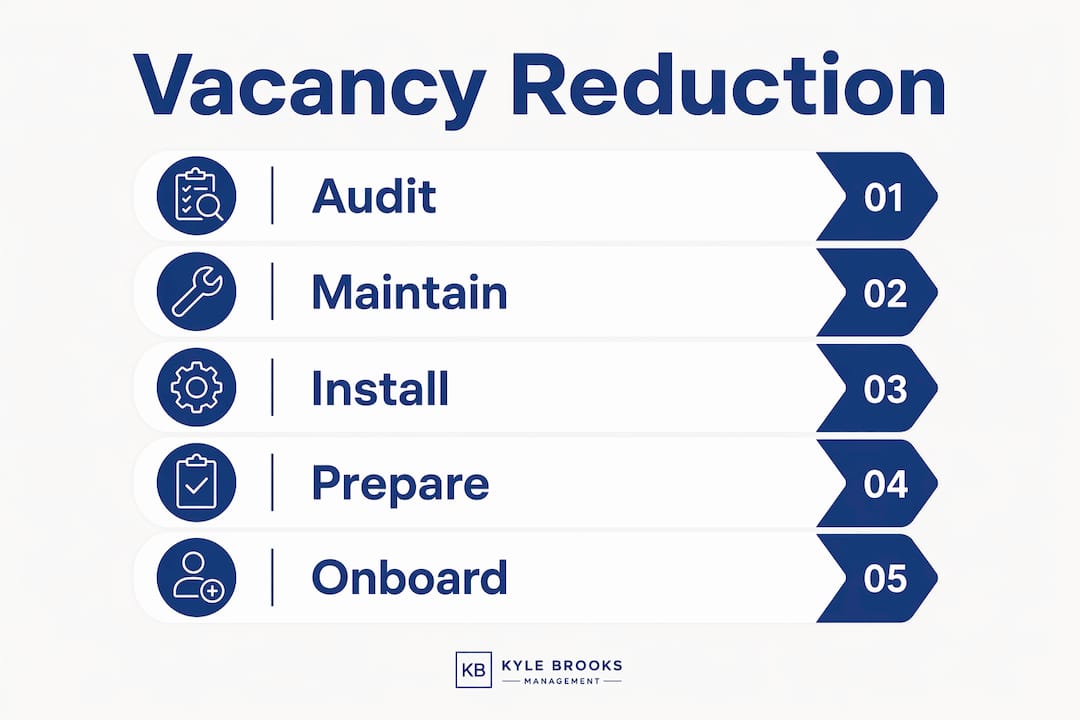
1. Audit logistics infrastructure first
Start with the physical features that logistics operators care about most: dock height, dock levellers, truck court depth, and column spacing. These are difficult and expensive to change. If your building falls short on any of these, price accordingly or target tenants whose operations do not require them.
2. Maintain HVAC, lighting, and electrical systems
Modernising property amenities including HVAC efficiency and well-lit spaces increases lease renewal rates by up to 30%. That figure reflects a direct financial return on maintenance investment. Tenants who are comfortable and operationally efficient do not leave.
3. Install flexible, modular racking infrastructure
Flexible racking systems that are code-compliant and modular reduce the capital burden on incoming tenants. They also increase what practitioners call “exit velocity,” the speed at which a vacated space can be re-leased to a new occupier. A building with certified, adaptable racking infrastructure is ready to show and ready to lease on short notice.
4. Prepare presentation materials before vacancy occurs
Floor plans, ceiling heights, power specifications, and loading details should be documented and ready before a tenant gives notice. Owners who can respond to a broker inquiry within 24 hours with a complete information package move faster through the leasing process. Curb appeal matters too. A clean, well-maintained exterior signals to prospective tenants that the landlord takes operations seriously.
5. Design for fast tenant onboarding
The goal is to minimise the time between lease execution and tenant move-in. Buildings with upgrades that support efficiency such as pre-wired data conduits, LED lighting, and accessible utility connections reduce tenant fit-out time and accelerate occupancy.
Pro Tip: Design your vacant space as if the next tenant is already signed. Have your floor plan, power spec sheet, and dock configuration documented before you list the space. Brokers move fast, and a landlord who cannot answer basic technical questions in the first call loses deals.
What leasing and tenant management strategies effectively reduce industrial vacancies?
Property condition gets tenants through the door. Leasing strategy and tenant management keep them there.
Experienced industrial brokers with proven track records in specific submarkets improve fill rates and accelerate market visibility. A broker who knows the Brampton or Markham market understands which tenants are actively looking, what lease structures they prefer, and which buildings they have already rejected. That intelligence shortens the leasing cycle.
Flexible lease terms are equally important. Rigid structures that do not accommodate rent escalation schedules, renewal options, or early termination provisions deter prospective tenants who need operational flexibility. The GTA market in 2026 rewards owners who can negotiate creatively without giving away net effective rent.
Strategies that directly improve occupancy rates:
- Work with specialist brokers: Partner with brokers who have a documented history in your specific submarket, not generalists. Broker involvement accelerates market visibility and tenant acquisition.
- Offer structured renewal incentives: Tenants who receive a renewal proposal six months before expiry are far more likely to stay than those who receive one at the 90-day mark.
- Implement digital operations platforms: Tenants expect digital rent payment and maintenance request systems. These tools reduce friction and signal that the landlord is organised and responsive.
- Maintain open communication channels: Engaged tenants stay longer and reduce vacancy cycles. A quarterly check-in call costs nothing and surfaces issues before they become reasons to leave.
- Understand your tenant’s business: A logistics operator facing supply chain pressure has different needs than a light manufacturer. Owners who understand those pressures can offer solutions, not just square footage.
Pro Tip: Send a formal lease renewal proposal at least six months before expiry. Include a market rent comparison so the tenant can see you have done your homework. Tenants who feel respected and informed renew at higher rates than those who feel like they are being managed.
Tenant turnover is expensive. It disrupts cash flow, triggers capital expenditure, and resets the leasing clock. The most cost-effective vacancy reduction strategy is keeping the tenants you already have.
How do specialised property management practices support lower vacancy?
Expert property management is not a cost centre. It is a direct driver of occupancy stability and asset value.
Industrial properties require management expertise that differs fundamentally from office or retail. The infrastructure is heavier, the operational stakes are higher, and the tenants are less tolerant of downtime. A landlord who manages an industrial building like an office complex will lose tenants.
-
Prioritise preventive maintenance. Preventive maintenance tailored to industrial properties prevents costly downtime and equipment failure. Timely upkeep of HVAC systems, electrical panels, and dock equipment reduces emergencies and builds tenant trust. A tenant whose operations are disrupted by a preventable failure will not renew.
-
Balance capital expenditure with operational upkeep. Owners who defer maintenance to protect short-term cash flow create long-term vacancy risk. A building that looks tired and operates poorly cannot compete with newer stock, even at a discount. Allocate a maintenance reserve and spend it systematically.
-
Master lease administration. Triple net (NNN) leases are standard in Canadian industrial real estate. CAM reconciliations, operating cost estimates, and year-end adjustments must be handled accurately and transparently. Tenants who receive surprise charges at year-end lose trust quickly. Accurate, well-communicated lease administration is a retention tool.
-
Use data to anticipate tenant needs. Track maintenance request patterns, utility consumption, and lease milestone dates. These data points reveal which tenants are under operational stress and which are approaching a renewal decision. Proactive outreach based on data is far more effective than reactive responses to problems.
-
Build relationships rooted in operational understanding. Industrial tenants view their space as a supply chain asset. Owners who understand that perspective, and who communicate in terms of operational uptime rather than building features, build the kind of relationships that produce long lease terms and low turnover. Reviewing examples of GTA industrial tenants helps owners understand the operational priorities of the businesses they are trying to attract and retain.
What common mistakes cause prolonged vacancies in industrial properties?
Most extended vacancies are self-inflicted. The mistakes are predictable, and they are avoidable.
“The biggest vacancy risk in industrial real estate is not a bad market. It is a landlord who stops paying attention. Buildings that fall behind on maintenance, ignore tenant feedback, and price against wishful thinking rather than market data sit empty while comparable properties lease up.”
The most common mistakes that extend vacancy periods:
- Deferring infrastructure maintenance. A building with a failing HVAC system, outdated electrical service, or deteriorating dock equipment signals neglect. Prospective tenants walk away. Existing tenants plan their exit.
- Ignoring emerging tenant types. Owners who only market to traditional distribution and manufacturing users miss the growing pool of non-traditional industrial tenants such as data centres and recreational operators who are actively seeking space.
- Applying rigid lease structures. A lease template that cannot accommodate a tenant’s preferred term length, renewal option, or rent escalation schedule is a deal-killer. Flexibility does not mean giving away value. It means structuring deals that work for both parties.
- Slow maintenance response. Tenants who submit a maintenance request and wait two weeks for a response do not renew. Response time is a direct measure of landlord quality in the eyes of an industrial occupier.
- Neglecting logistics-focused features. Dock access, truck court depth, and power capacity are not amenities. They are functional requirements. Owners who fail to maintain or communicate these features lose tenants to buildings that do.
The pattern across all these mistakes is the same: passive management produces vacancy. Active, informed management produces occupancy. Owners who treat their industrial building as a passive investment rather than an operating asset will consistently underperform the market. Reviewing GTA industrial vacancy data confirms that the best-performing properties share a common trait: they are actively managed by owners who understand their tenants’ businesses.
Key takeaways
Reducing vacancy in industrial properties requires active management, logistics-ready infrastructure, flexible leasing, and genuine understanding of how tenants use their space as a supply chain asset.
| Point | Details |
|---|---|
| Market awareness is non-negotiable | Monitor sublease competition, tenant profile shifts, and submarket-specific vacancy drivers in your area. |
| Property readiness drives lease-up speed | Dock access, power reliability, and modular racking reduce tenant onboarding time and increase exit velocity. |
| Flexible leasing fills space faster | Renewal incentives, structured escalations, and digital operations tools reduce turnover and attract quality tenants. |
| Preventive maintenance protects occupancy | Timely upkeep of HVAC, electrical, and dock systems builds tenant trust and prevents lease-ending disruptions. |
| Passive management creates vacancy | Owners who treat industrial buildings as passive assets consistently underperform those who manage proactively. |
What I have learned about keeping industrial properties full
The owners I work with who maintain the lowest vacancy rates share one trait: they think like their tenants. They understand that a warehouse or distribution facility is not just a building. It is the physical infrastructure of someone’s business. When that building fails, the business fails. That perspective changes how you manage.
I have seen landlords spend significant capital on cosmetic upgrades while ignoring dock levellers that have not been serviced in three years. The tenant does not care about new paint. They care about whether their trucks can load and unload without delays. Getting that priority right is the difference between a tenant who renews and one who starts calling brokers.
The non-traditional tenant opportunity is real, but it requires a different kind of preparation. A data centre operator needs power infrastructure that most older industrial buildings cannot provide without investment. A recreational operator needs clear heights and open floor plates. Owners who want to access these tenant pools need to assess their buildings honestly and invest where it counts.
The GTA market in 2026 rewards owners who are prepared, responsive, and genuinely engaged with their tenants’ operational realities. The sublease overhang is real, and competition is stiff. But buildings that are well-maintained, well-positioned, and well-managed by owners who understand the GTA industrial market continue to lease up. The vacancy problem is almost always a management problem in disguise.
— Michael Law
Working with Michael Law | Lennard Commercial to reduce vacancy
Michael Law | Lennard Commercial works directly with industrial property owners and managers across the GTA to reduce vacancy periods and attract quality tenants.

With over a decade of experience in Ontario’s industrial market, Michael Law brings submarket-specific knowledge across Mississauga, Brampton, Vaughan, Markham, and beyond. Services cover industrial tenant representation, property marketing, lease negotiation, and occupancy strategy. Whether you are managing a single-tenant building or a multi-unit portfolio, the team at Michael Law | Lennard Commercial builds leasing strategies grounded in current market data and real tenant demand. Contact Michael Law | Lennard Commercial to discuss your property’s occupancy goals.
FAQ
What is the current industrial vacancy rate in Canada?
Canada’s national industrial availability rate stabilised at 5.5% in Q1 2026, with positive net leasing of 4.2 million sq. ft. Sublease availability remains at a record 15.3 million sq. ft., concentrated in Toronto and Montreal.
How do I attract non-traditional tenants to industrial space?
Assess your building’s power capacity, clear heights, and floor plate configuration, then market directly to data centre operators, recreational users, and life sciences tenants who are actively seeking industrial-zoned space in the GTA.
What property features matter most to industrial tenants?
Logistics efficiency features including dock access, high-uptime electrical systems, and adequate truck court depth are the primary decision criteria. Tenants treat these as operational requirements, not preferences.
How does preventive maintenance reduce vacancy?
Preventive maintenance of HVAC, electrical, and dock systems prevents operational disruptions that trigger tenant departures. Tenants whose businesses run without interruption are significantly more likely to renew their leases.
How can a broker help reduce industrial property vacancies?
Experienced industrial brokers with submarket expertise accelerate market visibility, identify active tenant prospects, and structure lease terms that attract quality occupiers faster than owner-direct marketing alone.
Recommended

About Michael Law
Managing Partner and Industrial Real Estate Broker at Lennard Commercial Realty. Representing tenants and landlords across Toronto and the GTA for 15+ years. Michael specializes in GTA industrial real estate — connect with Toronto's leading industrial broker at mlawrealestate.com/industrial-broker-toronto.