
Industrial build-to-suit process: a GTA executive's guide
By Michael Law · Industrial Real Estate Broker, Lennard Commercial Realty
TL;DR:
- Build-to-suit development involves custom construction for tenants with long-term lease agreements, especially in the GTA where available land is scarce.
- Tenants must have strong credit, clear operational plans, and meet site and zoning requirements before engaging developers.
The industrial build-to-suit process is defined as a custom facility development model where a developer acquires land, finances construction, and builds an industrial property to a tenant’s exact specifications in exchange for a long-term lease commitment. Unlike leasing an existing building, this approach gives corporate executives direct control over ceiling heights, dock configurations, power supply, and site layout before a single foundation is poured. Build-to-suit development typically runs 9–24 months from site contract to occupancy, depending on project complexity. In the Greater Toronto Area, where available industrial inventory remains tight across corridors from Mississauga to Markham, custom industrial construction is increasingly the only path to securing a facility that truly fits operational requirements.
What are the prerequisites for an industrial build-to-suit project?
Starting a build-to-suit project without the right groundwork wastes months and damages credibility with developers. Three conditions must be in place before any site search begins.
Business stability and long-term operational clarity
Developers commit millions of dollars to a single tenant. They require proof that your business will occupy and pay rent for the full lease term. A clear 10-year operational plan, audited financials, and a defined headcount and throughput forecast are the minimum documents you need before approaching any developer.
Credit profile and financial strength
Strong credit is non-negotiable in build-to-suit projects because developers and their lenders carry the full financing risk during construction. A tenant with a weak balance sheet will not get past the initial feasibility stage. Prepare two to three years of audited financial statements, bank references, and a corporate credit summary before your first developer meeting.
Site and zoning requirements
Your operational needs translate directly into site requirements. Clear height, truck court depth, trailer parking count, and power load all determine the minimum lot size and zoning class you need. In the GTA, Employment Area and Prestige Employment designations govern most industrial land. Municipalities including Brampton, Vaughan, and Milton each apply different setback and coverage rules, so confirming local entitlement conditions early prevents costly redesigns later.
Pro Tip: Engage a tenant representative before you contact a single developer. An advisor who works exclusively for tenants will identify site constraints, flag unfavourable lease structures, and prevent you from inadvertently negotiating against your own interests.
The table below summarises the key prerequisites and typical documentation required at each stage.
| Prerequisite | Typical documentation required |
|---|---|
| Business stability | 10-year operational plan, headcount forecast, throughput projections |
| Credit profile | 2–3 years audited financials, bank references, corporate credit summary |
| Site requirements | Facility programme, clear height spec, power load, truck court dimensions |
| Zoning confirmation | Municipal zoning certificate, Employment Area designation confirmation |
| Advisor engagement | Signed tenant representation agreement, conflict-of-interest disclosure |
How does the industrial build-to-suit process progress step by step?
The build-to-suit development cycle follows a defined sequence. Skipping or compressing any phase creates downstream risk. Here are the six core stages.
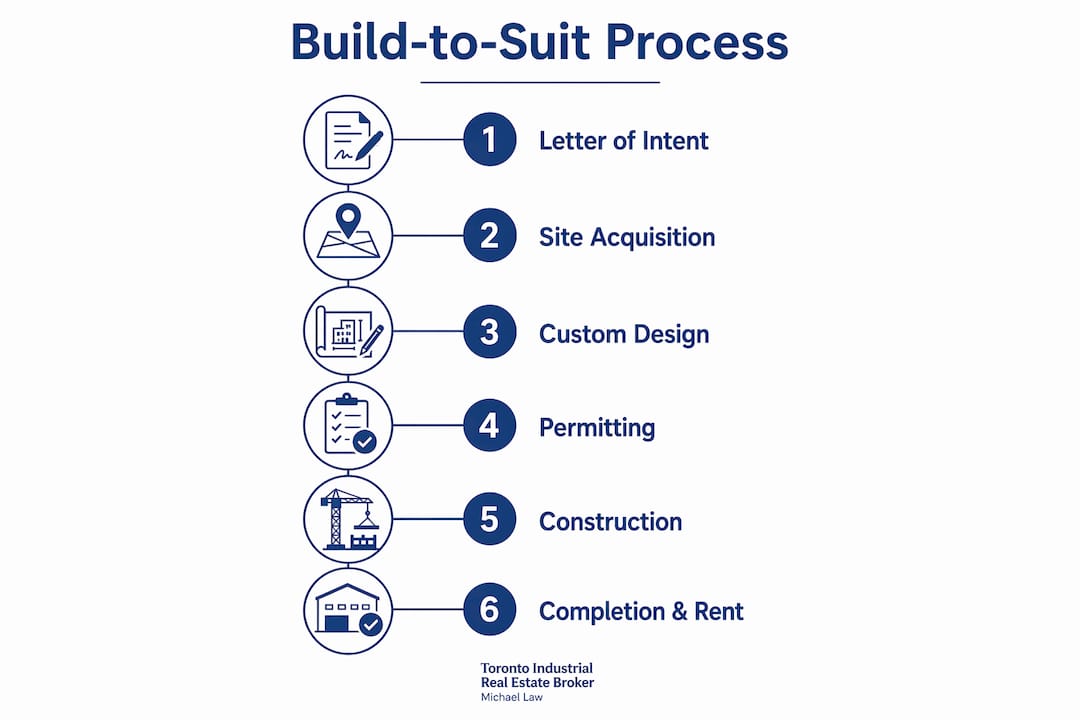
1. Letter of Intent
The process opens with a non-binding Letter of Intent that captures the key commercial terms: square footage, target location, rent range, lease duration, and the broad structure of tenant improvement allowances. The LOI is not a lease, but it is the document that determines whether a developer will commit resources to feasibility work. Treat every word in the LOI seriously. Vague language here becomes a dispute later.
2. Site acquisition and lease execution
Once the LOI is agreed, the developer moves to acquire or control the land. The formal lease is signed concurrently with the land acquisition to confirm project feasibility for the developer’s lender. This parallel signing is the moment your long-term commitment becomes legally binding. Your advisor must review the lease in full before this step, not after.
3. Custom design and tenant input
The design phase is where build-to-suit earns its name. Your operations team works directly with the developer’s architect to specify dock door counts, column spacing, ESFR sprinkler systems, office square footage, and yard configuration. Changes made during design cost a fraction of what they cost during construction. Front-load every operational requirement into this phase.

4. Permitting and municipal approvals
Permitting timelines in the GTA vary significantly by municipality. Vaughan and Brampton have established industrial approval processes, but site plan approval can still add three to six months to a project schedule. The GTA build-to-suit timeline from site contract to occupancy typically runs two to three years when local entitlement complexity is factored in. Build this buffer into your occupancy planning from day one.
5. Construction and milestone management
Construction on a standard GTA warehouse runs 9–18 months. Complex builds with cold storage, heavy power, or mezzanine structures can extend to 24 months. Monthly site visits, written progress reports, and a dedicated project contact on the developer’s side are not optional extras. They are the minimum oversight standard for a project of this scale.
6. Substantial completion and rent commencement
Rent begins upon substantial completion or the issuance of a certificate of occupancy, not at an arbitrary calendar date. This distinction protects you from paying rent on a building you cannot legally occupy. Confirm this trigger in the lease before signing.
Pro Tip: Build a shared project schedule with your developer and update it monthly. When delays appear, you want written documentation of the cause and the revised timeline. This record protects your rent commencement date and supports any delay penalty claims.
What lease terms should tenants negotiate in build-to-suit agreements?
Build-to-suit leases are long and complex. Lease terms typically run 10–20 years, and in cases where significant tenant improvements are amortised into the rent, terms can extend to 25 or 30 years. That duration makes every clause consequential. The following points are non-negotiable in any well-structured build-to-suit agreement.
Tenant improvement allowances and amortisation
Tenant improvements can represent 10–30% of total development cost. Developers typically fold this cost into the lease rate rather than paying it as a lump sum. Transparency at the LOI stage is critical. You need to know exactly what is included in the base building specification and what falls under your TI budget, because the line between the two directly affects your rent. Review the GTA tenant improvement examples to understand what is standard and what is negotiable.
Hard rent commencement dates
Negotiate a hard rent commencement date tied to the certificate of occupancy, not to a construction milestone. A milestone-based trigger can force you to pay rent on a building that lacks occupancy approval. The certificate of occupancy is the only objective, legally verifiable trigger that confirms the building is ready for use.
Force majeure and delay penalties
Developers face real liability when construction deadlines are missed. Negotiate delay buffers and financial penalties for late delivery into the lease. Force majeure clauses are standard, but their scope varies widely. A well-drafted clause covers genuine acts of God while excluding developer-caused delays from protection.
Lien waiver requirements
Unconditional lien waivers from all subcontractors must be required before any contractor payment is released. Without them, a subcontractor dispute between the developer and a trades company can result in a mechanics’ lien registered against the property, which clouds title and can delay your occupancy.
Make-good clauses
Sophisticated tenants negotiate make-good clauses requiring the demolition of specialised infrastructure at lease end to return the building to a warm shell condition. This protects you from inheriting decommissioning costs if you vacate, and it protects the developer from being left with an unmarketable building. Agree on the scope of make-good obligations in writing before the lease is executed.
Key clauses to review in every build-to-suit lease:
- Rent commencement trigger (certificate of occupancy vs. construction milestone)
- TI allowance scope, amount, and amortisation rate
- Force majeure definition and exclusions
- Delay penalty structure and notice requirements
- Unconditional lien waiver requirements
- Make-good and restoration obligations
- Renewal options and rent escalation formula
- Assignment and subletting rights
Pro Tip: Use the GTA lease negotiation guide as a checklist before your lawyer reviews the final draft. Advisors who specialise in GTA industrial leasing will identify market-specific clauses that a general commercial lawyer may miss.
What are the main risks in build-to-suit projects and how do you manage them?
Build-to-suit projects carry risks that standard lease transactions do not. Identifying them early is the difference between a smooth occupancy and a costly dispute.
Credit sensitivity
The entire project approval depends on your credit profile. A single adverse credit event during the development period, such as a covenant breach or a change in ownership structure, can trigger a developer’s right to terminate. Maintain financial stability throughout the construction period and notify your developer immediately if material changes occur.
Specialised infrastructure and exit risk
A facility built for cold storage, heavy manufacturing, or pharmaceutical production is difficult to re-let to another tenant. If your business exits the lease early, you may face significant make-good costs and a developer who struggles to find a replacement tenant. Negotiate early termination rights with defined penalty structures rather than assuming you will never need them.
Construction delays and cost escalation
Labour shortages, supply chain disruptions, and municipal approval delays are the three most common causes of schedule overruns in GTA industrial construction. Cost escalation in materials affects projects where the construction contract is not fixed-price. Require a fixed-price or guaranteed maximum price contract from the developer and confirm that the contract covers your full specification.
“The tenants who fare best in build-to-suit projects are those who treat the construction phase with the same rigour as the lease negotiation phase. Monthly oversight, written records, and a clear escalation path for disputes are what separate a smooth delivery from a protracted legal battle.”
Mitigation strategies that work in practice:
- Require a fixed-price or guaranteed maximum price construction contract
- Negotiate a 60-day delay buffer before financial penalties trigger
- Confirm the developer carries builder’s risk insurance for the full construction value
- Retain an independent project monitor to review monthly progress reports
- Include a termination right if delays exceed a defined threshold
Pro Tip: Due diligence on industrial leasing applies equally to build-to-suit projects. Verify the developer’s track record on similar projects, check references from previous tenants, and confirm their financing is in place before you sign the lease.
What GTA market conditions affect the build-to-suit process?
The GTA industrial market shapes every aspect of a build-to-suit project, from land cost to permitting timelines. Understanding the local context is not optional for executives making a 15-year facility commitment.
The GTA has experienced sustained demand from logistics, e-commerce, and advanced manufacturing occupiers. Available serviced industrial land in core nodes like Mississauga Airport and Vaughan is scarce. This scarcity pushes build-to-suit activity toward secondary nodes including Milton, Caledon, and the Durham Region municipalities of Pickering, Ajax, and Whitby, where larger land parcels remain available at lower per-acre costs.
Monitoring industrial property trends in the GTA is critical because lease rates and land values shift materially between the time you sign an LOI and the time you take occupancy. Build rent escalation clauses that reflect actual market conditions, not optimistic projections.
The table below compares key regional factors affecting build-to-suit timelines and costs across major GTA nodes.
| GTA node | Land availability | Typical entitlement timeline | Relative land cost | Best suited for |
|---|---|---|---|---|
| Mississauga/Airport | Very limited | 12–18 months | High | Distribution, cold chain |
| Vaughan/North GTA | Limited | 10–15 months | High | Manufacturing, logistics |
| Brampton | Moderate | 10–14 months | Moderate to high | E-commerce, warehousing |
| Milton/Halton | Moderate | 8–12 months | Moderate | Large-format distribution |
| Durham Region | Available | 8–12 months | Lower | Manufacturing, owner-users |
Municipal entitlement complexity is the single biggest variable in GTA build-to-suit timelines. Site plan approval, servicing agreements, and environmental studies add time that no developer can fully control. Factor a minimum 12-month entitlement buffer into any GTA project schedule, regardless of the municipality.
Key takeaways
The industrial build-to-suit process delivers a custom facility, but it requires long-term lease commitment, strong credit, and active tenant oversight from LOI through occupancy.
| Point | Details |
|---|---|
| Credit is the entry requirement | Developers require near-flawless credit before approving any build-to-suit project. |
| Timelines run 2–3 years in the GTA | Factor local entitlement complexity into occupancy planning from the start. |
| Negotiate rent commencement carefully | Tie rent start to the certificate of occupancy, not to a construction milestone. |
| Lien waivers and make-good clauses matter | Require unconditional lien waivers and define make-good obligations before signing. |
| Engage a tenant advisor early | Early advisory involvement protects against unfavourable terms and construction-phase disputes. |
What I have learned from GTA build-to-suit projects
The executives who get the best outcomes from build-to-suit projects share one trait: they treat the process as a capital allocation decision, not a real estate transaction. A 15-year lease on a custom-built facility is a balance sheet commitment that rivals a major equipment purchase. The due diligence standard should match that weight.
The mistake I see most often is companies entering the design phase before the lease is fully negotiated. Developers are skilled at using construction momentum to pressure tenants into accepting unfavourable terms. Once your operations team is invested in a specific floor plan, your negotiating position weakens. Lock down the commercial terms first. Design second.
I have also seen tenants underestimate the GTA’s entitlement complexity. A site that looks straightforward on a zoning map can carry servicing constraints, environmental conditions, or heritage designations that add six to twelve months to the schedule. The municipalities in the Durham Region and Halton have improved their approval processes, but no GTA municipality moves quickly when a project is large and complex.
My strongest advice is to engage an advisor who works exclusively for tenants and who has closed build-to-suit transactions in the specific GTA node you are targeting. Market knowledge at the submarket level, not the regional level, is what determines whether you get a fair lease rate, a realistic timeline, and a facility that actually fits your operation. You can review my professional background and transaction experience at Lennard Commercial Realty.
— Michael
GTA build-to-suit advisory from Mlawrealestate
Executives planning a custom industrial facility in the GTA need an advisor who understands both the real estate transaction and the operational requirements behind it.
Mlawrealestate provides tenant representation, site selection, and lease negotiation services across all major GTA industrial nodes, from Mississauga and Brampton to Milton, Vaughan, and the Durham Region. The advisory approach is built on transaction data, submarket expertise, and a track record of protecting tenant interests through every phase of the build-to-suit cycle. Browse current GTA industrial properties and connect with the Mlawrealestate team to discuss your facility requirements and timeline.
FAQ
What is the industrial build-to-suit process?
The industrial build-to-suit process is a development model where a developer builds a custom industrial facility to a tenant’s specifications in exchange for a long-term lease, typically running 10–20 years.
How long does a build-to-suit project take in the GTA?
GTA build-to-suit projects typically take 2–3 years from site contract to occupancy, accounting for entitlement complexity, permitting, and construction timelines.
What credit requirements do tenants need for build-to-suit?
Developers require tenants to have strong credit histories and audited financials because the developer carries the full financing risk during the construction period.
When does rent start in a build-to-suit lease?
Rent should commence upon the issuance of a certificate of occupancy or substantial completion, not at an earlier construction milestone, to protect tenants from paying rent before the facility is legally occupiable.
What is a make-good clause in a build-to-suit lease?
A make-good clause requires the tenant to restore the building to a warm shell condition at lease end by demolishing specialised infrastructure, protecting both parties from disputes over the building’s future marketability.
Recommended

About Michael Law
Managing Partner and Industrial Real Estate Broker at Lennard Commercial Realty. Representing tenants and landlords across Toronto and the GTA for 15+ years. Michael specializes in GTA industrial real estate — connect with Toronto's leading industrial broker at mlawrealestate.com/industrial-broker-toronto.
Related Articles



More Toronto Industrial Real Estate Insights
Articles & Analysis
How to Prepare Industrial Offers That Win Deals
Read →Avoid $6,401 Permit Shock for Toronto Micro Fulfillment Sites
Avoid permit and power surprises when launching micro fulfillment in Toronto. Site selection, lease tactics, $6,401 mini-hub fees, timelines, and a pilot...
Read →How to Handle Lease Renewal for Industrial Space
Read →Avoid Commission Forfeiture: Dual Agency in Ontario for GTA Tenants
Understand Ontario dual agency rules, why written disclosure and consent must come before an offer, and Michael Law's GTA industrial advice.
Read →GTA Tenants: 3 Deadlines to Diarize for an Expansion Option Lease
GTA industrial tenants: use three deadline checkpoints to manage your expansion option. Learn extension vs renewal, rent setting methods, and when to...
Read →Common Questions
What is a sale-leaseback in industrial real estate?
A sale-leaseback is a transaction in which an industrial property owner sells their building to an investor and simultaneously signs a long-term lease to remain in the property as a tenant. The seller unlocks the capital tied up in their real estate while retaining full operational use of the facility. The buyer acquires a tenanted investment property with immediate cash flow from a known occupant.
Read →What is a dock-to-grade ratio in industrial real estate?
Dock-to-grade ratio in industrial real estate refers to the number of dock-level loading doors relative to the building's floor area, typically expressed as one dock door per X,000 square feet. It is a key specification for distribution and warehousing tenants because it determines how many trucks can load and unload simultaneously and therefore the building's throughput capacity.
Read →What is clear height in a warehouse or distribution centre?
Clear height in a warehouse or distribution centre refers to the usable vertical space from the finished floor to the lowest overhead obstruction — typically the bottom of the roof structure, sprinkler heads, or HVAC equipment. It is the single most important building specification for warehouse tenants because it determines how many racking levels can be installed and therefore how much product can be stored per square foot of floor space.
Read →