
GTA Tenants: 3 Deadlines to Diarize for an Expansion Option Lease
By Michael Law · Industrial Real Estate Broker, Lennard Commercial Realty
An expansion option lease clause gives a commercial tenant the contractual right to add more space at a set point during the term. In Canada, that right exists only if the lease spells it out. There’s no statutory backstop. Before you sign anything or let a deadline pass, check the exact wording of your clause and diarize every notice date now, not next quarter.
TL;DR:
- Exercising an expansion option requires strict compliance with notice deadlines, forms, and delivery methods specified in the lease, or rights may be voided.
- Most tenants should prioritize “extension” language over “renewal” to preserve existing covenants and concessions during a lease expansion or extension.
- In tight GTA industrial markets, expansion rights often offer more value as a low-cost insurance policy than as a simple contractual convenience due to high vacancy and rental rates.
- Budgets should account for GST/HST, leasehold improvement costs, and potential tax impacts, which can influence the financial benefit of exercising an expansion option.
- Reviewing the lease clause at least six months before the deadline and over-complying with all procedural requirements significantly reduces the risk of losing expansion rights in court.
Table of Contents
- What is an expansion option lease? Types and the renewal vs. extension trap
- Exercising the option: deadlines, notice form, and what can void your rights
- Negotiating the clause: what tenants and landlords should each push for
- Weighing the trade-offs before you commit
- A pre-deadline checklist for GTA industrial tenants
- A GTA broker’s view on when expansion rights actually pay off
- Tax and financial implications of exercising an expansion option
- What Canadian case law says about option compliance
- My take on expansion options in the GTA
- How Michael Law | Lennard Commercial can help with your expansion decision
- Sources
- FAQ
What is an expansion option lease? Types and the renewal vs. extension trap
An expansion option is a contractual right, not a legal entitlement handed down by provincial statute. Ontario landlord-tenant law gives commercial tenants no automatic right of renewal, meaning every expansion, renewal, or extension right lives entirely inside your lease document. If the clause doesn’t say it, you don’t have it.
Three structures dominate the Canadian market, and each carries a different level of predictability:
- Straight expansion option: a fixed right to take defined additional space at a defined time, usually on pre-agreed or formula-based rent. Most predictable for tenants, least flexible for landlords.
- Right of first offer (ROFO): the landlord must offer you the space before marketing it elsewhere, but the landlord sets the initial terms. Landlord-friendly by design.
- Right of first refusal (ROFR): you get to match a third-party offer once the landlord has one in hand. Reactive, and it can land at an inconvenient moment in your business cycle.
The renewal versus extension distinction matters more than most tenants realize. A renewal creates a brand-new lease. An extension continues the existing one. Personal covenants, guarantees, and tenant-specific concessions may not survive a renewal unless the clause expressly carries them forward. Landlords often prefer “renewal” language for exactly that reason, while tenants should push for “extension” wording to preserve what they’ve already negotiated.
Exercising the option: deadlines, notice form, and what can void your rights
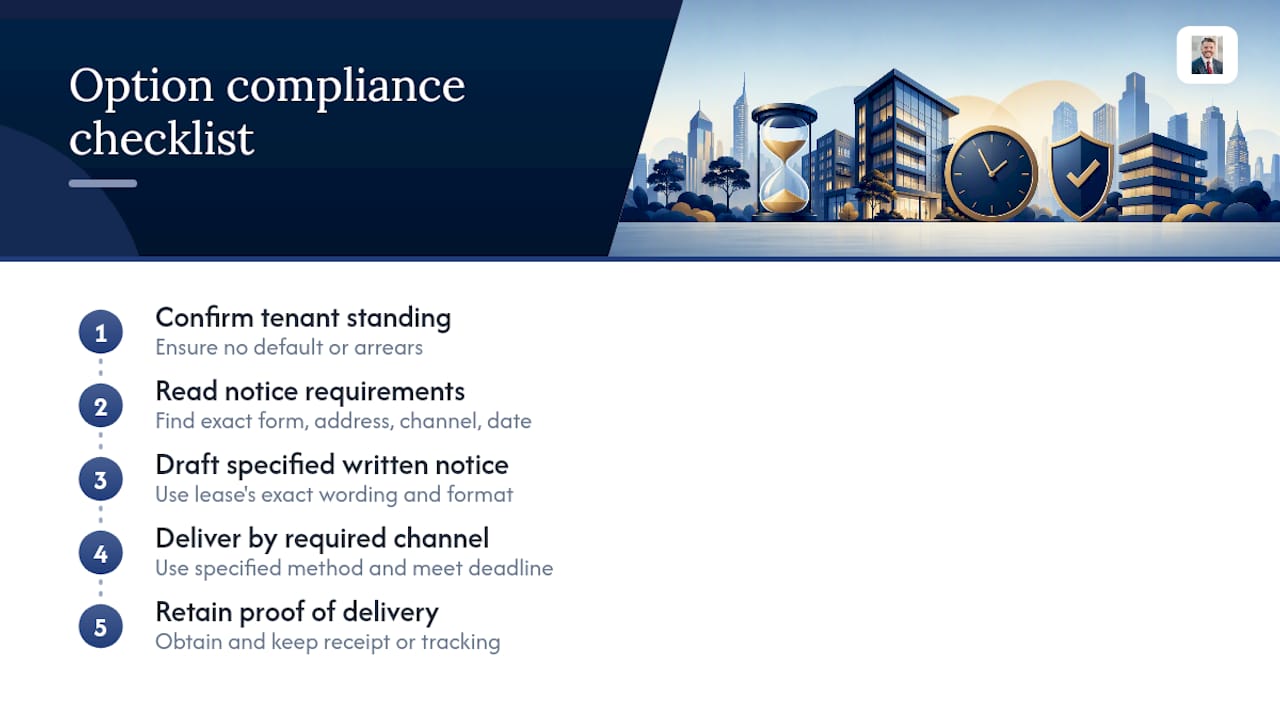
Canadian courts apply strict compliance rules to option exercise. A verbal heads-up to your landlord’s property manager, an email that doesn’t match the lease’s required form, or a notice sent to the wrong address can all be fatal to an otherwise valid claim.
Three things typically stand between you and a valid exercise:
- The notice window. Most industrial leases require written notice somewhere between six and nine months before the expansion date, often framed as “time of the essence.”
- The form and delivery method. The lease usually specifies who must sign, how notice gets delivered (registered mail, personal service, sometimes courier with tracking), and to which address.
- Your standing at the time of exercise. Many clauses require the tenant to be in good standing and not in default. Missed deadlines and non-compliant notice forms have repeatedly defeated tenants in Canadian litigation, even when the tenant clearly intended to exercise.
Pro Tip: A single day late on a “time of the essence” notice window has been enough to void an option in Canadian case law. Diarize the deadline with a 60-day buffer, not the exact date.
Once validly exercised, rent on the new space gets set one of three ways: a fixed formula written into the lease, fair market or net rent determined at the time, or an arbitration mechanism when the parties can’t agree. Fixed formulas are cleanest but can drift from market reality over a long term. Fair-market clauses track reality but invite disputes over comparables. Arbitration fallback language resolves the deadlock, but adds time and cost.
Negotiating the clause: what tenants and landlords should each push for
Tenants and landlords are negotiating from opposite incentives on almost every clause element, and the wording you accept now determines what you can actually do at exercise time.
Tenants should prioritize:
- Extension language over renewal, to preserve personal covenants and existing concessions.
- A transparent rent-setting formula, or at minimum an arbitration fallback, rather than an open-ended “fair market rent to be determined.”
- Cure or second-chance language that gives a short grace period if notice is defective in form but timely in substance.
- Clear survival provisions confirming which existing lease terms carry over to the expanded space.
Landlords tend to favour the opposite structure:
- ROFO over straight expansion, since it keeps pricing control with the landlord.
- Tight limits on assignment and sublease rights tied to the expansion space.
- Conditions precedent (no default, minimum notice period, specific delivery method) that give the landlord a clean out if the tenant stumbles procedurally.
A well-drafted clause should nail down four things regardless of which side you’re on: the exact space being defined (with a floor plan reference, not just square footage), the notice mechanics (window, form, delivery, recipient), the rent-setting method, and which covenants survive into the new term. Practical Law Canada’s model clauses are a useful drafting reference if you’re building language from scratch, and reviewing how GTA industrial tenants approach lease negotiation before you sit down with a landlord tends to shift the outcome in your favour.
Weighing the trade-offs before you commit
Exercising an expansion option isn’t automatically the right move, and granting one isn’t automatically good business for a landlord either.
For tenants, the downsides run in the opposite direction of the benefits:
- You may lose the leverage that comes with a live market search, including tenant improvement allowances and free rent periods landlords offer to win new deals.
- Fit-out and renovation costs on the expanded space are often higher than what a competing landlord would offer to attract you fresh.
- Locking into a formula set years earlier can mean paying above or below market, with no easy exit either way.
For landlords, an expansion clause can chill the broader leasing pipeline for adjacent space, since brokers hesitate to market space that might get absorbed by an existing tenant’s option. It also constrains portfolio flexibility if the landlord later wants to consolidate, subdivide, or reposition the asset. And an expansion right rarely lives in isolation. It can interact badly with an early termination or contraction clause elsewhere in the same lease, effectively cancelling out the certainty either side thought they’d secured.
A pre-deadline checklist for GTA industrial tenants
Work backward from your option deadline using three checkpoints, and involve the right people at each one.
- Six months out: Pull the lease, confirm the exact notice window and delivery requirements, and loop in your broker and lawyer for a joint read of the clause.
- Three months out: Model the true cost of exercising, including current market rent, forgone incentives, and renovation timeline, against the cost and downtime of relocating.
- One month out: Finalize your decision (exercise, negotiate an alternative, or walk), draft notice in the exact contractual form, and confirm delivery method with proof of receipt.
| Milestone | Who’s involved | Key question |
|---|---|---|
| Six months out | Broker, lawyer | Does the notice window and form match what the lease actually requires? |
| 3 months out | Broker, operations, finance | Is exercising cheaper than relocating once fit-out and downtime are counted? |
| 1 month out | Lawyer, signatory, landlord’s agent | Has notice been delivered in the exact required form, with proof? |
Assemble your lease, any amendments, current rent roll comparables, and a written list of questions for the landlord before that six-month mark. Reviewing a prior option-to-renew scenario side by side with your own clause often exposes gaps in your notice language before they become a problem.
A GTA broker’s view on when expansion rights actually pay off
Industrial vacancy across the GTA has stayed historically tight for years, which changes the math on expansion options entirely. When available space is scarce, an expansion right embedded in your current lease is often worth more than its face value, because the alternative is a competitive search with fewer listings and higher asking rents.
An expansion option in a tight GTA industrial market isn’t just a contractual convenience. It’s often the cheapest insurance policy a growing tenant can hold, because the replacement cost of finding comparable space on the open market, plus the downtime of a move, usually exceeds whatever premium the option locks in.
I generally recommend tenants exercise rather than test the open market when local availability is constrained and the fixed or formula rent in their clause tracks reasonably close to current asking rents. When the gap is wide, or when a straight expansion clause has aged into an unfavourable formula, testing the market first, with a broker running comparables, is usually worth the extra weeks it takes.
Tax and financial implications of exercising an expansion option
Exercising an expansion option triggers financial consequences that go beyond the headline rent figure, and they’re worth modelling before you commit.
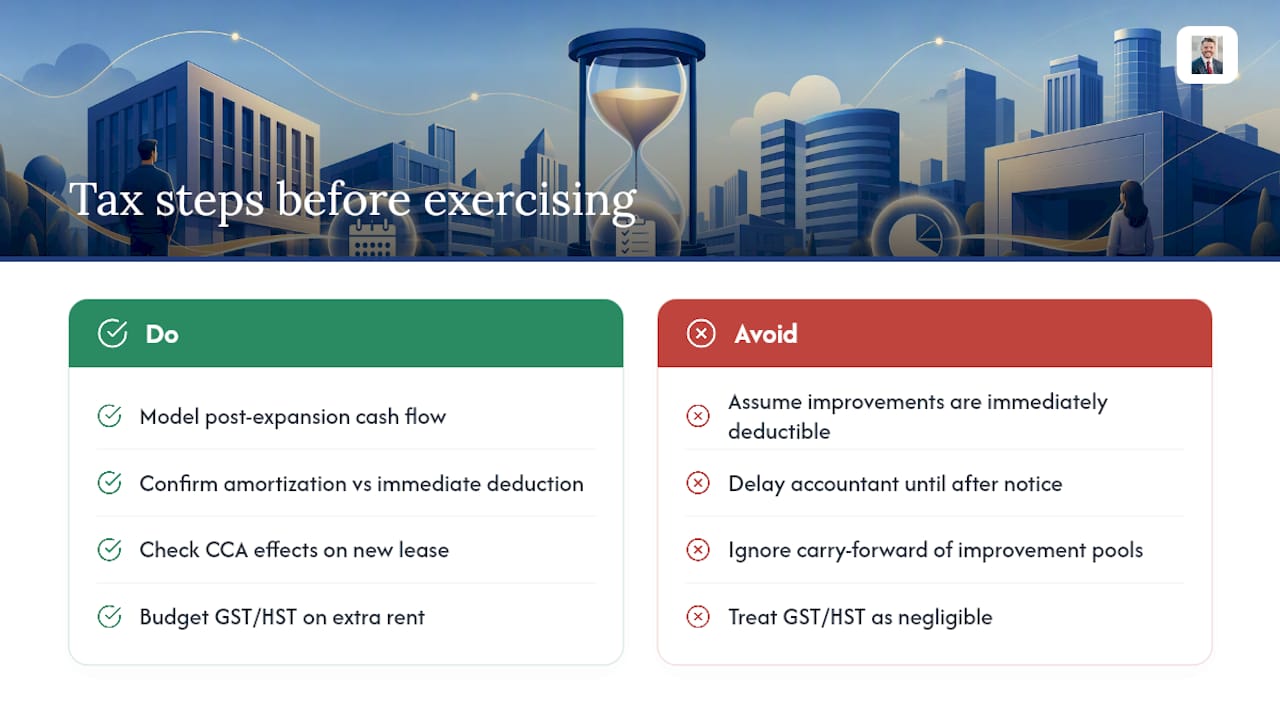
Additional rent on the expanded space is generally deductible as a business expense for income tax purposes, same as your base rent, provided the space is used in the course of earning business income. Where the exercise involves tenant-funded leasehold improvements, those costs typically get capitalized and amortized over the lease term rather than deducted immediately, which affects your cash flow timeline differently than a simple rent increase would.
If the expansion involves a new lease being executed rather than a true extension of the existing one, there can be implications for any capital cost allowance claims tied to prior improvements, and your accountant should confirm whether existing leasehold improvement pools carry forward cleanly. GST/HST applies to commercial rent in the same way it applies to your base lease, so budget for that on the incremental square footage.
There’s also a financial planning angle beyond the lease itself. Businesses weighing a long-term expansion commitment are often simultaneously working through ownership transition or succession questions, and the two decisions can interact more than owners expect. If your business is approaching a transition point, succession and tax planning resources are worth reviewing alongside your lease decision, since a major space commitment can complicate or clarify a succession timeline depending on how it’s structured. None of this replaces a conversation with your accountant before you sign, but it’s worth having that conversation before the notice deadline, not after.
What Canadian case law says about option compliance
Canadian courts have been consistent on one point across recent litigation: strict, unequivocal written notice beats informal communication every time a “time of the essence” clause is in play. Litigators and solicitors reviewing recent commercial lease disputes point to a recurring pattern: tenants who believed they’d communicated their intent to renew or expand, through phone calls, emails referencing “our renewal,” or ongoing negotiations, found those communications insufficient when the lease required a specific written form delivered a specific way.
The lesson from that case pattern isn’t subtle. Courts read the clause language literally. If your lease says notice must be delivered by registered mail to a named address by a named date, a courtesy email to your leasing rep doesn’t satisfy that requirement, no matter how clearly it expresses intent. Good standing matters too. Where a lease conditions the option on the tenant not being in default, even a minor or disputed arrears issue at the notice date has been enough for landlords to successfully resist an exercise.
The practical takeaway for GTA industrial tenants is to treat the option clause as a strict procedural contract, not a statement of intent. Draft your notice using the exact language and format the lease specifies, deliver it through the exact channel specified, and get proof of delivery. When in doubt, over-comply rather than assume substance will save you.
My take on expansion options in the GTA
Most industrial tenants in the GTA should treat their expansion option as an active asset to manage, not a clause to forget until the deadline arrives. Get your lease reviewed well before your notice window opens, and reach out if you want a second set of eyes on your clause before you diarize the date.
— Michael Law
How Michael Law | Lennard Commercial can help with your expansion decision
Deciding whether to exercise, renegotiate, or walk away from an expansion option is rarely a pure legal question. It’s a real estate decision that hinges on what’s actually available in your submarket right now, and that’s where local market intelligence changes the outcome. We work through this exact calculation with GTA industrial tenants: comparing locked-in rent formulas against current asking rents in the local region before commitment.

A lease review engagement typically starts with a read of your existing clause, a market comparison of available industrial space in your submarket, and a straight recommendation on whether exercising, renegotiating, or testing the market makes financial sense for your business. Services include tenant representation for industrial users, lease renewal and relocation support, and landlord representation for owners weighing whether to grant expansion rights on their own assets. Full details on available services are listed on the site. If your option deadline is within the next year, get your clause reviewed now, not the week notice is due.
Sources
- Renewal clauses in Ontario leases: how to negotiate fair terms — Hadri Law
- Room to grow or shrink: expansion and contraction rights in commercial leases — Mondaq (Blakes contributor)
- Cracking the option to extend — McMillan LLP
FAQ
What is an expansion option in a lease?
An expansion option is a lease clause giving a tenant the right to take additional space, typically adjacent to their existing premises, at a defined point during the term. It’s purely contractual: Canadian law provides no automatic right of expansion or renewal, so the specific wording of your clause controls everything.
What are the new rental laws in Ontario for 2026?
There’s no new statutory renewal right for commercial tenants in Ontario. Commercial leases remain governed by the terms the parties negotiate, unlike residential tenancies, so any expansion, renewal, or extension right still has to be written into your lease to exist.
What are the four main types of leases?
Commercial leasing typically involves gross leases, net leases, percentage leases, and modified gross leases, each defining differently how operating costs and taxes get allocated between landlord and tenant. Expansion options can attach to any of these structures and are negotiated separately from the base rent format.
Is subletting taking over a lease?
No. Subletting means the original tenant assigns part or all of their space to another party while remaining responsible under the head lease, whereas a full assignment transfers the tenant’s obligations outright. Either arrangement can complicate an expansion option, since many clauses restrict or void expansion rights once space has been sublet or assigned, which is worth checking with tenant representation before you sign a sublease.
What’s the difference between a ROFO and a ROFR in a lease?
A right of first offer (ROFO) requires the landlord to offer available space to the tenant before marketing it externally, with the landlord setting initial terms. A right of first refusal (ROFR) only triggers once the landlord already has a third-party offer, giving the tenant a chance to match it rather than negotiate fresh terms.
Recommended

About Michael Law
Managing Partner and Industrial Real Estate Broker at Lennard Commercial Realty. Representing tenants and landlords across Toronto and the GTA for 15+ years. Michael specializes in GTA industrial real estate — connect with Toronto's leading industrial broker at mlawrealestate.com/industrial-broker-toronto.
Related Articles



More Toronto Industrial Real Estate Insights
Articles & Analysis
Avoid $6,401 Permit Shock for Toronto Micro Fulfillment Sites
Avoid permit and power surprises when launching micro fulfillment in Toronto. Site selection, lease tactics, $6,401 mini-hub fees, timelines, and a pilot...
Read →How to Handle Lease Renewal for Industrial Space
Read →Avoid Commission Forfeiture: Dual Agency in Ontario for GTA Tenants
Understand Ontario dual agency rules, why written disclosure and consent must come before an offer, and Michael Law's GTA industrial advice.
Read →Best Industrial Buildings for Investors in 2026
Read →GTA OREA Clauses That Cut Broker Commission on Commercial Leases
Learn who pays commercial lease broker fees in Canada, typical rates (2%–4% industrial, 4%–6% office), and the OREA clauses and GTA tactics that limit...
Read →Common Questions
What is a sale-leaseback in industrial real estate?
A sale-leaseback is a transaction in which an industrial property owner sells their building to an investor and simultaneously signs a long-term lease to remain in the property as a tenant. The seller unlocks the capital tied up in their real estate while retaining full operational use of the facility. The buyer acquires a tenanted investment property with immediate cash flow from a known occupant.
Read →What is a dock-to-grade ratio in industrial real estate?
Dock-to-grade ratio in industrial real estate refers to the number of dock-level loading doors relative to the building's floor area, typically expressed as one dock door per X,000 square feet. It is a key specification for distribution and warehousing tenants because it determines how many trucks can load and unload simultaneously and therefore the building's throughput capacity.
Read →What is clear height in a warehouse or distribution centre?
Clear height in a warehouse or distribution centre refers to the usable vertical space from the finished floor to the lowest overhead obstruction — typically the bottom of the roof structure, sprinkler heads, or HVAC equipment. It is the single most important building specification for warehouse tenants because it determines how many racking levels can be installed and therefore how much product can be stored per square foot of floor space.
Read →