
GTA OREA Clauses That Cut Broker Commission on Commercial Leases
By Michael Law · Industrial Real Estate Broker, Lennard Commercial Realty
The landlord pays the broker commission on almost every commercial lease in Canada, not the tenant. Industrial deals typically run from 2% to 4% of the aggregate rent over the lease term, while office and retail commissions commonly land at 4% to 6%. The exact number depends on deal size, term length, and how the listing agreement (typically an OREA Form 525 or Form 540 in Ontario) is drafted.
TL;DR:
- Tenant costs can include shortfall payments, independent broker retainers, or indirect rent increases from landlord-baked commissions, but are often overlooked.
- Commission calculations vary: most are percentage-based on total rent, but some use months-of-rent or flat per-square-foot fees, leading to large differences in total costs.
- Standard forms and clauses, like holdover periods and renewal language, significantly impact deal protections and eventual commission amounts.
- Provincial regulations govern disclosure and dispute resolution but do not cap commission rates, which are always negotiated between landlord and broker.
- Clear negotiation of payment triggers, holdover limits, and exclusive agreements at the outset can save landlords and tenants substantial costs over the lease’s life.
Table of Contents
- Who pays: landlord obligations, cooperating brokers, and hidden tenant costs
- How commissions get calculated: percentage, months of rent, and $/ft² methods
- Listing agreement essentials: OREA forms, holdover, and shortfall language
- Timing and clawbacks: when commission is earned, paid, and refundable
- Negotiation checklist for landlords and tenants before signing
- What GTA industrial leasing actually looks like from the broker’s chair
- Legal regulations and compliance across Canadian provinces
- New leases versus renewals: how commission structures actually differ
- Exclusivity agreements and how they change what you pay
- Tax implications for landlords and tenants
- Where this leaves you heading into 2026
- How Michael Law | Lennard Commercial can help you manage commission exposure
- Sources
- FAQ
Who pays: landlord obligations, cooperating brokers, and hidden tenant costs
The landlord signs a listing agreement with a broker and pays the full commission once the deal closes. If a tenant works with their own representative, that representative is usually a cooperating broker, and the two firms split the fee, most often 50/50, out of the amount the landlord already agreed to pay. That’s why tenants are often told representation is “free.” It isn’t, exactly. The cost is built into the deal economics long before either side sits down at the table.
There are three situations where a tenant ends up paying something directly:
- The tenant’s own representation agreement (often an OREA Form 540) includes a shortfall clause, and the landlord’s side pays less than the agreed fee.
- The tenant hires a broker on a paid retainer basis for a complex site search, independent of any landlord commission.
- The landlord bakes commission costs into asking rent, so the tenant absorbs it indirectly through a higher rate per square foot.
None of this is hidden if you read the paperwork closely, but few tenants ask to see the landlord’s listing agreement before signing an offer to lease. That single request often reveals more about deal costs than anything in the lease itself.
How commissions get calculated: percentage, months of rent, and $/ft² methods
Three calculation methods dominate the Canadian market, and each produces a meaningfully different number on the same deal.
- Percentage of aggregate rent — the most common method. The broker’s fee is calculated against the total base rent paid over the full lease term, not just year one.
- Months-of-rent formula — common on smaller leases, where the fee equals a fixed number of months of gross rent, sometimes scaled by term length (e.g., one month per year of term).
- Flat rate per square foot — used on large industrial deals where a straight percentage would produce an unusually large fee relative to the broker’s actual workload.
Many agreements also use a sliding scale: a higher percentage on the early years of the term, tapering down for later years, because most of the broker’s work happens up front during negotiation and lease-up.
Pro Tip: Always ask your broker or the landlord’s agent to show the commission calculation on paper before you sign anything. A 4% fee on a 10-year office lease and a 2.5% fee on a 5-year industrial lease can produce wildly different dollar totals even on similar square footage, and the number should never come as a surprise at closing.
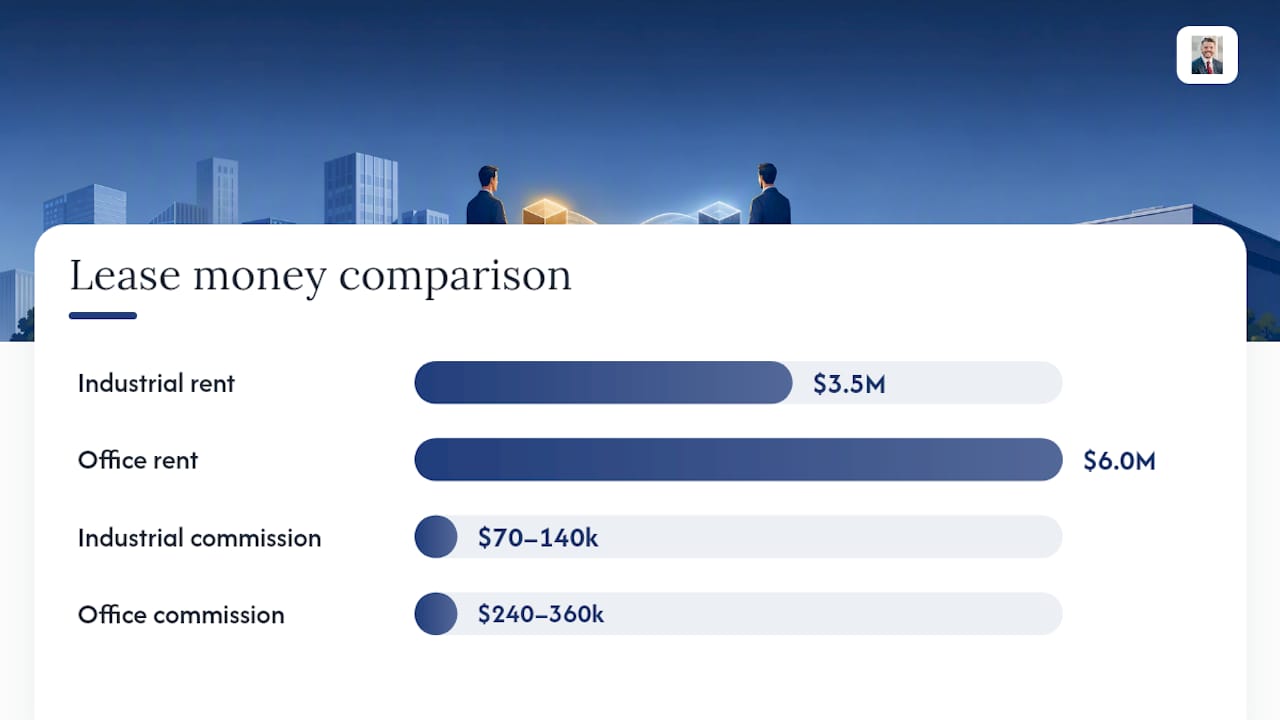
Here’s how that plays out. A 50,000 square foot GTA industrial lease at $14 per square foot net, over five years, generates roughly $3.5 million in aggregate rent. At a typical 2% to 4% industrial rate, that’s a commission somewhere between $70,000 and $140,000, split between the listing and tenant-side brokers. Compare that to a 20,000 square foot office lease at $30 per square foot gross over ten years: aggregate rent of $6 million, and at a 4% to 6% office rate, the fee runs from $240,000 to $360,000. Same broker effort in some cases, very different fee outcomes, purely because of rate class and rent base.
Listing agreement essentials: OREA forms, holdover, and shortfall language
Ontario landlords almost always formalize a broker relationship through OREA Form 525, the standard listing agreement for commercial leasing, while tenant-side representation typically runs through OREA Form 540. Both forms set the fee structure, but the fine print is where deals get expensive or protected, depending on which side reads it carefully.
Watch for these clauses before signing either form:
- Payment trigger: does commission become due on lease execution, or only once the tenant takes occupancy and starts paying rent?
- Holdover (tail) period: how long after the listing expires does the broker still earn commission on a deal with a prospect they introduced?
- Renewal and option clauses: brokers are only entitled to commission on a renewal or exercised option if the agreement expressly says so — there’s no automatic right.
- Carve-outs: landlord-originated tenants (existing contacts, prior inquiries) should be excluded from the broker’s holdover claim in writing.
- Shortfall provisions: a tenant representation agreement can require the tenant to make up the difference if the landlord’s side pays less than the agreed fee.
Pro Tip: Landlords should list every existing tenant conversation or inquiry in writing before signing a Form 525, so those contacts are excluded from the broker’s holdover claim later. This one paragraph prevents most post-listing commission disputes.
Timing and clawbacks: when commission is earned, paid, and refundable
Most Canadian commercial lease commissions are paid in two instalments, though the exact split is negotiable and varies by brokerage and deal size.
- 50% on lease execution, 50% on occupancy or first rent payment is the most common structure.
- Some landlords negotiate a single payment tied to rent commencement rather than execution, which reduces their risk if the deal falls through before the tenant actually moves in.
- Clawback clauses can require the broker to repay a prorated portion of the commission if the tenant defaults or vacates within a defined early period, though these are far less standard than payment splits.
- Taper schedules sometimes apply if a lease is terminated early through a tenant default, reducing what the broker is owed on unearned future terms.
Negotiating the trigger to rent commencement, rather than signature, is one of the more effective landlord protections available in a standard listing agreement, since it aligns the broker’s payout with the tenant actually showing up and paying.
Negotiation checklist for landlords and tenants before signing
Landlords and tenants are negotiating from opposite sides of the same document, and both sides tend to leave money or protection on the table by not asking basic questions early.
For landlords:
- Decide between exclusive agency and exclusive right to lease. The latter pays the broker regardless of who finds the tenant.
- Cap the holdover period, ideally 30 to 60 days for high-turnover industrial assets rather than the 90-day defaults some forms carry.
- Tie payment to rent commencement, not signature, to reduce exposure on deals that never close.
- Exclude landlord-originated prospects from the broker’s protected list in writing.
- Limit or delete broad renewal commission language unless you intend to pay it every renewal cycle.
For tenants, confirm exactly what counts as “rent” in the commission calculation (base rent only, or additional rent too), get written confirmation of what your representation agreement covers, and understand your shortfall exposure before signing a Form 540. On any lease above roughly 20,000 square feet, or any deal involving multiple sites, bring in tenant representation before you tour space, not after you’ve already found a building you like.
What GTA industrial leasing actually looks like from the broker’s chair
Industrial commission percentages in the GTA tend to run lower than office or retail not because the work is easier, but because the rent base is larger. A 100,000 square foot distribution deal generates enough aggregate rent that a 2.5% fee still represents real dollars for the broker, while the same percentage on a small retail unit wouldn’t cover the time spent.
The changes I push hardest for on listing agreements are almost always the same three: shorten the holdover period, tie payment to rent commencement instead of execution, and strip out vague renewal language that entitles a broker to a second payday years later without having done any work. None of these are exotic requests. They’re standard industrial leasing practice across the GTA, and landlords who ask for them get them more often than not.
Legal regulations and compliance across Canadian provinces
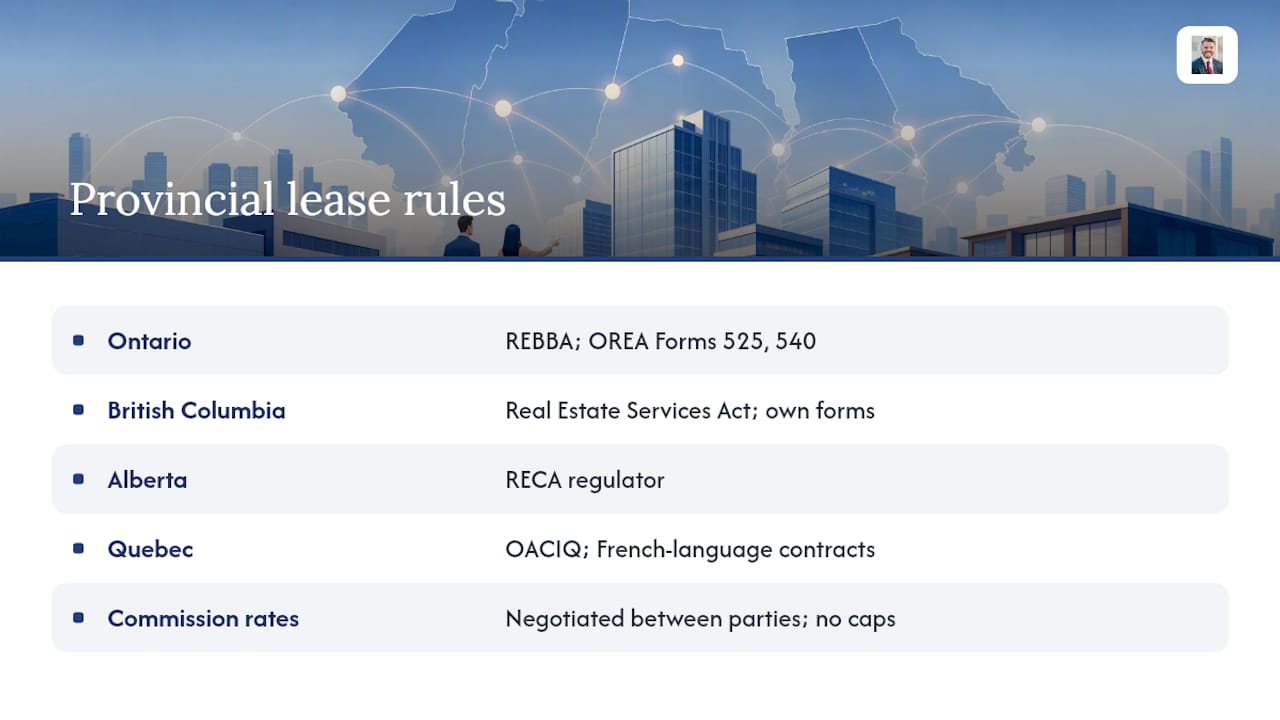
Commercial lease commissions in Canada are governed provincially, not federally, and the rules differ in meaningful ways depending on where the property sits. In Ontario, brokerage conduct falls under the Real Estate and Business Brokers Act (REBBA), and standard forms like OREA Form 525 and Form 540 reflect that framework’s disclosure and fiduciary requirements. British Columbia regulates brokers through the Real Estate Services Act, with its own standard forms and disclosure rules that differ from Ontario’s in wording, though the underlying commission mechanics (percentage of rent, split between listing and cooperating brokers) are broadly similar.
Alberta and Quebec each have their own regulatory bodies (RECA in Alberta, OACIQ in Quebec) and, in Quebec’s case, French-language contract requirements that apply even to commercial brokerage agreements. None of these provincial regimes set a mandated commission rate. Commission percentages are negotiated between the landlord and broker in every province, and no province caps what a landlord and broker can agree to charge. What varies is the disclosure obligation, the standard-form language, and how disputes over unpaid or contested commissions get resolved, typically through the provincial real estate regulator or civil courts rather than a rate-setting authority. A broker operating across provincial lines, which is common for GTA firms handling multi-market industrial portfolios, needs separate licensing and compliance in each province where they actively represent a client.
New leases versus renewals: how commission structures actually differ
A new lease commission is calculated against the full aggregate rent over the initial term, and it’s earned through the full cycle of marketing the space, touring prospects, and negotiating from a cold start. A renewal is a different animal entirely, and the fee structure usually reflects that.
Renewal commissions are never automatic. A broker is only entitled to be paid on a renewal or exercised option if the original listing agreement or lease expressly says so. Many landlords strike this clause entirely during negotiation, since a renewal often involves far less broker work than a fresh deal, sometimes just a phone call and a letter confirming extended terms.
Where renewal commissions do apply, they’re frequently set at a reduced percentage compared to the original deal, or structured as a flat fee rather than a percentage of the renewed rent. This makes sense from a workload standpoint. A tenant who already occupies the space and wants to stay doesn’t need to be found, toured, or sold on the building. If your original listing agreement includes broad renewal language with no reduction, that’s worth renegotiating before you sign, not after the renewal comes due. The same logic applies to exercised renewal options built into the original lease term, where a tenant simply activates a pre-negotiated right rather than negotiating fresh terms.
Exclusivity agreements and how they change what you pay
An exclusive right to lease agreement pays the broker commission regardless of who actually finds the tenant, even if the landlord brings in a prospect on their own. An exclusive agency agreement pays the broker only if they, or a cooperating broker, are the ones who produce the eventual tenant, leaving the landlord free to deal directly with a self-sourced prospect without owing a fee on that specific transaction.
The trade-off is straightforward: exclusive right to lease agreements tend to get more aggressive marketing effort from the broker, since the payout is guaranteed either way, while exclusive agency arrangements can save a landlord money on a property with strong existing interest but usually mean less proactive marketing investment from the brokerage. Landlords with a large existing network of industrial tenant contacts, common among owners with several buildings in one submarket, often lean toward exclusive agency for exactly this reason. Landlords marketing a vacant building cold, with no existing prospect list, generally get better results and faster lease-up under an exclusive right to lease structure, even though it removes the option to sidestep commission on a self-sourced deal.
Tax implications for landlords and tenants
For landlords, broker commission is a deductible business expense, but the timing of that deduction depends on how the lease and commission are structured. A commission paid on a long-term lease is typically treated as a capital expenditure for tax purposes in many cases, meaning it gets amortized over the lease term rather than deducted in full in the year it’s paid. This differs from a simple operating expense, and it’s worth confirming treatment with an accountant familiar with commercial real estate, since misclassifying a commission payment can trigger a reassessment.
GST/HST also applies to broker commissions in Canada, since real estate brokerage services are a taxable supply. The landlord paying the commission typically pays GST/HST on top of the fee, and can generally claim an input tax credit if the property is used in a commercial (taxable) activity. Tenants who pay a shortfall or a direct representation fee face the same tax treatment on their end, GST/HST applies, and the fee may be deductible as a business expense depending on how the lease space is used. None of this replaces proper tax advice specific to your situation, but knowing that commission isn’t simply a rent-adjacent number with no tax consequence changes how both sides should budget for it.
Where this leaves you heading into 2026
Prioritize clear payment triggers and a limited holdover period in every listing agreement you sign, whether you’re the landlord or the tenant’s representative. Model commission costs into net effective rent from the start, not as an afterthought once the deal is done. On any large or multi-site lease, paid tenant representation almost always pays for itself by protecting the long-term economics of the deal.
— Michael Law
How Michael Law | Lennard Commercial can help you manage commission exposure
Reading a listing agreement clause by clause isn’t something most occupiers do for a living, and the fee structures above are exactly where deals quietly get more expensive than they need to be. Tenant representation and industrial leasing services are offered across the GTA, focused on protecting occupiers from vague payment triggers, broad holdover periods, and renewal clauses.

That means walking into a lease negotiation with someone who reads the listing agreement before you sign the offer to lease, not after. Whether searching for warehouse space, a distribution facility, or a manufacturing site across the GTA, the goal is to negotiate commission and lease terms that protect occupancy costs for the full term, not just the first year. Start by reviewing the full range of tenant representation and leasing services available, or reach out directly to talk through a specific deal on the table.
Sources
- Offer to Lease Listing Agreements - What to Look for as a Landlord Looking to Hire a Broker - Lexology
- OREA Form 540 - Buyer Representation Agreement – Commercial (Mandate for Purchase or Lease) - RunSensible Forms
- How to Calculate Commercial Lease Commission: Rates and Splits - LegalClarity
FAQ
How are leasing commissions calculated in Canada?
Commissions are usually calculated as a percentage of the aggregate rent paid over the full lease term, though months-of-rent and flat $/ft² formulas are also used, especially on smaller or larger-than-average deals. Industrial rates typically run 2% to 4%, while office and retail commonly sit at 4% to 6%.
What are typical broker fees for a commercial lease in Canada?
Fees vary by asset type and deal size, but industrial leases typically fall in the 2% to 4% range of aggregate rent, while office and retail leases often land between 4% and 6%. The landlord pays this fee, and it’s commonly split with a tenant’s representative on a 50/50 basis.
Do tenants ever pay legal fees or broker fees directly on a commercial lease?
Tenants rarely pay broker commission directly, since the landlord covers it under the listing agreement, but a tenant representation agreement (OREA Form 540) can require the tenant to cover a shortfall if the landlord’s side pays less than agreed. Legal fees for reviewing a lease are separate from commission and are typically the tenant’s own cost regardless of how commission is structured.
What’s a reasonable brokerage fee for a commercial lease?
A reasonable fee depends heavily on asset type and deal size, but 2% to 4% for industrial and 4% to 6% for office or retail reflect standard Canadian practice on the aggregate rent over the term. Anything well outside those bands on a standard-size deal is worth questioning before you sign the listing or representation agreement.
Does Michael Law | Lennard Commercial offer tenant representation services in the GTA?
Yes, Michael Law | Lennard Commercial provides tenant representation, industrial leasing, and lease negotiation services for occupiers across the Greater Toronto Area. Current service details and areas of focus are available on the services page.
Recommended

About Michael Law
Managing Partner and Industrial Real Estate Broker at Lennard Commercial Realty. Representing tenants and landlords across Toronto and the GTA for 15+ years. Michael specializes in GTA industrial real estate — connect with Toronto's leading industrial broker at mlawrealestate.com/industrial-broker-toronto.
Related Articles


More Toronto Industrial Real Estate Insights
Articles & Analysis
Tenant Improvements: Plan Costs and Lease Terms
Read →Guide to Commercial Property Disposition
Read →How to Reduce Warehouse Vacancy in the GTA
Read →Markham Industrial Rents 2026: Tenant Rep Says Budget C$22 PSF
Tenant focused 2026 Markham industrial rent snapshot from a GTA tenant rep. Expect C$16–22 net and about C$22 gross; negotiation levers, cost checks, and...
Read →Brampton Warehouse Lease Negotiation Tactics
Read →Common Questions
What is a sale-leaseback in industrial real estate?
A sale-leaseback is a transaction in which an industrial property owner sells their building to an investor and simultaneously signs a long-term lease to remain in the property as a tenant. The seller unlocks the capital tied up in their real estate while retaining full operational use of the facility. The buyer acquires a tenanted investment property with immediate cash flow from a known occupant.
Read →What is a dock-to-grade ratio in industrial real estate?
Dock-to-grade ratio in industrial real estate refers to the number of dock-level loading doors relative to the building's floor area, typically expressed as one dock door per X,000 square feet. It is a key specification for distribution and warehousing tenants because it determines how many trucks can load and unload simultaneously and therefore the building's throughput capacity.
Read →What is clear height in a warehouse or distribution centre?
Clear height in a warehouse or distribution centre refers to the usable vertical space from the finished floor to the lowest overhead obstruction — typically the bottom of the roof structure, sprinkler heads, or HVAC equipment. It is the single most important building specification for warehouse tenants because it determines how many racking levels can be installed and therefore how much product can be stored per square foot of floor space.
Read →