
3 clauses Ontario commercial tenants must check in Form 346
By Michael Law · Industrial Real Estate Broker, Lennard Commercial Realty
A tenant representation agreement in Ontario, most often signed as OREA Form 346, is the written contract that makes a brokerage your legal representative for leasing or buying commercial space. It sets out how the brokerage gets paid, whether that relationship is exclusive, and what happens if you find space after the agreement expires. Before signing anything, check three clauses first: the fee section, the exclusivity terms, and the holdover window. Ask for RECO’s written disclosures at the same time.
TL;DR:
- Tenant representation agreements in Ontario should be signed before a broker starts negotiating or advising on a lease to clearly define scope and fee expectations.
- The fee section should specify who pays, how much, and under what conditions, with landlord-paid fees being common but requiring explicit confirmation.
- Exclusion clauses and holdover periods are negotiable, with shorter holdover windows of 60 to 90 days generally better for tenants.
- Clarifying the scope of property type and geography, and attaching prior property contact lists, helps prevent disputes over fees or property credit.
- Disclosures about multiple representation must be provided in writing, and tenants should seek independent advice if their broker also represents landlords or other parties in the deal.
Table of Contents
- What OREA Form 346 is and when you should sign one
- The clause checklist every tenant should run through
- RECO disclosures and multiple representation: what you’re owed
- Negotiating Form 346: the questions that surface the real terms
- Ending the agreement or avoiding an unwanted holdover claim
- Where to get Form 346 and how to fill it out correctly
- Why tenant representation actually changes deal outcomes
- Get tenant representation built around your lease economics, not the broker’s fee
- Sources
- FAQ
What OREA Form 346 is and when you should sign one
OREA Form 346 is the standard “Authority for Lease or Purchase” template used across Ontario for commercial tenant representation. Real estate boards built it for exactly this purpose: giving a brokerage authority to act for a tenant across lease negotiations, offers, and site searches, and it’s published through OREA standard forms.
You should sign a representation agreement before a brokerage submits an offer or negotiates materially on your behalf, not after. A broker showing you three warehouses in Milton on a casual basis is different from a broker preparing an offer to lease, negotiating tenant improvement allowances, or advising you on a letter of intent. That second scenario is formal representation, and it needs a signed agreement first.
Watch for the gap between the two:
- Casual property tours and market updates generally don’t require a signed agreement.
- Once a broker starts negotiating terms, submitting paperwork, or advising on strategy, you’re in a representation relationship, whether or not paper has changed hands yet.
- Signing before that point protects both sides on scope and fee expectations.
The clause checklist every tenant should run through
Form 346 reads like boilerplate until you hit the sections that actually cost you money. Here’s the order to check them in.
- Scope and geography. The form should specify property type (industrial, office, retail) and a defined search area. A vague scope, like “any commercial space in the GTA,” can inadvertently capture deals you found entirely on your own.
- Fee section. This defines who pays, how much, and what triggers payment. Commercial deals typically have landlords paying the brokerage fee, but the agreement should state that explicitly, along with what happens if the landlord’s offered commission falls short of the brokerage’s minimum.
- Exclusivity. An exclusive agreement means you can’t use another broker during the term. Ask for carve-outs for properties you’re already tracking independently before you sign.
- Holdover. This is the clause that keeps earning the brokerage a fee for a set period after the agreement ends, if you sign a lease on a property the broker introduced. The annotated Form 346 shows this window is negotiable, and shorter is almost always better for you.
- Term and termination. Under Ontario’s real estate rules, any agreement longer than six months requires the tenant’s initials on a separate acknowledgment, specifically because longer terms lock in more risk.
Pro Tip: Ask the brokerage to list every property you’ve already contacted or toured before signing. Attach that list as a schedule to the agreement so a later holdover dispute can’t claim credit for something you found on your own.
RECO disclosures and multiple representation: what you’re owed
Ontario brokers work under the Trust in Real Estate Services Act, and that law requires specific written disclosures before a brokerage starts acting for you. RECO’s own guidance spells out what those disclosures must cover: the services being offered, how the brokerage gets paid, how long the agreement runs, and what happens if the brokerage represents both you and the landlord in the same deal, a situation called multiple representation.
Under RECO’s framework, multiple representation cannot happen without your written consent, and it comes with real limits: your broker owes reduced duties in that scenario and can’t share confidential information that would help the other side.
That’s worth sitting with. If your broker also represents the landlord you’re negotiating against, ask directly how they intend to protect your negotiating position, and request independent legal advice if the answer feels thin. Ontario courts have weighed in on disputes over representation enforceability and fee claims, and a 2019 Ontario Court of Appeal decision is one example of how these agreements get tested when relationships break down. The RECO commercial information guide is the document to request if a brokerage hasn’t already handed it to you.
Negotiating Form 346: the questions that surface the real terms
Most tenants sign Form 346 as presented because nobody tells them it’s negotiable. It is, on nearly every point that matters.
Push on four things before you sign:
- Cap the holdover period, ideally 60 to 90 days rather than six months or longer.
- Narrow exclusivity to a specific property type and geography instead of accepting an open-ended territory.
- Get the fee-earning event defined in plain language: is it lease signing, offer acceptance, or something else?
- Require written confirmation of how the landlord’s fee gets split before you sign anything.
Ask these directly: Who pays the fee, and does that change if the landlord doesn’t offer full commission? When exactly is the fee earned? Who is the designated representative on this file, and what happens if they also work with landlords in my target buildings? How does your brokerage handle multiple representation if it comes up mid-negotiation?
If a broker hesitates on any of those answers, that’s the moment to bring in a real estate lawyer, not after you’ve signed. In tight industrial submarkets like Vaughan or Milton, where net effective rents and tenant improvement allowances vary widely between landlords, precise fee and scope language is what actually protects your lease economics, not the broker’s sales pitch.
Pro Tip: Get the fee-earning definition in writing as a separate line item, not folded into general “services” language. Vague fee triggers are the single most common source of post-deal disputes.
Ending the agreement or avoiding an unwanted holdover claim
Most Form 346 agreements include a defined term with an expiry date, plus language on how either party can terminate early. Some brokerages will agree to mutual termination on written notice; others hold firm to the full term. Negotiate this before signing, not after you want out.
To reduce holdover exposure:
- Push for the shortest holdover window the brokerage will accept.
- Get a written list of properties the broker actually introduced you to, since holdover fees typically only apply to those.
- If you receive a holdover demand after the agreement ends, ask for the fee calculation in writing and compare it against your own property list before paying anything.
- Contact a lawyer or RECO if the demand covers a property you found independently.
Where to get Form 346 and how to fill it out correctly
Get Form 346 directly from OREA’s standard forms page or from your brokerage’s own transaction system. Third-party sites host fillable copies, but stick with the official version or your brokerage’s signed copy so you’re not working from outdated clause language.
When you’re reviewing the document, check these fields specifically:
- Names of all parties and the brokerage’s registered legal name
- Property description and defined search area
- Term dates and the separate initials line required for terms over six months
- The full fee section, including any minimum commission language
- The name of your designated representative
Before you hand it back signed, initial every page, keep a countersigned copy for your own records, and ask for the RECO disclosure documents if you haven’t received them yet.
Why tenant representation actually changes deal outcomes
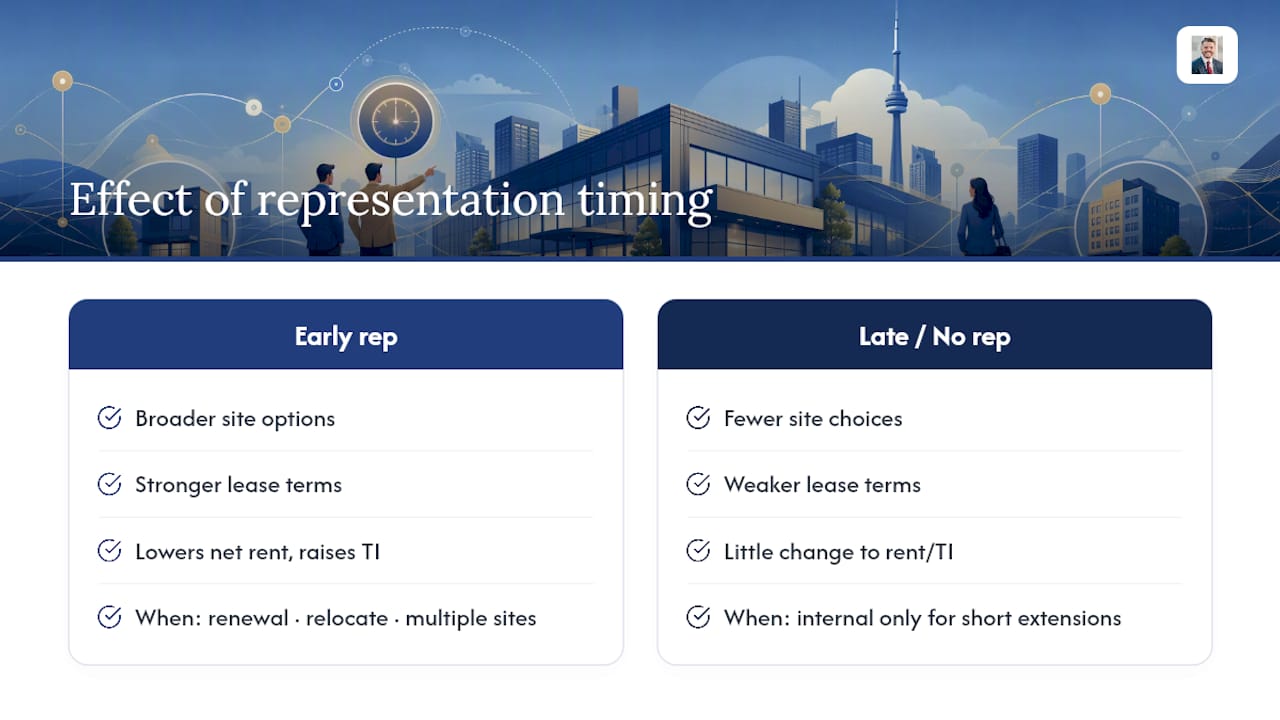
I’ve spent over a decade working GTA industrial leasing, and the pattern is consistent: tenants who sign representation early get better site options and stronger lease terms than those who call a broker after they’ve already found a building. As a CoStar Power Broker focused on this market, I’ve seen representation shift net effective rent and tenant improvement allowances meaningfully when a broker brings comparables to the table early, not after terms are already set.
Hire a rep when you’re negotiating a renewal, relocating, or evaluating multiple sites. Handle it internally only for simple, short-term extensions with no real negotiation at stake.
— Michael Law
Get tenant representation built around your lease economics, not the broker’s fee
Michael Law | Lennard Commercial handles industrial tenant representation across the Greater Toronto Area, including Mississauga, Brampton, Vaughan, Milton, and Barrie, with a focus on warehouse, distribution, and flex industrial space.

What that gets you: negotiation grounded in current market comparables, help defining fee terms before you sign anything, and site selection guidance that accounts for how tight the GTA industrial market actually is right now. Instead of reviewing a standard form alone, you get someone reading the fee and holdover clauses on your side of the table before you commit to anything. If you’re evaluating a lease, renewal, or new site, visit the industrial tenant representation page to see coverage details and start a conversation about your specific situation.
Sources
- RECO Information guide (commercial)
- OREA standard forms
- Form 346 explained (annotated copy)
- CanLII — 2019 ONCA decision (agency/representation dispute)
FAQ
What is a tenant representation agreement in Ontario?
It’s a written contract, commonly OREA Form 346, that authorizes a brokerage to act on your behalf when leasing or buying commercial space, setting out fees, exclusivity, and notice terms.
How do I get out of a tenant representation agreement in Ontario?
Check the termination clause first. Many agreements allow mutual termination on written notice, but if yours doesn’t, you’ll likely need to negotiate an early exit directly with the brokerage or wait out the term.
What’s the difference between a representation agreement and a living will?
They’re unrelated. A living will, sometimes called a personal directive, covers personal care and health decisions, while a tenant representation agreement is a commercial real estate contract governing brokerage services and fees.
Where can I find OREA Form 346?
Get it directly from OREA’s standard forms page or through your brokerage’s own transaction system rather than a third-party document site.
Do I need a lawyer to review a tenant representation agreement?
Not always, but it’s worth it for longer terms, exclusive arrangements, or any deal involving multiple representation, since those are the clauses most likely to create disputes later.
Recommended

About Michael Law
Managing Partner and Industrial Real Estate Broker at Lennard Commercial Realty. Representing tenants and landlords across Toronto and the GTA for 15+ years. Michael specializes in GTA industrial real estate — connect with Toronto's leading industrial broker at mlawrealestate.com/industrial-broker-toronto.