
Avoid Six Figure ESFR Retrofits: Sprinkler Rules Occupiers Must Check
By Michael Law · Industrial Real Estate Broker, Lennard Commercial Realty
ESFR protection hinges on three things: compliance with NFPA 13 Chapter 23, a minimum deflector-to-storage clearance of approximately 450 mm, and correct K-factor and pressure selection for the storage height and commodity class involved. In Ontario, the Fire Code references NFPA 13 for design and installation. Always confirm which edition your authority having jurisdiction (AHJ) has adopted before finalizing any layout.
TL;DR:
- Most older buildings may not meet current NFPA 13 standards, especially regarding deflector clearance and updated hydraulic design areas, risking non-compliance.
- Obstructions such as signage and ductwork can compromise ESFR activation, often requiring additional supplemental sprinklers that increase hydraulic demand.
- Existing municipal water supplies might not support the higher flow rates needed for certain ESFR layouts, potentially necessitating dedicated pumps or water storage.
- Transitioning from a 12-sprinkler to an 18-sprinkler design area due to sloped ceilings can significantly impact retrofit costs and hydraulic capacity.
- Thorough inspection, documentation review, and verification of current system compliance should be prioritized in lease negotiations to avoid costly remediation later.
Table of Contents
- What is ESFR and how does it differ from conventional sprinklers?
- What codes and standards govern ESFR system design?
- What are the K-factor, pressure, and design density rules?
- What clearance and obstruction rules apply to ESFR sprinklers?
- How do hydraulics and water supply drive ESFR feasibility?
- What ongoing inspection and testing does ESFR require?
- When is ESFR not the right fit?
- Installation mounting heights and orientation requirements
- What temperature ratings apply to ESFR sprinklers?
- Which building uses and hazard classes call for ESFR beyond storage?
- How does ESFR protect rack storage and multi-tier shelving?
- What is response time index and why does it matter for ESFR?
- Why sprinkler compliance belongs in every industrial lease negotiation
- How Michael Law | Lennard Commercial helps occupiers manage sprinkler compliance risk
- Sources
- FAQ
What is ESFR and how does it differ from conventional sprinklers?
Early Suppression Fast Response (ESFR) sprinklers are built to knock down a fire at its source rather than just holding it in check until crews arrive. That is the fundamental split from control-mode sprinklers, which are designed to control heat release and limit fire spread while the fire department handles final extinguishment. ESFR heads use a large orifice, a high K-factor, and a fast-response thermal element that reacts to heat far quicker than a standard bulb, which lets the system deliver a dense water pattern right into the seat of the fire before it can climb into the rack structure above.
That speed matters because it often eliminates the need for in-rack sprinklers. When storage height, commodity type, and ceiling height fall within the ranges covered in NFPA 13’s ESFR tables, a single layer of ceiling-mounted heads can protect the entire storage array. That is a meaningful design and cost advantage for warehouse operators who would otherwise need to run branch lines through rack uprights.
ESFR is commonly applied to:
- Palletized and solid-piled storage of Class I through Class IV commodities
- Rack storage, including single, double, and multi-row configurations
- Storage involving Group A plastics, with restrictions depending on whether the plastics are exposed or cartoned
- Mixed-commodity warehouses where uniform ceiling-only protection simplifies design
The trade-off is that ESFR performance depends entirely on unobstructed heat detection and discharge. Miss that condition and the “suppression” promise falls apart fast.
What codes and standards govern ESFR system design?
NFPA 13 is the primary design standard, and Chapter 23 is where ESFR lives. It sets out the design tables engineers actually use: maximum storage and ceiling heights, minimum operating pressures, K-factor requirements, and orientation rules by commodity class. If you are speccing an ESFR system, Chapter 23 is where the numbers come from, not a general rule of thumb from a past project.
Three standards work together in practice:
- NFPA 13 governs design, layout, and installation criteria for the sprinkler system itself
- NFPA 25 governs the ongoing inspection, testing, and maintenance obligations once the system is in service
- Provincial fire codes govern legal enforcement, adoption of NFPA editions, and owner notification duties
In Ontario, O. Reg. 213/07 requires automatic sprinkler protection for indoor storage areas above certain heights and mandates that systems be designed and installed in conformance with NFPA 13. Facilities storing dangerous goods or large volumes of combustible material typically need sprinkler coverage throughout the building, not just in the storage bay. The code also sets notification procedures owners must follow whenever a system is tested, repaired, or altered.
National Research Council guidance confirms that NFPA 13 is the standard commonly cited across Canada as an acceptable solution for sprinkler system design, tied to occupancy classification and hazard level under the National Building Code framework. That said, editions matter. NFPA 13 gets revised on a regular cycle, and provinces do not always adopt the newest edition immediately. Before you finalize a design or accept an existing installation as compliant, verify with the AHJ exactly which edition is in force. A system designed to a 2019 edition table may not satisfy a 2025 edition requirement if the jurisdiction has since updated its reference.
What are the K-factor, pressure, and design density rules?
ESFR hydraulic design starts with three linked variables: K-factor, minimum operating pressure, and design density over a specified design area. NFPA 13’s ESFR tables set minimum operating pressures by commodity class, ceiling height, and storage height, and the sprinkler’s K-factor determines how much water flows at a given pressure. Higher-challenge commodities, taller storage, or higher ceilings generally push you toward a higher K-factor and higher minimum pressure to hit the discharge density the fire scenario demands.
Design area is the other lever. Standard ESFR design typically assumes a 12-sprinkler design area for hydraulic calculations. But the 2025 edition of NFPA 13 introduced a change that increases that design area to 18 sprinklers, a 50% jump, under Section 20.9 Option 5 for unobstructed construction meeting certain slope criteria. Sloped ceilings change the heat and smoke plume behaviour enough that the code now demands a larger design area to compensate.
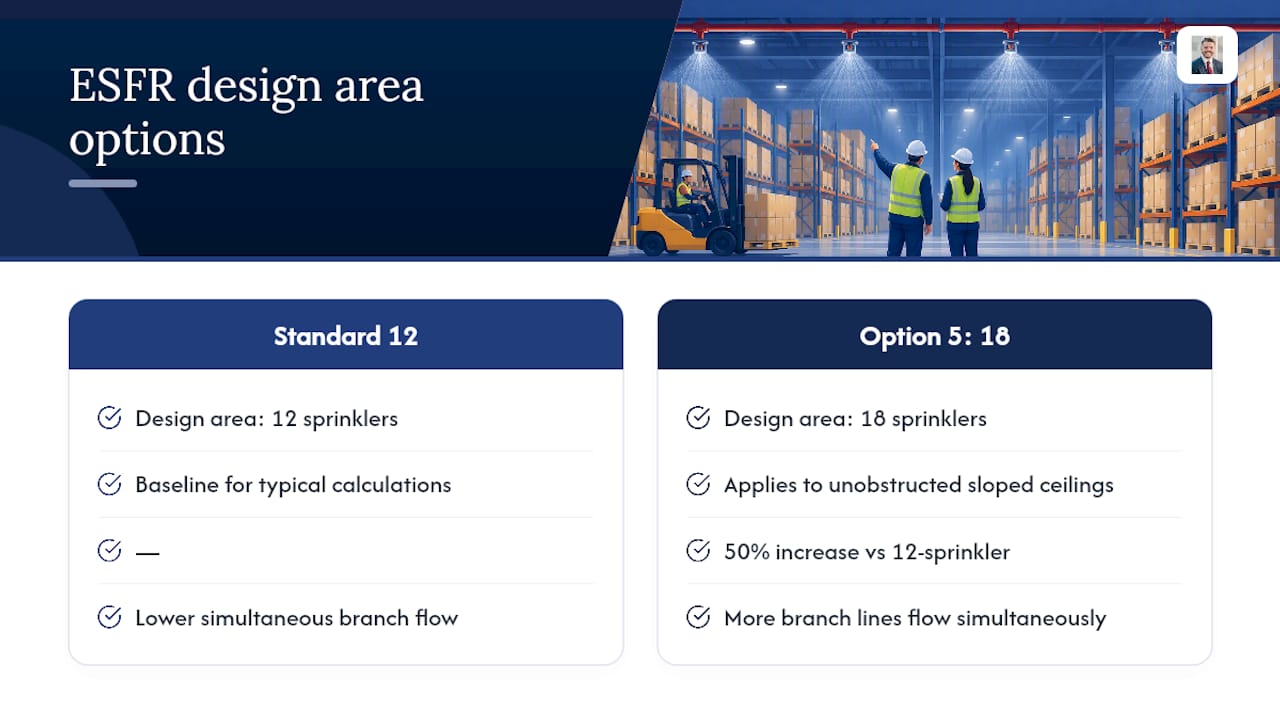
This matters well beyond the drafting table. An 18-sprinkler design area instead of 12 means more branch lines flowing simultaneously, which raises hydraulic demand at the riser and can force a pump upsizing that was not in the original capital budget. If you are evaluating an existing building with a sloped or peaked roof deck, this single table change is worth checking before you assume the current system meets today’s requirements.
What clearance and obstruction rules apply to ESFR sprinklers?
Every ESFR layout comes down to one governing number: a minimum clearance of about 450 mm between the sprinkler deflector and the top of the stored commodity. This is not a suggestion. Clearance guidance treats it as a hard design constraint because ESFR heads rely on an unobstructed discharge pattern to suppress a fire before it develops. Stack storage too close to the deflector and you choke the spray pattern exactly when you need it most.
Obstructions cause the most common design failures on real projects. Here is the sequence that trips up most facility teams:
- Overhead signage, lighting fixtures, ductwork, or mezzanine framing sits between the sprinkler and the fire below.
- That obstruction delays heat from reaching the fast-response thermal element, slowing activation.
- Even after activation, the obstruction can deflect or shadow the discharge pattern before it reaches the commodity.
- Under NFPA 13, this triggers a requirement for supplemental sprinklers positioned beneath the obstruction.
- Those supplemental sprinklers are sized using the bottom of the obstruction as the effective ceiling, which changes their spacing and hydraulic demand from the primary ESFR array.
Design changes in the current NFPA 13 edition make spacing for ESFR and CMSA supplemental sprinklers under obstructions more restrictive than earlier editions allowed. In some configurations, supplemental sprinklers can be excluded from the primary hydraulic calculation set, but only when the obstruction and spacing conditions match specific code criteria, not by default. A racking layout change that adds a mezzanine or conveyor bridge after the sprinkler system was designed can silently create a compliance gap.
How do hydraulics and water supply drive ESFR feasibility?
K-factor, pressure, and design area combine to set the total hydraulic demand at the base of the riser, and that demand determines whether your existing water supply can even support ESFR. A higher K-factor head at a given pressure delivers substantially more flow per sprinkler than a standard control-mode head, and multiply that across a 12 or 18-sprinkler design area and you get a demand curve that many older municipal supplies in the GTA simply cannot meet without a fire pump.
The design-area shift from 12 to 18 sprinklers for certain sloped-ceiling arrangements is a direct driver of pump sizing decisions during retrofits, since that single table change increases branch-line demand enough to push a marginal supply below the threshold. Where municipal pressure and flow fall short, a fire pump and often a dedicated water storage tank become part of the project, along with fire department connection requirements that vary by municipality.
For any occupier evaluating a warehouse conversion or an ESFR retrofit in an existing GTA building, the water supply question should be answered before the lease is signed, not after, by consulting a building code compliance guide for owners and contractors. A building with adequate roof structure and clear height but inadequate municipal supply pressure can turn a straightforward ESFR fit-out into a six-figure infrastructure project.
What ongoing inspection and testing does ESFR require?
NFPA 25 governs the inspection, testing, and maintenance schedule once an ESFR system is installed, and it is the standard most facility managers underestimate until an insurer or fire inspector asks for the logs. Owners are responsible for a Fire Safety Plan, and installing a compliant system is only the starting point. Ongoing inspection and testing are what keep it compliant year over year.
Facility managers should track:
- Weekly, monthly, quarterly, and annual inspection intervals for valves, gauges, and system components as set by NFPA 25
- Full trip tests and internal pipe inspections on the schedule the standard requires
- Written records of every inspection, test, and repair, kept on site and available on request
- Owner notification to the AHJ whenever a system is taken out of service, repaired, or altered, as required under provincial fire code
Pro Tip: Ask your sprinkler contractor for the last three years of NFPA 25 inspection logs before you sign a lease renewal on an older industrial building. A gap in the paper trail is often the first sign of a bigger deficiency hiding behind the ceiling tiles.
The most common deficiencies inspectors flag are blocked or painted-over sprinklers, storage encroaching on the 457 mm clearance, and valves left in the wrong position after maintenance. All three are cheap to fix early and expensive to discover during an insurance audit.

When is ESFR not the right fit?
ESFR has real limits. Exposed expanded Group A plastics, roll paper, and tire storage carry commodity-specific rules that often push design outside standard ESFR tables entirely, sometimes requiring in-rack sprinklers or a different suppression approach altogether. Very tall rack storage or unusually dense multi-tier layouts can also blow past what ceiling-only ESFR can support at any reasonable pressure.
In-rack systems remain the better call when deflector clearance would eat too much usable storage height, or when the commodity class simply falls outside NFPA 13’s ESFR parameters. Every clearance requirement is ultimately a space-efficiency trade-off, and sometimes the math favours the more labour-intensive in-rack option.
Installation mounting heights and orientation requirements
ESFR sprinklers must be installed within the maximum ceiling height limits set out in their specific listing, and exceeding that height voids the design assumptions the entire suppression strategy relies on. NFPA 13’s ESFR tables pair each sprinkler’s K-factor and pressure rating with a maximum protected ceiling height, and going even slightly beyond that limit means the head can no longer deliver the density needed to suppress the fire before it spreads.
Orientation matters as much as height. ESFR sprinklers are listed as either upright or pendent, and the two are not interchangeable on site regardless of what is convenient for the ductwork layout. An upright head installed where the listing calls for pendent orientation, or vice versa, changes the discharge pattern enough to fail the design intent even if every other spacing rule is met.
Mounting also has to account for structural members. Bar joists, purlins, and roof deck profiles can create the kind of localized obstruction that shifts a sprinkler’s effective coverage area, which is why layout drawings need to reflect the actual structural drawings for the building, not a generic ceiling plan. This is a frequent gap in older industrial buildings where structural retrofits happened after the original sprinkler design was stamped.
Distance below the roof deck or ceiling is also constrained, typically within a defined range rather than a single number, because too close to the deck delays activation and too far below reduces the coverage the head was tested to deliver.
What temperature ratings apply to ESFR sprinklers?
ESFR sprinklers carry a temperature rating tied to the fast-response thermal element inside the head, and matching that rating to the ambient conditions of the space is not optional. Most warehouse and distribution applications use ordinary or intermediate temperature-rated heads, but ceiling areas near loading docks, rooftop equipment, or process heat sources can run hotter than the general storage area below.
Installing a sprinkler with too low a temperature rating in a naturally warm zone risks nuisance activation from ambient heat rather than an actual fire. Installing one with too high a rating in a zone where a fire needs to be caught early can delay activation past the point where ESFR’s suppression advantage still applies. Facility managers retrofitting mezzanines, adding process equipment, or converting warehouse space to include heat-generating machinery should flag any zone where ambient temperature has shifted since the original sprinkler design was approved.
Seasonal swings matter too. Unheated warehouse space in Ontario can see wide temperature variation between summer and winter, and any zone prone to freezing needs separate consideration for dry-pipe or other freeze-protected system types, which carry their own listing and temperature-rating implications distinct from standard wet-pipe ESFR installations.
Which building uses and hazard classes call for ESFR beyond storage?
ESFR is best known for warehouse and distribution storage protection, but hazard classification, not building type alone, is what actually determines whether ESFR applies. A manufacturing floor with high-piled combustible inventory can trigger the same ESFR design requirements as a pure distribution centre, even though the primary use is production rather than storage.
Facilities that combine light manufacturing with palletized raw material or finished goods storage often need a hybrid design approach, where ESFR protects the storage zones and a different sprinkler design covers the process areas. Getting that boundary wrong, treating an entire building as one hazard class when it actually contains two or three distinct zones, is one of the more expensive design mistakes an engineer can make on an industrial retrofit.
Cold storage and food-grade facilities add another layer of complexity, since freezer temperatures affect both sprinkler type selection and the commodity classification of the stored goods themselves. Occupiers considering cold storage lease arrangements should treat the sprinkler and hazard classification review as a core part of site evaluation, not an afterthought handled after the lease is signed.
How does ESFR protect rack storage and multi-tier shelving?
Rack storage is where ESFR earns its reputation, because a correctly designed ceiling-only system can eliminate the need for in-rack sprinklers that would otherwise run through every level of a multi-tier structure. NFPA 13’s tables specify maximum storage heights and rack configurations, single-row, double-row, and multi-row, that ceiling-only ESFR can protect without supplemental in-rack protection.
That said, rack storage introduces obstruction risk that flat solid-pile storage does not. Rack uprights, horizontal load beams, and wire mesh decking can all interfere with both heat detection and water discharge as it travels down through the flue spaces between loads. Flue space width, the gap maintained between palletized loads and between back-to-back racks, is itself a governed dimension in NFPA 13 because inadequate flue space prevents water from reaching lower rack levels at all.
Multi-tier shelving with solid or slatted decking on each level changes the calculation further, since solid shelving can block ceiling-level discharge from reaching stock below entirely, often forcing a design that reverts to in-rack sprinklers regardless of what ceiling-only ESFR tables would otherwise allow. Facility managers evaluating a building for high-density rack storage should confirm which rack configuration the existing sprinkler design was actually calculated for, since a change from single-row to double-row racking after installation can quietly invalidate the original hydraulic design.
What is response time index and why does it matter for ESFR?
Response Time Index (RTI) is the metric that defines how quickly a sprinkler’s thermal element reacts to heat, and it is the core engineering property that makes ESFR different from every other sprinkler category. ESFR sprinklers carry a fast-response RTI rating, which means the thermal element has low thermal mass and activates at a lower accumulated heat exposure than a standard-response sprinkler.
That speed is what allows ESFR to suppress a fire rather than simply control it. A standard-response sprinkler activates later in the fire’s growth curve, by which point the fire may already be established enough that only a control strategy, holding the fire in check until firefighters arrive, is realistic. ESFR’s fast RTI catches the fire earlier in its development, while a high-density, high-pressure discharge can still overwhelm it at the source.
This is also why obstructions are so damaging to ESFR performance specifically. Because the fast-response element depends on rapid, unobstructed heat collection to do its job, anything that delays that heat reaching the sprinkler, overhead signage, ductwork, lighting clusters, mezzanine framing, erodes the exact timing advantage the whole ESFR design strategy is built around. A fast RTI sprinkler that activates late because of an obstruction has lost the one property that justified choosing ESFR in the first place.
Why sprinkler compliance belongs in every industrial lease negotiation
Most occupiers treat sprinkler compliance as a technical footnote handled by a contractor after the lease is signed. That is backwards. The deflector clearance requirement alone can determine whether a warehouse actually delivers the storage capacity a tenant is paying for, and that clearance constraint frequently forces operators to strip out top-level stock in older buildings designed before current ESFR tables existed.
Before committing to a site, request the as-built sprinkler drawings, the hydraulic calculations, the last several years of inspection logs, and any correspondence with the AHJ about system alterations. If those documents show a design based on an older NFPA 13 edition, or gaps between what is drawn and what is installed, that is a negotiation lever, not just a red flag. Landlords should be pushed to scope and fund remediation, or tenants should negotiate an allowance, before the lease commits them to a building that cannot support the storage density they are budgeting for.
— Michael Law
How Michael Law | Lennard Commercial helps occupiers manage sprinkler compliance risk
Sprinkler compliance is a real estate decision as much as an engineering one, and that is exactly where Michael Law | Lennard Commercial fits in for GTA industrial occupiers. Where a fire protection engineer confirms whether a building’s ESFR system meets current NFPA 13 tables, Michael Law | Lennard Commercial helps you determine whether that building, or a shortlist of alternatives, actually fits your operation before you spend engineering fees confirming it.

That means incorporating sprinkler documentation review into the due-diligence process early, identifying potential clearance and water-supply issues before lease signing, and considering remediation costs during negotiations rather than after occupancy. For tenants deciding between relocation and lease renewal, awareness of sprinkler upgrade risks can influence site selection decisions.
If you are evaluating industrial space in Toronto or across the GTA and want a broker who factors building system risk into the negotiation, start with Michael Law | Lennard Commercial’s services page or reach out directly through tenant representation services to commission a property compliance review before your next lease decision.
Sources
- Ontario
- NFPA 13, Automatic Sprinkler Systems Handbook (2025)
- Changes in the 2025 edition of NFPA 13 | TechNotes - National Fire Sprinkler Association
- Automatic sprinkler systems (Canadian Conservation Institute notes)
- NRC technical guidance referencing NFPA 13 and sprinkler requirements
FAQ
Where are ESFR sprinklers required?
ESFR is typically required in warehouses and distribution centres with palletized, solid-piled, or rack storage that exceeds the height thresholds set in NFPA 13 Chapter 23 or provincial fire code. In Ontario, O. Reg. 213/07 mandates automatic sprinkler protection for indoor storage above certain heights, designed in conformance with NFPA 13.
What is the difference between ESFR and a normal sprinkler?
ESFR sprinklers use a fast-response thermal element and high K-factor to suppress a fire at its source, while conventional control-mode sprinklers are designed to control fire growth until firefighters arrive. That difference in activation speed and discharge density is also why ESFR can often protect rack storage from the ceiling alone, without in-rack sprinklers.
Is a sprinkler system mandatory in Ontario?
Yes, for many industrial occupancies. Ontario’s Fire Code requires automatic sprinkler protection for indoor storage areas above specified sizes and heights, and for facilities storing dangerous goods or large quantities of combustible material, per O. Reg. 213/07. Requirements vary by occupancy and hazard classification, so confirming applicability with the local AHJ is essential.
What is the 457 mm clearance rule for ESFR sprinklers?
ESFR design requires a minimum clearance of about 450 mm between the sprinkler deflector and the top of the stored commodity, as confirmed in sprinkler clearance guidance. This clearance is critical because ESFR relies on an unobstructed discharge pattern to suppress a fire, and storage encroaching on that space is one of the most common compliance deficiencies inspectors find.
Does Michael Law | Lennard Commercial review sprinkler compliance for occupiers?
Michael Law | Lennard Commercial works with GTA industrial occupiers to flag building system risks, including sprinkler compliance gaps, during site selection and lease negotiation, and can connect tenants with the documentation needed for a technical review. Pricing for specific services is available directly through the services page.
Recommended

About Michael Law
Managing Partner and Industrial Real Estate Broker at Lennard Commercial Realty. Representing tenants and landlords across Toronto and the GTA for 15+ years. Michael specializes in GTA industrial real estate — connect with Toronto's leading industrial broker at mlawrealestate.com/industrial-broker-toronto.