Industrial building compliance for GTA tenants: a practical guide
By Michael Law · Industrial Real Estate Broker, Lennard Commercial Realty
Before you sign a GTA industrial lease, commission a Phase I Environmental Site Assessment, confirm zoning and permitted use, and determine whether your operations will trigger an Environmental Compliance Approval under Ontario’s Environmental Protection Act. Key authorities governing your occupancy are the Ministry of the Environment, Conservation and Parks (MECP), O. Reg. 419/05 (Air Pollution — Local Air Quality), the D-Series Land Use Compatibility Guidelines, the Ontario Building Code, and the Commercial Tenancies Act. None of these are optional checks — each one can delay or block your occupancy if left until after you’ve committed to a space.
The industrial building compliance process for tenants is distinct from a municipal construction permit process. It includes considerations of site suitability, environmental approvals, fire and life-safety requirements, and operational conditions to meet from possession onward. Here is what to do, in sequence.
Start here:
- Confirm zoning and permitted use with the municipality before signing
- Commission a Phase I ESA (and Phase II if contamination indicators are found)
- Search the Environmental Site Registry for any Record of Site Condition on the property
- Determine whether your equipment or processes require an Environmental Compliance Approval
- Verify occupancy classification and fire-safety requirements under the Ontario Building Code
- Negotiate environmental representations, warranties, and indemnities into the lease before execution
Contact a tenant representative or environmental consultant to scope these items early. Michael Law | Lennard Commercial can help coordinate that process from site selection through lease execution.
Key takeaways
The industrial building compliance process for GTA tenants requires completing environmental, zoning, and fire-safety checks before lease signing — not after possession.
| Point | Details |
|---|---|
| Commission Phase I ESA pre-signing | Engage an environmental consultant before committing; Phase II follows if contamination is indicated. |
| Confirm zoning and permitted use | Verify your specific operations are allowed under the municipal by-law, not just the zoning category. |
| Assess ECA requirements early | Determine whether your equipment triggers an Environmental Compliance Approval under O. Reg. 419/05 before occupancy. |
| Negotiate environmental protections | Secure representations, warranties, and indemnities in the lease; the Commercial Tenancies Act does not provide them automatically. |
| Maintain ongoing compliance records | ECA conditions require complaint logs, annual Written Summary Forms, and documented maintenance records post-occupancy. |
| Michael Law | Lennard Commercial |
Table of Contents
- What does the industrial building compliance process actually involve?
- How do municipal zoning and local by-laws affect your operations?
- What ongoing compliance monitoring is required after the first 90 days?
- How do insurance requirements interact with your lease compliance obligations?
- What most GTA tenants get wrong about industrial compliance
- Work with a tenant rep who knows the compliance process
- Sources
- FAQ
What does the industrial building compliance process actually involve?
The steps below follow a practical sequence from pre-lease through ongoing operations. Each milestone identifies who typically owns the action and when it needs to happen.
Step-by-step compliance timeline
-
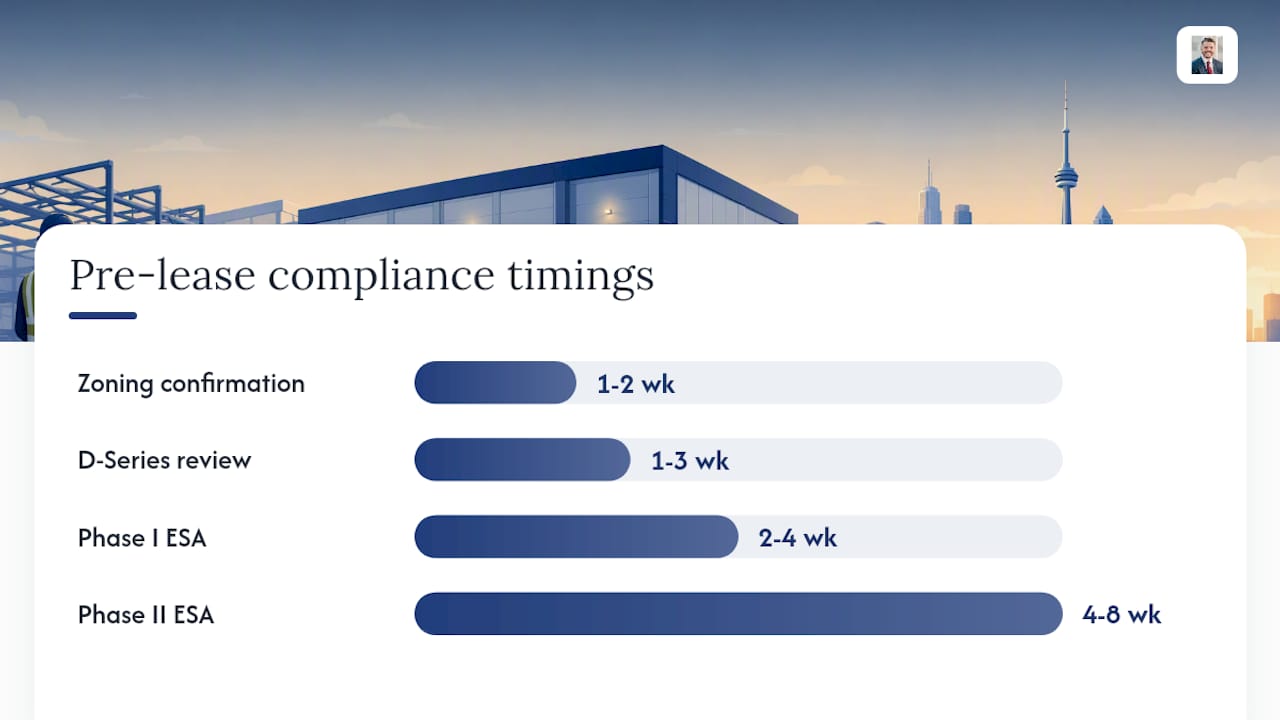
Zoning and use confirmation (pre-lease, weeks 1–2). Verify that your intended operations are permitted under the municipal zoning by-law. An industrial zoning designation does not automatically permit every industrial activity — operational intensity, outdoor storage, vehicle movements, and emission profiles all affect whether a specific use is allowed. Your tenant rep or a zoning consultant pulls this in days.
-
D-Series land use compatibility review (pre-lease, weeks 1–3). The MECP’s D-Series guidelines classify industrial facilities as Class I, II, or III based on expected emissions and recommend minimum separation distances from sensitive land uses. If your site sits near residential or mixed-use zones, site-specific noise, odour, and air quality studies may be required before you can operate.
-
Phase I ESA (pre-lease, weeks 2–4). A qualified environmental consultant reviews site history, aerial photographs, regulatory databases, and a site walkthrough to identify any Recognized Environmental Conditions. Prudent due diligence also includes a search of the Environmental Site Registry for any existing Record of Site Condition and a check for outstanding municipal orders.
-
Phase II ESA (if triggered, weeks 4–8). If the Phase I flags contamination indicators, a Phase II involves soil and groundwater sampling. Results determine whether remediation is needed and who is responsible — a question that must be resolved in the lease before you commit.
-
ECA trigger assessment (pre-lease to pre-occupancy, weeks 3–6). Determine whether your equipment (boilers, spray booths, generators, refrigeration systems) requires an Environmental Compliance Approval under O. Reg. 419/05. An ECA is effectively a site-level operational contract: it sets performance limits, reporting deadlines, and prescribed complaint procedures. If a prior tenant held an ECA, confirm whether it transfers, lapses, or needs amendment.
-
Fire and occupancy classification review (pre-occupancy, weeks 4–6). The Ontario Fire Code classifies industrial occupancies as low, medium, or high hazard. Your operations must match the building’s classification. Verify sprinkler coverage, fire suppression systems, exit requirements, and any notification obligations for system tests or alterations.
-
Acoustic and odour assessment (pre-occupancy, if applicable). If your site is near sensitive receptors or your operations involve significant noise or odour sources, an acoustical engineer and environmental consultant should model off-property impacts using AERMOD or SCREEN3. The MECP uses an averaging period for odour modelling under D-Series guidance, typically considering short-term concentration averages.
-
Lease negotiation (concurrent with steps 1–6). Secure environmental representations and warranties, require the landlord to disclose all known contamination and provide copies of existing ESAs, and negotiate indemnities that limit your exposure to pre-existing conditions. The Commercial Tenancies Act does not prescribe these protections — they exist only if you negotiate them.
-
Pre-occupancy HVAC and operational review (weeks 6–8). Confirm that HVAC systems are adequate for your process loads, that any required ECA conditions are understood, and that operational and maintenance programmes are in place.
-
First 90 days. Establish compliance logs, implement ECA complaint-recording procedures, and confirm that any required annual Written Summary Forms are calendared. ECA conditions commonly require operational maintenance programmes within three months of approval.
Pro Tip: Ask the landlord for the existing ECA (if any) and all prior Phase I/II ESAs before you negotiate heads of terms — not after. Reviewing them costs nothing at that stage; remediating a surprise after lease execution can cost significantly more.
| Milestone | Typical owner | Approximate timing |
|---|---|---|
| Zoning and use confirmation | Tenant / tenant rep | Before heads of terms |
| Phase I ESA | Tenant’s environmental consultant | Before lease signing |
| Phase II ESA (if triggered) | Tenant’s environmental consultant | 4–8 weeks pre-signing |
| ECA trigger assessment | Environmental consultant | Pre-lease to pre-occupancy |
| Fire/occupancy classification review | Fire code consultant | Pre-occupancy |
| Acoustic/odour assessment | Acoustical engineer | Pre-occupancy (if applicable) |
| Lease environmental reps and warranties | Legal counsel | Lease negotiation |
| Compliance logs and ECA reporting | Tenant | First 90 days and ongoing |
How do municipal zoning and local by-laws affect your operations?
Zoning confirmation is not a one-time checkbox. Across the GTA, municipalities from Mississauga to Oshawa apply their own zoning by-laws, Official Plan policies, and local performance standards that can restrict hours of operation, outdoor storage, truck idling, and noise levels beyond provincial minimums.
The practical risk for tenants is assuming that an “M” or “E” industrial zone covers everything. It rarely does. A food processing operation, a cold storage facility, or a logistics hub with 24-hour truck movements each carries a different compliance footprint, even on identically zoned parcels. Municipal by-law officers can issue orders that halt operations independently of any provincial approval you hold.
Before signing, confirm with the municipality whether your specific use requires a minor variance, a zoning by-law amendment, or a site plan agreement. Some GTA municipalities also require a pre-consultation meeting before approving certain industrial uses near sensitive receptors. That meeting can take weeks to schedule, so build it into your timeline.
What ongoing compliance monitoring is required after the first 90 days?
Post-occupancy compliance does not end with a successful move-in. If your operations are governed by an ECA, the approval typically requires annual Written Summary Forms, ongoing complaint logging, and periodic updates to your Emission Summary and Dispersion Modelling (ESDM) report and Acoustic Assessment when processes or equipment change.
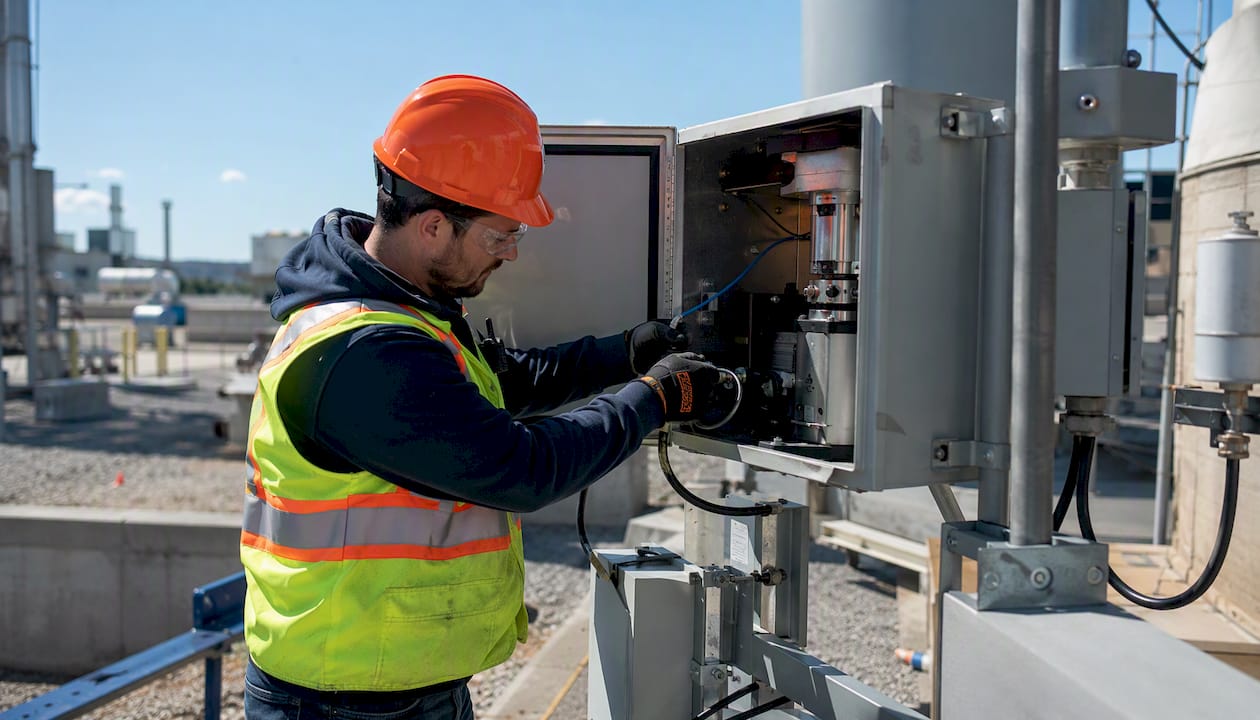
Any modification to regulated equipment — a new boiler, an expanded spray booth, a generator upgrade — may require an ECA amendment before the change is made. Operating outside ECA conditions exposes the tenant to MECP enforcement, which can include orders to cease operations.
Beyond the ECA, fire code compliance requires periodic inspections of suppression systems, annual testing of fire alarm systems, and documented maintenance records. The Ontario Fire Code requires notification to the fire department before certain tests, repairs, or alterations to fire protection installations. Keep those records accessible; a compliance audit can be triggered by a complaint, an insurance inspection, or a routine municipal visit.
How do insurance requirements interact with your lease compliance obligations?
Insurance and compliance are more tightly linked than most tenants expect. Standard commercial lease agreements require tenants to carry commercial general liability, property, and often environmental impairment liability insurance. The specific limits and endorsements required are set by the lease, not by statute — the Commercial Tenancies Act leaves these terms to negotiation.
Where environmental conditions exist on site, landlords increasingly require tenants to carry pollution liability coverage, particularly if the tenant operates equipment that could cause a spill or release. If an ECA is in place, the insurer may require evidence of compliance with ECA conditions as a condition of coverage. A lapse in ECA compliance can therefore void coverage at exactly the moment you need it.
Negotiate insurance requirements alongside environmental reps and warranties. If the landlord is retaining responsibility for pre-existing contamination, confirm that the indemnity is backed by adequate financial capacity or an environmental insurance policy. A contractual indemnity from a landlord with no assets is not protection.
What most GTA tenants get wrong about industrial compliance
The most common failure is treating compliance as a post-signing task. By the time a tenant has executed a lease, the leverage to negotiate environmental protections, require remediation, or walk away from a contaminated site is largely gone. The second most common failure is underestimating how much operational intensity matters relative to zoning label. A site zoned for general industrial use can still generate MECP enforcement if the tenant’s processes exceed ECA limits or create off-property odour complaints — regardless of what the zoning certificate says.
The third failure is not reading the existing ECA. Many GTA industrial buildings carry approvals from prior tenants that contain conditions the new occupier inherits or must amend. Treating an ECA as the landlord’s problem is a misreading of how Ontario environmental law works: the operator of the equipment is the regulated party.
Coordinating a tenant rep, an environmental consultant, and legal counsel before heads of terms is not overcautious. In a market where industrial availability across the GTA remains tight, the temptation to move fast is real. The tenants who avoid costly surprises are the ones who run the compliance scoping process in parallel with site selection, not after the lease is signed.
Work with a tenant rep who knows the compliance process
Navigating the industrial building compliance process across the GTA is faster and less expensive when a tenant representative coordinates the technical and legal workstreams from the start. Michael Law | Lennard Commercial provides tenant representation across Toronto, Mississauga, Brampton, Vaughan, Markham, and the broader GTA, with direct experience coordinating Phase I/II ESAs, ECA trigger assessments, fire code reviews, and lease negotiation for environmental protections.

The difference between a smooth occupancy and a delayed one usually comes down to sequencing: getting the right consultants engaged before heads of terms, not after. Michael Law | Lennard Commercial manages that coordination so you are not chasing reports while a landlord’s deadline clock runs. Contact Michael Law to book a compliance scoping call before your next site commitment.
Sources
- AMENDED ENVIRONMENTAL COMPLIANCE APPROVAL 7951-BGTKKZ
- Ontario
- So you want to be a tenant - prudent searches for lease due diligence | Robins Appleby
- Ontario commercial required disclosures | Landager
This article is general information, not a substitute for advice from a qualified lawyer. Consult a qualified legal professional about your own circumstances before acting on anything here.
FAQ
What is the first step in the industrial building compliance process?
Commission a Phase I ESA and confirm zoning and permitted use before signing the lease. These two steps identify the most common deal-stopping issues — contamination history and use restrictions — before you are contractually committed.
Does an industrial zoning designation mean any industrial use is permitted?
No. Municipal zoning by-laws specify permitted uses within industrial zones, and operational characteristics such as hours, truck movements, outdoor storage, and emissions can restrict or require approval for specific activities even on industrially zoned land.
When does an Environmental Compliance Approval apply to a tenant?
An ECA is required under Ontario’s Environmental Protection Act when a tenant operates equipment or processes that emit air contaminants, such as boilers, generators, spray booths, or refrigeration systems. The tenant operating the equipment is the regulated party, regardless of what a prior occupant held.
What lease clauses protect tenants from pre-existing environmental conditions?
Environmental representations and warranties, indemnities limiting tenant liability for pre-existing contamination, and a requirement for the landlord to provide all prior Phase I/II ESAs and Records of Site Condition are the core protections. The Commercial Tenancies Act does not provide these automatically — they must be negotiated.
How long does the full compliance process take before occupancy?
A site without contamination concerns or ECA requirements may be cleared relatively quickly, while sites requiring Phase II ESAs, ECA applications, or acoustic modelling generally require additional time, possibly several months. Build that timeline into your lease commencement date negotiations.
Recommended

About Michael Law
Managing Partner and Industrial Real Estate Broker at Lennard Commercial Realty. Representing tenants and landlords across Toronto and the GTA for 15+ years. Michael specializes in GTA industrial real estate — connect with Toronto's leading industrial broker at mlawrealestate.com/industrial-broker-toronto.
Related Articles

More Toronto Industrial Real Estate Insights
Common Questions
What is a sale-leaseback in industrial real estate?
A sale-leaseback is a transaction in which an industrial property owner sells their building to an investor and simultaneously signs a long-term lease to remain in the property as a tenant. The seller unlocks the capital tied up in their real estate while retaining full operational use of the facility. The buyer acquires a tenanted investment property with immediate cash flow from a known occupant.
Read →What is a dock-to-grade ratio in industrial real estate?
Dock-to-grade ratio in industrial real estate refers to the number of dock-level loading doors relative to the building's floor area, typically expressed as one dock door per X,000 square feet. It is a key specification for distribution and warehousing tenants because it determines how many trucks can load and unload simultaneously and therefore the building's throughput capacity.
Read →What is clear height in a warehouse or distribution centre?
Clear height in a warehouse or distribution centre refers to the usable vertical space from the finished floor to the lowest overhead obstruction — typically the bottom of the roof structure, sprinkler heads, or HVAC equipment. It is the single most important building specification for warehouse tenants because it determines how many racking levels can be installed and therefore how much product can be stored per square foot of floor space.
Read →