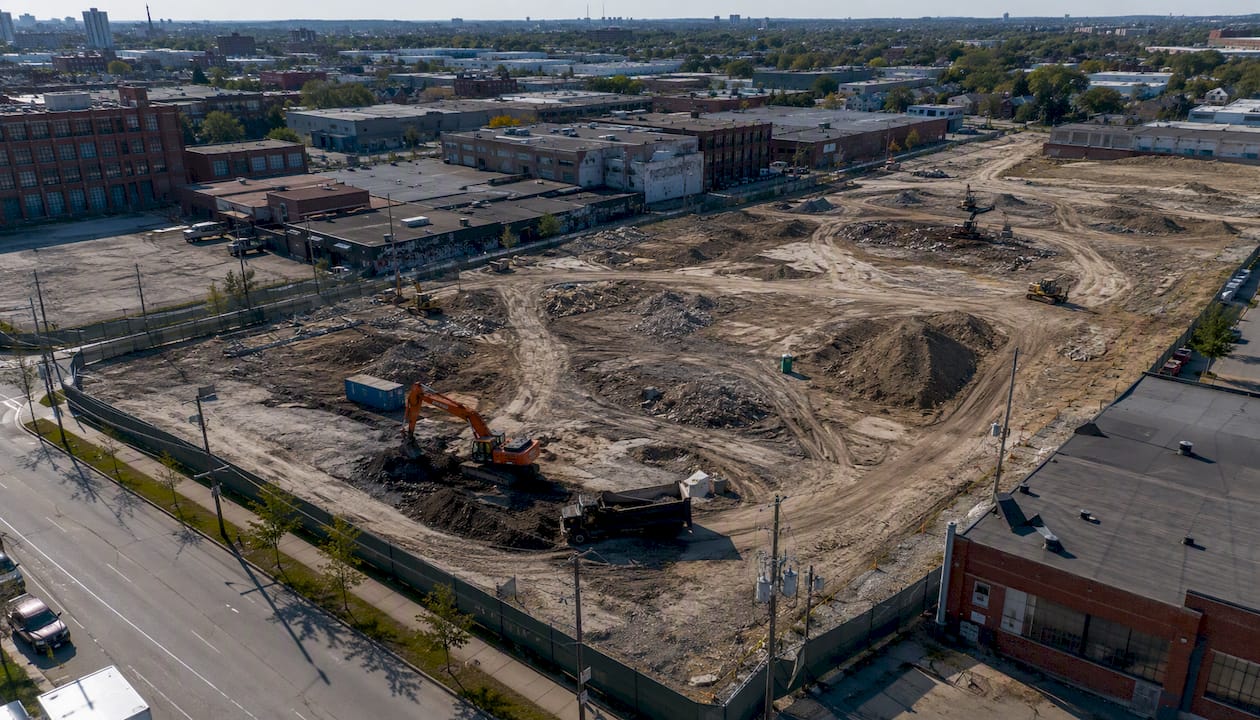
Industrial site redevelopment guide for the GTA
By Michael Law · Industrial Real Estate Broker, Lennard Commercial Realty
Engage a specialised industrial broker and complete a targeted site feasibility checklist before you spend a dollar on offers or designs. That single step compresses months of uncertainty into a focused 30–90 day action plan. Start with these two moves: retain a broker who knows GTA industrial zoning and municipal planning, then run a quick feasibility screen against these six items:
- Location and access: Highway proximity, truck routes, and last-mile fit
- Building specs: Clear height (minimum 28–32 ft for modern logistics), dock count and configuration
- Land and services: Lot depth, yard area, hydro capacity, and gas service
- Zoning and Official Plan designation: Confirm permitted uses, any Regeneration Area or SASP flag, and OPA 653 status
- High-level capex estimate: Envelope, loading, and fit-out costs before committing
- Tenant or lease status: Existing occupancy, lease expiry, and any assignment or sublease rights
Key takeaways
Successful GTA industrial redevelopment requires front-loaded due diligence, a clear zoning picture, and a pro-forma that honestly prices entitlement delay, environmental risk, and utility upgrade costs before you commit.
| Point | Details |
|---|---|
| Front-load the ESA | Phase I ESA is non-negotiable before any acquisition; Phase II follows only if Phase I flags a concern. |
| Check SASP and OPA 653 status | Regeneration Area sites can face multi-year planning delays; confirm designation before committing. |
| Model utility upgrades early | Hydro upgrades can take over a year to complete and are frequently underestimated in redevelopment budgets. |
| Lease vs buy hinges on entitlement risk | Clean zoning and a clear ESA favour buying; uncertain entitlement favours leasing existing functional product. |
| Michael Law | Lennard Commercial |
Table of Contents
- What environmental assessments does a GTA industrial site require?
- What approvals and permits does industrial redevelopment require in the GTA?
- How does community engagement affect your redevelopment timeline?
- What infrastructure and utility upgrades should you budget for?
- What are the biggest risks in GTA industrial redevelopment, and how do you manage them?
- The buy vs lease decision in the GTA: a broker’s view
- Work with Michael Law | Lennard Commercial on your next GTA industrial project
- Sources
- FAQ
What environmental assessments does a GTA industrial site require?
Most GTA industrial sites trigger at least a Phase I Environmental Site Assessment (ESA) before acquisition or redevelopment. A Phase I reviews historical land use, aerial photos, and regulatory databases to flag potential contamination. If it identifies a concern, a Phase II ESA follows with soil and groundwater sampling. Remediation, when required, can range from a simple risk management plan to full excavation, and the cost difference is enormous. Budget for Phase I as a non-negotiable line item in every acquisition due diligence sequence; Phase II is conditional on findings. Ontario’s Environmental Protection Act and the Ministry of the Environment’s Record of Site Condition (RSC) process govern when a formal RSC must be filed, typically when a site changes to a more sensitive use.
What approvals and permits does industrial redevelopment require in the GTA?
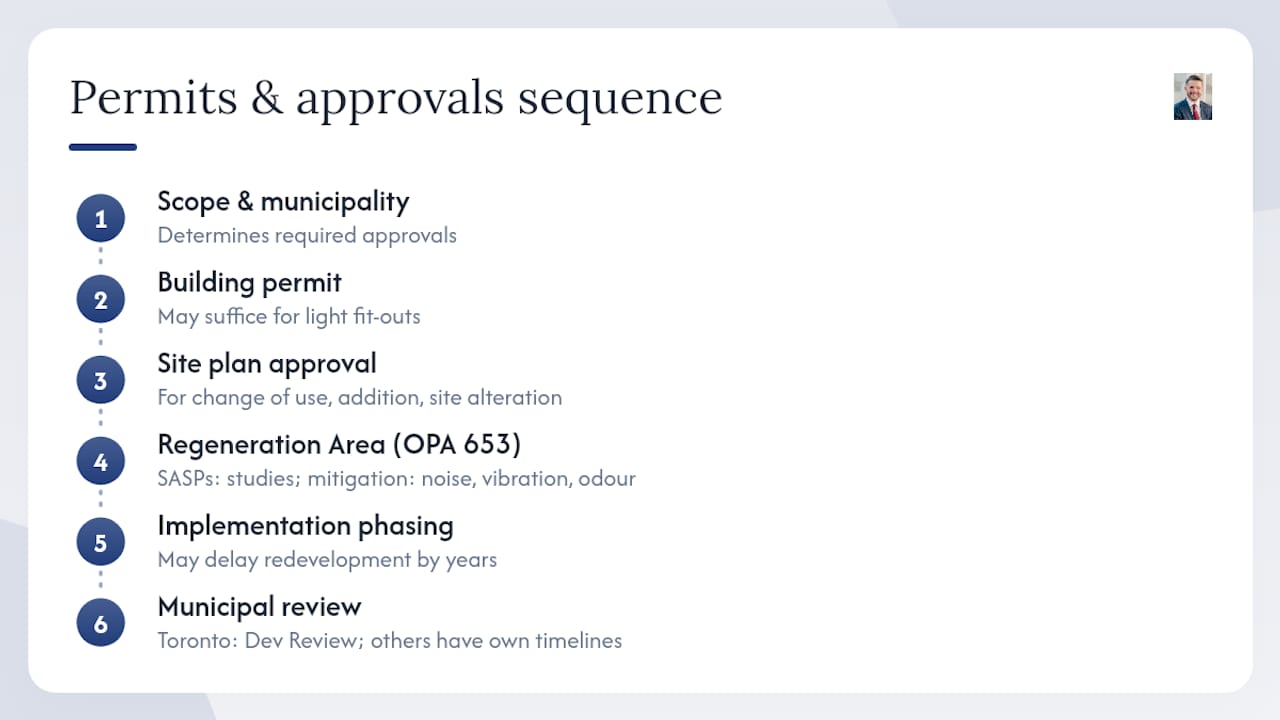
The permitting sequence depends on the scope of work and the municipality. A light fit-out may need only a building permit. A change of use, addition, or site alteration typically adds a site plan approval application, which in Toronto runs through the City’s Development Review division. Sites within a Regeneration Area face an additional layer: OPA 653, approved January 27, 2025, converted many employment lands to Regeneration Areas and introduced Site and Area Specific Policies (SASPs) that set compatibility studies, mitigation requirements for industrial adjacencies (noise, vibration, odour), and implementation phasing. That phasing can delay redevelopment by multiple years. Outside Toronto, Mississauga, Brampton, Vaughan, and Markham each run their own planning and building departments with distinct timelines and submission requirements.
How does community engagement affect your redevelopment timeline?
Statutory public consultation is mandatory for most Official Plan amendments and rezoning applications in Ontario. In practice, a pre-application community meeting with neighbours and local councillors, held before a formal submission, almost always shortens the approval timeline. Industrial adjacency issues — truck traffic, noise, lighting — are the most common friction points. Addressing them in a mitigation study submitted with the application gives the planning committee less to object to.
What infrastructure and utility upgrades should you budget for?
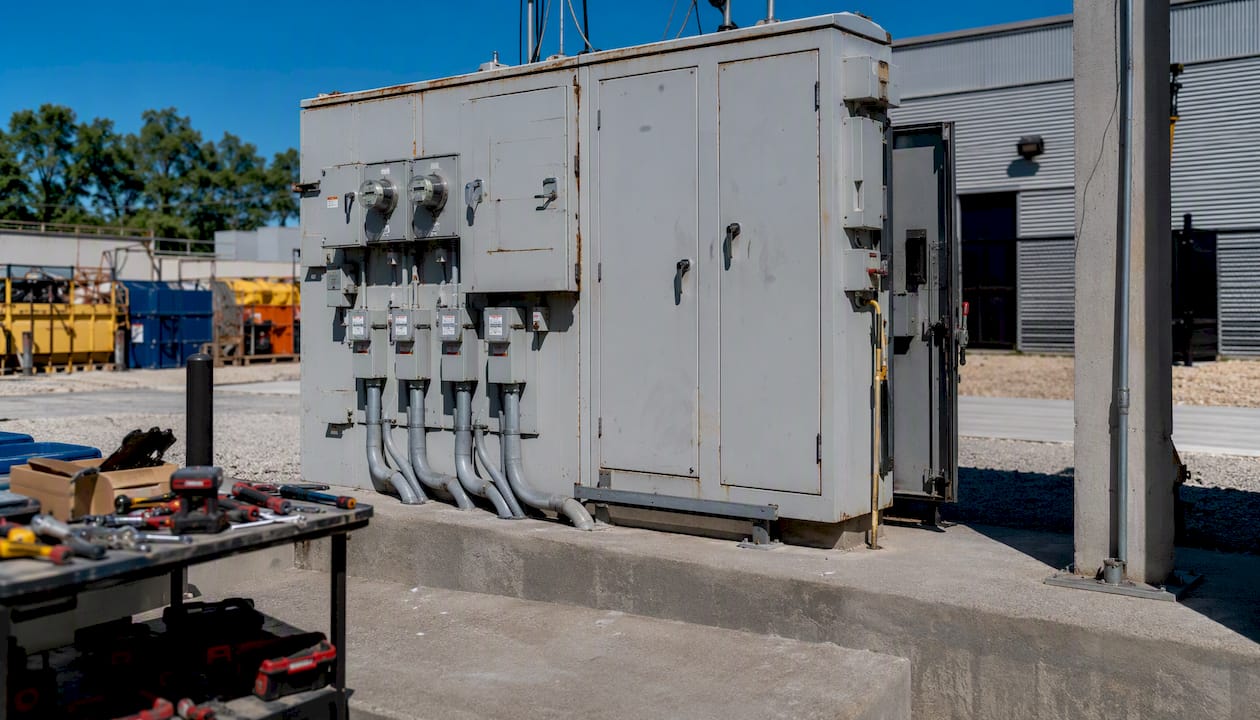
Hydro capacity is the most frequently underestimated cost in GTA industrial redevelopment. Modern logistics and cold-storage operations frequently require high-capacity electrical service, and a utility upgrade from Toronto Hydro or Alectra can take 12–18 months to complete. EV charging infrastructure, LED lighting, and improved dock levellers are high-return capital upgrades that also satisfy green-standard compliance requirements increasingly embedded in municipal approvals and institutional lease terms.
What are the biggest risks in GTA industrial redevelopment, and how do you manage them?
Zoning and entitlement risk tops the list. A site that looks industrial on a map may carry a SASP that restricts intensification or mandates compatibility studies before any new use is approved. Verify site-specific zoning exceptions and permitted uses before signing anything. Market risk is secondary but real: GTA industrial vacancy stabilized near 3.1% in 2025, and while the market remains tight, trade disruptions can soften absorption quickly. Environmental risk is manageable when you sequence the ESA correctly. The mitigation strategy for all three is the same: front-load your due diligence, retain specialists early, and never let a vendor’s timeline pressure you into skipping a Phase I.
The buy vs lease decision in the GTA: a broker’s view
The conventional wisdom that buying always beats leasing for long-term occupiers misses a critical variable: entitlement risk. A site you own but cannot redevelop on your timeline is capital tied up in a planning process, not a productive asset.
For occupiers with a 10-plus year horizon and stable operational requirements, ownership makes sense when the site’s zoning is clean, the ESA is clear, and the capex budget is funded. For everyone else, leasing functional existing product is faster and lower risk.
Repositioning paths in the GTA follow three common patterns: a light re-fit for logistics (dock additions, LED, yard paving), conversion to multi-tenant distribution with demising walls and separate utilities, and adaptive reuse to mixed commercial uses where the Official Plan permits it. Adaptive reuse can preserve industrial character and reduce demolition cost, but municipal incentives and policy language vary enough across the GTA that it is opportunistic, not a default strategy.
SASP and Regeneration Area timing is the municipal risk most occupiers underestimate. A site located within a Regeneration Area study boundary may remain in planning limbo for two to four years while compatibility and mitigation studies are completed. That is not a reason to avoid those sites, but it is a reason to price the delay into your pro-forma and your lease-vs-buy analysis.
Michael Law’s decade-plus advising GTA occupiers and investors consistently shows that the deals that go sideways share one trait: the occupier committed before the zoning and environmental picture was clear.
Work with Michael Law | Lennard Commercial on your next GTA industrial project
GTA industrial redevelopment moves fast and the planning layer is unforgiving. Michael Law | Lennard Commercial gives occupiers, investors, and logistics operators a single point of contact for tenant representation, site selection, acquisition and lease negotiation, Phase I/II ESA coordination, pro-forma and capex modelling, and municipal engagement support across SASP and Regeneration Area processes.
The engagement path is direct: an initial consultation to scope your requirements, a targeted feasibility checklist against live GTA inventory, and a retained mandate to execute. Contact Michael Law at Mlawrealestate to book your consultation.
Sources
- Regeneration Area Studies – City of Toronto
- Promoting Adaptive Reuse in Ontario: A Planning Policy Tool for Making the Best of Manufacturing Decline | Article | Urban Planning
- Michael Law | Lennard Commercial
FAQ
What is the first step in a GTA industrial site redevelopment?
Engage a specialised industrial broker and run a site feasibility checklist covering zoning, environmental flags, and logistics fit before making any financial commitment.
How long does a GTA industrial redevelopment approval take?
A straightforward building permit can take weeks; a site plan approval or rezoning typically runs 12–18 months, and sites inside a Regeneration Area study boundary can face additional delays of two to four years.
When does a Phase II ESA become necessary?
A Phase II ESA is triggered when a Phase I assessment identifies a potential area of concern, such as historical industrial use, underground storage tanks, or proximity to a contaminated site.
Is adaptive reuse a viable strategy for GTA industrial properties?
Adaptive reuse can reduce demolition costs and preserve industrial character, but municipal incentives and policy support vary across the GTA, making it an opportunistic rather than universally available strategy.
Should a GTA occupier buy or lease industrial space right now?
Recommended

About Michael Law
Managing Partner and Industrial Real Estate Broker at Lennard Commercial Realty. Representing tenants and landlords across Toronto and the GTA for 15+ years. Michael specializes in GTA industrial real estate — connect with Toronto's leading industrial broker at mlawrealestate.com/industrial-broker-toronto.
Related Articles



More Toronto Industrial Real Estate Insights
Articles & Analysis
Get a Five Year Exclusive Use That Holds Up in GTA Industrial Leases
GTA practical guidance for landlords and tenants on drafting defensible industrial exclusive use clauses. Includes five year examples, negotiation tips...
Read →GTA Industrial Rent Trends: What Drives the Market
Read →2–3x Rent Gap: Secure a Compliant GTA Outside Storage Lease
GTA tenants: secure a compliant outside storage lease with zoning and environmental checks, clear site improvement priorities, and off market sourcing.
Read →GTA Finance: Operating Cost Reconciliation and GST/HST ITC Rules
A GTA playbook for operating cost reconciliation: step-by-step checks, a reconciliation checklist, sample journal entries, CRA GST/HST ITC guidance and...
Read →Catch Hidden Additional Rent: GTA Industrial Lease Audit
Broker led lease audits help GTA industrial tenants spot hidden additional rent, make good liabilities, and negotiation levers at the offer stage before...
Read →Common Questions
What is a sale-leaseback in industrial real estate?
A sale-leaseback is a transaction in which an industrial property owner sells their building to an investor and simultaneously signs a long-term lease to remain in the property as a tenant. The seller unlocks the capital tied up in their real estate while retaining full operational use of the facility. The buyer acquires a tenanted investment property with immediate cash flow from a known occupant.
Read →What is a dock-to-grade ratio in industrial real estate?
Dock-to-grade ratio in industrial real estate refers to the number of dock-level loading doors relative to the building's floor area, typically expressed as one dock door per X,000 square feet. It is a key specification for distribution and warehousing tenants because it determines how many trucks can load and unload simultaneously and therefore the building's throughput capacity.
Read →What is clear height in a warehouse or distribution centre?
Clear height in a warehouse or distribution centre refers to the usable vertical space from the finished floor to the lowest overhead obstruction — typically the bottom of the roof structure, sprinkler heads, or HVAC equipment. It is the single most important building specification for warehouse tenants because it determines how many racking levels can be installed and therefore how much product can be stored per square foot of floor space.
Read →