Key metrics for warehouse leasing in the GTA: 2026 guide
By Michael Law · Industrial Real Estate Broker, Lennard Commercial Realty
The metrics that matter most when leasing GTA warehouse space are net effective rent, total occupancy cost (asking rent plus additional rent/TMI), vacancy and availability rate, net absorption, sublease supply, clear height and technical specs, and lease term with escalation structure. Net effective rent is the primary comparison metric because it accounts for free rent and tenant improvement (TI) allowances across competing offers, giving you a true apples-to-apples number. Start by calculating it for every offer on the table.
Quick checklist:
- Calculate net effective rent (NPV of all cash flows including free rent and TIs)
- Add asking rent + additional rent to get total occupancy cost
- Confirm clear height, column spacing, dock count, and floor load
- Check vacancy and sublease availability in the target submarket
- Review escalation structure (CPI vs. fixed) and cap on operating costs
- Identify lease term, TI allowance, and free-rent period
Key takeaways
Effective rent, not asking rent, is the single metric that determines whether a GTA warehouse deal is good or not. Calculate it for every offer before you negotiate.
| Point | Details |
|---|---|
| Net effective rent first | Discount all cash flows (free rent, TIs, escalations) using NPV to compare offers on equal terms. |
| Total occupancy cost near C$22/sf | Mid-2026 GTA asking rent (~C$16.9/sf) plus additional rent (~C$5.3/sf) sets your baseline budget. |
| Clear height drives price | Class A product (26–40 ft clear) commands a measurable premium; match spec to operational need. |
| Sublease supply is a lever | ~6.3 MSF of GTA sublease availability in Q2 2026 gives tenants comparables to anchor concession talks. |
| Michael Law | Lennard Commercial |
Table of Contents
- How are GTA industrial rents trending in 2026?
- How does location within the GTA affect your lease metrics?
- What lease clauses most affect your cost and liability?
- Gross vs. net lease: which structure costs you more?
- What concessions go beyond TIs and free rent?
- What GTA occupiers should actually prioritise right now
- Tenant representation that moves the numbers
- Sources
- FAQ
How are GTA industrial rents trending in 2026?
The market has shifted from the frenzy of 2022–2023. Average net asking rents stabilised near C$16.49/sf in Q1 2026, and mid-year 2026 figures show asking rents near C$16.9/sf with additional rent around C$5.3/sf, putting total occupancy cost close to C$22/sf for a typical GTA deal. The construction pipeline has fallen materially, so the current window of tenant leverage on TIs and free rent is narrowing. Lock favourable concessions now rather than waiting.
Small-bay product under 25,000 sf remains structurally undersupplied and has held rents better than larger formats. If your requirement is under that threshold, budget a premium.
How does location within the GTA affect your lease metrics?
Proximity to Highway 400, 401, 410, and 427 corridors, Pearson Airport, and the Port of Hamilton directly affects asking rent and availability. Mississauga and Brampton command the tightest vacancy and highest rents given their logistics density. Vaughan and Markham offer access to the 400 and 404/407 networks with slightly more availability. East-GTA nodes like Ajax, Whitby, and Pickering carry lower asking rents and are worth modelling when last-mile coverage extends that far.
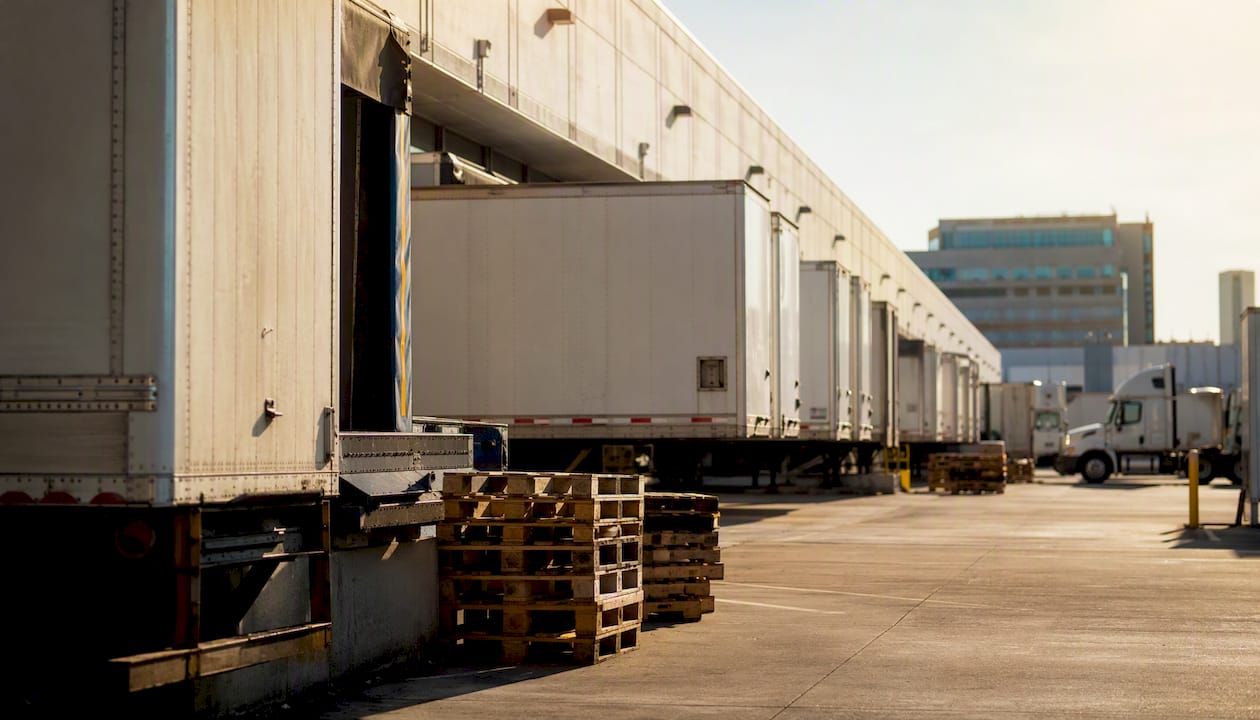
Submarket rent dispersion is real. A 26-ft-clear bay in Mississauga and a 24-ft-clear bay in Oshawa are not the same product at the same price. Build location into your comparables table alongside technical specs.
What lease clauses most affect your cost and liability?
Four clauses deserve close attention before you sign:
Maintenance and repair obligations define whether the tenant or landlord covers roof, HVAC, and structural repairs. In a net lease, tenants often carry HVAC maintenance; confirm whether that includes replacement.
Indemnity and environmental clauses can expose a tenant to pre-existing contamination liability. Require a Phase I environmental report and negotiate a carve-out for pre-existing conditions.
Termination and early exit provisions are rarely offered voluntarily. A lease break option at year three or five, even with a penalty, has real value in a market where business needs shift.
Operating cost caps limit annual increases in additional rent. Without a cap, TMI can escalate faster than your base rent. Negotiate a cap tied to CPI or a fixed percentage.
Gross vs. net lease: which structure costs you more?
Nearly all GTA industrial leases are net leases (also called NNN or triple-net). You pay base rent plus your proportionate share of property taxes, building insurance, and common area maintenance (CAM), collectively called additional rent or TMI. The landlord quotes a net rate; you add TMI on top.
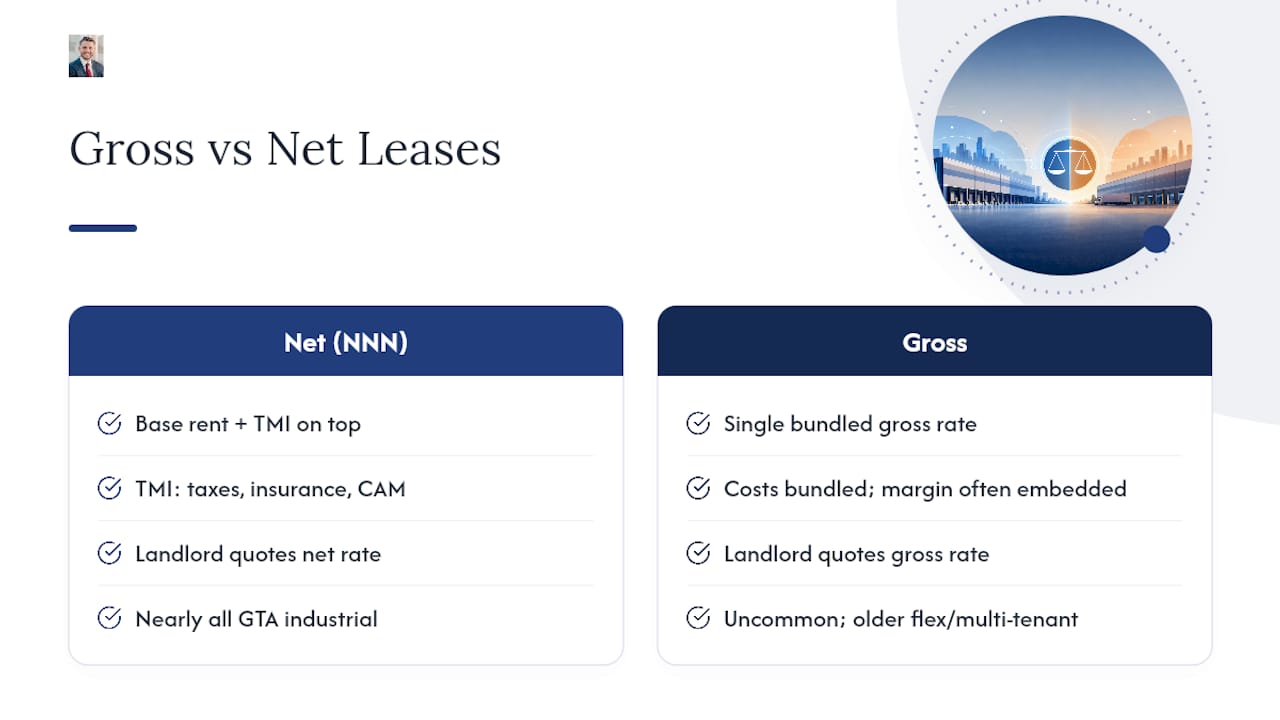
A gross lease bundles all costs into one rate. Gross leases are uncommon in GTA industrial but occasionally appear in older flex or multi-tenant buildings. They look simpler but often embed a landlord margin into the gross rate. When comparing a gross offer to a net offer, strip out the estimated TMI from the gross rate to normalise the comparison. CREDA’s definitions are a useful reference for standardising these calculations across offers.
Note that industrial asking rents in Canada are typically quoted per square foot per year, not per month. Confirm the convention with each landlord before building your model.
What concessions go beyond TIs and free rent?
TIs and free rent get most of the attention, but three other concessions are worth negotiating:
Moving allowances are a cash contribution from the landlord toward relocation costs. They are more common when a tenant is vacating a competing property and the landlord wants to close quickly.
Lease break options give you the right to exit at a defined point, usually with six months’ notice and a penalty equal to unamortised TIs. In a five-to-seven-year lease, a break at year three is a meaningful hedge against business change.
Rent abatement on holdover protects you if your current landlord delays your exit. Some leases include a provision that suspends rent on the new space if the tenant cannot take possession on the agreed date.
Sublease availability also creates indirect leverage. With approximately 6.3 million square feet of sublease space on the GTA market in Q2 2026, landlords of direct space know tenants have alternatives. Reference sublease comparables in your LOI to anchor concession expectations.
What GTA occupiers should actually prioritise right now
Most tenants spend too much time negotiating base rent and not enough time on the variables that move net effective rent the most: TI quantum, free-rent period, and escalation structure. A landlord who holds firm on face rate will often move on TIs or an extra month of free rent, and those concessions are worth more over a five-year term than a $0.25/sf reduction in asking rent.
The pricing decoupling RENX documented between Class A (26–40 ft clear) and lower-clear product is now an active factor in GTA comparables. Clear height is not just a spec preference; it is a price driver. If your operation can use vertical cube, the premium for Class A is often justified. If it cannot, a 22–24 ft clear building at a lower rate may deliver better effective rent.
The construction pipeline contraction means new supply is not coming to rescue tenants who wait. The leverage window is open now, not in 2027.
Tenant representation that moves the numbers
Knowing the metrics is the first step. Applying them under negotiation pressure is where most occupiers leave money on the table. Michael Law | Lennard Commercial provides full tenant representation across the GTA, including effective-rent modelling, market comparables, technical site review, and lease negotiation oversight from LOI through to execution.

With coverage across Mississauga, Brampton, Vaughan, Markham, Ajax, Whitby, and every major GTA submarket, the team brings current transaction data to every negotiation. If you are comparing offers or preparing an LOI, request a tenant-representation consultation to get a clear picture of what each offer actually costs.
Sources
- Industrial Market Overview
- Commercial real estate terms and definitions • NAIOP
- The great decoupling in industrial real estate leasing • RENX - Real Estate News Exchange
- Toronto Industrial & Warehouse Market Report | Q1 2026 | WareCRE
- Commercial Real Estate Terms and Definitions | Commercial Real Estate Development Association
FAQ
What is net effective rent and why does it matter?
Net effective rent is the NPV of all lease cash flows, adjusted for free rent and TI allowances, expressed as a normalised per-square-foot rate. It is the only metric that lets you compare two offers with different concession structures on equal terms.
What is the difference between vacancy rate and availability rate?
Vacancy measures space that is physically unoccupied and available; availability includes space that is occupied but being marketed for sublease or future availability. NAIOP’s definitions also distinguish leasing activity (committed square footage) from net absorption (net change in occupied space), which can lag by months.
What is a typical additional rent amount in the GTA?
Mid-2026 GTA additional rent (TMI) averaged approximately C$5.3/sf annually, bringing total occupancy cost to roughly C$22/sf when combined with asking rent near C$16.9/sf.
How much clear height do I need for standard racking?
Standard selective pallet racking to six levels typically requires a minimum of 24 ft clear. Class A GTA buildings run 26–40 ft clear and command a rent premium; if your operation uses vertical cube, that premium is usually justified.
When should I start my GTA warehouse lease search?
Start well in advance before your required occupancy date.
Recommended

About Michael Law
Managing Partner and Industrial Real Estate Broker at Lennard Commercial Realty. Representing tenants and landlords across Toronto and the GTA for 15+ years. Michael specializes in GTA industrial real estate — connect with Toronto's leading industrial broker at mlawrealestate.com/industrial-broker-toronto.