Last mile delivery Toronto: finding fulfilment space in a tight GTA market
By Michael Law · Industrial Real Estate Broker, Lennard Commercial Realty
Last mile delivery in Toronto, in real estate terms, means urban fulfilment buildings roughly 30,000 to 100,000 square feet, often small-bay or micro-fulfilment, positioned close to dense population nodes. Suitable space exists but is not sitting on the market waiting for you. Vacancy across the GTA is tight, and the best last-mile buildings often move before they hit public listings. If you need last-mile capacity in the next two to twelve months, the right first move is to lock down your building criteria now and get tenant representation working your search before your competitors do.
Here is what to nail down before you call anyone:
- Target size band (30k to 60k SF for micro-fulfilment, up to 100k for regional last-mile hubs)
- Minimum clear height and dock door count for your throughput
- Drive-time radius to your core delivery zone
- Whether you can tolerate older multi-tenant stock or need automation-ready construction
Pro Tip: Start your search 9 to 12 months ahead of your lease expiry or growth trigger. In a market this tight, the buildings that fit last-mile criteria get absorbed quietly, often through broker relationships rather than public listings.
Key Takeaways
Last-mile fulfilment space in the GTA demands fast decisions, modern building specs, and broker-led search, because the tightest inventory band, 30,000 to 100,000 square feet, moves before it reaches public listings.
| Point | Details |
|---|---|
| Vacancy is tight but uneven | Toronto sits near 2.3%, York Region near 2.0%, and Peel near 2.8%, with the tightest gaps in small-bay last-mile stock. |
| Prioritize modern specifications | Clear height above 32 feet, higher power capacity, and floor loads over 150 psf future-proof automation investment. |
| Watch the negotiating window | Rents have eased from peak levels and concessions have been available recently, but tenant negotiating leverage is expected to narrow as the market tightens further. |
| Confirm zoning and power early | Municipal permitted-use rules and electrical service capacity can each add months if discovered late. |
| Start the search 9 to 12 months out | Full timelines from criteria-setting to occupancy typically run six to twelve months for a lease. |
Table of Contents
- Typical building specifications for last-mile fulfilment in the GTA
- Which GTA submarkets work best for last-mile delivery?
- What do leasing and acquisition costs look like right now?
- What should occupiers ask landlords before signing?
- Zoning and legal considerations for last-mile facilities
- How does transportation infrastructure shape site selection?
- What technology infrastructure should last-mile buildings support?
- Sustainability and environmental factors for last-mile sites
- Lease terms and flexibility clauses for last-mile warehouses
- What is the timeline to secure new last-mile space?
- Why most last-mile searches start too late
- Sources
- FAQ
Typical building specifications for last-mile fulfilment in the GTA
Last-mile buildings in the GTA fall into two generations, and the gap between them matters more than most occupiers assume. Older infill product, often built in the 1980s and 1990s, typically offers clear heights of 18 to 24 feet, shallow dock ratios, and floor loads that were never designed for today’s automated sortation systems or heavy racking loads.
Modern last-mile facilities push clear heights to 32 or 36 feet, with dock doors spaced for high-frequency van and cube-truck turnover rather than long-haul trailers. Power capacity is the detail most tenants underestimate. Automated conveyor systems, robotic pick modules, and EV delivery fleet charging can push electrical demand well past what a legacy building’s service was ever sized for.
Floor loading matters just as much. A building rated for 125 pounds per square foot handles standard palletized storage fine, but high-density mezzanine picking or automated storage and retrieval systems often need 150 psf or more. Analysts increasingly describe a flight-to-quality trend pulling occupiers out of older, lower-clear infill stock and into modern buildings built for exactly this kind of operation.
Before touring anything, ask for the building’s electrical single-line diagram and a structural floor load certificate. Both take time to obtain and both can quietly kill a site that looked perfect on paper.
Which GTA submarkets work best for last-mile delivery?
Proximity to population density drives last-mile site selection more than any other factor, and the GTA’s geography splits fairly cleanly into a handful of workable zones.
Halton (Milton, Burlington, Oakville) and Durham (Ajax, Whitby, Pickering) offer more available land and newer construction, at the cost of longer drive times into central Toronto. For a retailer running same-day promises across the whole GTA, a hub-and-spoke model, one larger regional facility supplemented by smaller nodes in Peel and York, often beats trying to find one perfect central building. Growing demand for small-bay and co-warehousing space in Mississauga, Vaughan, and Markham reflects exactly this shift toward proximity-driven, multi-node fulfilment networks. Michael Law | Lennard Commercial’s submarket analysis breaks down where demand is concentrating node by node.
What do leasing and acquisition costs look like right now?
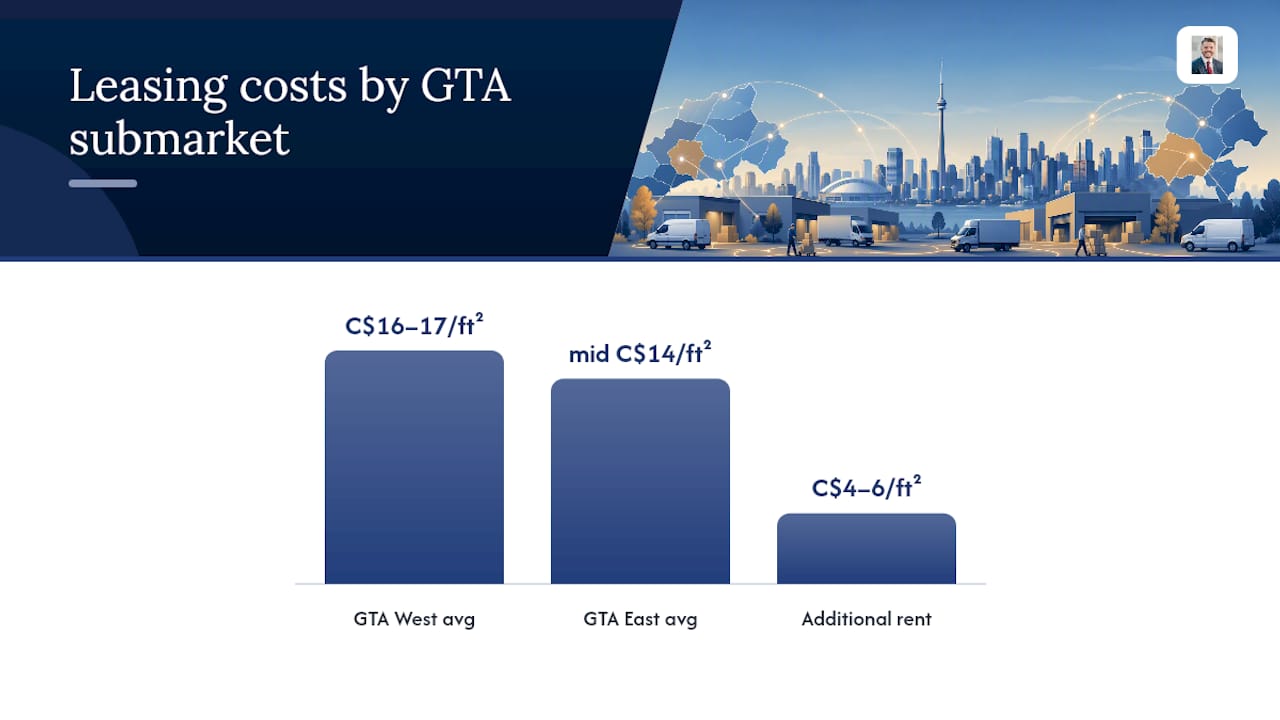
Rents vary meaningfully by geography, and averaging them into one GTA-wide figure hides the decision that actually matters. GTA West submarkets, including parts of Peel and Halton, have averaged in the C$16 to C$17 per square foot range, while GTA East nodes in Durham have sat closer to the mid-C$14 range.
There is a timing wrinkle worth acting on. That window does not stay open indefinitely. Once absorption catches up, which it tends to do quickly in a market this constrained, that negotiating leverage disappears.
For acquisition rather than lease, expect a longer runway. Owner-occupied purchases in the GTA typically run 4 to 9 months from offer to close, factoring in financing conditions, environmental due diligence, and municipal approvals if any zoning variance is needed. Leasing timelines compress to 60 to 120 days for straightforward deals in existing buildings, longer if the landlord requires tenant improvement work before occupancy.
Budget for total occupancy cost, not just base rent. Additional rent (property tax, insurance, common area costs) in the GTA typically adds C$4 to C$6 per square foot on top of net rent, and last-mile buildings with heavier power infrastructure or automation-ready specs often carry higher additional rent to cover that capital cost.
What should occupiers ask landlords before signing?
The wrong question at the tour stage costs you months later. Before you evaluate any building, run through this list with your broker and the landlord’s leasing team:
- Power capacity: What is the current electrical service, and what would upgrading it cost and how long would it take?
- Expansion rights: Does the landlord own adjacent land or buildings, and is there a documented right of first offer if you need to grow?
- Loading configuration: How many dock doors versus drive-in doors, and does the yard depth support your trailer or van turn radius?
- Environmental history: Has a Phase I or Phase II environmental assessment been completed, particularly for older industrial sites?
- Landlord track record: How responsive has this landlord been on capital repairs and building maintenance for existing tenants?
Ask for reference calls with two current tenants in the landlord’s portfolio, not just the leasing brochure’s testimonials. A landlord’s responsiveness on HVAC failures or roof leaks tells you more about your next five years than any amenity list. Also confirm whether the building’s zoning explicitly permits your intended use, since some older industrial designations restrict distribution and courier-style operations more than manufacturing.
Zoning and legal considerations for last-mile facilities
Municipal zoning across the GTA generally treats warehousing and distribution as permitted uses within employment lands, but the details differ by municipality and can trip up an otherwise clean deal. Toronto’s employment zones under its zoning by-law typically permit warehousing outright, though intensive last-mile operations with high vehicle turnover sometimes trigger site plan control review, especially where truck and van traffic interfaces with residential areas.
Peel, York, Halton, and Durham municipalities each maintain their own employment land policies, and some have begun tightening rules around 24-hour truck traffic, noise, and parking ratios specifically because of the surge in e-commerce and delivery-fleet operations. Before committing to a site, confirm the property’s zoning designation permits your specific use, including overnight vehicle staging if your operation runs early-morning delivery routes.
Building permits for tenant improvements, mezzanine installations, or dock additions require municipal sign-off and can add 8 to 16 weeks to a project timeline depending on the jurisdiction. Fire code compliance is another area worth checking early, particularly for automated storage systems or high-piled storage, since sprinkler design requirements differ for racked versus floor-stacked inventory.
Environmental compliance matters most for older industrial parcels, where historical uses may have left contamination requiring a Record of Site Condition before certain transactions or use changes proceed. None of this should discourage you from moving on a good building, but it should shape your due diligence timeline and your lease conditions around municipal approvals.
How does transportation infrastructure shape site selection?
Highway access and traffic patterns matter more for last-mile facilities than for traditional long-haul distribution, because your fleet is making dozens of short trips daily rather than a handful of long ones. Proximity to Highways 401, 400, 407, and the Gardiner or DVP corridor still matters, but local street-level access, traffic light timing, and residential-adjacent routing often decide whether a site actually works for delivery vehicles.
A building five minutes from a highway on-ramp but buried behind a congested arterial road during peak hours can lose more daily drive time than a site slightly farther out with a clean, direct route. Run your own drive-time modelling during actual peak periods, not off a map’s straight-line distance, before shortlisting any building.
The 407 corridor deserves particular attention for last-mile operators serving multiple GTA nodes from one hub, since it lets delivery fleets bypass the most congested sections of the 401 for a toll cost that is often cheaper than the fuel and driver-hours lost sitting in traffic. Sites in York Region and northern Peel increasingly position themselves specifically around 407 access for this reason.
Also weigh residential proximity carefully. A site that looks ideal for drive times can generate noise complaints or municipal pushback if delivery vans are running before 7 a.m. next to a residential zone, which can eventually restrict your operating hours through municipal enforcement.
What technology infrastructure should last-mile buildings support?
Connectivity and power infrastructure now rank alongside clear height on the last-mile building checklist. Fibre connectivity is table stakes for warehouse management systems, real-time inventory tracking, and route optimization software, but not every GTA industrial building has fibre run to the property yet, particularly in older business parks.

Confirm fibre availability and provider options before signing, since running new fibre to an isolated industrial site can take weeks and add unexpected cost. Buildings positioned for warehouse automation, conveyor sortation, robotic picking, or automated guided vehicles need power capacity well beyond legacy standards, along with structural floor specifications, that 150 psf-plus floor loading mentioned earlier, that many older buildings simply cannot provide without significant capital investment.
EV fleet charging infrastructure is becoming a genuine differentiator rather than a nice-to-have. Landlords who have already installed or pre-wired for EV charging give occupiers a real head start, since retrofitting charging infrastructure into an occupied building means downtime and disruption you would rather avoid.
Ask specifically whether the landlord will fund infrastructure upgrades as part of a tenant improvement allowance, or whether the cost falls entirely on you. This single line item can shift your effective occupancy cost by a meaningful margin over a five to ten year lease term, and it is one of the most negotiable points in a landlord’s proposal if you raise it early.
Sustainability and environmental factors for last-mile sites
Environmental performance is shifting from a marketing checkbox to a functional requirement for last-mile operators, partly because major retail and logistics clients now ask suppliers about building certifications as part of vendor scorecards. LEED certification, while not universal across GTA industrial stock, appears more frequently in new-build product and can support both operating cost savings and client-facing sustainability commitments.
Energy-efficient lighting retrofits, typically LED with occupancy sensors, cut utility costs meaningfully in high-bay warehouse space where lighting runs continuously across long shifts. Roof condition and insulation matter more than most occupiers realize for a last-mile building, since HVAC costs in a poorly insulated older shell can run substantially higher than in newer construction, especially with docks and doors cycling frequently throughout the day.
Solar-ready roof structures are appearing in newer GTA industrial development, giving occupiers or landlords the option to add rooftop solar later without structural reinforcement. EV fleet charging, covered above from a technology angle, also carries a sustainability dimension worth flagging to stakeholders tracking emissions targets, since electrified last-mile delivery fleets are becoming standard practice for larger e-commerce operators.
Ask landlords directly about any sustainability certifications, recent capital upgrades to building envelope or mechanical systems, and whether the property has undergone an energy audit. These questions cost nothing to ask and often reveal how well-maintained a building genuinely is beneath the surface.
Lease terms and flexibility clauses for last-mile warehouses
Standard GTA industrial leases run five to ten years, but last-mile occupiers should push harder than most tenants for flexibility clauses, since delivery volume and network design change faster in this sector than in traditional distribution. A right of first offer or right of first refusal on adjacent space gives you a documented path to expand without relocating your entire operation when volume grows.
Contraction clauses work in the opposite direction and matter more than tenants often realize until they need one. A partial termination right, allowing you to give back a portion of the space at a defined point in the term with notice and a penalty, protects you if your network shifts toward more, smaller nodes rather than one large facility.
Additional rent structures deserve scrutiny too. Confirm whether operating costs and property tax are capped or fully pass-through, since older buildings with deferred maintenance can generate operating cost increases that erode any headline rent savings. Renewal options should specify the rate-setting mechanism, market rent at renewal versus a fixed escalation, since a poorly worded renewal clause can leave you renegotiating from a weak position.
Tenant improvement allowances are genuinely negotiable right now given the concessions landlords have offered as rents eased from peak in early 2026. Push for the allowance to cover power upgrades, racking infrastructure, or dock modifications specific to your fulfilment operation, not just cosmetic office build-out.
What is the timeline to secure new last-mile space?
Securing the right last-mile facility runs on a predictable sequence, and skipping steps to move faster almost always costs more time later. Start with a needs assessment: size band, clear height, power requirements, and target submarkets, roughly two to four weeks with your broker to define this clearly.
Market search and shortlisting typically take four to eight weeks in the current environment, longer if your criteria are narrow or your size band sits in the most competitive 30,000 to 60,000 square foot range. Touring and due diligence, including reviewing electrical capacity, floor loading, and zoning compliance, generally runs another two to four weeks per serious candidate building.
Lease negotiation and documentation add another four to eight weeks once you have identified a preferred site, with landlord tenant improvement work, if required, adding anywhere from four weeks for cosmetic changes to four months for structural modifications like added dock doors or power upgrades. All told, budget six to twelve months from initial search to occupancy for a straightforward lease, and closer to nine to fifteen months if acquisition or significant tenant improvement work is involved.
Onboarding after occupancy, racking installation, systems integration, staff training, adds another two to six weeks before full operational capacity. Starting your search early is the single biggest lever you control in a market where the right buildings do not sit available for long.
Michael Law, Managing Partner at Lennard Commercial, works directly with occupiers on this entire sequence, from defining criteria through industrial tenant representation to closing terms that protect your flexibility. For occupiers specifically building out e-commerce fulfilment operations, the ecommerce fulfilment service page outlines how that representation applies to last-mile networks, and occupiers with temperature-sensitive product should review the cold storage capabilities available across the GTA. To start a search in your target submarket, visit the GTA coverage page to connect with the team.
Why most last-mile searches start too late
The conventional advice tells occupiers to wait until lease expiry gets close before starting a search. That guidance made sense in a slack market with abundant supply. It does not hold up in a GTA industrial market where vacancy sits in the low single digits and the specific size band last-mile operators need, that 30,000 to 100,000 square foot sweet spot, gets absorbed faster than the headline vacancy numbers suggest.
What gets underestimated most is the building specification gap. Occupiers fixate on rent per square foot and location, then discover during due diligence that the building’s power service cannot support their automation plans, or the floor was never rated for their racking system. That discovery costs months, not days.
My honest read: the occupiers who win in this market are not the ones who negotiate the hardest on rent. They are the ones who define their real building requirements early, move on qualified space quickly, and use broker relationships to see buildings before they hit public listings. Speed and specification discipline beat price negotiation in a market this tight.
Sources
- 2Q26 Toronto Ontario industrial market report (NMRK)
- Toronto commercial real estate market update (Altus Group)
- Toronto warehouse market report (WareCRE)
FAQ
Is there available last-mile warehouse space in the GTA right now?
Yes, though vacancy is tight overall, with Toronto near 2.3%, York Region near 2.0%, and Peel near 2.8%. Pockets of opportunity exist in older multi-tenant stock and in submarkets like Halton and Durham with more available land.
What size of building counts as last-mile space?
Last-mile fulfilment buildings typically range from 30,000 to 100,000 square feet, sized for urban proximity and high-frequency van and cube-truck loading rather than long-haul trailer traffic.
How much does GTA industrial rent cost for last-mile buildings?
Rents vary by submarket, running roughly C$16 to C$17 per square foot in GTA West and closer to mid-C$14 in GTA East, plus additional rent typically adding C$4 to C$6 per square foot.
How long does it take to secure last-mile warehouse space?
Budget six to twelve months from defining criteria to occupancy for a straightforward lease, and nine to fifteen months if acquisition or significant tenant improvement work is required.
Which GTA submarkets work best for last-mile delivery networks?
Peel and York Region offer the strongest balance of proximity and available product, while Toronto proper commands a premium for the shortest drive times, and Halton and Durham offer more land at longer drive distances.
Recommended

About Michael Law
Managing Partner and Industrial Real Estate Broker at Lennard Commercial Realty. Representing tenants and landlords across Toronto and the GTA for 15+ years. Michael specializes in GTA industrial real estate — connect with Toronto's leading industrial broker at mlawrealestate.com/industrial-broker-toronto.